
Is a solar battery a savvy financial move or just an expensive paperweight in 2026? While the initial investment seems high, the actual solar battery cost Australia homeowners face is falling fast. You’re likely feeling the pressure of rising power bills while struggling to navigate confusing rebate eligibility and the technical gap between hybrid and retrofit inverters. It’s a complex landscape. You deserve a clear path to energy independence without the guesswork or the fear of rapid hardware degradation.
This guide cuts through the noise to help you master battery pricing and ROI. You’ll gain a precise understanding of total installed costs and confirm the latest rebate amounts for Victoria and other states. We’ll break down how the federal “Cheaper Home Batteries Program” can slash your expenses by thousands. From choosing the right kWh capacity to hitting a five year payback period, we provide the data you need to invest with absolute confidence. Let’s secure your energy future today.
Key Takeaways
- Understand the 2026 price landscape where hardware costs have stabilised but installation complexity has increased.
- Maximise your return by stacking Victorian state incentives with federal STCs to lower the total solar battery cost Australia homeowners pay.
- Discover why LiFePO4 chemistry remains the non-negotiable standard for enduring the harsh Australian climate.
- Avoid surprise expenses by identifying necessary switchboard upgrades and fire safety compliance requirements early in the process.
- Learn how to modernise an aging solar setup with professional battery upgrades and replacements tailored for Melbourne homes.
Understanding Solar Battery Costs in Australia: 2026 Market Update
The 2026 market has reached a critical point of maturity. While hardware prices have finally stabilised after years of global supply chain volatility, the actual solar battery cost Australia homeowners face is increasingly shaped by installation complexity and compliance. You’re getting more sophisticated technology for your money, but the ‘out of the box’ price is only half the story. Understanding what a solar battery energy storage system is requires looking beyond the lithium-ion cells to the balance of system components and professional labour.
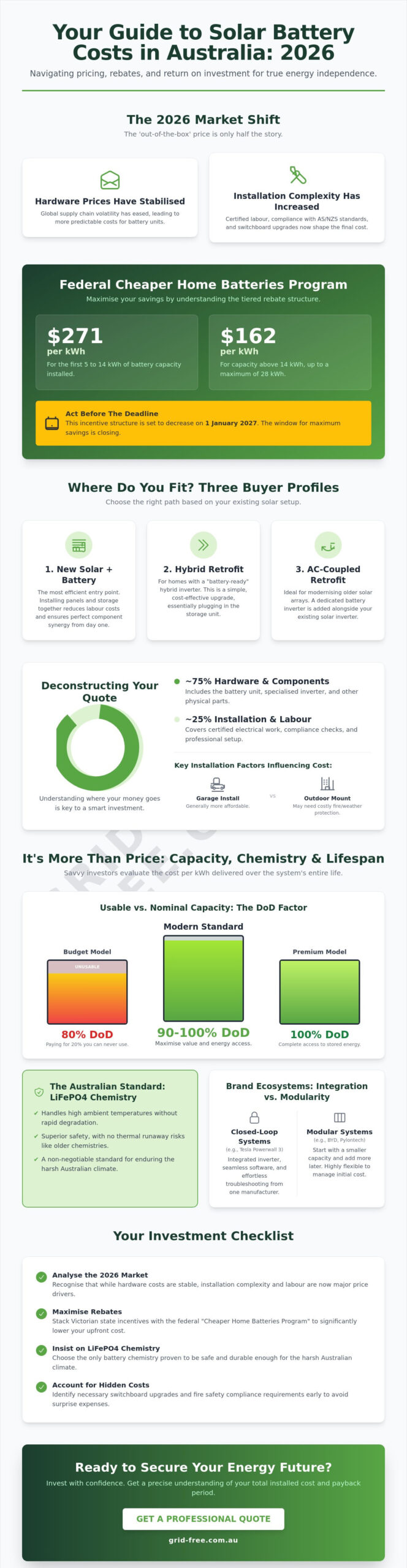
The total cost of your system isn’t just the battery unit itself. It’s the sum of hardware, specialized inverter technology, and the certified electrical work required to integrate it with your home’s switchboard. In 2026, the Federal “Cheaper Home Batteries Program” has shifted the ROI calculation significantly. This tiered rebate provides $271 per kWh for the first 5 to 14 kWh of capacity, dropping to $162 per kWh for larger systems up to 28 kWh. With these incentives set to decrease on January 1, 2027, the window for maximum savings is closing fast. Don’t fall for “bargain” batteries. Low-cost units often suffer from higher degradation rates and shorter warranty periods, leading to a much higher total cost of ownership over ten years.
The Three Buyer Profiles: Where Do You Fit?
- New Solar + Battery: This is the most efficient entry point. Installing panels and storage simultaneously reduces labour costs and ensures perfect component synergy from day one.
- Hybrid Retrofit: If you have a “battery-ready” system with a hybrid inverter, your upgrade path is simple and cost-effective. You’re essentially just plugging in the storage unit.
- AC-Coupled Retrofit: For older solar setups, this solution adds a dedicated battery inverter alongside your existing solar inverter. It’s the standard way to modernise aging systems without replacing your entire array.
Hardware vs. Installation: Breaking Down the Quote
Professional labour and electrical certification typically account for approximately 25% of a total installation quote in the Australian market. The physical location of your unit dictates the final price. Installing a battery inside a garage is generally more affordable than an outdoor mount, which may require additional fire-rated backing or weather protection to meet strict AS/NZS 5139 safety standards. Your home’s electrical phase also plays a role. Three-phase properties require more complex and expensive battery inverters compared to standard single-phase residences. Precision planning here prevents budget blowouts later.
What Determines the Price Tag? Capacity, Chemistry, and Components
The sticker price on a quote is only one part of the financial equation. In 2026, savvy investors evaluate the solar battery cost Australia through the lens of efficiency and longevity. It’s no longer just about the upfront hit. It’s about the cost per kilowatt-hour (kWh) delivered over the system’s entire operational life. High performance components often yield a lower cost per cycle, making them the smarter choice for long term independence.
Usable Capacity vs. Nominal Capacity
A battery labelled as 10kWh rarely provides 10kWh of actual power. You must look at the Depth of Discharge (DoD). Most modern units offer a 90% to 100% DoD. If a cheaper model only allows 80% discharge to protect the cells, you’re essentially paying for capacity you can never use. Understanding the efficiency of a lifepo4 battery is essential here. Lithium Iron Phosphate remains the gold standard for Australian conditions. It handles high ambient temperatures without the thermal runaway risks associated with older chemistries. This stability ensures your investment doesn’t degrade prematurely during a Melbourne heatwave.
The Premium Brand Factor
Is a Tesla Powerwall 3 worth the extra spend? For many, the answer lies in the “closed-loop” ecosystem. When your panels, inverter, and software are all from one manufacturer, troubleshooting becomes effortless. Systems like the Powerwall 3 integrate the inverter directly, which can simplify installation. Conversely, brands like BYD or Pylontech offer modular flexibility. You can start with a smaller stack and add capacity as your budget allows. This modularity is often the smartest way to manage the initial solar battery cost Australia without sacrificing future growth.
Cycle life and warranty fine print also dictate value. A premium battery might offer 6,000 cycles at 80% retained capacity, while a budget alternative might only promise 3,000 cycles. This effectively doubles the cost of the cheaper unit over ten years. Always check for “throughput” limits in the warranty. If you plan to cycle the battery twice a day for VPP participation, you might hit that limit in year seven, regardless of the ten year timeframe. If you’re looking to modernise an aging setup, it’s wise to consult a specialist about a battery upgrade and replacement to ensure your components are perfectly matched.
Inverter selection creates another price gap. Hybrid inverters are streamlined. They manage both your panels and your battery in one unit. If you’re adding storage to an old system, you’ll likely need an AC-coupled solution. This adds the cost of a second dedicated battery inverter. Micro-inverter storage systems offer the highest granularity and safety, though they carry a higher upfront price tag for that precision. Choose based on your existing infrastructure to avoid unnecessary overheads.
ROI and Payback: Rebates, VPPs, and Victorian Incentives
Calculating the true solar battery cost Australia requires looking past the initial invoice. In 2026, the financial landscape has flipped. While feed-in tariffs (FiTs) have dwindled to negligible amounts, the value of self-consumption has skyrocketed. Storing your own solar energy is now the only way to shield yourself from peak retail rates. The return on investment is no longer a decade-long wait. It’s a strategic, fast-tracked recovery of capital driven by aggressive state and federal support.
The Victorian Advantage: Solar Victoria Rebates
Melbourne residents hold a distinct advantage. Solar Victoria continues to offer substantial rebates that directly reduce the upfront burden. To be eligible in 2026, you must be an owner-occupier with a combined household income under $210,000 and a property value below $3 million. These incentives are designed to stack. You can combine the state rebate with federal Small-scale Technology Certificates (STCs) to maximise your savings. For a full breakdown of how these figures impact a total installation, see our solar system price Victoria guide. This dual-layered subsidy approach effectively slashes the barrier to entry for Victorian families.
The Federal “Cheaper Home Batteries Program” adds another layer of security. With rebates of $271 per kWh for the first 14 kWh of capacity, a standard 10 kWh unit receives an upfront discount of approximately $2,720. This is a point-of-sale discount. Your installer handles the paperwork. You simply enjoy the lower price. This federal support is scheduled to decrease on January 1, 2027. Acting now secures the highest possible subsidy before the next scheduled step-down. If you’re also considering a full system from scratch, our comprehensive guide to solar panel installation Melbourne covers the latest 2026 regulations, apprentice supervision rules, and how to claim every available incentive before key deadlines close.
Payback Period Reality Check
In 2021, a typical solar battery faced a 10 to 12 year payback period; however, in 2026, the combination of hardware price drops and VPP incentives has crushed that timeframe to just 5 to 7 years. Joining a Virtual Power Plant (VPP) is the ultimate ROI accelerator. By allowing the grid to briefly access your stored energy during peak demand, you can earn sign-on bonuses and ongoing credits. In New South Wales, the Peak Demand Reduction Scheme (PDRS) can offer up to $1,500 in incentives. These payments shave years off your payback period. They turn your battery from a passive storage unit into an active income generator.
There is also the “Invisible Profit” to consider. Blackout protection provides a level of energy security that is difficult to quantify until the grid goes down. When the rest of the street is in darkness, your home remains powered. This reliability is a core component of modern energy independence. For a deeper dive into how these savings manifest in the local market, read our analysis on is solar worth it Melbourne. The math is clear. Self-consumption is the new profit centre.
Hidden Costs of Battery Installation in Melbourne
Stop looking at the hardware sticker price as your final figure. In the real world of Melbourne retrofitting, the solar battery cost Australia homeowners actually pay is often inflated by site-specific technicalities. If you live in a classic 1970s weatherboard or a heritage-listed terrace, your electrical infrastructure likely isn’t ready for 2026 technology. A standard switchboard from forty years ago cannot handle the sophisticated bi-directional power flow of a modern storage system. Expect to pay approximately $1,500 for a comprehensive electrical overhaul before the first battery bracket even touches your wall.
Compliance isn’t optional; it’s a safety and insurance requirement. The AS/NZS 5139 standards dictate exactly where and how a battery can be mounted. These regulations often require fire-rated backing materials or specific clearance distances from windows and doors. If your preferred location doesn’t meet these rules, the extra labour and materials to create a compliant zone will add to your bottom line. Additionally, site accessibility plays a massive role. Multi-storey installs or homes with restricted side-access require more personnel and specialised equipment. Labour isn’t just about carrying a box. It’s about precision engineering in tight spaces.
Electrical Compliance in Victoria
Every installation in Melbourne must be accompanied by a Certificate of Electrical Safety (COES). This document isn’t just paperwork. It’s your proof that the system meets rigorous Victorian standards. Skipping this or hiring a non-certified installer to save a few hundred dollars will void your home insurance. Melbourne’s volatile weather also demands high-quality weatherproofing. Outdoor enclosures must be rated to withstand “four seasons in one day” without compromising the sensitive lithium cells inside. Cheap enclosures fail early, leading to catastrophic hardware replacement costs down the road.
Single-Phase vs. Three-Phase Costs
Your home’s connection type dictates your inverter price. Three-phase homes require more complex inverters to manage the load across multiple circuits, which naturally carries a premium over single-phase equivalents. Phase balancing is the critical next step. You must ensure your battery is wired to power the circuits that actually matter during an outage, such as your fridge and lighting. This custom backup circuit wiring is a specialised task that adds hours to the installation. To understand how these technical choices impact your long-term reliability, explore the latest solar battery storage benefits data. Precision at the start prevents failure at the finish.
Don’t leave your energy security to chance. Ensure your home is fully compliant and ready for the future by booking a professional solar and battery installation assessment today.
Maximising Value with GridFree Solar: Upgrades & Replacements
The era of the first-gen solar battery is ending. Many early adopters now face declining performance from aging units installed years ago. We’ve reached the replacement era. At GridFree Solar, we specialise in navigating this transition. We don’t just sell hardware; we engineer modern upgrades that breathe new life into existing Melbourne systems. Whether your storage is failing or you’re finally ready to add storage to an older array, our focus is on precision integration and long-term reliability. We ensure the solar battery cost Australia homeowners invest today translates into a decade of peak performance.
Integrated design is our point of difference. Adding a battery isn’t a simple “plug and play” task for older systems. We optimise your panel-to-battery ratio to ensure your array actually has the capacity to charge your storage during shorter winter days. Without this balance, your ROI stalls. Professional monitoring is the final piece of the puzzle. We provide the tools to track your efficiency in real-time. You’ll see exactly how your system performs, ensuring your investment remains an asset rather than a mystery. We’re here to take the complexity out of the upgrade process.
Replacing Your Aging Battery
Is your old battery costing you money? Rapid voltage drops or a noticeable decrease in backup duration are clear signs of failure. Modern LiFePO4 units offer a significant leap in energy density and safety compared to early lithium or lead-acid models. We can retrofit these advanced units to almost any older solar array using AC-coupling technology. Our team handles the entire decommissioning process. We ensure old lead-acid or early lithium cells are recycled responsibly, meeting all Victorian environmental standards. It’s a seamless transition to superior tech.
The GridFree Advantage in Victoria
Local expertise is non-negotiable when dealing with state-specific bureaucracy. We navigate the Solar Victoria rebate portal for you, ensuring every available dollar is claimed without the typical administrative headaches. Our approach is built on data-backed system sizing. We refuse to oversell. Instead, we match storage capacity to your actual household usage patterns. This honesty ensures the solar battery cost Australia families pay is minimised while their energy independence is maximised. We’re your partners in a smarter, more efficient energy future.
Don’t let an outdated system hold you back from true independence. Ready to slash your bills? Get a professional battery quote from GridFree Solar and secure your energy future today.
Secure Your Energy Independence Today
The energy landscape of 2026 demands a proactive strategy. You’ve discovered that the solar battery cost Australia families invest is no longer a simple expense; it’s a high-yield asset when paired with the right rebates and VPP incentives. Remember that the federal “Cheaper Home Batteries Program” begins its scheduled step-down in January 2027. Delaying your installation means leaving significant savings on the table. By focusing on premium LiFePO4 chemistry and professional switchboard compliance, you ensure your system delivers reliable power for over a decade. The transition from a passive consumer to an active energy producer has never been more financially viable.
GridFree Solar are the local specialists in Melbourne battery upgrades and replacements. We take the complexity out of the process by providing expert guidance on claiming 2026 Victorian rebates. Our team ensures your storage capacity is perfectly sized for your household’s unique demand. Secure Your Energy Independence with a GridFree Battery Quote and stop being at the mercy of rising retail rates. Take charge of your energy future with confidence and join the thousands of Australians achieving true grid-free living.
Frequently Asked Questions
How much does a 10kWh solar battery cost in Australia in 2026?
A 10kWh battery typically ranges from $8,000 to $10,000 fully installed before any applicable rebates. Premium systems with capacities between 13kWh and 15kWh often reach $15,000. The solar battery cost Australia homeowners pay is influenced by the brand, the complexity of the electrical work, and the specific mounting requirements of your property.
Is the federal battery rebate still available for Victorian residents?
Yes. Victorian residents can currently access the federal “Cheaper Home Batteries Program” which provides an upfront discount via Small-scale Technology Certificates. This tiered rebate offers $271 per kWh for the first 14kWh of capacity. You can often stack this with state-specific Victorian incentives to maximise your total savings before the federal rates decrease on January 1, 2027.
Can I add a battery to my existing solar system if it is not battery-ready?
Absolutely. You don’t need a hybrid inverter to add storage to an older system. We use an AC-coupled configuration that adds a dedicated battery inverter alongside your existing solar setup. This allows you to gain energy independence without the need to replace your entire functioning solar array.
What is the average payback period for a solar battery in Melbourne?
The average payback period in Melbourne has dropped to between 5 and 7 years as of mid-2026. This accelerated ROI is driven by the widening gap between low feed-in tariffs and high retail electricity rates. By storing your own solar energy for use during peak evening periods, you avoid the most expensive power prices.
Do solar batteries work during a grid blackout in Victoria?
Only if your system is configured with a backup circuit and islanding capabilities. Standard solar installations automatically shut down during a blackout to protect technicians working on the grid. We must specifically wire your essential loads, such as refrigeration and lighting, to the battery to ensure they remain operational when the local network fails.
Is it better to buy a larger battery now or add more modules later?
It’s generally more cost-effective to install your required capacity from day one. While modular systems like BYD allow for expansion, adding modules later involves a second round of professional labour and compliance certification costs. Choosing a larger capacity upfront also allows you to take full advantage of current federal rebate levels before they step down.
How much does it cost to replace an old solar battery?
Replacing an old unit involves the cost of the new hardware plus labour for the safe decommissioning of the aging cells. Since your home likely already has the necessary switchboard upgrades and cabling, the solar battery cost Australia for a replacement is often lower than a first-time installation. We also ensure your old lead-acid or lithium units are recycled according to Victorian environmental standards.
What is the difference between AC-coupled and DC-coupled battery systems?
DC-coupled systems are highly efficient for new builds because they keep the solar energy in DC form until it’s needed by your home. AC-coupled systems are the standard choice for retrofitting existing solar arrays. They offer greater flexibility by allowing the battery to operate independently of your solar inverter, making them ideal for upgrading older Melbourne systems.