By July 1, 2026, the window for many Victorian families to access state-funded solar incentives will narrow significantly as the household income eligibility cap drops to $150,000. It is a critical turning point for anyone tracking the current solar system price Victoria homeowners are navigating. You have likely felt the frustration of decoding complex rebate rules or the anxiety of avoiding “solar cowboys” who push unreliable hardware. We understand that you want more than just panels on a roof; you want a high-performance energy ecosystem that delivers genuine grid independence and long-term security.
This guide reveals the exact factors driving solar and battery costs in 2026, from the January STC deeming period reduction to the sophisticated tiered battery rebate structure introduced in May. You will discover how to maximise your ROI by leveraging the new Midday Power Saver program and preparing for the mandatory 2027 all-electric home standards. We provide a clear, data-backed breakdown of the net investment required after all current rebates are applied. This ensures you can transition to a modern energy solution with technical precision and total financial clarity.
Key Takeaways
- Master the distinction between gross and net solar system price Victoria residents pay by factoring in the 2026 STC phase-out.
- Secure your financial advantage by applying for the $1,400 Solar Victoria rebate before the income eligibility threshold drops on July 1.
- Protect your investment by opting for Tier 1 components and CEC accredited installers to avoid the costly “cheap” trap.
- Optimise your ROI through intelligent self-consumption strategies that capitalise on the new Midday Power Saver program.
- Future-proof your home against 2027 electrification standards by integrating smart battery technology today.
Key Drivers of Solar System Prices in Victoria (2026)
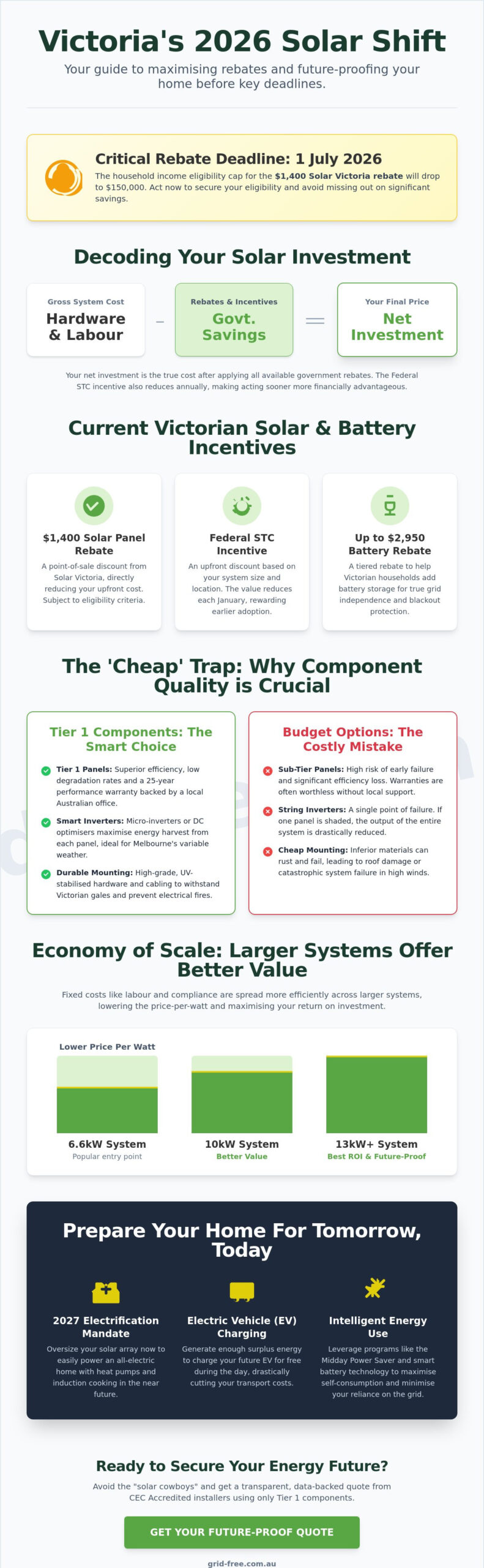
The sticker price of solar is a moving target. To understand the solar system price Victoria residents are quoted, you must first distinguish between the gross cost and your net investment. The gross price represents the total value of premium hardware and specialised labour. Your net investment is what remains after subtracting the Federal STC discount and the $1,400 Solar Victoria rebate. With the STC deeming period reduced to five years as of January 1, 2026, the upfront discount is smaller than last year. This creates a sense of urgency for homeowners to lock in current rates before the next annual reduction.
Victorian pricing is also defined by the state’s rigorous compliance landscape. Unlike other regions, Victoria mandates strict safety standards and specific licensed electrical work for every installation. These regulations ensure long-term reliability but require a higher initial outlay for quality labour. When viewed in the context of Solar power in Australia, Victoria’s commitment to consumer protection and Clean Energy Council (CEC) requirements sets a high benchmark for installation excellence. Supply chain variables in Melbourne also play a role; local inventory of high-efficiency N-type panels and smart hybrid inverters fluctuates based on port activity and global demand, directly impacting short-term quotes.
The Impact of System Capacity on Value
Economy of scale is your greatest financial ally. While a 6.6kW system remains the popular entry point, a 10kW or 13kW array often delivers a far superior price-per-watt. Fixed costs like engineering, council approvals, and travel remain relatively constant regardless of the number of panels installed. Fixed installation costs are spread more efficiently across larger systems, which effectively lowers the cost of every additional kilowatt you add to your roof. Oversizing your array is a strategic move. It prepares your home for the 2027 mandatory electrification standards and ensures you have enough surplus energy to charge a future battery or electric vehicle.
Local Melbourne Installation Factors
Your specific Melbourne address dictates the technical complexity of the build. Installing on a classic terracotta tile roof in the inner-east requires more delicate handling and labour hours than a modern “tin” roof in a new estate. Double-storey homes necessitate advanced safety equipment, including temporary edge protection or scaffolding, which adds to the final quote. Furthermore, inner-city Melbourne suburbs often present unique shading profiles from neighbouring terrace houses or heritage trees. These site-specific variables mean a generic online estimate rarely reflects the reality of a professional, compliant installation. You need a quote that accounts for your roof’s unique pitch, orientation, and material to ensure the system performs as promised.
Breaking Down the Components: Quality vs. Cost
Don’t be misled by bargain-basement bundles. The true solar system price Victoria families encounter is measured in decades, not just the initial invoice. High-quality hardware prevents the “buy twice” scenario that plagues budget installations. Tier 1 panels are the industry standard for a reason. They offer superior degradation rates and bankability. Choosing a sub-tier panel might save a few hundred dollars today, but it risks catastrophic failure or significant efficiency loss within five years. Your roof is a harsh environment. Only premium materials survive the Victorian climate long-term.
The inverter is your system’s brain. It is also the component most likely to fail first. While string inverters are the budget-friendly choice, they create a single point of failure. If one panel is shaded, the whole string suffers. Micro-inverters or DC optimisers mitigate this by managing each panel independently. This technology increases the upfront cost but maximises energy harvest in Melbourne’s variable weather. Safety is another hidden cost. High-grade mounting hardware and UV-stabilised cabling are essential. They ensure your array stays attached during a Gippsland gale and prevents electrical fires. Always verify your installer uses components approved under the Victorian Government’s Solar Homes Program to ensure eligibility for financial support.
Warranty support is the final pillar of your investment. A 25-year performance warranty is worthless if the manufacturer has no Australian presence. We prioritise components backed by local Victorian offices. This ensures that if a technical issue arises, you have a local contact to manage the claim quickly. It is about security. It is about knowing your system will actually perform for its entire expected lifespan without unexpected out-of-pocket expenses.
Choosing the Right Battery Storage
Retrofitting an existing system is a major trend in 2026. If you already have solar, an AC-coupled battery is often the most seamless upgrade path. For new installations, DC-coupled systems offer higher round-trip efficiency. We recommend prioritising lifepo4 battery technology. It offers superior thermal stability and a higher cycle life compared to older lithium-ion chemistries. Your storage capacity must scale with your evening demand. A typical Melbourne household might require 10kWh to 14kWh to achieve true grid independence. Understanding the full solar battery storage benefits can help you determine the right capacity and technology to eliminate your dependence on expensive peak grid rates. Before committing to a capacity, reviewing the latest solar battery cost Australia data ensures you are benchmarking your quotes against current market pricing and available rebates. If you are unsure about your storage needs, you can explore our battery upgrade options to find a tailored fit.
Smart Energy Management Systems
Hardware alone is no longer enough. You need intelligence. Smart meters provide the granular data required to track your ROI in real-time. Without this visibility, you are guessing your savings. VPP-ready hardware is another 2026 essential. It allows you to join Virtual Power Plants, which can effectively lower your net system price through ongoing grid participation credits. Intelligent software optimises battery discharge for peak rates by analysing real-time grid prices and household demand. This level of automation ensures you never pay for expensive peak power when your battery is full. It transforms a simple solar array into a sophisticated, profit-generating asset.
Victorian Solar Rebates and Financial Incentives in 2026
The clock is ticking on Victoria’s most generous solar incentives. Understanding the solar system price Victoria homeowners pay requires a deep dive into the current rebate landscape. From July 1, 2026, the combined household taxable income threshold for the Solar Victoria rebate will drop from $210,000 to $150,000. This $60,000 reduction means many middle-income families will lose access to the $1,400 rebate and the $1,400 interest-free loan if they don’t act before the 5 pm deadline on June 30. It is a significant shift that prioritises lower-income households and underscores the urgency of securing your installation now.
The federal landscape is equally dynamic. On January 1, 2026, the STC “deeming period” was reduced to just five years. This annual phase-out directly increases the upfront cost of every new system. By combining federal STCs with the Victorian Solar Homes Program, you can still offset a substantial portion of your initial capital outlay. Rental providers aren’t left behind either. Specific incentives exist to help landlords improve property value while lowering tenant bills. This creates a rare win-win in the Victorian rental market. You gain an asset while your tenants gain relief from rising energy costs.
Maximising the Victorian Battery Rebate
Storage is no longer a luxury. It is a financial necessity. As of May 2026, a tiered rebate system provides approximately $245 per kWh for the first 14kWh of capacity. This makes a solar battery replacement Melbourne homeowners might be considering far more affordable. To qualify, you must use an authorised retailer and choose from an approved product list. GridFree Solar manages the administrative burden for clients, ensuring all paperwork and eligibility checks are handled seamlessly. We take the complexity out of the state’s storage subsidies so you can focus on your energy independence. For a comprehensive breakdown of what storage units cost after all federal and state incentives are applied, our guide to solar battery cost Australia homeowners face in 2026 provides the definitive pricing and ROI analysis you need.
Virtual Power Plants (VPP) and Your Bottom Line
The era of high Feed-in Tariffs is over. Since July 1, 2025, there has been no regulated minimum FiT in Victoria. This shift makes self-consumption the only viable path to a high ROI. Joining a Virtual Power Plant (VPP) offers a modern alternative. Many VPP providers offer upfront hardware discounts or ongoing financial credits in exchange for occasional grid support. It is a sophisticated way to lower your effective system price. You balance community grid participation with personal independence. Your home becomes a mini power station that earns money even when the sun isn’t shining. It is the ultimate evolution of the Victorian energy consumer.
Calculating ROI: Payback Periods for Melbourne Households
ROI isn’t just a financial metric; it’s a measure of your energy freedom. While the upfront solar system price Victoria homeowners face can seem daunting, the recovery period is remarkably short. Most Melbourne households see a full return on investment within 3 to 5 years. This timeline is accelerating as retail electricity prices continue their upward trajectory. You aren’t just buying panels; you are pre-purchasing 25 years of power at a fraction of the grid price.
Self-consumption is the engine of your ROI. Since the minimum feed-in tariff was abolished in July 2025, exporting power to the grid is a losing game. Every kilowatt-hour you generate and use yourself saves you the full retail rate, which is often four to five times higher than what a retailer might pay you for exports. A typical four-person Melbourne household consuming 20kWh per day can slash their quarterly bills by hundreds of dollars simply by shifting appliance usage to peak daylight hours. Delaying your installation is an expensive mistake. The “opportunity cost” of waiting six months for a potential hardware price drop is usually far higher than the six months of electricity savings you forfeit in the process. You can request a tailored savings estimate to see exactly how fast your system will pay for itself.
Is Solar Worth It in Melbourne?
There is a common myth that Melbourne’s “four seasons in one day” weather makes solar unviable. This is false. While Melbourne averages 3.6 to 3.8 peak sun hours per day compared to Brisbane’s 5.2, our higher retail electricity costs equalise the playing field. Even in mid-winter, a well-designed array produces enough power to cover baseline daytime loads. You can view a detailed is solar worth it Melbourne savings forecast to see how seasonal yields impact your bottom line. Modern N-type cells are incredibly efficient in low-light conditions, ensuring your ROI remains steady even on overcast days.
Commercial ROI for Victorian Businesses
For local enterprises, the financial argument is even more compelling. Most businesses operate primarily between 9 am and 5 pm, aligning perfectly with peak solar generation. This allows for near-total self-consumption without the immediate need for large-scale battery storage. Significant tax depreciation benefits through commercial solar installation Melbourne programs further reduce the effective cost. A typical Victorian SME in 2026 can expect a full ROI within 3 to 5 years, depending on their daytime load profile and available roof space. It is a strategic move that protects your margins from volatile energy markets for decades.
Choosing the Right Installer: Avoiding the “Cheap” Trap
The allure of a rock-bottom quote is powerful. However, the lowest solar system price Victoria offers often comes with hidden compromises that jeopardise your home’s safety. Cheap installers frequently cut corners on “invisible” components like UV-stabilised conduits, high-quality DC isolators, and compliant earthing. These sub-standard materials fail rapidly in the harsh Victorian sun. They don’t just reduce efficiency; they create genuine fire risks. A professional installation isn’t just about bolting panels to a roof. It’s about precision engineering that protects your family and your financial future.
Watch for red flags that signal a “solar cowboy” operation. If a company refuses a physical site visit or uses high-pressure sales tactics, walk away. Professional Victorian specialists evaluate your roof’s structural integrity and shading profile before providing a final figure. They don’t rely on generic satellite imagery alone. Clean Energy Council (CEC) Accreditation is your baseline for trust. Without it, you aren’t just risking quality; you’re forfeiting your eligibility for the $1,400 Victorian rebate. Demand to see the credentials of the specific electrician performing the work, not just the company logo. Long-term performance requires more than a one-day installation; it requires local Melbourne monitoring and support to ensure your ROI remains on track for the next 25 years.
Questions to Ask Your Victorian Solar Specialist
- Are you a CEC Accredited Installer and a signatory to the Solar Safety and Quality Code?
- Will you perform a comprehensive on-site assessment of my switchboard and roof structure?
- Do you have a local Melbourne office to handle warranty claims and technical support?
- Can you provide a detailed breakdown of the net solar system price Victoria homeowners pay after all 2026 rebates are applied?
The GridFree Solar Advantage
We lead the market through assertive, technical expertise. Our focus is total grid independence. We specialise in residential solar panel installation and complex battery upgrade and replacement projects that other installers avoid. By integrating modern, intelligent hardware, we take the complexity out of the 2026 rebate process. Your investment is protected by our commitment to specialised, local monitoring. We are your forward-thinking partner in a rapidly evolving energy market. We don’t just sell solar; we deliver high-performance energy ecosystems designed for the unique Victorian landscape.
Secure Your Energy Future Before the Window Closes
The transition to an all-electric Victoria is a current reality. Acting before the July 1 income eligibility shift is the only way to lock in the maximum $1,400 state rebate and interest-free loan. You now understand that the true solar system price Victoria residents should focus on is the long-term net cost, not just the initial quote. Prioritising Tier 1 hardware and intelligent battery integration ensures you aren’t just saving money; you’re gaining total grid independence.
Precision is non-negotiable. As Victorian CEC Accredited Installers, we specialise in complex 2026 rebate navigation and intelligent storage solutions. We provide the dedicated local Melbourne support required to maintain peak efficiency year-round. Get a Professional Solar Quote for Your Melbourne Property now to secure your advantage. Take the first step toward a smarter, more resilient home today. Your path to energy freedom starts now.
Frequently Asked Questions
What is the average solar system price in Victoria in 2026?
The net solar system price Victoria residents pay typically ranges between $2,800 and $5,600 for a quality 6.6kW system after all rebates are applied. This figure fluctuates based on your choice of Tier 1 hardware and the complexity of your Melbourne roofline. Since the STC deeming period reduced to five years in January 2026, upfront discounts are lower than previous years. Investing now prevents further losses as federal incentives continue to phase out annually until 2030.
Are there still solar rebates available for Melbourne residents?
Yes, eligible Melbourne households can still access a Solar Victoria rebate of up to $1,400. You must act quickly, as the combined household income threshold to qualify for this incentive will drop from $210,000 to $150,000 on July 1, 2026. This state-level support works alongside the federal STC scheme to significantly lower your initial capital outlay. Always verify your installer is an authorised retailer to ensure your application is successful.
How much can I save on my Victorian electricity bill with solar?
A typical four-person Melbourne household consuming 20kWh daily can save hundreds of dollars per quarter by maximising self-consumption. Your total savings depend on how effectively you shift heavy appliance use to the peak generation window between 11 am and 2 pm. With the introduction of the Midday Power Saver program in October 2026, the financial incentive to use your own clean energy has never been higher. Solar protects you from volatile retail price hikes.
Is it better to get a larger solar system or add a battery first?
Prioritising a larger solar system generally offers a faster ROI due to the superior price-per-watt of 10kW and 13kW arrays. Oversizing your system now prepares your home for the mandatory 2027 electrification standards and ensures you have enough surplus energy to charge a future battery. While storage is vital for grid independence, starting with a robust generation capacity allows you to capitalise on the tiered battery rebate structure when you are ready to upgrade.
Can I upgrade my existing solar system with a new battery in Victoria?
You can seamlessly upgrade your current array using an AC-coupled battery system designed for Victorian retrofits. The state now offers a tiered rebate structure for storage, providing approximately $245 per kWh for the first 14kWh of capacity. This incentive makes replacing an older, inefficient battery or adding storage to an existing system financially viable in 2026. We specialise in these technical upgrades to help you achieve total energy security without replacing your entire solar array.
What is the current feed-in tariff for Victorian solar owners?
There is no longer a regulated minimum feed-in tariff in Victoria as of July 1, 2025. Electricity retailers now set their own rates, which can be as low as 0.00 c/kWh. This regulatory shift has transformed the financial landscape, making it far more profitable to use your solar energy at home rather than exporting it to the grid. To maintain a high ROI, focus on intelligent energy management and battery storage to avoid buying expensive peak power.
How long is the typical payback period for a 10kW solar system in Melbourne?
Most 10kW systems in Melbourne achieve a full payback within 3 to 5 years. This rapid ROI is driven by the high efficiency of modern N-type panels in variable weather and the rising cost of grid electricity. By spreading fixed installation costs across a larger number of panels, you lower the cost of every kilowatt generated. This makes the 10kW threshold the “sweet spot” for many Victorian families looking for long-term financial performance.
Does the Victorian government offer interest-free loans for solar?
The Victorian government provides interest-free loans of up to $1,400 to help homeowners manage the upfront cost of solar PV. This loan is designed to be paid back over four years, effectively allowing your electricity savings to cover the instalments. When combined with the $1,400 rebate, this program significantly lowers the barrier to entry for high-quality installations. It is an essential tool for families aiming to future-proof their homes against rising energy costs.