The cheapest home battery isn’t the one with the lowest price tag; it’s the one you never have to replace. Most Victorian households are currently losing hundreds of dollars every year because they’re paralysed by the complexity of lithium chemistries and fire safety concerns. Investing in a lifepo4 battery is the only way to lock in a “set and forget” energy strategy that outlasts the competition.
You deserve a power system that provides total blackout protection and slashes those relentless Victorian electricity bills without requiring a second thought. This article explains why LiFePO4 technology is the safest, longest-lasting, and most financially savvy choice for your solar setup in 2026. We’ll preview the latest federal incentives, including the A$252 per kWh STC rate, and explain how to beat the July 1st income eligibility squeeze. Discover how to secure a battery that delivers over 10 years of reliable performance while keeping your home and family safe.
Key Takeaways
- Understand why a lifepo4 battery is the safest energy storage solution for your home, offering a “set and forget” lifespan of up to 15 years.
- Learn how to maximise your investment by utilising 100% Depth of Discharge without damaging your system’s long-term health.
- Discover why this technology thrives in Melbourne’s volatile climate, maintaining peak performance from 40-degree summer afternoons to freezing winter nights.
- Calculate the ideal capacity for your property to secure the highest possible federal rebates before upcoming eligibility changes in July 2026.
- Identify the critical reasons why professional installation is non-negotiable for maintaining home insurance and grid stability.
What is a LiFePO4 Battery? The New Benchmark for Australian Home Storage
LiFePO4 stands for Lithium Iron Phosphate. It is a high-performance lithium-ion variant designed specifically for stationary home storage. While your smartphone or laptop uses lithium-ion, the chemistry is fundamentally different. Those portable devices use chemistries built for light weight and high energy density. A lifepo4 battery is a “Deep Cycle” unit. It’s engineered to be drained and recharged every single day for over a decade without significant degradation. This isn’t just a minor upgrade. It is a complete reimagining of how we store solar energy in Victoria.
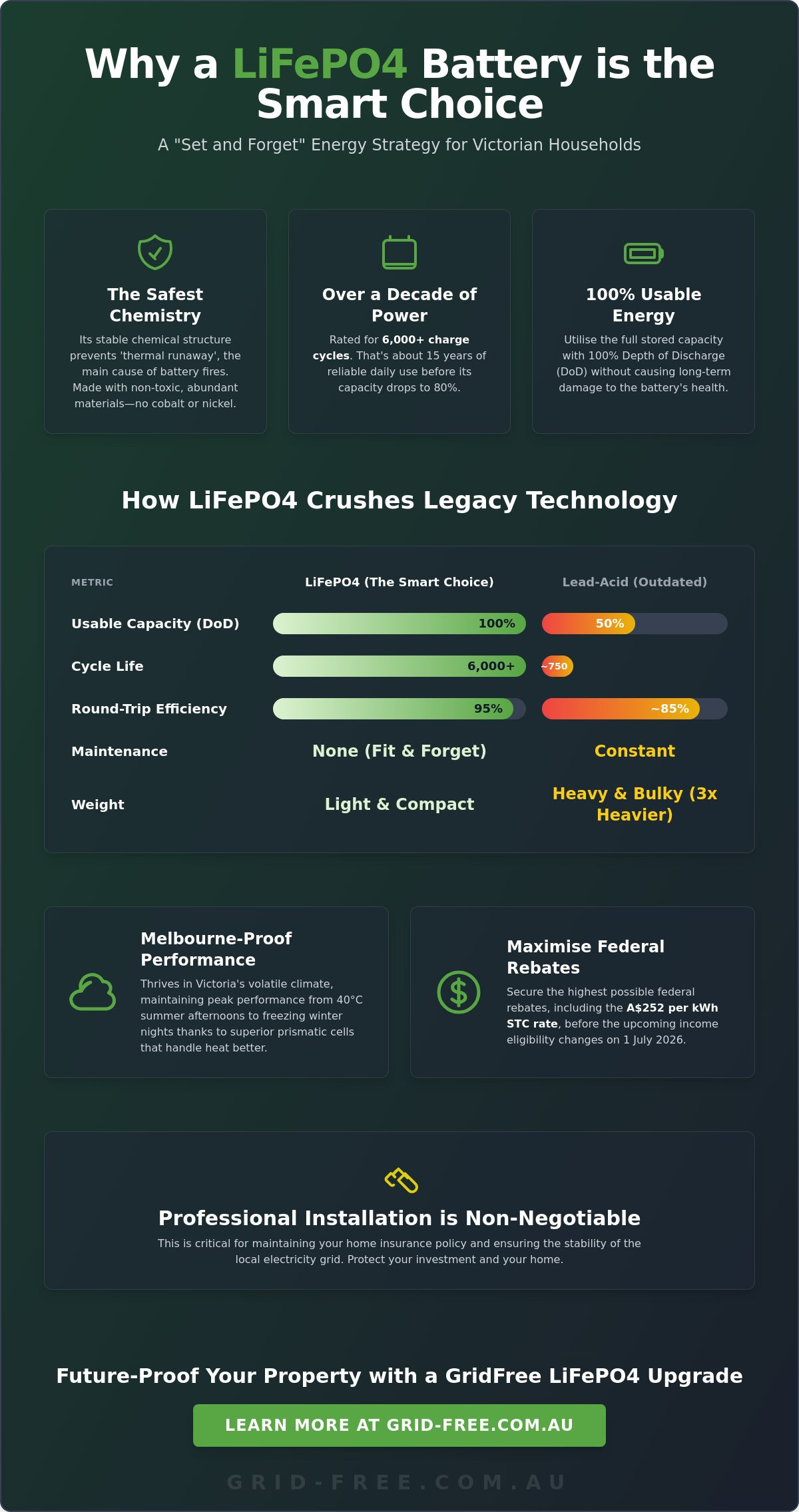
The “Iron Phosphate” part of the name is critical for stability. To truly grasp What is a LiFePO4 Battery?, you must understand its resilience. Traditional Lead-Acid batteries are rapidly disappearing from the Australian market. They are bulky, inefficient, and require constant maintenance. LiFePO4 has replaced them because it offers 95% round-trip efficiency. You keep more of the power your panels produce. The transition from Lead-Acid is driven by three main factors:
- Usable Capacity: You can use 100% of a LiFePO4 battery’s energy. Lead-Acid only allows for 50% before permanent damage occurs.
- Weight: LiFePO4 is roughly one-third the weight of Lead-Acid for the same amount of power, making installation easier.
- Maintenance: There are no fluids to check or terminals to clean. It is a genuine fit-and-forget solution.
The Chemistry of Energy Independence
The molecular bond in Lithium Iron Phosphate is incredibly strong. This structure prevents “thermal runaway,” the primary cause of battery fires in older lithium technologies. LiFePO4 uses non-toxic, abundant materials. There is no cobalt and no nickel. This makes it the most environmentally responsible choice available today. Because of this safety profile, it has become the industry standard for a solar battery replacement Melbourne families choose for peace of mind. It is clean, stable, and incredibly reliable for residential settings.
LiFePO4 vs. Traditional Lithium-Ion
Most electric vehicles use NMC (Nickel Manganese Cobalt) technology. NMC is great for cars because it’s lightweight. However, your home doesn’t need a lightweight battery. It needs a durable one. Cycle life is the metric that determines your return on investment. A lifepo4 battery typically offers 6,000 cycles or more. That is triple the lifespan of many NMC alternatives. Premium units in Australia utilise “Prismatic Cells.” These large, flat cells handle heat better than the small cylindrical cells found in budget brands. They ensure your system stays cool and efficient even during a brutal Victorian heatwave, protecting your investment for the long haul.
The Triple Threat: Why LiFePO4 Crushes Traditional Lead-Acid Technology
Lead-acid is a legacy technology that no longer makes sense for Victorian homeowners. It is heavy, inefficient, and requires frequent replacement. By contrast, a lifepo4 battery represents a quantum leap in home energy storage. You get more power, more safety, and significantly more value over the life of the system. It is the definitive choice for those who prioritise long-term performance over a deceptively low upfront price tag.
Depth of Discharge (DoD) is where the battle is won. Lead-acid batteries are notoriously fragile. Discharge them past 50% and you have likely halved their lifespan. LiFePO4 technology removes this limitation entirely. You can use 100% of the energy you have stored without worrying about chemical degradation. This means a smaller, more efficient lifepo4 battery often outperforms a much larger lead-acid alternative. You aren’t just buying a battery; you’re buying usable energy. Why pay for capacity you can’t actually use? Understanding the full solar battery storage benefits helps you appreciate exactly how much value this technology unlocks compared to legacy alternatives.
6,000+ Cycles: Investing for the Next Decade
In the context of a Victorian solar day, a cycle represents one full discharge and one full recharge. While lead-acid options typically fail after 500 to 1,000 cycles, a quality lithium unit is rated for 6,000 cycles or more. This translates to roughly 15 years of daily use. Cycle life is the number of full charges a unit can complete before its capacity drops to 80% of its original rating. It is the ultimate metric of financial savvy. When you calculate the cost per cycle, the high-quality lithium option is significantly cheaper than the “budget” lead-acid alternative. It is a one-time investment that secures your energy future.
Thermal Stability and Home Safety
Safety is a non-negotiable requirement for residential storage. Unlike other lithium chemistries, LiFePO4 is thermally stable and virtually impossible to ignite through overcharging or physical damage. This is vital when considering the Performance in Victoria’s Unpredictable Climate, where temperature spikes can stress less stable systems. Every unit includes an internal Battery Management System (BMS). This digital guardian monitors voltage and temperature in real-time to prevent issues before they occur. It provides genuine peace of mind for families installing storage in garages or utility rooms. If you’re ready to secure your energy independence, a professional solar and battery installation is the smartest next step for your property.
Melbourne Proof: Performance in Victoria’s Unpredictable Climate
Melbourne’s weather is notoriously volatile. One day it’s a 42-degree scorcher in January; the next it’s a 4-degree morning in July. Your energy storage must be resilient enough to handle these extremes without losing efficiency. A lifepo4 battery is the only solution that truly thrives in this environment. While traditional lead-acid or AGM batteries suffer from “capacity fade” when temperatures fluctuate, lithium iron phosphate remains remarkably stable. It is the definitive choice for Victorian households that require reliable power regardless of what the Bureau of Meteorology predicts.
Beyond temperature, the high “C-rating” of modern lithium units is a game-changer for the Australian lifestyle. This rating determines how much power the battery can deliver at once. Melbourne homes often rely on power-hungry appliances like reverse-cycle air conditioners and induction cooktops. A high-quality lifepo4 battery can discharge large amounts of energy rapidly to meet these peak demands. You won’t have to choose between cooling your home and cooking dinner. This high-current capability ensures your solar investment works for you when you need it most, even during the highest peak demand periods on the Victorian grid.
Beating the Heat and the Chill
LiFePO4 chemistry has a natural resistance to high ambient temperatures. It can operate effectively in environments up to 60 degrees Celsius. This is far beyond the limits of older AGM batteries, which often fail prematurely in uninsulated Victorian garages during summer. While the chemistry is robust, proper ventilation remains essential for larger systems. This is especially true for a commercial solar installation Melbourne businesses use to offset heavy daytime loads. During winter, the internal Battery Management System (BMS) ensures the cells stay within a safe operating range, preventing the sluggish performance and voltage drops typical of legacy storage technology.
Space-Saving Storage for Urban Living
Modern Melbourne living often means townhouses with limited utility space. You shouldn’t have to sacrifice a car park or valuable storage for a battery bank. LiFePO4 provides The New Benchmark for Australian Home Storage by offering incredible energy density. These units are roughly one-third the weight of lead-acid counterparts. This weight reduction allows for flexible mounting options. You can choose a sleek, wall-mounted unit to save floor space or a compact floor-standing stack in a corner. This density is a massive win for urban dwellers who need maximum power in a minimal footprint without compromising on aesthetics or room.
Calculating Your Capacity: Sizing LiFePO4 for Maximum Victorian Rebates
Stop measuring home energy in Amp-hours. While camping retailers focus on Ah for small appliances, residential storage demands a focus on Kilowatt-hours (kWh). This is the only accurate way to calculate how much power your house consumes during the expensive evening peak. A high-quality lifepo4 battery allows you to store excess solar energy generated during the day for use when the sun goes down. Most Melbourne households find that a 10kWh system is the optimal “sweet spot” for balancing upfront cost with daily energy independence.
Matching your capacity to your solar array is vital. If your solar system is too small; your battery will never reach a full charge in winter. Conversely, an oversized battery is a wasted investment. Modern systems are also VPP-ready. By joining a Virtual Power Plant, you can earn additional credits by sharing your stored power with the grid during peak events. This turns your lifepo4 battery into a dynamic revenue stream that pays you back while supporting the Victorian grid.
Sizing Your Storage for Maximum ROI
Audit your evening usage to see where your money goes. Victorian electricity prices are tiered; peak rates often double the cost of off-peak power. Shifting your load to your battery during these windows drastically shortens your payback period. A 10kWh LiFePO4 battery typically covers the overnight needs of a standard four-bedroom home. This size ensures you aren’t paying for excess capacity you’ll never utilise during the shorter winter days.
Navigating Victorian Battery Rebates
The incentive landscape in Victoria is shifting rapidly. From July 1, 2026, the combined household taxable income limit for the Solar PV rebate drops from A$210,000 to A$150,000. If you are above this new threshold, act right now. Understanding the full solar system price Victoria homeowners face in 2026 is essential for calculating your true out-of-pocket costs after rebates. While the Victorian Battery Loan program ended in 2025, the Federal Cheaper Home Batteries Program remains a powerhouse for savings. For the remainder of 2026, you can claim 6.8 STCs per kWh of storage. This provides a saving of approximately A$252 per kWh; significantly reducing your upfront costs. Professional installation is mandatory to access these credits and ensure your warranty remains valid. Don’t leave money on the table. Secure your solar rebate today before the eligibility window narrows.
Future-Proof Your Property with a GridFree LiFePO4 Upgrade
Don’t gamble with your home’s safety or insurance coverage. While budget DIY kits are popular for camping and caravans, they are entirely unsuitable for a permanent residential energy system. A professional lifepo4 battery installation ensures your property remains compliant with Australian Standards and protects your home insurance policy. Most insurers will flatly reject a fire claim involving a non-certified battery setup. You need a solution that is engineered for the long haul; not a weekend project that might fail when you need it most.
Choosing a local partner matters for energy security. GridFree Solar provides a custom design approach tailored specifically to Melbourne’s unique grid requirements and administrative landscape. We don’t believe in “one size fits all” packages. Just as you might check out Jelvis for family-run electrical and heating expertise in the UK, we pride ourselves on providing that same level of dedicated, specialist service here in Victoria. Our systems are built to handle the specific voltage fluctuations and feed-in limitations of the Victorian network. This proactive strategy ensures your system stays online and efficient while others struggle with grid instability.
Seamless integration is the hallmark of a modern energy hub. Our LiFePO4 solutions are designed to communicate perfectly with your existing solar inverters and smart home ecosystems. You get total visibility through intuitive mobile apps. This allows you to monitor your storage levels and household consumption in real-time. It’s about giving you total control over your power; ensuring you never pay for grid energy when your battery is ready to work.
The GridFree Solar Advantage: Quality You Can Trust
Our rigorous selection process focuses on premium lifepo4 battery cells and sophisticated BMS hardware. We don’t cut corners on the digital guardian of your system. Our engineers optimise every setting for the Victorian climate; ensuring peak performance during those 40-degree summer afternoons mentioned earlier. A typical Melbourne home transitioning to this technology sees a dramatic reduction in grid reliance; often achieving near-total independence during the peak summer months.
Take the Next Step Toward Energy Independence
Ready to reclaim control of your power bills? The process starts with a comprehensive site assessment of your Melbourne property. We’ll evaluate your current solar setup and energy needs to design a high-performance upgrade. Whether you are replacing an aging lead-acid bank or adding storage to a newer array; we provide the expertise to get it right the first time. Contact GridFree Solar for a custom quote and join the thousands of Victorians securing their energy future today.
Secure Your Energy Independence Today
Transitioning to a lifepo4 battery is the most significant step you can take toward total grid autonomy. You’ve seen the data. This technology offers unmatched thermal stability, a 15-year lifecycle, and the resilience to thrive in Melbourne’s volatile climate. It isn’t just an upgrade; it’s a defensive strategy against rising electricity costs and the inevitable shift toward all-electric Victorian homes. You’re no longer just consuming power; you’re managing a high-performance asset.
The window for maximum savings is narrowing. With the Federal STC rate currently providing approximately A$252 per kWh in savings, the financial incentive to act has never been stronger. Don’t wait for the July 1st income eligibility changes to lock you out of potential support. As local Melbourne installation experts and CEC Accredited Installers, we ensure your system is optimised for maximum ROI. We are also Solar Victoria rebate specialists, taking the complexity out of your application process from start to finish.
Get a Professional LiFePO4 Quote for Your Melbourne Home and start your journey toward a smarter, more resilient property. Your future self will thank you for making the switch today.
Frequently Asked Questions
Is a LiFePO4 battery better than a standard Lithium-Ion battery?
LiFePO4 is superior for stationary home storage applications. While standard lithium-ion chemistries like NMC are lighter and better suited for electric vehicles, they lack the thermal stability of iron phosphate. A lifepo4 battery offers a significantly longer cycle life and handles the heat of a Victorian summer without the risk of thermal runaway. It is the safest and most durable choice for residential environments.
How many years will a LiFePO4 battery last in Melbourne conditions?
You can expect a service life of 10 to 15 years. Quality units are rated for thousands of cycles, which translates to over a decade of daily charging and discharging. Even after 10 years of use in Melbourne’s variable climate, most systems retain roughly 80% of their original capacity. This longevity makes it a far more cost-effective investment than legacy lead-acid alternatives.
Can I replace my old Lead-Acid or AGM batteries with LiFePO4?
You certainly can. Upgrading an aging lead-acid bank to lithium iron phosphate is one of the most effective ways to modernise your solar setup. This process involves a battery upgrade and replacement of the charging profile settings to match the new chemistry. You’ll gain more usable energy and a much longer lifespan without increasing the physical footprint of your storage area.
Are LiFePO4 batteries safe to install inside my home or garage?
They are the safest lithium technology for indoor residential installation. Unlike older lead-acid batteries, they don’t emit toxic gases during the charging process. Their chemistry is naturally resistant to fire and high temperatures, making them ideal for installation in garages or utility rooms. The internal management system provides an extra layer of digital protection against electrical faults.
What is the “Depth of Discharge” and why does it matter for my ROI?
Depth of Discharge (DoD) is the percentage of the battery’s energy that can be safely used. A lifepo4 battery typically offers 100% DoD, meaning you can use every watt you’ve stored. This matters for your return on investment because you aren’t paying for “buffer” capacity that you’re forbidden from using. You get more usable power for every dollar spent compared to other chemistries.
Can I use a LiFePO4 battery with my existing solar panel system?
Most existing solar systems are compatible with a lithium upgrade. We use AC-coupling to integrate new storage with older solar arrays without needing to replace your original solar inverter. This allows you to add evening power and blackout protection to an established property with minimal disruption. It is a straightforward way to future-proof an older investment.
Do LiFePO4 batteries require any regular maintenance?
No regular maintenance is required. These are genuine “set and forget” units. There are no fluids to check, no terminals to clean, and no manual equalisation cycles to perform. The sophisticated internal Battery Management System (BMS) balances the cells and monitors the system’s health automatically. You can simply enjoy the lower power bills without any ongoing chores.
What happens to a LiFePO4 battery at the end of its life?
They are highly recyclable. Because they don’t contain toxic heavy metals like lead or cobalt, the environmental impact is significantly lower than other battery types. Specialist Australian recycling centres can recover the lithium, iron, and phosphate for reuse in new manufacturing. This creates a circular economy and ensures your green energy solution stays green until the very end.