

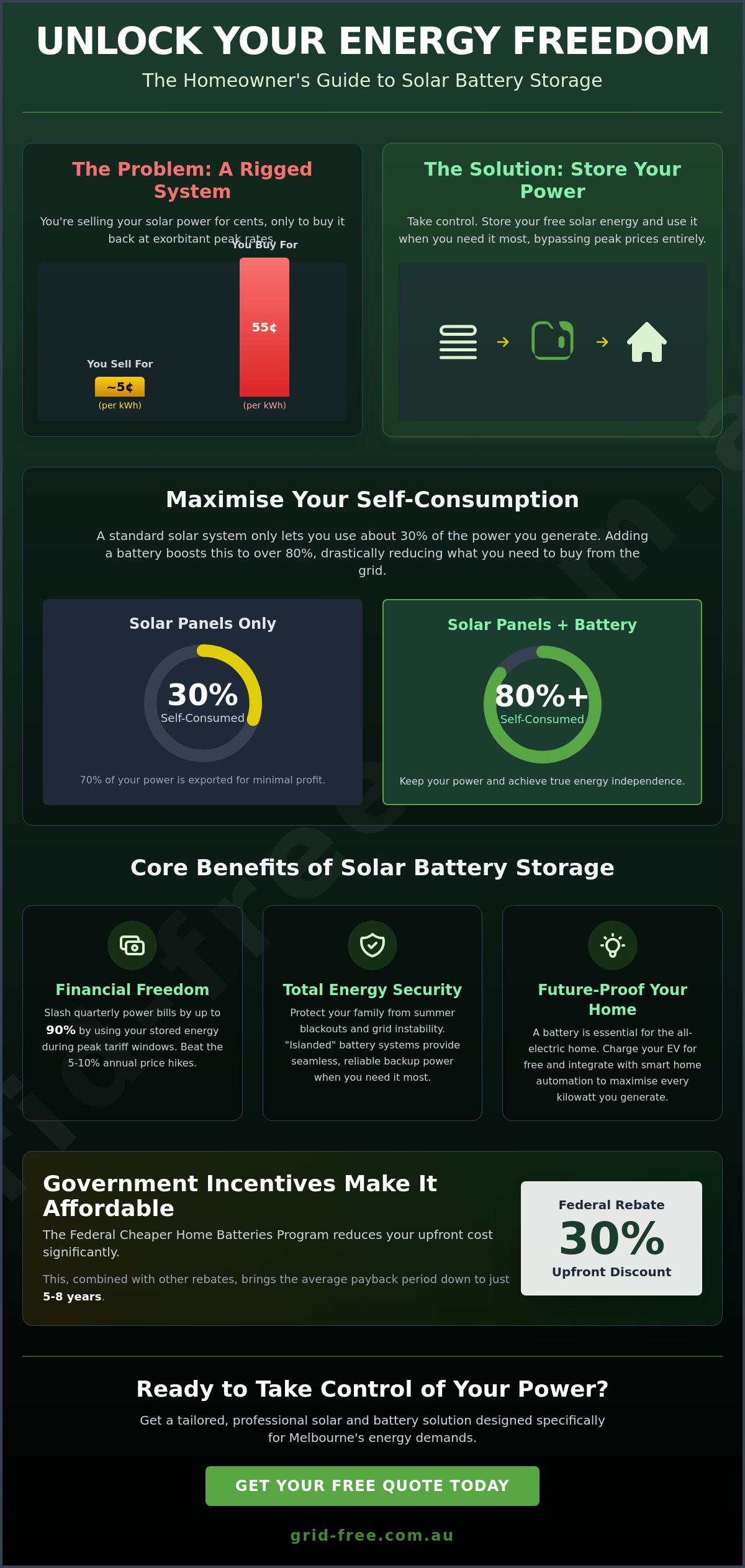
Your solar panels are currently making your power retailer rich while you struggle with peak rates of up to 55 cents per kilowatt-hour. It’s a rigged system. You invested in green energy, yet those quarterly bills remain stubbornly high. You’re likely tired of “solar cowboys” and the constant threat of summer blackouts. Mastering the solar battery storage benefits is the only way to stop the cycle of grid dependency and reclaim your financial freedom.
We agree that Melbourne homeowners deserve better than rising costs and unreliable supply. This guide shows you how modern solar battery storage transforms your home from a simple power consumer into a self-sufficient energy powerhouse. You’ll learn how to leverage the 30% upfront discount from the Federal Cheaper Home Batteries Program, navigate the latest 2026 rebate changes, and secure the reliable backup power your family needs to stay grid-free.
Key Takeaways
- Master the financial shift from exporting energy to storing value. Learn how to slash quarterly bills by up to 90% using intelligent discharge during peak tariff windows.
- Secure your home against grid instability. We explain how “islanded” battery systems provide reliable backup power during extreme weather and summer blackouts.
- Maximise the solar battery storage benefits by integrating storage with smart home automation. This synergy ensures every kilowatt your panels produce is used with maximum efficiency.
- Future-proof your lifestyle for the electric vehicle era. Discover why a home battery is essential for EV owners to avoid paying high grid prices for charging.
- Optimise your ROI with a tailored local solution. Understand why professional, customised installation is the only way to ensure your system meets Melbourne’s specific energy demands.
The Evolution of Energy: Why Solar Battery Storage is Essential in 2026
The Australian energy market has reached a critical threshold. For years, solar was about putting as many panels on the roof as possible. That era is over. In 2026, the focus has shifted to intelligence and retention. A modern unit is no longer just a passive container for electricity. It’s a sophisticated energy management system that predicts your usage and optimises every watt. This shift is why Melbourne homeowners are prioritising solar battery storage benefits over simple panel expansions.
The transition to a fully electric home is accelerating. With gas connections being phased out in new Victorian builds, your electricity demand is rising. Heating, cooling, and cooking now all draw from the same source. Without storage, you’re at the mercy of the grid during the most expensive hours of the day. 2026 is the tipping point because the technology has finally caught up with the economic necessity of self-reliance. You’re no longer just a consumer. You’re a power plant operator.
Moving Beyond the Feed-in Tariff
Relying on feed-in tariffs is a losing game. In 2026, the rates paid by retailers for your excess solar are at historic lows. Meanwhile, peak electricity rates in Melbourne have climbed to between 40 and 55 cents per kWh. Sending your power back to the grid for a few cents while buying it back hours later at a massive markup makes no financial sense. Home energy storage allows you to “buy back” your own energy for $0. By shifting your usage to stored solar during peak windows, you effectively bypass the most expensive electricity in the country.
The “Storage-First” Mindset
Smart design now starts with the battery. We no longer just look at roof space; we look at your evening consumption profile. A standard solar-only system typically achieves a self-consumption rate of around 30%. Adding a 10 kWh battery can push that figure above 80%. This is the core of the “storage-first” approach. You aren’t just generating power; you’re securing it. Energy independence in the Victorian context means having the technical capacity to power your essential loads indefinitely without drawing a single watt from the external grid. It’s about moving from being a consumer to becoming a producer who controls their own supply.
Maximising Your ROI: The Financial Benefits of Solar Batteries
Financial freedom starts with intelligent discharge. In 2026, the primary driver for solar battery storage benefits is the massive gap between what you pay for power and what you get for exporting it. While retailers offer mere cents for your excess solar, they charge up to 55 cents per kWh during peak evening windows. A smart battery system eliminates this disparity. By storing your midday production and discharging it when rates are highest, you can slash your quarterly power bills by up to 90%.
Most Melbourne households now operate on “Time of Use” (ToU) tariffs. This pricing structure makes batteries significantly more profitable than they were just two years ago. We employ a “Peak Shaving” strategy where your battery handles the heavy lifting during the most expensive hours. You effectively bypass the price spikes that hit everyone else when the sun goes down. Over a 10-year period, the compounding value of these savings is staggering. You aren’t just saving money; you’re insulating your household from the inevitable 5% to 10% annual energy price hikes forecasted for the late 2020s.
Virtual Power Plants (VPPs): Getting Paid to Store Energy
Virtual Power Plants represent the next frontier of residential earnings. By joining a VPP, you allow your battery to support the Victorian grid during critical events, such as extreme summer heatwaves. In exchange, you receive direct credits on your bill or higher feed-in rates. This turns your storage unit into a proactive revenue source. For a technical breakdown of how these systems synchronise with the grid, see our guide on VPP solar battery Victoria solutions.
Rebates and Incentives in Victoria
The incentive landscape has shifted dramatically. While the Victorian state battery loan program closed in 2025, the Federal Cheaper Home Batteries Program now provides a substantial 30% upfront discount on eligible systems. This federal support, combined with Australian Government incentives for batteries like Small-scale Technology Certificates (STCs), has brought the average payback period down to between 5 and 8 years.
Urgency is required for those also looking at panel upgrades. The income threshold for the $1,400 Victorian solar PV rebate is set to drop from $210,000 to $150,000 on July 1, 2026. Waiting for “cheaper tech” is a false economy. Every month you delay is a month of lost savings and missed government support. You can review current market rates in our solar system price Victoria cost guide. For a comprehensive breakdown of what you should expect to pay and how to calculate your return on investment, our solar battery cost Australia 2026 price and ROI guide provides the detailed figures you need. To see how these numbers apply to your specific roofline, you should consider a professional energy assessment to lock in your savings before the next price hike.
Total Energy Security: Protecting Your Home Against Blackouts
Grid reliability in Victoria is no longer a given. As we face more frequent extreme weather events, from severe storms to intense summer heatwaves, the vulnerability of our ageing infrastructure is exposed. For many Melbourne homeowners, the most tangible solar battery storage benefits aren’t found on a spreadsheet; they’re felt when the rest of the street goes dark. A battery system with “islanding” capability ensures your home remains a sanctuary while others are left in the dark. This reliability is equally critical for site safety, which is why construction site camera hire australia has become a preferred choice for projects requiring robust, solar-powered surveillance regardless of grid status.
Standard solar systems without batteries are designed to shut down during a power failure for safety reasons. This leaves you powerless even on a bright, sunny day. An islanded battery system creates its own microgrid. It physically disconnects from the main grid during an outage, allowing your panels to keep generating power and your battery to keep discharging. This 24/7 energy safety net also acts as a shield for your sensitive electronics. It filters out grid surges and fluctuations that often occur during load shedding or when power is being restored.
Essential vs. Non-Essential Load Backup
Success during a blackout depends on smart circuit organisation. We help you categorise your home into essential and non-essential loads. Essential circuits typically include your fridge, Wi-Fi, lighting, and security systems. These stay active indefinitely. High-draw appliances like ducted air conditioning or pool pumps require significantly more power. Understanding how home batteries work in these scenarios is crucial. Achieving a whole-home backup requires specific battery configurations and higher discharge rates to handle those heavy startup currents.
Reliability in the Face of Climate Extremes
Melbourne’s volatile climate puts immense stress on energy hardware. Summer peaks often lead to voltage instability. We prioritise systems using Lithium Iron Phosphate (LFP) chemistry for this reason. LFP batteries offer superior thermal stability and a longer lifecycle compared to older technologies. They are built to handle the heat. When selecting the best home battery for Victorian conditions, reliability under pressure is our non-negotiable standard. You need a system that performs when the temperature hits 40 degrees and the grid begins to buckle. It’s the ultimate insurance policy for your modern lifestyle.
Future-Proofing Your Lifestyle: EV Charging and Smart Homes
The home of 2026 is an integrated circuit. As Victoria moves toward a fully electric mandate, your energy consumption habits must evolve to stay ahead of the curve. For those wanting to explore comprehensive energy-efficient solutions, you can check out Carbon Saving Group for expert guidance. One of the most overlooked solar battery storage benefits is its ability to act as the central nervous system for your high-tech lifestyle. From powering your transport to managing smart appliances, storage is the foundation of a modern, cost-controlled residence. It’s no longer about just saving money; it’s about controlling your own infrastructure.
The EV-Battery Synergy
Owning an Electric Vehicle (EV) without a home battery is a missed opportunity. Charging your car directly from the grid during peak evening hours is essentially paying “petrol prices” for electricity. A battery captures “free” sunshine during the day and delivers it to your vehicle overnight. It also provides a critical safety buffer. High-speed chargers draw significant current. A battery manages this load peak, preventing your EV charger from tripping the main house fuse during heavy usage. This efficiency also extends to other electric transport; for instance, you can explore Mobility Scooters that can be charged using your own solar reserves. Bi-directional charging (V2H) will soon transform the game by allowing your vehicle to act as a mobile power bank that feeds your home during emergencies.
Increasing Property Value
Energy efficiency is the new luxury. In the current Melbourne property market, “Solar + Battery” has officially replaced high-end kitchen finishes as the primary draw for savvy buyers. Modern purchasers prioritise long-term running costs over cosmetic upgrades. Data from the real estate sector shows that homes with established storage systems and high energy ratings sell faster than grid-dependent counterparts. This is about protecting your asset. If your existing system is underperforming, securing a solar battery replacement Melbourne service ensures your home remains a top-tier prospect in an increasingly green-conscious market.
Don’t let your home fall behind the curve. You should consult with our technical advisors to design a storage solution that powers your future today.
The GridFree Advantage: Custom Storage Solutions for Melbourne
Generic energy solutions are a financial liability. A “one size fits all” battery approach often ignores the nuances of Melbourne’s specific tariff structures and seasonal weather patterns. To truly capture the solar battery storage benefits discussed in this guide, your system must be engineered for your specific consumption profile. We don’t just install hardware. We deploy intelligent energy management systems designed to outperform the standard market offerings.
Precision matters. ROI depends on it. At GridFree Solar, we act as your proactive specialist, navigating the complex administrative landscape of Victorian energy regulations. While others simply mount a unit, we ensure your system is optimised for the federal 30% discount and compliant with the latest grid requirements. Our commitment to high-quality components means your investment isn’t just a temporary fix; it’s a 10-year asset backed by local, expert support.
Tailored System Design
Every home has a unique energy fingerprint. We begin with a deep analysis of your historical usage data before recommending a single component. This ensures you aren’t paying for capacity you won’t use or, conversely, ending up with a system that drains before the evening peak ends. We prioritise professional solar installation Victoria standards over the lure of cheap, unproven imports. Whether your property requires a DC-coupled system for maximum efficiency in a new build or an AC-coupled unit for a seamless retrofit, our technical advisors match the technology to your roofline.
Start Your Journey to Independence
The transition to a grid-free lifestyle should be seamless. Our methodical process takes you from the initial energy audit through to the final grid connection and rebate processing. We handle the technical heavy lifting, ensuring your battery is integrated correctly with your existing solar array and smart home devices. Once live, our ongoing monitoring ensures your battery performs at peak efficiency for a decade or more.
The window for maximum government support is narrowing. Don’t leave your energy future to chance or “solar cowboys.” Secure your home’s autonomy with a system built for the long haul. You can contact our Melbourne-based team today for a custom energy assessment and take the first step toward a near-zero power bill.
Secure Your Energy Autonomy Today
The transition to a grid-free lifestyle is no longer a distant goal. It’s a practical necessity for every Melbourne household facing rising costs and climate volatility. You now understand how to bypass peak rates, secure reliable backup power, and integrate your transport into a self-sufficient ecosystem. Reaping the full solar battery storage benefits requires a partner who understands the local landscape and technical requirements.
Our CEC Accredited Installers are ready to help you navigate the 2026 rebate changes with expert local Melbourne support. We’re specialists in Victorian battery rebates and provide dedicated service to ensure you maximise your upfront savings. Get a Custom Solar Battery Quote for Your Melbourne Home and start your journey toward near-zero bills today. It’s time to stop exporting your value and start storing it for your own family’s future.
Frequently Asked Questions
Is solar battery storage worth it in Melbourne in 2026?
Yes, the financial case is stronger than ever. With peak electricity rates reaching 55 cents per kWh and the Federal Cheaper Home Batteries Program offering a 30% upfront discount, the typical payback period has dropped to between 5 and 8 years. You effectively bypass the “solar tax” of low feed-in tariffs while securing your home against future price hikes.
Can a solar battery power my whole house during a blackout?
Yes, but this requires a specific technical configuration known as “islanding” or whole-home backup. You must ensure your battery has a high enough continuous discharge rate to handle heavy startup currents from appliances like air conditioners. Most Melbourne households choose to back up essential circuits like refrigeration, lighting, and Wi-Fi to extend the battery’s duration during an outage.
How long do modern solar batteries like LiFePO4 actually last?
Lithium Iron Phosphate (LiFePO4) units typically last 10 years or longer with minimal capacity loss. These modern cells are designed for daily cycling and offer superior thermal stability in Melbourne’s summer heat. Most premium units are warranted for a full decade, ensuring your solar battery storage benefits persist well into the 2030s.
What is the current Victorian battery rebate for 2026?
The Victorian state-based interest-free battery loan program closed to new applications in May 2025. In 2026, the primary financial incentive is the federal Cheaper Home Batteries Program, which provides an upfront discount of approximately 30%. This discount is applied directly by your installer at the point of sale, making the technology significantly more accessible to a wider range of households.
Can I add a battery to my existing solar panel system?
Yes, you can retrofit a battery to almost any existing solar array. This is usually achieved through AC-coupling, which allows the battery to work alongside your current inverter without needing to rewire your panels. It is a fast, efficient way to upgrade an older system into a modern, self-sufficient energy powerhouse without replacing your entire setup.
Do I need a special inverter to install a battery?
You require either a hybrid inverter or a dedicated battery inverter. If you are installing a new system, a hybrid inverter manages both your panels and your battery in one unit. For retrofits, we often install an AC-coupled battery inverter that sits alongside your existing hardware to manage the storage and discharge cycles independently.
What is a Virtual Power Plant (VPP) and should I join one?
A VPP is a network of home batteries that work together to support the grid during periods of peak demand. Joining one allows you to earn additional bill credits or access higher feed-in rates by discharging power when the grid needs it most. It is an excellent way to accelerate your ROI while contributing to local energy stability during Melbourne’s summer peaks.
How much maintenance does a home solar battery require?
Modern storage systems are virtually maintenance-free. There are no moving parts and the units are designed to be “set and forget” once commissioned. We provide remote monitoring services to track your system’s health and efficiency, ensuring you continue to receive the maximum solar battery storage benefits without needing to perform any manual checks or physical servicing.