If your household income sits between $150,000 and $210,000, your window to claim the $1,400 Victorian rebate slams shut at 5:00 PM on 30 June 2026. It is a high-stakes moment for energy autonomy. Most homeowners want to slash their power bills but feel paralysed by “solar cowboys” and the complex shift from state to federal battery incentives. A professional solar panel installation Melbourne requires more than just hardware; it demands a strategic approach to the latest 2026 regulations and cybersecurity standards.
You are right to be cautious about upfront costs versus long-term ROI. We will show you how to navigate the new Cheaper Home Batteries Program to secure discounts of up to $4,000 while ensuring your system meets the strict 1 July 2026 apprentice supervision rules. This guide provides a definitive roadmap to total grid independence. You will learn how to integrate smart battery storage, claim every available incentive, and finally outsmart the volatile energy market with a system built for the next decade. It is time to take control of your energy future with confidence and precision.
Key Takeaways
- Master the transition from feed-in tariffs to self-consumption strategies to achieve true energy independence in 2026.
- Discover why a 10kW+ solar panel installation Melbourne is now the benchmark for homes integrating advanced battery storage systems.
- Navigate the updated federal “Cheaper Home Batteries Program” to claim significant point-of-sale discounts on your storage capacity.
- Learn how precision site audits and customised mounting hardware protect your investment against Melbourne’s unique “four seasons in one day” climate.
- Stay ahead of new 2026 regulatory changes, including mandatory cybersecurity standards for all smart energy devices and inverters.
Why Solar Panel Installation in Melbourne is Changing in 2026
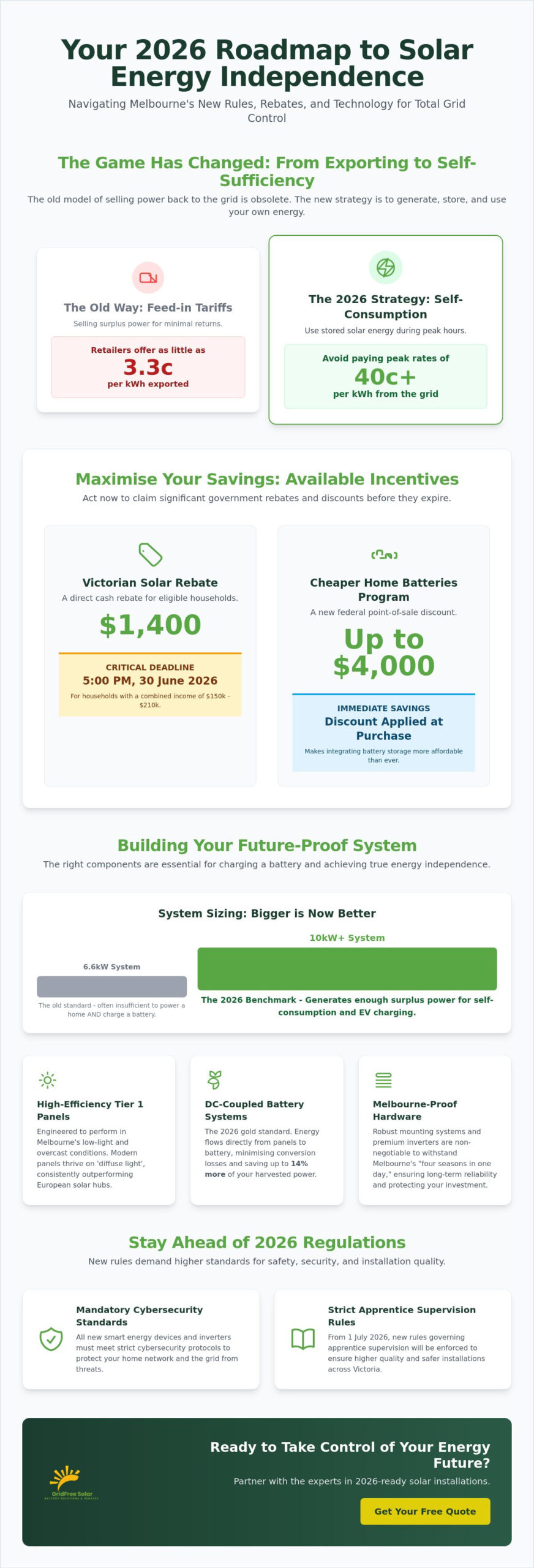
Energy dynamics in Victoria have reached a definitive tipping point. The old strategy of “hunting” for high feed-in tariffs is dead. With retailers now offering as little as 3.3c per kWh for exports, the financial logic has shifted entirely toward self-consumption. In 2026, a solar panel installation Melbourne isn’t about selling power back to the grid for pennies. It’s about hoarding every photon you capture to offset soaring peak-time electricity prices. This transition is fueled by the state’s move toward full electrification, as new homes are no longer connected to the gas network. Every kilowatt you generate and use yourself is a direct shield against the inevitable price hikes hitting Victorian households this year.
Melbourne’s notorious “four seasons in one day” weather demands a higher standard of hardware. You can’t rely on generic systems designed for the steady sun of Queensland. In our local climate, rapid temperature fluctuations and high-wind events are the norm. Premium inverters and robust mounting systems are non-negotiable for long-term reliability. Understanding the state of solar power in Australia reveals that Melbourne homeowners who invest in high-efficiency Tier 1 panels see faster payback periods, often within three to five years, despite the cloud cover. Efficiency is no longer a luxury; it’s a survival tactic.
The Melbourne Solar Advantage: Debunking the Cloud Myth
Don’t let the grey skies fool you. Modern solar technology thrives on “diffuse light”, which is the sunlight that scatters through cloud layers. Even on an overcast Tuesday in July, high-performance panels continue to generate significant energy. In fact, Melbourne’s solar yield consistently outperforms major European solar hubs like Berlin or London. We aren’t just matching them; we’re crushing them. Tier 1 panels are engineered to maintain high output in low-light conditions, ensuring your home remains powered even when the sun isn’t “cracking the flags.” It’s about consistent energy harvesting, not just peak-hour performance.
Energy Independence vs. Grid Reliance
Total grid independence is no longer a fringe concept for off-grid enthusiasts. It’s a pragmatic financial goal for suburban families. By pairing a solar panel installation Melbourne with intelligent battery storage, you can effectively bypass the grid during the most expensive 6:00 PM to 9:00 PM window. Smart energy management software now does the heavy lifting, automatically directing power to your heavy appliances when production is highest. Some residents worry that waiting for “cheaper” technology is the smarter move. It isn’t. Every month you delay is a month of paying retail prices to a power company that doesn’t care about your bottom line. The tech is mature, the rebates are active, and the urgency is real.
Choosing Your System: The Synergy of Panels and Battery Storage
The 6.6kW solar era is over. For a modern solar panel installation Melbourne, this once-standard size is now a bottleneck. High-performance households are shifting toward 10kW or larger arrays. The logic is simple. A battery requires a massive surplus of energy to charge effectively while your home is active. If your panels only cover your immediate daytime load, your battery stays empty. You remain grid-dependent. A larger array ensures that even on shorter winter days, you generate enough excess to fill your storage for the evening peak. It is the difference between a system that looks good on paper and one that actually eliminates your bill.
Choosing the right inverter is your next tactical move. You need a hybrid system that manages both generation and storage simultaneously. This eliminates the need for separate units, significantly reducing energy conversion losses. Consult the Clean Energy Council consumer guide to verify that your chosen components meet the 2026 safety and performance standards. Future-proofing is essential. With electric vehicles becoming the norm, your 2026 installation must account for an extra 30kWh to 60kWh of weekly demand. Don’t build for today. Build for your 2030 energy profile.
The Integrated Solar and Battery Solution
Efficiency lives in the details. DC-coupled systems are the 2026 gold standard for new installs. They allow energy to flow directly from your panels to your battery without multiple conversions. This saves up to 14% of your harvested power compared to older AC-coupled setups. When selecting a solar panel and battery package Melbourne, prioritise LiFePO4 (Lithium Iron Phosphate) chemistry. It is more stable; it offers a longer cycle life; it is significantly safer for residential environments. It is the intelligent choice for Melbourne’s variable thermal conditions. To compare the top-performing LFP systems available right now, the best solar battery for home Australia roundup provides a detailed 2026 breakdown of leading models, chemistry comparisons, and federal discount eligibility.
When to Consider an Upgrade vs. a New Install
Your existing system might be holding you back. If your current storage is failing to hold a charge or your inverter is frequently tripping, it is likely time for a solar battery replacement Melbourne. Adding a battery to an old string inverter system is often technically difficult and financially inefficient. In many cases, replacing aging 250W panels with modern 450W+ high-efficiency modules provides a much higher ROI. You get more power from the same roof footprint. If you aren’t sure where your system stands, explore our residential solar solutions to see how a modern upgrade can revitalise your energy savings and restore your independence.
Navigating Victorian Solar Rebates and Financial Incentives
The financial landscape for a solar panel installation Melbourne is undergoing a massive shift in 2026. Urgency is the priority for middle-income earners. From 1 July 2026, the combined household income threshold for the state rebate drops from $210,000 to $150,000. If you sit in that bracket, you have until 5:00 PM on 30 June to secure your funding. Missing this deadline means losing out on the $1,400 rebate and the matching $1,400 interest-free loan. It is a high-stakes cliff that requires immediate action to maximise your return on investment. Understanding exactly what constitutes a professional solar installation Victoria in 2026 — including the shift from CEC to SAA accreditation and the new cybersecurity compliance requirements — is essential before you submit your application.
Navigating the Victorian Government’s Solar Homes Program remains the most effective way to lower your entry costs. For properties valued under $3 million, these incentives provide a significant buffer against the initial capital outlay. While the direct state battery rebate has ended, the federal “Cheaper Home Batteries Program” has stepped in. This new 2026 initiative provides a point-of-sale discount based on capacity, typically shaving between $2,000 and $4,000 off a standard residential storage system. When combined with the federal STC scheme, which offers roughly $2,800 for a 6.6kW system, the upfront cost of energy independence has never been more manageable. To understand how to maximise these incentives alongside the right storage technology, explore the comprehensive energy storage solutions Melbourne guide for a complete 2026 roadmap to grid autonomy.
Virtual Power Plants (VPPs): Earning While You Sleep
Traditional feed-in tariffs are no longer the primary driver of solar savings. In 2026, Victorian retailers are aggressively pushing Virtual Power Plants. By joining a VPP, you allow the grid to “borrow” small amounts of your stored battery power during peak demand events. In exchange, you receive premium credits that far exceed the standard 3.3c to 5.2c export rates. It turns your home into a dynamic grid-ready asset. You aren’t just saving money; you are generating a passive revenue stream while supporting Melbourne’s energy stability.
Commercial ROI: Solar for Melbourne Businesses
For organisations, the math is even more compelling. A commercial solar installation Melbourne offers a powerful hedge against rising operational costs. Businesses can leverage instant asset write-offs to deduct the full cost of the system in a single tax year. We focus on demand-charge reduction, ensuring your system peak-shaves during the most expensive billing cycles. When you request commercial solar quotes Melbourne, look for a three to four-year payback period. It is a tax-efficient move that transforms a liability into a high-yield infrastructure asset.
The Anatomy of a Premium Melbourne Solar Installation
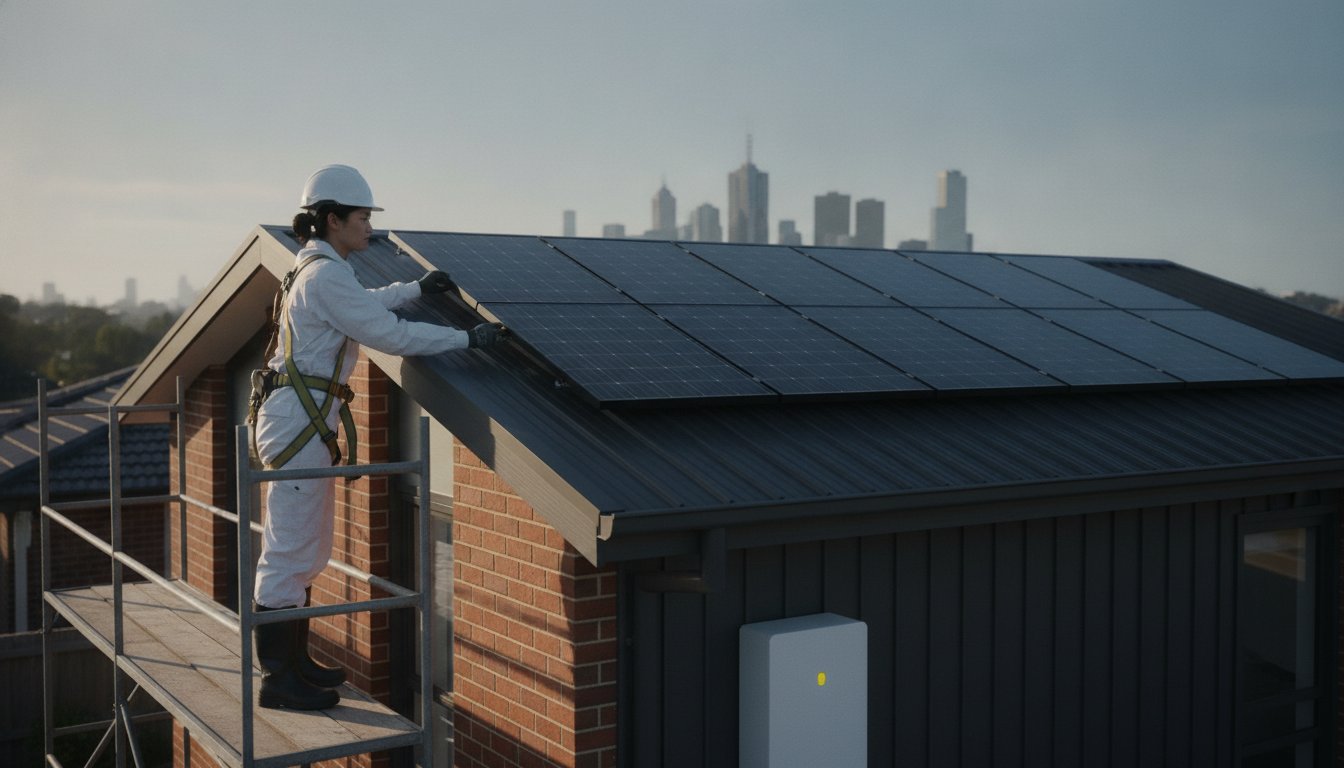
A high-performance solar panel installation Melbourne is a masterclass in precision engineering. It isn’t just about “slapping panels on a roof.” It is a multi-stage technical execution designed to last 25 years in a volatile climate. The process begins with a meticulous site audit. We perform a detailed shading analysis using 3D modelling to track the sun’s path across your specific postcode. This is coupled with a switchboard capacity check to ensure your home meets the stricter 2026 electrical standards for battery housing and smart device integration. Without this foundation, your system is built on guesswork.
The physical installation follows a strict five-step hierarchy of quality:
- Customised Mounting: Whether you have Colorbond, concrete tile, or fragile terracotta, we use roof-specific mounting hardware. This ensures structural integrity and zero leaks during Melbourne’s flash storms.
- Premium Electrical Work: We prioritise internal conduit runs. This protects your cabling from UV degradation and keeps your home’s exterior clean and professional.
- High-Spec Switchgear: We use industrial-grade circuit breakers and isolators. Cheap components are the primary cause of system failure; we don’t use them.
- Battery Commissioning: Our technicians calibrate your storage system and integrate the smart app. You leave the day with full visibility of your energy flow.
- Active Monitoring: Every GridFree system includes post-install support. We monitor your system’s health remotely to catch anomalies before they impact your bill.
The “Solar Cowboy” Red Flags to Avoid
In a mature market, “cheap” is a dangerous word. A quote that seems too good to be true usually hides sub-standard mounting systems or generic inverters that lack 2026 cybersecurity compliance. Always verify that your team consists of Clean Energy Council (CEC) Accredited Installers. Poorly managed cabling isn’t just an eyesore. It is a legitimate fire risk. If an installer cannot explain how they manage DC cable protection or roof penetration sealing, they aren’t experts; they’re cowboys. Protect your family and your investment by choosing a partner that values technical safety over a quick sale.
Aesthetics and Durability: The Melbourne Standard
Your roof is a valuable asset. A premium solar panel installation Melbourne should enhance your home’s street appeal, not detract from it. We utilise “black-frame” panels for a sleek, low-profile finish that blends into modern architectural styles. Inverter placement is equally critical. We strategically locate your hardware to avoid direct afternoon sun, which prevents thermal throttling and extends the life of the electronics. It is this attention to detail that separates a generic install from a high-yield power station. If you are ready for a system that performs as well as it looks, request your customised solar and battery assessment today.
Partnering with GridFree Solar for Long-Term Energy Independence
Choosing a partner for your solar panel installation Melbourne is a decision that impacts your financial health for decades. At GridFree Solar, we operate under a “Total System” philosophy. We don’t just sell panels; we build high-tech residential power stations. This distinction is critical in 2026. While generic installers focus on volume, we focus on energy density and grid-free potential. We understand the specific voltage fluctuations of the Melbourne grid, whether you are in the eastern suburbs or the inner north. This localised expertise ensures your system remains stable when others trip during peak summer demand.
Your investment is secured by the GridFree warranty. We provide above-market protection that covers your panels, battery storage, and our precision workmanship. It is a commitment to reliability that large, impersonal corporations simply cannot match. Starting your journey is a streamlined process. We move from an initial technical consult to a bespoke solar battery cost Australia analysis. This isn’t a generic estimate. It is a data-backed ROI roadmap tailored to your specific roof and consumption habits.
Why GridFree Solar is the Top Choice in Victoria
Performance is non-negotiable. We exclusively utilise Tier 1, high-efficiency 2026 hardware designed to thrive in Melbourne’s variable light. Our specialists live and breathe battery integration; we ensure your storage capacity perfectly matches your generation array to avoid energy waste. Our team provides dedicated, on-the-ground support to ensure every Melbourne household receives personalised technical guidance and rapid local service. We are your neighbours, and we take your energy independence personally.
Ready to Secure Your Energy Future?
Expect a different experience in your first professional consultation. We don’t use high-pressure sales tactics. Instead, we perform a deep dive into your energy profile to identify exactly where you are losing money to the grid. We handle the entire Victorian rebate application process on your behalf. We manage the paperwork; we deal with the authorities; you get the savings. The window for the current $1,400 rebate is closing fast. Take control of your energy bills today and lock in your path to total independence before the 2026 threshold changes take effect.
Own Your Energy Future with Precision and Authority
The 2026 energy landscape in Victoria leaves no room for hesitation. Achieving total grid independence requires a definitive shift from passive generation to active self-consumption. By pairing a high-capacity array with intelligent battery storage, you effectively bypass rising retail rates and take control of your household’s financial future. It’s vital to remember that the 30 June deadline for current rebate eligibility is a critical milestone for middle-income earners. A professional solar panel installation Melbourne is your most powerful tool against energy volatility; provided it’s executed with technical precision.
GridFree Solar stands as a Victorian Government Approved Provider and a team of CEC Accredited Installers. We’re specialists in high-performance battery integration, ensuring your system is built for the next decade of innovation. Don’t settle for “solar cowboys” or generic hardware that fails under Melbourne’s unique pressure. It’s time to transform your roof into a high-yield power station that delivers long-term reliability and security. Your journey to energy autonomy is just a consultation away. Let’s build a solution that secures your independence for years to come.
Get a Professional Melbourne Solar Quote Today
Frequently Asked Questions
How much does solar panel installation cost in Melbourne in 2026?
System costs are influenced by component quality, roof complexity, and total capacity. In the current 2026 market, a standard 6.6kW system typically ranges between $5,500 and $9,500 after the federal STC discount is applied. This price excludes optional battery storage or specific state-based rebates. Investing in premium Tier 1 hardware usually sits at the higher end of this scale but offers significantly better long-term yield and reliability.
What is the best solar panel for Melbourne weather?
High-efficiency N-type monocrystalline panels are the superior choice for Melbourne’s “four seasons in one day” climate. These modules are specifically engineered to harvest diffuse light during overcast conditions, ensuring consistent generation even on grey winter days. You should prioritise panels with a low temperature coefficient and a high wind-load rating to withstand the rapid thermal shifts and gusty conditions common across Victorian suburbs.
Am I still eligible for the Victorian solar rebate if I already have solar?
The Solar Homes Program generally restricts the solar panel rebate to one per household. If you’ve already claimed a rebate for your current property, you won’t be eligible for a second panel discount. However, you can still access the federal “Cheaper Home Batteries Program” for a storage upgrade. If you move to a new primary residence that hasn’t previously received a rebate, you may be eligible to apply again.
How many solar panels do I need for a 10kW battery?
To effectively charge a 10kW battery while simultaneously powering your home, we recommend a minimum solar array of 8kW. For true energy independence in 2026, a 10kW+ solar panel installation Melbourne is the ideal benchmark. This larger capacity ensures you generate a sufficient energy surplus during the day to fully replenish your battery storage, even during the shorter daylight hours of a Victorian winter.
Can I install solar panels on a flat roof in Melbourne?
Flat roofs are perfectly suitable for solar when using specialised tilt-frame mounting systems. These frames are typically set at an angle of 10 to 15 degrees to maximise solar absorption and facilitate natural rain runoff. This prevents water pooling and debris accumulation, which are common issues with flush-mounted panels on flat surfaces. A professional site audit will determine the precise orientation required for your specific roofline.
What happens to my solar system during a Melbourne power outage?
Standard solar systems automatically shut down during a blackout to prevent “islanding” and protect grid technicians. If you want your home to remain powered during an outage, you must install a battery with a dedicated backup or Emergency Power Supply (EPS) gateway. This hardware allows your system to disconnect from the grid and use your stored energy to keep your essential appliances running until the mains power is restored.
Is it worth getting a solar battery in Victoria right now?
Yes, the financial logic for batteries has never been stronger due to low feed-in tariffs and the federal battery discount. Storing your excess solar energy to avoid paying 30c per kWh or more during peak evening periods is far more lucrative than exporting it for a 5c credit. A solar panel installation Melbourne integrated with storage is currently the most effective strategy for eliminating high electricity bills and achieving autonomy. For a deeper breakdown of your options, our guide to energy storage solutions Melbourne homeowners can access in 2026 covers VPP participation, battery chemistry, and rebate stacking in full detail.
How long does a typical solar installation take in Melbourne?
Most residential solar installations are completed within a single day. Our technicians arrive early to set up safety equipment and usually have the panels mounted and the electrical work finished by late afternoon. More complex projects, such as large-scale commercial arrays or integrated multi-battery systems, may require two to three days for full commissioning. We handle all the council and grid paperwork to ensure your system is ready for immediate use.