
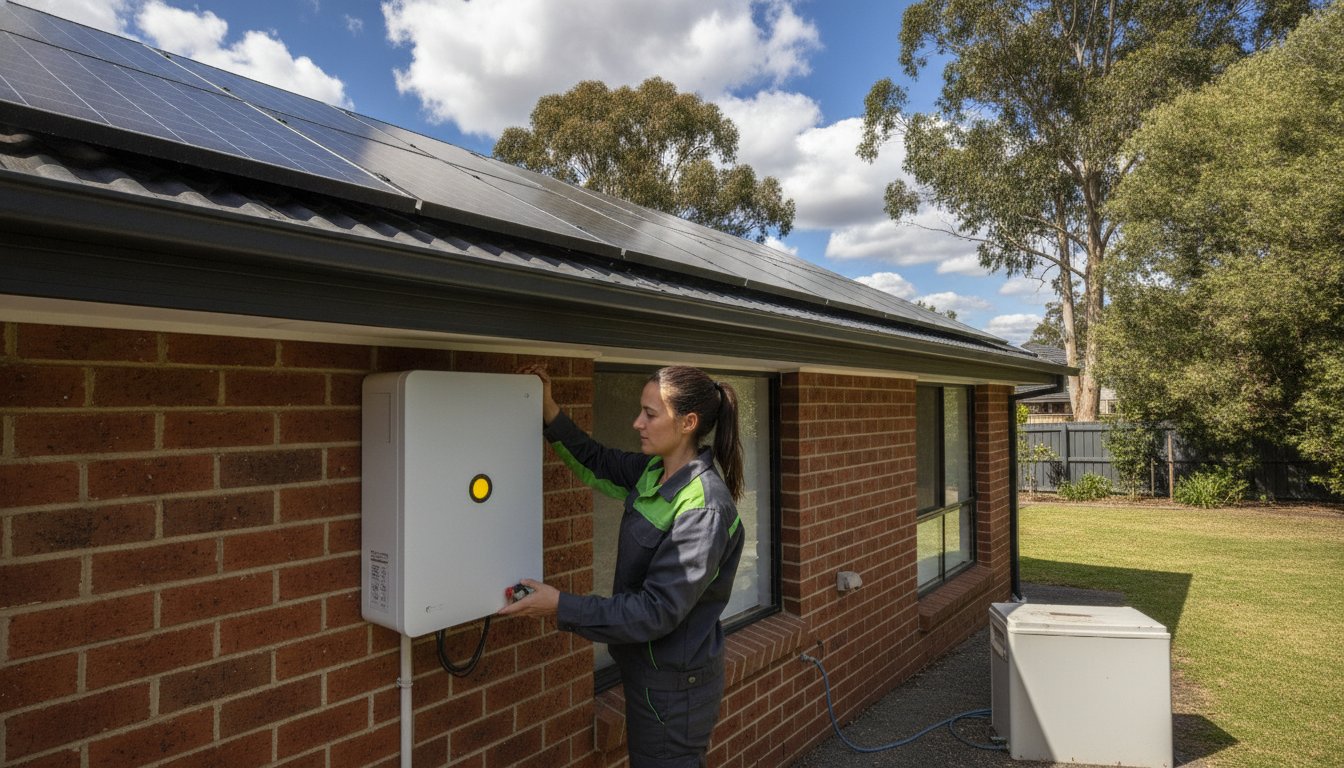
Is your solar battery a high-performance asset or just an expensive wall ornament? You’ve likely noticed your electricity bills creeping up despite the panels on your roof. It’s frustrating to invest in renewable energy only to find yourself reliant on the grid during a sudden Melbourne storm. Understanding exactly when to replace solar battery systems is no longer about guesswork; it’s a strategic move to protect your home against evolving peak demand tariffs. You’re likely feeling the pressure of rising costs and confusion over whether your battery’s actual lifespan matches its warranty.
We’ll help you identify the critical warning signs of a failing unit so you can regain total energy independence. You’ll get a clear yes or no framework for making the switch and a professional perspective on modern battery ROI. We also break down the latest federal incentives, such as the Cheaper Home Batteries Program, which currently offers approximately $252 per usable kWh for standard systems. Stop wondering if your hardware is underperforming and start optimising your home’s power with the latest intelligent, VPP-capable technology.
Key Takeaways
- Identify the technical “End of Life” threshold for your storage and how Melbourne’s temperature swings accelerate lithium-ion degradation.
- Spot the five critical performance red flags, including rapid discharge and peak-hour grid reliance, to determine exactly when to replace solar battery systems.
- Understand the financial impact of the 2026 Transitional Demand Tariff and why keeping an underperforming battery is costing you more than an upgrade.
- Compare 2026 LiFePO4 technology against legacy standards to see how modular, high-efficiency systems provide superior safety and long-term reliability.
- Learn how to secure a comprehensive “System Health Check” to verify your actual energy needs before committing to a modern storage solution.
Understanding Solar Battery Lifespan in the Australian Climate
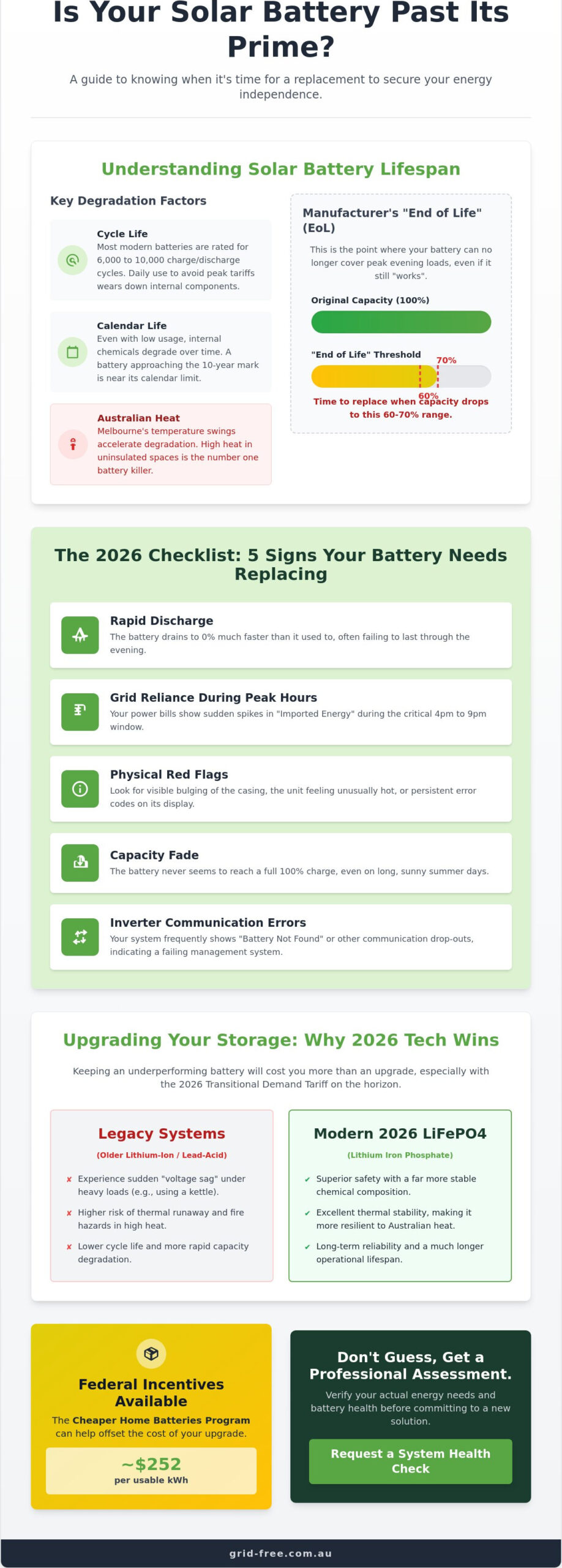
Your solar battery isn’t a “set and forget” appliance. It’s a hard-working chemical engine. In the volatile Australian climate, performance doesn’t just gradually fade; it can drop off a cliff. Most manufacturers define “End of Life” (EoL) when a unit’s capacity hits 60% to 70% of its original rating. At this point, the battery still functions, but it no longer stores enough energy to cover your evening peak loads. This capacity threshold is the definitive signal for when to replace solar battery systems to maintain your energy independence. By 2026, the industry has shifted toward LiFePO4 (Lithium Iron Phosphate) as the standard for longevity, offering a much more stable alternative to earlier chemistries.
Cycle Life vs. Calendar Life: What Actually Matters?
Every time you discharge and recharge your system, you consume a “cycle.” Most modern residential units are rated for 6,000 to 10,000 cycles. If you’re cycling your battery daily to avoid high evening tariffs, you’re physically wearing down the internal components. However, calendar life is equally critical. Even if you rarely use the storage, the internal chemicals degrade over time. Understanding how long does solar battery last involves balancing these two factors. If your system is approaching the ten-year mark, it’s likely reaching its calendar limit regardless of how many cycles are left on the counter. Don’t wait for a total blackout to realise your storage has timed out.
The underlying rechargeable battery technology dictates how gracefully your system ages. Older units often experience a sudden “voltage sag” where they appear full but empty within minutes of a heavy load, such as turning on the kettle or air conditioner.
Why Australian Heat is the Number One Battery Killer
Melbourne’s weather is notorious for rapid shifts, and these fluctuations are brutal on lithium-ion chemistry. High ambient temperatures in uninsulated garages accelerate internal resistance and chemical breakdown. When a battery operates in high-heat environments, the degradation process speeds up exponentially. This is particularly dangerous for early-generation lithium or older lead-acid units, which face a higher risk of thermal runaway. Thermal runaway is a self-sustaining cycle where rising internal temperatures cause even more heat, eventually leading to total system failure or fire hazards.
To maximise the life of your replacement, prioritise a location with adequate ventilation. A cramped, dusty corner of a hot garage is a death sentence for sophisticated electronics. When considering when to replace solar battery hardware, evaluate if your current installation site needs a cooling upgrade or a more sheltered position. Modern 2026 LiFePO4 systems are far more resilient, but they still require smart placement to deliver their full decade of promised value.
The 2026 Checklist: 5 Signs Your Solar Battery Needs Replacing
Identifying when to replace solar battery units requires more than a glance at your utility bill. It demands a technical audit of how your storage handles daily loads. Your system is either an asset that shields you from peak tariffs or a liability that leaves you vulnerable to grid fluctuations. Don’t wait for a total blackout to discover your hardware has failed. If you notice any of these five red flags, your energy independence is at risk.
- Rapid Discharge: The battery hits 0% significantly faster than in previous years, often failing before the evening is halfway through.
- Grid Reliance: You see sudden, unexplained spikes in “Imported Energy” during the critical 4pm to 9pm peak window.
- Physical Red Flags: Visible bulging in the casing, unusual heat radiating from the unit, or persistent error codes on the display.
- Inverter Communication Errors: Frequent drop-outs or “Battery Not Found” messages suggest the internal management system is failing.
- Capacity Fade: The unit never reaches a full 100% charge even during peak summer days with maximum solar gain.
Performance Red Flags: The “Peak Hour” Test
Your monitoring app is the most powerful tool for determining when to replace solar battery hardware. Open your data logs and look at your discharge curve between 6pm and 8pm. A healthy battery should maintain a steady, controlled decline. If the curve drops vertically while running standard household appliances, the internal cells can no longer hold a stable voltage. This is often linked to the “Depth of Discharge” (DoD) limit. Older units were frequently pushed to 90% or 100% DoD, which causes rapid chemical exhaustion. Compare your current discharge rates against the solar battery replacement Melbourne benchmarks to see if your system still meets local performance standards.
Physical and Technical Warning Signs
A visual inspection of your storage enclosure can reveal hidden dangers. Look for any signs of corrosion around terminals or warping of the outer shell. If your battery has started making frequent “clicking” sounds or if the cooling fans are running at high speed even in mild weather, the system is under significant internal stress. This often indicates that the internal resistance has increased, forcing the hardware to work harder to deliver less power. While modern home battery systems are designed with robust safety protocols, older units lack these sophisticated protections. Never attempt a DIY internal inspection. If the casing is hot to the touch or smells like ozone, it’s time to request a system audit from a Clean Energy Council accredited professional. Victorian regulations are strict for a reason; safety must always precede savings.
The Financial Logic: Repair, Recycle, or Replace?
A failing storage unit is a financial leak. Many homeowners mistakenly believe that “squeezing another year” out of an old battery saves money. The reality is quite the opposite. By 2026, Victoria’s Transitional Demand Tariff has fundamentally changed the ROI of residential storage. These tariffs penalise households that draw heavy power during peak windows, typically between 3pm and 9pm. If your hardware fails during these hours, you aren’t just paying for standard electricity; you’re paying a premium for peak demand. This makes the decision of when to replace solar battery systems a matter of urgent financial strategy rather than just maintenance.
Safety must also be a primary driver in your financial calculations. Lithium batteries have a finite chemical life. Using a unit beyond its rated cycles increases the risk of internal cell degradation. While modern LiFePO4 systems are exceptionally stable, legacy lithium-ion units from the mid-2010s can become liabilities as they age. Replacing an old unit ensures you aren’t just saving on bills but also protecting your property. When you do upgrade, ensure your old unit is processed through an approved Australian recycling scheme to recover valuable minerals like cobalt and lithium responsibly.
Calculating the Cost of Inefficiency
Old batteries suffer from high internal resistance. This means they “leak” energy during the charging and discharging process. You might generate 10kWh of solar power, but a degraded battery may only return 6kWh of usable electricity. You’re effectively losing 40% of your generated value before you even turn on a light. In Melbourne, where winter solar gain is precious, this level of waste is unacceptable. Compare your current performance against the latest solar battery cost Australia benchmarks to see how much a high-efficiency replacement could save you. Modern systems boast round-trip efficiencies of over 95%, ensuring almost every watt you generate is available for use at night.
Victorian Battery Rebates: Can You Claim Twice?
The incentive landscape in 2026 has shifted. While the original Solar Victoria battery rebate has closed, Victorian residents can now access the federal Cheaper Home Batteries Program. This provides approximately $252 per usable kWh, which can slash thousands off the price of a new 13.5kWh system. Timing is critical here. These federal rebates are scheduled to decrease every six months. Furthermore, if you’re also looking at panel upgrades, the Victorian income threshold for solar panel rebates will drop from $210,000 to $150,000 on July 1, 2026. Applying before this deadline is essential for many households.
Virtual Power Plants (VPPs) offer another layer of subsidy. By joining a VPP with your new replacement battery, you can receive net payments ranging from $720 to $1,500 per year. These payments effectively pay off the unit while your battery supports the grid during peak events. This level of modern financial support is a compelling reason for when to replace solar battery units that are no longer VPP-compatible. Don’t let an obsolete system lock you out of these recurring revenue streams.
Upgrading Your Storage: Why 2026 Tech Beats Your Old System
The technological chasm between 2016 and 2026 is vast. If you’re weighing up when to replace solar battery units installed during the first wave of storage adoption, the performance gap alone provides a compelling argument. Early systems were often bulky, inefficient, and lacked the sophisticated management software required for today’s complex energy market. Modern hardware isn’t just a newer version of the same product; it’s a fundamental reimagining of home energy management. Upgrading allows you to transition from a passive storage tank to an active, intelligent asset that predicts your needs.
Modular design is a standout feature of 2026 systems. Unlike older “all-in-one” units that required a total replacement for any capacity increase, modern solutions allow you to add battery modules as your household grows. This is particularly valuable for Melbourne families planning to add an electric vehicle or induction cooking in the future. For a technical deep dive into these retrofitting options, consult our upgrade existing solar battery guide. This flexibility ensures your investment remains relevant for the next decade.
LiFePO4: The New Standard for Australian Safety
Lithium Iron Phosphate (LiFePO4) has officially superseded traditional lithium-ion chemistries for residential use. This shift is driven by superior thermal stability. Melbourne’s temperature swings can be extreme, and LiFePO4 handles high-heat environments without the risk of oxygen release. These units offer an impressive cycle life, often exceeding 6,000 cycles at 90% depth of discharge, which is double the lifespan of many 2016-era batteries. Because LiFePO4 chemistry is inherently non-combustible, 2026 batteries provide a much higher level of fire resistance than older cobalt-based lithium models. This safety profile is a decisive factor for homeowners deciding when to replace solar battery hardware located near living areas.
Smart Integration and VPP Readiness
Intelligence is the core of 2026 storage. Modern batteries utilise AI-driven software to optimise charging cycles based on real-time weather forecasts. If the system predicts a cloudy afternoon in Melbourne, it will prioritise storing every available watt from the morning sun. This predictive logic is essential for navigating the 2026 Transitional Demand Tariff mentioned earlier. Furthermore, as of May 2026, all new batteries receiving federal rebates must be VPP-capable. This hardware readiness allows you to participate in Virtual Power Plants, where your system supports the grid during peak events in exchange for significant net payments. Older systems lack the high-speed communication protocols needed for these programmes, making them “dumb” assets in a “smart” grid. Ensure your next system uses a hybrid inverter to streamline this integration and maximise your long-term ROI. For a detailed breakdown of real-world returns, our solar battery upgrade Melbourne case study and ROI analysis shows exactly how much Melbourne households are saving after making the switch.
Ready to see how modern storage transforms your home’s efficiency? Book a solar battery upgrade assessment today to secure your energy future.
Next Steps: Securing Your Melbourne Energy Independence
Deciding when to replace solar battery hardware is the first step toward reclaiming your home’s energy efficiency. Awareness of the problem is vital, but technical action is what stops the financial bleed. Your current system is a ticking clock. Every day you rely on a degraded battery is another day you remain exposed to Melbourne’s volatile grid prices and unpredictable weather patterns. Transitioning to a high-performance, 2026-standard storage solution requires a methodical approach to ensure your new investment delivers maximum ROI from day one.
The GridFree Professional Assessment
GridFree Solar provides a comprehensive diagnostic framework to distinguish between simple inverter communication faults and terminal chemical degradation. Not every underperforming system requires a full replacement. Sometimes, a firmware update or a recalibration of the Battery Management System (BMS) can restore functionality. Our specialist team conducts a rigorous “System Health Check” to give you a definitive answer. We analyse your historical discharge data, check for voltage sags under load, and inspect physical connections for signs of high-resistance heat damage.
Our local expertise is particularly critical when navigating the complex Victorian administrative landscape. We understand the nuances of the federal Cheaper Home Batteries Program and the shifting Solar Victoria panel rebate thresholds. We don’t just install hardware; we organise the entire rebate application process to ensure you receive every dollar of government support available. Every installation we perform is carried out by Clean Energy Council (CEC) accredited professionals, ensuring your system exceeds Australian Standards for safety and reliability.
Don’t Wait for a Total System Failure
Proactive replacement is always more cost-effective than an emergency call-out. If you wait until your battery completely dies during a severe Melbourne storm, you lose your primary shield against power outages. Emergency repairs often carry premium labour rates and leave you at the mercy of current stock availability. By acting now, you can strategically select a modular, VPP-capable system that fits your specific energy profile. You also secure current federal rebate rates before they decrease in the next six-month cycle.
A failing battery is a liability that grows more expensive with every billing cycle. Modern LiFePO4 technology offers the peace of mind that legacy systems simply cannot match. Secure your energy future and protect your household from the next peak tariff hike by verifying your system’s performance today. Contact GridFree Solar for a professional battery health check today and ensure your home remains powered, no matter what the grid does.
Take Command of Your Home’s Power
Energy independence is a moving target. You now understand the critical performance thresholds and why modern LiFePO4 technology is the only logical choice for Melbourne’s climate. Knowing exactly when to replace solar battery hardware is the difference between a high-performing asset and a mounting liability. By acting proactively, you secure your home against peak demand tariffs while capitalising on current federal incentives like the Cheaper Home Batteries Program.
GridFree Solar provides the local Melbourne support and service you need to navigate this transition seamlessly. As Clean Energy Council Accredited Installers and specialists in Victorian solar rebates, we ensure your upgrade is safe, compliant, and optimised for maximum ROI. Don’t wait for your storage to fail during the next storm. Upgrade your storage with GridFree Solar – Get a Quote and join the thousands of Victorians already benefiting from intelligent, resilient energy storage. Your path to long-term reliability starts with a single professional assessment.
Frequently Asked Questions
How many years does a whole house solar battery last in Australia?
A whole house solar battery typically lasts between 10 and 15 years in the Australian climate. This lifespan depends heavily on the balance between cycle life and calendar life. High ambient temperatures in Australian garages can accelerate chemical degradation, potentially reducing this window if the unit lacks robust thermal management. Modern LiFePO4 systems are now the industry standard for reaching the upper end of this range.
Is it worth replacing a solar battery that is still 50% functional?
Yes, replacing a battery at 50% capacity is a strategic financial move. Most manufacturers define “End of Life” at 60% to 70% because the unit can no longer sustain a typical household through the evening peak. Operating a severely degraded unit leaves you vulnerable to high peak demand tariffs. The cost of drawing power from the grid during these windows often outweighs the investment in a high-efficiency replacement.
Can I replace just one module in my solar battery bank?
You can only replace a single module if your system utilizes a modern modular architecture. However, mixing a brand new module with aged ones often leads to balancing issues where the older modules limit the performance of the new one. For older, monolithic systems, a full unit replacement is mandatory to ensure technical stability and warranty validity. Professional testing is required to determine if your existing rack supports partial upgrades.
What happens to my old solar battery once it is replaced?
Old batteries are processed through accredited Australian recycling schemes to recover critical minerals like lithium, cobalt, and copper. It is illegal and dangerous to dispose of these units in standard waste. Most professional installers handle the decommissioning and transport to specialised recycling facilities. This ensures that up to 95% of the battery components are repurposed for new manufacturing cycles.
Do I need a new inverter when I replace my solar battery?
You don’t always need a new inverter, but it depends on your specific technical goals. AC-coupled batteries can often be retrofitted to existing solar systems without changing the original inverter. However, if you want to access advanced VPP features or move to a more efficient DC-coupled setup, upgrading to a modern hybrid inverter is usually necessary. A professional audit will identify the most cost-effective path for your hardware.
Are there any government rebates for replacing an old solar battery in Victoria?
Victorian residents can currently access the federal Cheaper Home Batteries Program for battery replacements. As of May 2026, this rebate provides approximately $252 per usable kWh for standard home batteries. This federal incentive has replaced the previous state-level Victorian battery rebate. It is important to note that this rebate amount is scheduled to decrease every six months, making early applications essential for maximum savings.
How can I tell if my solar battery is not holding charge correctly?
Monitor your system’s discharge curve during the 4pm to 9pm peak window to spot charging faults. If the battery percentage drops vertically under light loads or never reaches a full 100% charge even on sunny days, the internal cells are failing. These performance patterns are the primary indicators of when to replace solar battery hardware to maintain your energy independence. Persistent communication errors on your monitoring app also signal internal management failure.
Can a failing solar battery damage my solar panels or inverter?
A failing battery rarely damages solar panels, but it can put significant electrical stress on your inverter. Constant voltage fluctuations and internal resistance spikes force the inverter to work harder to manage the energy flow. This can lead to overheating and premature failure of the inverter’s capacitors. Replacing a degraded battery protects the rest of your solar infrastructure and ensures the entire system operates within its designed safety parameters.