
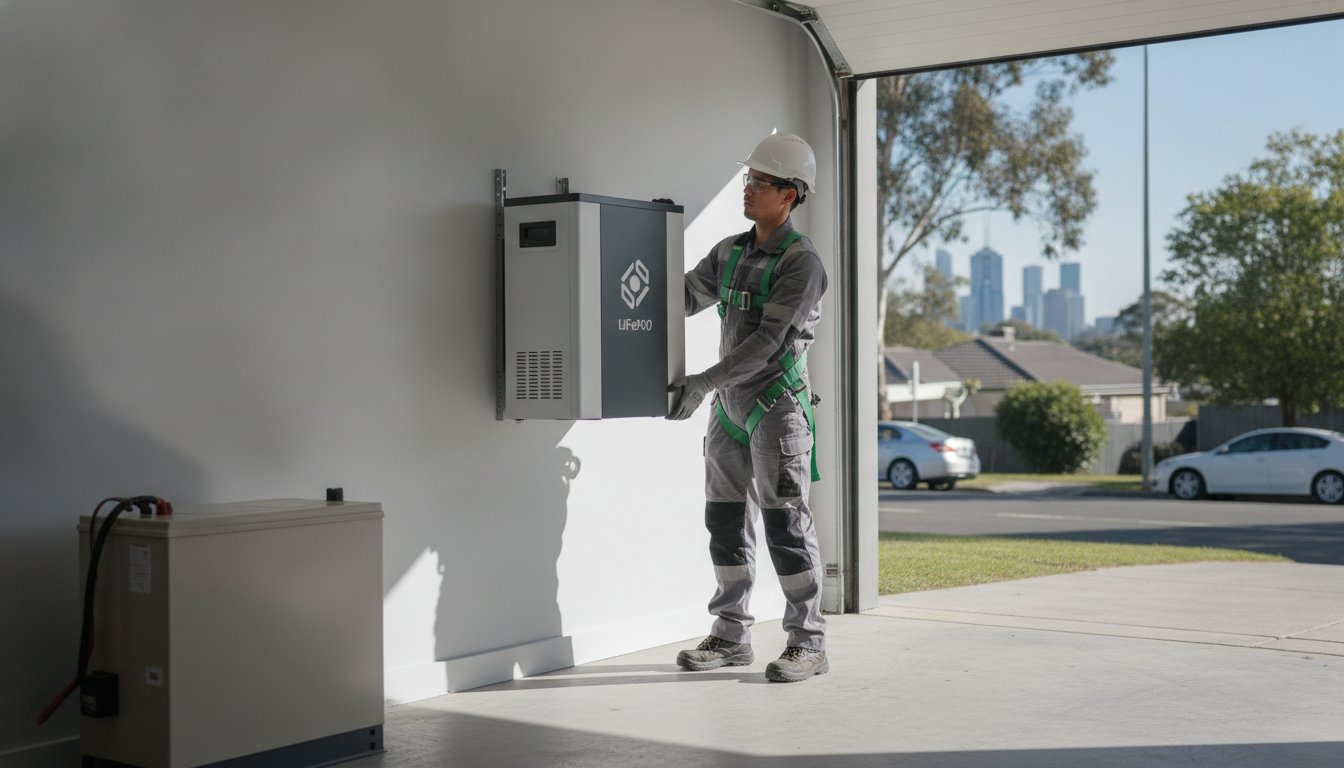
Your 2018 solar battery isn’t just aging; it is actively costing you money every time the sun goes down. While your panels are still performing, that older storage unit likely struggles to bridge the gap between sunset and sleep. You aren’t alone in feeling the pinch. Many Melbourne homeowners now face peak electricity rates as high as 50 cents per kilowatt-hour while their legacy batteries fail to hold a full charge. It is time to reclaim your energy autonomy. You can upgrade existing solar battery systems to modern LiFePO4 technology to restore your backup capacity and slash your power bills.
We understand the hesitation. You don’t want to lose your legacy Feed-in Tariff or get bogged down in the technical confusion of AC versus DC coupling. This 2026 guide simplifies the entire process. We will show you how to navigate the current federal STC discount landscape and access Victorian interest-free loans of up to $8,800. You’ll discover how a strategic hardware refresh can future-proof your home, allow participation in lucrative Virtual Power Plants, and finally achieve the total grid independence you were promised years ago.
Key Takeaways
- Identify the “capacity cliff” affecting batteries installed between 2018 and 2020 and how to restore 100% storage efficiency.
- Navigate the technical requirements of AC versus DC coupling to ensure your new storage integrates perfectly with your current panels.
- Learn the essential steps to upgrade existing solar battery hardware while successfully claiming federal STC discounts and Victorian interest-free loans.
- Maximise your return on investment by transforming passive storage into an active, income-generating asset through Virtual Power Plant (VPP) participation.
- Secure your legacy Feed-in Tariff (FiT) with a professional system audit that ensures compliance with the latest Victorian grid regulations.
Why Upgrade Your Existing Solar Battery in 2026?
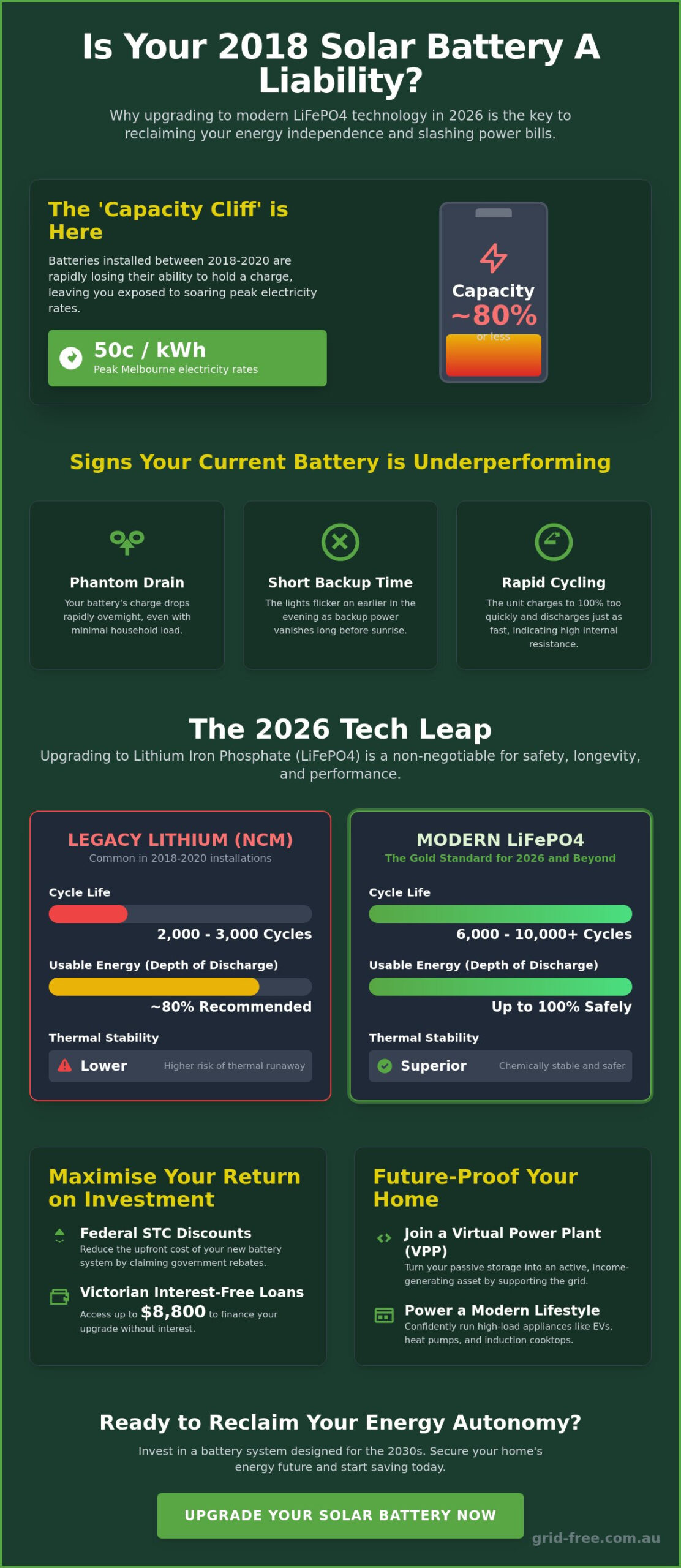
The energy landscape in Melbourne has shifted dramatically since the first wave of home storage hit the market. If you installed your system between 2018 and 2020, you are likely approaching the “capacity cliff.” This is the point where early lithium-ion cells hit their 80% health threshold. Once a battery reaches this stage, degradation accelerates. You notice the lights flickering earlier in the evening. Your backup time vanishes. To upgrade existing solar battery units in 2026 is to move beyond simple hardware replacement; it is a strategic transition to high-density LiFePO4 technology.
Modern home electrification demands more than yesterday’s tech can provide. A legacy 5kWh battery was sufficient when solar was just about offset. In 2026, you are likely balancing induction cooktops, heat pump hot water, and the massive load of an electric vehicle. A degraded battery cannot sustain these high-discharge cycles. Upgrading allows you to increase your usable capacity while ensuring your system is ready for Virtual Power Plant (VPP) participation. This turns your storage from a passive box on the wall into an active, income-generating asset that supports the Victorian grid during peak stress.
Signs Your Current Storage is Underperforming
Don’t wait for a total system failure to take action. Identifying underperformance early saves you from unexpected blackouts and soaring peak-time power bills. Check your monitoring app for “phantom” drain where the state of charge drops rapidly without a corresponding household load. If your battery reaches 100% too quickly and discharges just as fast, the internal resistance has likely spiked. You should learn when to replace solar battery components before a safety fault occurs. Rapid discharge cycles are a clear signal that your storage can no longer handle Melbourne’s 2026 energy requirements. If you’re also evaluating whether your overall solar setup still makes financial sense, understanding when to replace solar battery systems based on rising electricity bills can help you make a more informed decision about your next upgrade.
The 2026 Tech Leap: LiFePO4 vs. Legacy Lithium
The transition to Lithium Iron Phosphate (LiFePO4) is the most significant advancement in residential storage. Early residential units often utilised NCM (Nickel Cobalt Manganese) chemistries. While compact, these cells lack the thermal stability required for long-term reliability in varying Victorian climates. Modern LiFePO4 is the gold standard for safety and cycle life in 2026. Upgrading your battery energy storage system to this chemistry offers several non-negotiable benefits:
- Superior Thermal Stability: LiFePO4 chemistry is significantly less prone to thermal runaway.
- Extended Cycle Life: Expect 6,000 to 10,000 cycles compared to the 2,000 to 3,000 cycles of legacy units.
- Depth of Discharge: Safely use up to 100% of your stored energy without damaging the cells.
When you choose to upgrade existing solar battery setups today, you are investing in a system designed to last well into the 2030s. It’s about securing a reliable energy foundation for a fully electrified home.
Technical Compatibility: Retrofitting New Storage to Old Systems
Technical compatibility is the primary hurdle when you decide to upgrade existing solar battery hardware. The “Inverter Dilemma” is real. Most legacy hybrid inverters were designed for 48V battery architectures. Modern high-performance units often operate at much higher voltages. Trying to force a 2026-spec battery onto a 2018-spec inverter usually leads to communication errors or total system lockouts. It isn’t just about the plug fitting; it is about the digital handshake between the battery management system and the inverter brain.
We often see Melbourne homeowners attempting to “stack” new batteries onto their existing ones to increase capacity. We strongly advise against this. Mixing old and new cells creates a voltage mismatch. Different internal resistances cause the batteries to discharge at uneven rates. This imbalance eventually kills the newer, more expensive unit. For a successful upgrade existing solar battery project, you must choose between a universal retrofit or a total system refresh. Managing these voltage mismatches is critical for system longevity. You need a setup that works in harmony, not a patchwork of competing technologies.
AC-Coupled Upgrades: The Universal Retrofit
AC-coupling is the most reliable path for older Melbourne installations. It allows you to add a new storage unit, such as a Tesla Powerwall, to any existing solar system regardless of the original inverter brand. This method is the safest way to avoid losing legacy Feed-in Tariffs. Because the new battery has its own dedicated internal inverter, it doesn’t require you to modify your existing solar array. You get the benefits of modern storage without the risk of administrative headaches with your energy retailer. It is a plug-and-play solution for the modern era.
The Hybrid Inverter Swap
Sometimes, a clean break is the most financially savvy move. If your current inverter is more than five years old, it likely lacks the smart features required for 2026 energy demands. Swapping to a modern “all-in-one” hybrid solution offers peak efficiency and streamlined monitoring. These systems are VPP-ready out of the box. You can leverage the Victorian solar battery loan program to help finance a total refresh. This approach ensures your monitoring software can “talk” to every component of your system through a single, unified interface. If you’re unsure which path fits your home, request a professional system audit to determine your hardware’s true upgrade potential.
Maximising ROI: Victorian Rebates and VPP Income
Upgrading your energy storage in 2026 is a calculated financial move. The days of relying on a 5-cent Feed-in Tariff (FiT) are over. With Melbourne’s peak electricity rates often hitting 50 cents per kilowatt-hour, every unit of power you export is a missed opportunity. Self-consumption is the new gold standard. By choosing to upgrade existing solar battery capacity, you stop selling cheap power to the grid and start using it to offset your own expensive peak-time usage. The math is simple. Saving 45 cents on a purchased kilowatt-hour is nine times more valuable than earning a 5-cent credit. For a detailed breakdown of real-world savings, see our solar battery upgrade Melbourne 2026 case study and ROI analysis to understand exactly what returns Melbourne homeowners are achieving.
While the direct Solar Victoria battery rebate has concluded, significant financial support remains accessible. Eligible households can still secure an interest-free loan of up to $8,800 through the Solar Victoria battery loan program. This allows you to spread the cost of your upgrade over four years without interest charges. Additionally, the federal Small-scale Technology Certificates (STC) scheme provides an upfront discount on the hardware itself. Combining these incentives drastically reduces the payback period, often bringing it down to between four and seven years for a typical Melbourne home.
Participating in Melbourne Virtual Power Plants
A Virtual Power Plant (VPP) is the most powerful tool for accelerating your ROI. In a VPP, the grid “borrows” small amounts of your stored power during peak demand events in exchange for direct credits or higher export rates. It transforms your battery into a proactive revenue stream. Top-rated Victorian providers in 2026 now offer sophisticated VPP integration that manages these events automatically. You don’t have to lift a finger. Your system simply responds to grid signals, helping to prevent local blackouts while padding your wallet.
Navigating the Feed-in Tariff Trap
The biggest fear for many long-term solar owners is losing their legacy FiT. Adding storage can sometimes be classified as a “system alteration” by distributors like United Energy or Citipower. This is why a professional audit is non-negotiable. When you upgrade existing solar battery systems, you must ensure the total inverter capacity doesn’t exceed the 5kW threshold or whatever limit your specific distributor enforces. We specialise in configurations that add storage capacity without triggering a tariff reset. It is about working within the rules to keep your old benefits while gaining modern efficiency. Consult with a specialist to ensure your local distributor remains happy with your new configuration.
The Step-by-Step Guide to a Seamless Battery Upgrade
Executing a project to upgrade existing solar battery storage requires a methodical, professional approach. It isn’t a simple swap. We begin with a total system audit. Our specialists scrutinise your solar panels, inverter efficiency, and current battery health. We look for hidden degradation that could throttle your new storage. Once the data is in, we define your 2026 energy goals. You might prioritise total backup for Melbourne’s unpredictable storms. Alternatively, you may focus on peak-shaving or VPP participation. This objective dictates whether you need a modular expansion or a total hardware replacement.
Hardware selection is critical. If your current system allows it, modular expansion is a cost-effective way to boost capacity. However, if your existing tech is obsolete, a total replacement ensures you access the full benefits of LiFePO4 chemistry. On installation day, our CEC-accredited installers handle the transition with clinical precision. We minimise your system’s downtime. Once the physical unit is mounted, we move to post-install optimisation. This involves setting up smart-metering and cloud monitoring. You need to see your energy flow in real-time to truly master your savings.
Compliance and Safety Standards (AS/NZS 5139)
Safety regulations have shifted significantly since your original installation. The AS/NZS 5139 standards are now the mandatory benchmark for Victorian homes. When you upgrade existing solar battery units, your new system might require a different physical location to meet fire safety codes. We install specific non-combustible backing and maintain strict clearances from windows and doors. GridFree ensures every Melbourne upgrade meets these 2026 safety requirements. We don’t cut corners on protection.
Optimising Your New Storage for 2026 Rates
Your new battery is only as smart as its configuration. We program “Time of Use” (ToU) charging to fill your storage during cheap off-peak windows. This is essential for navigating Melbourne’s high peak rates. We also integrate your battery with smart appliances and EV chargers. This ensures your self-generated power is used where it provides the most value. Understanding how long does a solar battery last helps you manage these discharge cycles for maximum longevity. Proper optimisation can add years to your system’s functional life. Ready to modernise your home’s energy? Contact GridFree for a professional battery upgrade consultation.
The GridFree Advantage: Expert Battery Upgrades in Melbourne
Navigating the Victorian energy landscape requires more than just technical skill; it demands local precision. Melbourne’s grid requirements are notoriously specific. Whether your property is connected to United Energy, Jemena, or Citipower, the administrative hurdles are significant. GridFree acts as your definitive guide through this complexity. We specialise in the high-stakes environment of 2026 energy demands. Our commitment is simple. We provide a high-impact, assertive service designed to get your system online faster and performing better than the day it was first commissioned.
Our “Future-Proof” guarantee is the cornerstone of our reputation. We refuse to install outdated or inferior chemistries. We only deploy VPP-ready, high-cycle LiFePO4 systems. These units are engineered for the long haul. When you choose to upgrade existing solar battery storage with us, you are investing in hardware that handles 6,000 to 10,000 discharge cycles with ease. We also take the administrative burden off your shoulders. Our team manages the technical compliance and assists with federal STC claim documentation. You get the maximum financial benefit without the headache of government portals and complex technical filings.
Commercial and Residential Expertise
Energy costs are a primary concern for Melbourne businesses looking to slash overheads. We scale our battery solutions to meet the intense demands of commercial operations. A robust battery upgrade can shield your enterprise from peak demand charges that often cripple profitability. You can explore our specialised services for Commercial Solar Installation Melbourne to see how we future-proof local businesses. We have a proven track record of helping residential clients double their storage capacity while protecting their legacy energy contracts. Our dual expertise ensures that your system is sized correctly for your specific load profile.
Start Your Upgrade Journey Today
Stop guessing about your system’s performance. Request a comprehensive “Battery Health Audit” from our professional team today. We perform a deep-dive into your existing inverter communication, cell health, and cable integrity. This data-driven approach allows us to provide a tailored quote that accounts for your existing hardware. We identify exactly what can be salvaged and what must be modernised. Don’t let an aging battery dictate your power bills. It’s time to take control. Join the thousands of Victorians who are already reclaiming their energy independence with a high-performance upgrade existing solar battery solution. Contact us now to secure your audit and start your transition to a smarter, more reliable home.
Secure Your Energy Autonomy Today
The transition from passive storage to an active, income-generating asset is no longer a luxury. It’s a necessity for the 2026 Melbourne home. You’ve seen how early lithium systems are hitting the capacity cliff and why high-density LiFePO4 is the non-negotiable standard for safety and longevity. By choosing to upgrade existing solar battery hardware now, you lock in the benefits of modern efficiency while protecting your legacy Feed-in Tariffs. You aren’t just replacing a battery; you’re future-proofing your lifestyle against rising peak rates.
GridFree delivers the expertise required to navigate this technical shift. As CEC Accredited Installers and specialists in Victorian solar rebates, we ensure your transition is seamless and compliant. We only deploy VPP-ready storage solutions designed to maximise your return on investment through smart grid participation. Don’t let your energy independence fade with an aging system. Take the final step toward a smarter, more resilient home. Upgrade your Melbourne solar battery with GridFree today and reclaim total control over your power bills.
Frequently Asked Questions
Can I add a different brand of battery to my existing solar system?
Yes, you can integrate a different brand of storage using an AC-coupled configuration. This method allows the new battery to operate independently of your existing solar inverter, ensuring there are no communication conflicts between different manufacturers. It is the most flexible way to upgrade existing solar battery setups without being locked into a single ecosystem.
Will upgrading my solar battery cause me to lose my legacy Feed-in Tariff in Victoria?
You can keep your legacy Feed-in Tariff (FiT) if the upgrade is designed as an “add-on” rather than a fundamental system alteration. Using an AC-coupled battery typically avoids triggering a tariff reset because it doesn’t change the capacity of your solar array. We recommend a professional audit to ensure your specific distributor, such as Citipower or United Energy, remains satisfied with the new hardware configuration.
How much does it cost to upgrade an existing solar battery in 2026?
The total investment depends on your required capacity and the complexity of the retrofit. While hardware costs vary, Victorian homeowners can offset the expense by accessing the $8,800 interest-free loan through Solar Victoria. Additionally, the federal STC scheme provides an upfront discount that reduces the out-of-pocket cost for new LiFePO4 hardware. These incentives significantly accelerate your return on investment.
Is it better to add more panels or a bigger battery for better ROI?
In 2026, increasing your battery capacity generally provides a superior ROI compared to adding more panels. With peak electricity rates in Melbourne reaching 50 cents per kilowatt-hour, the financial priority is avoiding grid purchases rather than increasing exports. If your current solar array already generates enough surplus to charge a larger unit, prioritising storage will slash your power bills more effectively than earning a small Feed-in Tariff. You can review real Melbourne household data in our solar battery upgrade Melbourne ROI analysis to see how these numbers play out in practice.
How long does the physical installation of a battery upgrade take?
A standard residential battery upgrade is usually completed within four to six hours. Our CEC-accredited installers manage the entire process in a single day, from mounting the new unit to commissioning the smart monitoring software. Your solar production is only interrupted for a brief window during the final electrical connections, ensuring minimal disruption to your home’s energy supply.
Do I need to replace my inverter if I upgrade my battery?
You don’t need to replace your solar inverter if you choose an AC-coupled upgrade path. The new battery comes with its own internal inverter that works alongside your existing gear. However, if you want a more streamlined DC-coupled system, you will need to swap your old unit for a modern hybrid inverter. This choice depends on the age and health of your current hardware.
What is the best solar battery for Melbourne’s climate in 2026?
Lithium Iron Phosphate (LiFePO4) systems are the non-negotiable standard for Melbourne’s variable climate. These units offer superior thermal stability during extreme Victorian heatwaves and provide a much longer cycle life than older chemistries. When you upgrade existing solar battery storage, ensure the new unit is VPP-capable to take advantage of future income-generating opportunities through the local grid.
Can I claim the Solar Victoria battery rebate for an upgrade or only for new systems?
The direct cash rebate for batteries is currently closed to new applicants, but the interest-free loan remains available for upgrades. Eligible Melbourne households can access up to $8,800 to fund their storage expansion, repayable over four years. This loan can be combined with federal STC discounts to make a high-performance battery upgrade more accessible for homeowners and small businesses alike.