
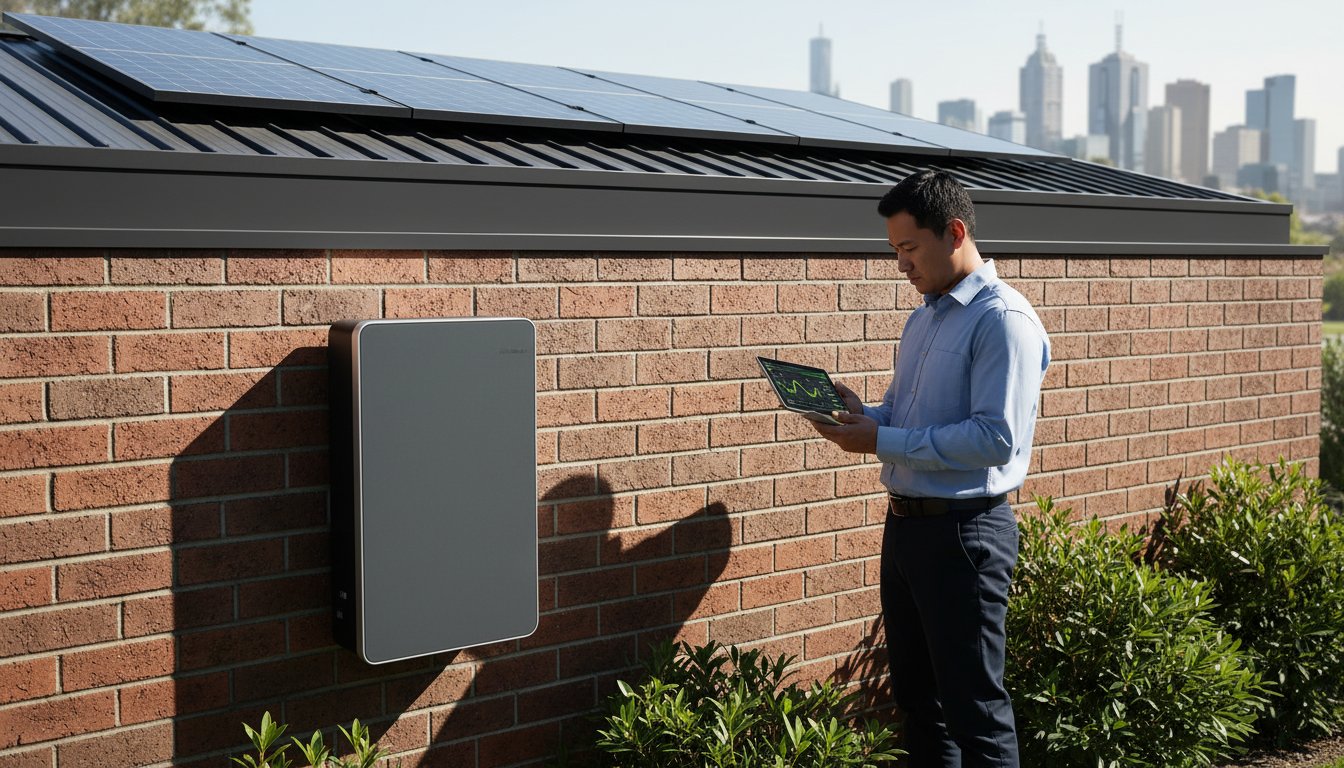
Your solar battery won’t actually “die” the moment its warranty expires. It is a common misconception that keeps Australian homeowners on the fence, fearing a massive replacement bill just as the system begins to pay for itself. You are likely asking how long does solar battery last because you want to ensure your investment survives the harsh local climate while delivering a real return. We understand the hesitation. Between confusing warranty fine print and the unpredictable Melbourne weather, the fear of high replacement costs is a valid concern for any household.
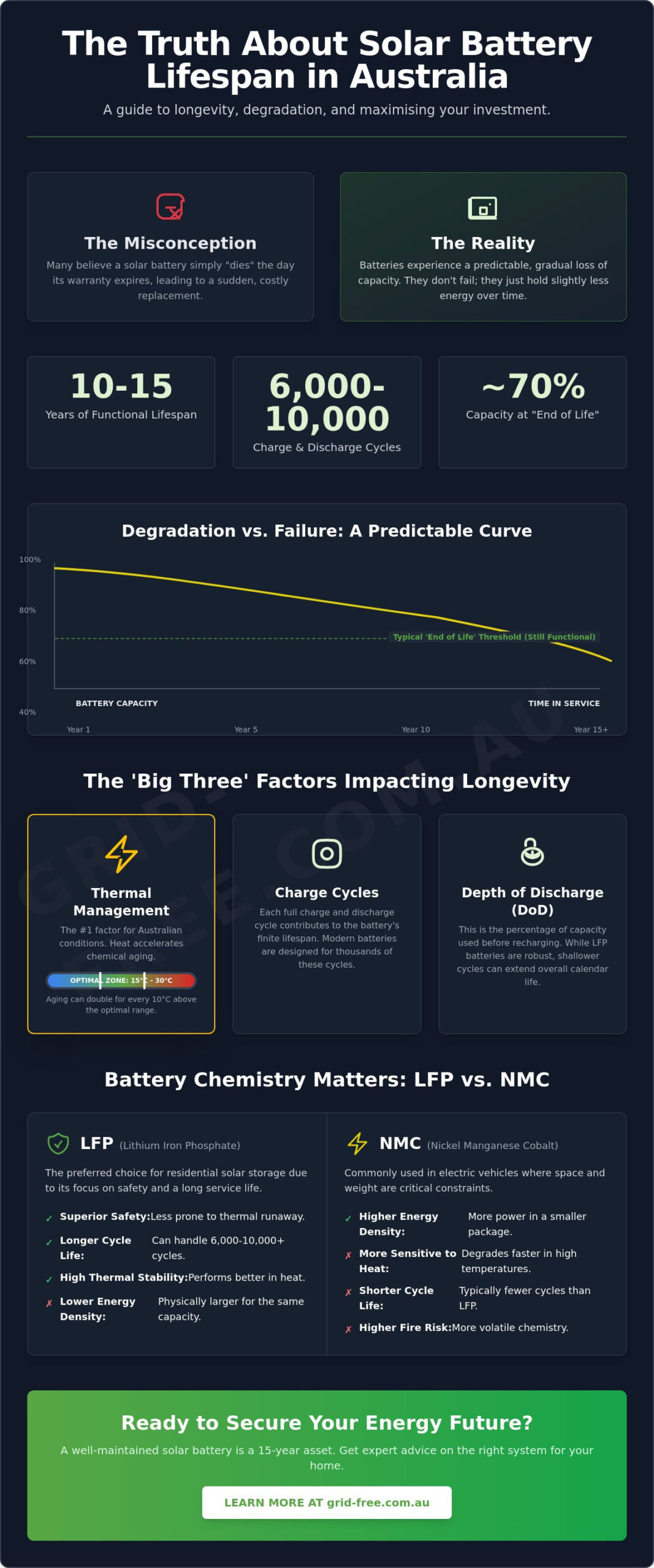
This 2026 guide delivers the hard data you need to move forward with confidence. Most modern Lithium Iron Phosphate (LFP) systems now offer a reliable lifespan of 10 to 15 years, often surviving 6,000 to 10,000 charge cycles before significant degradation occurs. We will break down the reality of capacity loss, explain how to “stack” federal and state rebates to offset costs, and provide actionable tips to extend your hardware’s life. You will learn exactly when a replacement is actually necessary and how to keep your system performing at its peak well into the next decade.
Key Takeaways
- Redefine “End of Life” as a predictable capacity curve. Understand it is a gradual shift in storage rather than a sudden hardware failure.
- Master thermal management. This is the most critical factor for shielding your investment from the unique stresses of Australia’s extreme heat.
- Compare LFP and NMC chemistries to determine how long does solar battery last when safety and high cycle counts are the priority.
- Implement active monitoring strategies. Move beyond “set and forget” to drive your system’s functional life toward 15 years or more.
- Identify the point of diminishing returns. Ensure your battery upgrade integrates perfectly with your current solar array for maximum efficiency.
Defining the Lifespan of a Modern Solar Battery
Your battery won’t simply stop working on its tenth birthday. Unlike traditional appliances that suffer catastrophic failure, solar storage follows a predictable curve of capacity loss. When asking how long does solar battery last, you are really asking when it will stop meeting your specific energy needs. In 2026, high-quality lithium units are engineered for a 15-year functional lifespan. This represents a significant shift from older technologies, providing homeowners with a durable asset rather than a temporary fix. Reliability is the new standard.
Professionals measure longevity through two distinct lenses:
- Calendar Life: The chronological years the unit spends mounted on your wall, regardless of usage.
- Cycle Life: The total number of full discharge and recharge events the cells can handle before reaching “End of Life” (EoL).
We define EoL as the moment a battery’s remaining capacity drops below 60% or 70% of its original rating. It is not a death sentence; it is a performance milestone. Even after passing this point, the system continues to operate. It just holds less energy than the day it was installed. For most Australian households, the transition is seamless and manageable.
Degradation vs. Total Failure
Modern rechargeable battery technology relies on the movement of lithium ions between electrodes. Over time, these chemical reactions cause microscopic changes that reduce the total energy the system can hold. This process is gradual. A battery at 70% capacity is still perfectly functional for many Melbourne households, especially those with modest overnight energy demands. This contrasts sharply with old-school lead-acid batteries. Those units often failed aggressively and required immediate replacement once they began to falter. Lithium is different. It offers a long, useful tail of performance that maximizes your initial investment.
The 10-Year Warranty Benchmark
The standard Australian 10-year warranty is often misunderstood. It doesn’t guarantee the battery will hold 100% of its charge for a decade. Instead, it typically guarantees a 60% to 70% capacity retention over that period. Most manufacturers use a “whichever comes first” clause. This links the warranty to either the chronological age or the total energy throughput. Throughput is the total amount of energy a battery is warranted to move over its life. If you cycle your battery frequently to take advantage of volatile energy prices, you might reach your throughput limit before the ten-year mark. Monitoring your usage ensures you stay within these critical parameters.
The ‘Big Three’ Factors Impacting Australian Battery Longevity
Understanding how long does solar battery last requires looking beyond the spec sheet. While manufacturers provide laboratory estimates, three real-world variables dictate the actual lifespan of your system: heat, cycle frequency, and depth of discharge. In the Australian context, these factors are not equal. Our climate makes thermal management the absolute priority for protecting your investment.
Batteries thrive in a “Goldilocks zone.” Ideally, they should operate between 15°C and 30°C. Straying outside this window triggers chemical stress. According to a National Renewable Energy Laboratory (NREL) study, consistent exposure to high temperatures significantly accelerates the degradation of lithium cells. In fact, for every 10°C increase above the optimal operating temperature, the chemical aging process can nearly double. If your system is working too hard in the heat, it is dying faster.
The Melbourne Temperature Factor
Melbourne presents a unique challenge. The city is famous for “four seasons in one day,” and these rapid temperature shifts put immense pressure on your Battery Management System (BMS). A sudden jump from a cool morning to a 35°C afternoon forces the BMS to work overtime to regulate internal cell temperatures. We often see indoor garage installations outlast units mounted on outdoor, north-facing walls by several years. To prevent “thermal throttling,” never install your battery where it faces direct afternoon sun. Shaded, well-ventilated areas are essential for maintaining peak performance.
Charge Cycles and Depth of Discharge (DoD)
Every time you use your battery, you consume a portion of its finite life. Depth of Discharge (DoD) refers to the percentage of the battery’s capacity used before it starts recharging. Older technologies were fragile, but modern Lithium Iron Phosphate (LFP) batteries are robust. They typically allow for a 90% to 100% DoD without the aggressive damage seen in previous generations. However, high-intensity usage still has a cost. If you are running multiple full cycles per day to combat peak energy prices, you are trading cycle life for immediate savings. Balancing these needs is key to a long-lasting solar and battery installation that pays for itself many times over.
While deep cycles are now safer, “shallow” cycles remain the gentlest way to treat your cells. Keeping your discharge levels between 20% and 80% can theoretically extend the total number of cycles available. It is about smart optimisation. By managing how hard your battery works during those scorching Victorian summers, you ensure the hardware remains an asset for the full 15-year target.
Battery Chemistry: LFP vs. NMC Lifespan Comparison
Chemistry dictates destiny. Your battery’s internal composition determines exactly how many years of value you will extract from your investment. When homeowners ask how long does solar battery last, they are often comparing Lithium Iron Phosphate (LFP) and Nickel Manganese Cobalt (NMC). In 2026, LFP has emerged as the definitive leader for Australian residential storage. It offers a massive cycle life, frequently exceeding 6,000 full charge-discharge events. In contrast, NMC units typically provide between 3,000 and 4,000 cycles before performance degrades significantly. This disparity is not just technical; it is financial. A system that lasts twice as long delivers twice the opportunity for savings.
Selecting the right chemistry is a critical step in your energy journey. Consulting the Australian Government’s Solar Consumer Guide confirms that understanding these variations is essential for long-term ROI. While NMC provides high energy density in a compact frame, LFP provides the endurance needed for the long haul. A battery rated for 6,000 cycles can theoretically operate for over 16 years if cycled once per day. An NMC battery at 3,000 cycles may struggle to reach the decade mark under identical conditions. This gap represents the difference between a system that pays for itself and one that requires replacement just as it reaches the break-even point.
Why LiFePO4 (LFP) is Winning the Longevity Race
LFP batteries are incredibly stable. Their chemical structure remains resilient even when ambient temperatures climb, making them perfectly suited for the Australian sun. This inherent stability prevents the rapid degradation that plagues less robust chemistries. High thermal resistance means the battery management system (BMS) doesn’t have to work as hard to maintain safety. This reliability is exactly why LFP is the preferred choice for solar battery replacement Melbourne projects. Beyond longevity, LFP offers a significantly lower fire risk. It is a safer, smarter, and more durable solution for the modern family home.
NMC Batteries: Performance vs. Cycle Life
NMC technology is not obsolete, but its role is becoming more specialised. Major brands, including older Tesla Powerwall models, utilised NMC to achieve a slim, lightweight design with high power output. The trade-off is clear. You get more power in a smaller box, but you sacrifice total cycle life. NMC remains a viable choice for installations with extreme space constraints where a larger LFP unit simply won’t fit. However, you must accept the reality that these cells will likely reach their “End of Life” milestone sooner. It is a calculated compromise of space over time. For most households, the longevity of LFP far outweighs the footprint benefits of NMC. If your existing NMC system is already showing signs of age, exploring how to upgrade your existing solar battery to modern LiFePO4 technology can restore your backup capacity and significantly reduce your power bills.
Maximising Your ROI: How to Make Your Battery Last 15+ Years
Ownership is not a passive experience. While modern systems are highly automated, your actions directly influence the final answer to how long does solar battery last. Transitioning from a “set and forget” mindset to a “set and monitor” approach is the most effective way to protect your investment. Smart charging is a vital tool here. Keeping a lithium battery at a 100% state of charge for extended periods creates unnecessary chemical stress. By using intelligent software to manage discharge levels during periods of low benefit, you keep the cells in their optimal health zone. Regular firmware updates are equally critical. Manufacturers frequently release patches that refine thermal management and charging algorithms. Skipping these updates is like ignoring a software patch on your smartphone; it leaves performance on the table.
To ensure your home’s electrical infrastructure is as durable as your storage system, you can check out Armour Corporation for their specialist electrical engineering and contracting services.
Optimal Installation Locations in Victorian Homes
Location dictates longevity. In Victoria, the environmental placement of your unit can add or subtract years from its functional life. An insulated garage is the gold standard. It provides a stable ambient temperature and shields the hardware from the elements. If a garage is not an option, a south-facing shaded wall is a strong alternative. You must avoid unshaded walls at all costs. Direct solar radiation causes internal temperatures to spike, forcing cooling fans to run at maximum capacity. Dust and debris are the silent killers of these fans. Ensure your installation environment meets these criteria:
- Clearance: Maintain at least 300mm of open space around all vents.
- Ventilation: Ensure constant airflow to prevent heat pockets.
- Cleanliness: Keep the area free of cobwebs and leaf litter that can clog intakes.
Smart Software and VPP Participation
Virtual Power Plants (VPPs) are the future of the Australian grid. By 2026, incentives in states like New South Wales and South Australia have made participation highly lucrative. However, joining a VPP changes the wear profile of your cells. These programs often require more frequent cycling to support the grid during peak demand. This increased activity can slightly reduce total calendar life, but the trade-off is often worth it. The income generated from VPP credits typically outweighs the cost of earlier degradation. The key is using advanced software to set “reserve” limits. This ensures the VPP operator never drains your battery to a level that compromises your household security or cell health. If you want to maximise your returns, speak to us about a professional solar and battery installation that balances grid participation with hardware protection.
When to Replace or Upgrade Your Storage System
Identifying the point of diminishing returns is vital for your financial security. You shouldn’t wait for your system to stop working entirely before considering an upgrade. The technology has moved fast. 2026 hardware offers massive efficiency gains over 2016 models. Newer units manage heat better and communicate more effectively with the grid. If your current storage is over 8 years old, it’s time for a professional health check. Upgrading doesn’t always mean starting from scratch. Modern batteries often integrate seamlessly with your existing solar array, allowing for a targeted performance boost without replacing every component.
Understanding how long does solar battery last helps you spot the moment your ROI begins to stall. An aging battery becomes a liability when it no longer covers your peak evening loads. If you notice your system is struggling to reach a full charge even on sunny days, the internal chemistry is likely failing. Don’t ignore these early warning signs. Knowing when to replace your solar battery before total failure ensures you never lose the benefit of your solar generation and allows you to take full advantage of current federal incentives like the Cheaper Home Batteries Program. Our comprehensive 2026 guide to upgrading your existing solar battery walks you through how to navigate the current federal STC discount landscape and access Victorian interest-free incentives to make the transition as cost-effective as possible.
Signs Your Battery is ‘End-of-Life’
Watch for specific symptoms of failure. Rapid percentage drops are a clear indicator of cell degradation. If your battery falls from 40% to 10% in minutes, the internal resistance is too high. You might also experience “Phantom Drain.” This occurs when the battery loses significant charge overnight while your home is under minimal load. It’s a sign of internal leakage. Check your monitoring app for “Internal Resistance” warnings. Unexpected shut-offs during high-discharge events, like using a kettle or dryer, suggest the unit can no longer handle the current. These are not minor glitches. They are signals that your storage is no longer fit for purpose.
If these glitches lead to broader electrical faults, it is important to consult a professional. For those seeking reliable maintenance or 24/7 support, Newcastle Emergency Electrical offers the expert assistance needed to keep residential systems functioning correctly.
Navigating Victorian Battery Rebates for Upgrades
Modernising your home is more affordable than you think. Solar Victoria frequently offers specific incentives for battery storage, making the transition to new hardware financially attractive. A professional solar battery replacement Melbourne assessment can determine if you are eligible for current 2026 incentives. These rebates are designed to keep the Victorian grid stable by encouraging the adoption of high-efficiency storage. Don’t settle for a degraded system that leaves you reliant on expensive grid power. Take action now. Secure a professional assessment to verify your system’s health and explore the latest rebate-eligible solutions available in your region.
Future-Proof Your Home Energy Storage
The data is clear. Determining how long does solar battery last is no longer a guessing game of warranty myths. By prioritising Lithium Iron Phosphate (LFP) chemistry and implementing smart thermal management, you can realistically expect 10 to 15 years of high-performance service. Your battery is a sophisticated asset that requires professional oversight to maintain its peak return on investment. Don’t let your savings degrade alongside your hardware. Secure the full potential of your system with expert guidance.
Our team of CEC Accredited Installers are specialists in Victorian solar rebates and understand the unique demands of the Melbourne climate. We provide the local support you need to ensure your system remains an efficient powerhouse. Whether you are ready for an upgrade or simply need a professional assessment of your current cells, we are here to guide you toward the most intelligent energy solutions. We take the complexity out of the process, ensuring you stay ahead of the curve.
Book a Battery Health Check with GridFree Solar Melbourne today to secure your energy independence. Our local Melbourne support team is ready to help you optimise your storage and maximise every kilowatt. Take the next step toward a more resilient, cost-effective home today.
Frequently Asked Questions
How many years does a Tesla Powerwall actually last?
A Tesla Powerwall is warranted for 10 years and typically delivers a functional lifespan of 10 to 15 years. While the battery continues to operate after a decade, its ability to hold a full charge will gradually decline. Most Victorian homeowners find the system remains economically viable until capacity drops below 70% of its original rating.
Does charging my battery to 100% every day hurt it?
Modern Battery Management Systems (BMS) are designed to handle daily 100% charging without immediate damage. However, keeping cells at maximum voltage for extended periods does create chemical stress. You can improve long-term health by using smart software to limit the charge to 80% during periods when your overnight energy needs are lower.
Can I replace just one faulty module in my solar battery?
Module replacement depends on your specific hardware architecture. Sealed units like the Tesla Powerwall require a complete internal assembly replacement if a fault occurs. Modular systems, such as those from BYD or Sungrow, allow for individual modules to be swapped or added. This modularity is a significant factor when calculating how long does solar battery last in a cost-effective way.
What happens to my solar battery at the end of its life?
Your battery enters a specialised recycling stream where up to 95% of the internal materials are recovered for future use. It won’t suddenly stop working; instead, it will reach a point where it can no longer store enough energy to power your home through the night. Australia has established recycling programs to ensure these components are processed responsibly rather than reaching a landfill.
Is it worth replacing an 8-year-old battery or should I wait for it to fail?
Upgrading an 8-year-old system is often a proactive financial move. 2026 hardware is significantly more efficient than 2018 models and offers better integration with lucrative Virtual Power Plant (VPP) incentives. Replacing the unit before total failure ensures you avoid sudden energy shortfalls and allows you to take advantage of current Victorian battery rebates while they remain available.
How does the Melbourne winter affect battery lifespan?
Melbourne’s winter temperatures reduce the speed of chemical reactions, which can temporarily lower discharge efficiency. While the cold isn’t as damaging as extreme summer heat, it can make the battery feel less responsive on frosty mornings. Installing your system in a protected garage helps maintain a stable internal temperature, ensuring the cells stay within their optimal operating window year-round.
Can a solar battery last 20 years?
A solar battery can technically reach the 20-year mark, but its capacity will likely be less than 50% of its original rating. While modern LFP chemistry is exceptionally durable, the question of how long does solar battery last usually focuses on its period of peak economic performance. Beyond 15 years, the efficiency loss typically makes a modern, high-capacity upgrade the more financially sound decision.