
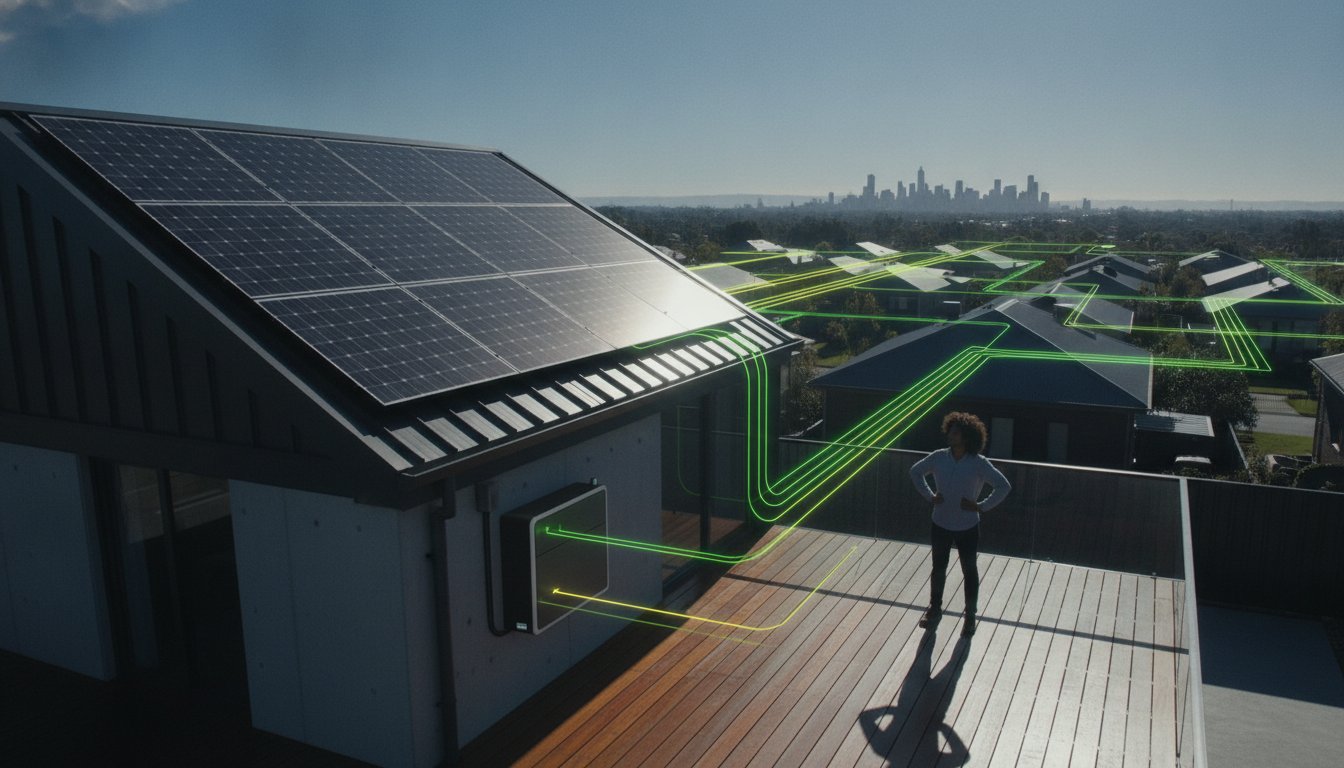
In 2026, a home solar battery without orchestration is a stranded asset. You’ve likely watched Victorian feed-in tariffs plummet toward record lows while your quarterly electricity bills continue to climb. It’s a frustrating paradox for Melbourne households that invested in solar for genuine independence. Joining a virtual power plant Victoria program changes the financial logic of your energy investment. It transforms your stationary battery into a high-performance energy hub that works for you.
We’ll show you how to trade your stored power for premium credits and drive your electricity costs down to near-zero. This guide provides the definitive roadmap to navigating the 2026 VPP landscape. We address the critical concerns around battery wear and complex exit fees with professional precision. You’ll learn how to support Victorian grid stability while securing the highest possible ROI for your hardware. Stop settling for the crumbs offered by traditional retailers. It’s time to leverage intelligent technology to master your home’s energy economy.
Key Takeaways
- Stop letting your stored energy sit idle. Orchestration transforms your battery from a simple backup into a high-yield financial asset.
- Discover why joining a virtual power plant Victoria in 2026 delivers significantly higher returns than traditional, declining feed-in tariffs.
- Master the technical side of discharge events. Learn how AI manages your supply to protect your home while earning you premium event-based credits.
- Identify the gold standard in VPP contracts. We explain why flexibility and no-lock-in clauses are essential for maintaining your energy independence.
- Ensure your hardware is compliant. Only specific smart inverters and VPP-ready systems can access these premium Victorian energy markets.
Understanding the Virtual Power Plant (VPP) Landscape in Victoria
Victoria is the epicentre of Australia’s energy transition. In 2026, the traditional model of passive solar consumption is obsolete. A virtual power plant Victoria network functions as a sophisticated, decentralised power station. It links thousands of individual home batteries via a central orchestrator to provide massive, on-demand energy capacity. This isn’t just about storage. It’s about active market participation. Your battery becomes a dynamic asset that responds to grid signals in real time.
The 2026 landscape is defined by the rapid phase-out of coal-fired power. As Victoria’s ageing thermal generators exit the market, the grid faces unprecedented volatility. VPPs fill this gap instantly. They offer the frequency control and peak-shaving services that massive coal plants once provided, but with far greater precision. Homeowners are no longer just consumers; they are the new backbone of the Victorian grid.
VPP vs. Traditional Solar: The ROI Shift
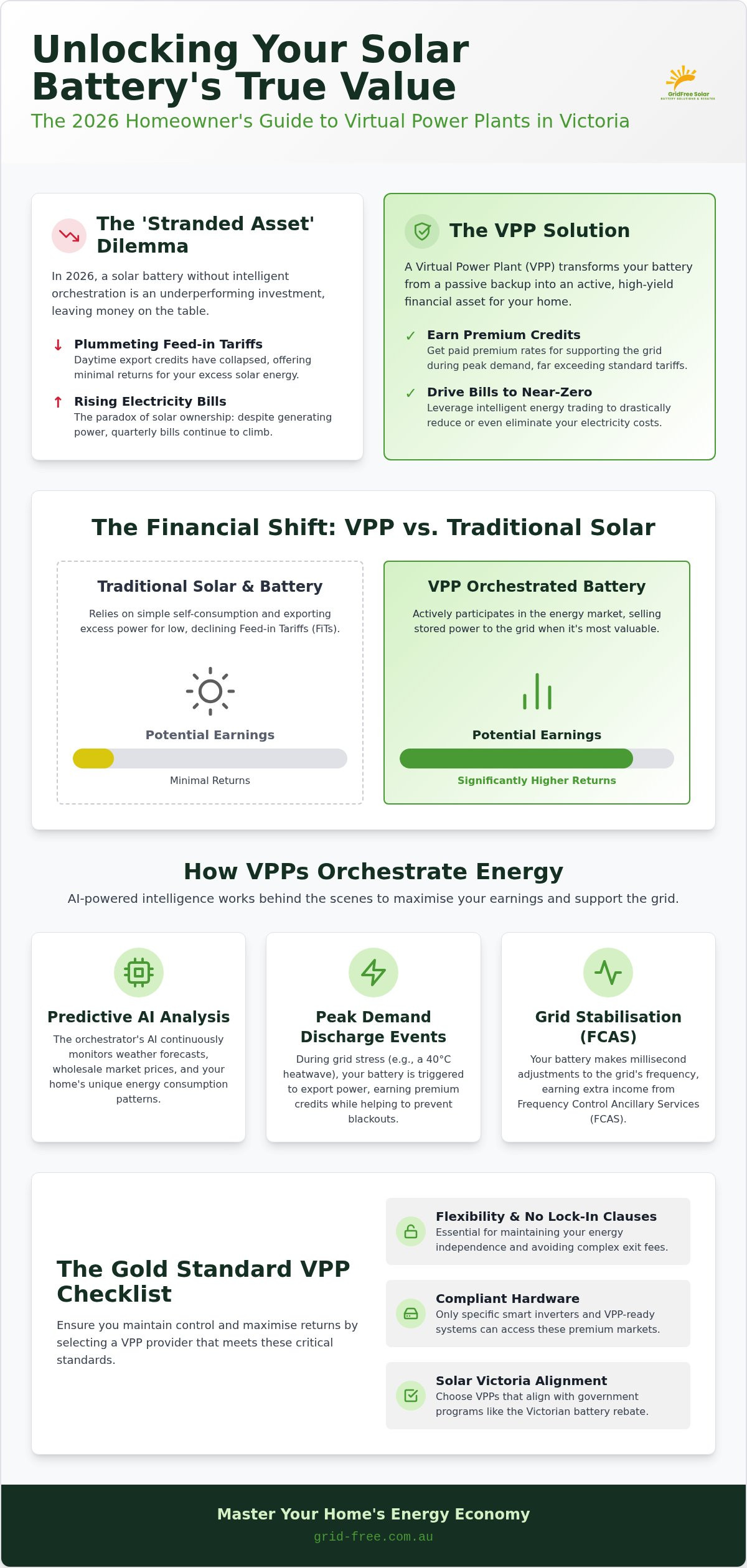
Standard feed-in tariffs (FiTs) have collapsed across the state. Homeowners who once relied on generous 10-cent or 12-cent credits now face a market where daytime exports are worth almost nothing. A VPP bypasses this race to the bottom. It offers a second income by paying you for the service your battery provides, not just the energy it exports. This shifts the financial focus from simple self-consumption to strategic grid support.
A VPP is a cloud-based utility that pays you for your battery’s flexibility.
By joining a network, you access wholesale market volatility that was previously reserved for major energy retailers. When prices spike during a Melbourne heatwave, your orchestrator discharges your stored energy at a premium. You earn credits that far exceed standard solar exports while keeping your home powered.
The Role of Solar Victoria and Government Support
The state government has shifted its strategy to match this technological evolution. Solar Victoria now prioritises infrastructure that supports grid stability through smart orchestration. This is a central component of the Victorian battery rebate 2024 to 2026, which incentivises the installation of VPP-ready hardware. The program is designed to lower the entry barrier for households willing to participate in these advanced networks.
The Solar Homes Program currently favours batteries that meet strict communication standards. To qualify for maximum support, your system must be capable of remote orchestration. This ensures that every subsidised battery contributes to a more resilient, decentralised energy future for all Victorians. Professional installation remains a non-negotiable requirement to ensure these high-tech systems integrate seamlessly with the orchestrator’s cloud platform.
How VPPs Orchestrate Victorian Energy: The Technical Breakdown
The intelligence behind a virtual power plant Victoria is predictive, not reactive. AI does the heavy lifting. The software monitors weather forecasts, wholesale price fluctuations, and your historical consumption to decide when to hold energy or sell it. This orchestration ensures that the grid remains stable without you lifting a finger. It’s a sophisticated dance of data that happens in milliseconds, turning thousands of separate batteries into a single, cohesive power station.
Discharge events are the most visible part of this process. When the grid faces extreme stress, such as during a 40-degree Melbourne heatwave, the orchestrator triggers a collective export. Your battery discharges into the grid precisely when demand is at its peak. This helps prevent blackouts and reduces the need for expensive, high-emission gas peaking plants. Participation in these events is where the financial rewards are most concentrated.
Frequency Control Ancillary Services (FCAS) represent the hidden goldmine of VPP participation. The grid must maintain a precise frequency of 50Hz to function safely. If it dips or spikes, equipment can be damaged. VPPs are paid to provide micro-adjustments to the grid’s frequency. Because batteries can respond in less than a second, they are far more effective at this than traditional coal or gas generators. High-speed, low-latency internet is essential here. A delay of even a few seconds can mean missing out on the most lucrative FCAS credits.
Cloud-Based Intelligence and Your Battery
Your orchestrator continuously analyses your household energy patterns. It learns when you turn on the kettle and when the air conditioning typically kicks in. This ensures the system always reserves enough power for your personal needs before committing to a grid export. Investing in high-performance energy storage solutions in Melbourne is vital because the software requires hardware that can handle frequent, precise cycling without excessive degradation.
Victorian Distribution Networks (DNSPs)
Your location determines which Distribution Network Service Provider (DNSP) manages your poles and wires. Whether you’re on the AusNet, Jemena, United Energy, or CitiPower network affects your technical export capacity. In 2026, dynamic export limits are the new standard. Instead of a fixed 5kW limit, your DNSP can remotely adjust your export capacity based on real-time grid conditions. This allows for higher exports during VPP events when the grid actually needs the extra power. Consulting with a local specialist at GridFree Solar can help you determine which network rules apply to your specific postcode.
The Financial Case: VPP Incentives vs. Traditional Feed-in Tariffs
Passive solar is a financial trap. Standard Victorian feed-in tariffs have stagnated at roughly 5 cents per kilowatt-hour, leaving many households with disappointing returns. Meanwhile, a virtual power plant Victoria allows you to sell that same energy for ten or twenty times the price during critical grid windows. In 2026, sign-on bonuses often range from A$200 to A$500 in upfront credits just for connecting your hardware. This immediate cash injection significantly offsets the initial solar battery cost in Australia, making smart storage a viable financial play for more households.
The real profit lies in event-based payments. When the Australian Energy Market Operator (AEMO) signals a supply crunch, VPP providers pay a premium for your discharge. You’re no longer accepting a pittance for your excess solar; you’re participating in a high-stakes energy market. It’s common to see event credits exceeding A$1.00 per kWh. The math is simple. One hour of VPP participation can earn you more than a full week of standard solar exports during the middle of the day. This is how smart owners reach near-zero bills.
Premium Feed-in Tariffs and Bill Credits
Many Victorian providers now offer ‘hybrid’ billing structures. You might receive a guaranteed daily credit just for being ‘available’ plus a performance-based bonus for every actual discharge event. Some retailers even offer a premium ongoing FiT, such as 10 to 15 cents, as a base rate for VPP members. VPPs can reduce battery payback periods by up to 3 years in Victoria. This accelerated ROI transforms the battery from a luxury backup into a core financial strategy for the modern home.
Hidden Costs and Battery Longevity
Don’t let fears of battery wear stall your progress. Modern lithium-ion units are designed for daily cycling, and the orchestrator manages discharge depth to ensure you remain within warranty specifications. High-quality contracts always include a ‘Backup Reserve’ guarantee. This ensures the software never drains your battery below a set level, usually 20 percent, so you’re never left in the dark during a local blackout. Watch the fine print for exit fees. In 2026, the best Victorian plans offer ‘no lock-in’ terms, giving you the freedom to switch providers if a more lucrative offer emerges.
Selecting Your VPP: A Comparison Framework for Melbourne Households
Choosing the right virtual power plant Victoria partner is a high-stakes decision. It’s the difference between owning a high-yield asset and a restricted battery. You generally face two paths: retailer-led or manufacturer-led programs. Retailers like Origin or AGL focus on bill credits and seamless integration with your existing electricity account. Manufacturer-led programs, such as those from Tesla or Sonnen, often provide deeper technical integration but require specific hardware brands. In 2026, the market is highly competitive. Don’t settle for the first offer that lands in your inbox.
Contract flexibility is your greatest leverage. Avoid long-term lock-ins at all costs. The energy market evolves rapidly; a “no lock-in” clause is the gold standard. It allows you to pivot if a competitor launches a more aggressive credit structure or if your household needs change. Transparency is equally vital. You must be able to see exactly when the orchestrator discharges your battery and the specific credit value earned for that event. If the data is opaque, the profits usually are too. Demand a provider that offers real-time tracking via a mobile app.
Key Criteria for Victorian Homeowners
Before signing any agreement, verify the provider’s credentials. Ensure they are a registered Solar Victoria participant to maintain eligibility for state-based support and rebates. You should also evaluate the ‘Event Frequency’—ask for a historical average of discharge events in your postcode. Too few events mean lower profits, while too many might impact your preferred backup levels. Finally, compare the daily supply charge. Some VPP plans offset their high event credits with higher daily fees, which can erode your net savings.
Top VPP Providers in Victoria for 2026
The Tesla Energy Plan remains a dominant force for Powerwall owners, offering aggressive event pricing and high-authority technical support. Origin Loop has expanded its reach, providing a reliable entry point for those seeking simplicity and consistent bill credits. We’re also seeing a surge in community-based VPPs across regional Victoria, where local networks prioritise regional grid resilience over corporate profit. Your solar panel installation in Melbourne serves as the foundation for these advanced plans. Without high-quality panels and a VPP-ready inverter, you’re locked out of these premium markets. To ensure your system is hardware-ready for the most lucrative programs, contact the specialists at GridFree Solar for a VPP compatibility audit.
Future-Proofing Your Home: Hardware Requirements for VPP Success
Hardware is the foundation of your energy independence. In 2026, a virtual power plant Victoria requires more than just a battery; it demands a sophisticated communication hub. Your system must be “VPP-ready” from day one. This means your inverter must support the IEEE 2030.5 communication standard. This protocol allows the grid orchestrator to send and receive high-speed data packets, ensuring your battery responds to market signals in milliseconds. Without this specific technical compatibility, your hardware remains a silent observer while others profit.
Battery chemistry is equally critical for long-term reliability. VPP participation involves more frequent cycling than traditional solar storage. Lithium Iron Phosphate (LiFePO4) has emerged as the preferred choice for high-orchestration environments. It offers superior thermal stability and a significantly longer cycle life compared to older cobalt-based chemistries. For business owners, a professional commercial solar installation in Melbourne ensures that high-capacity systems are engineered to handle these intense discharge demands without premature degradation.
Upgrading Your Existing System
Don’t assume an older solar setup is a dead end for orchestration. You can add a VPP-ready battery to almost any existing system using “AC Coupling.” This method installs a dedicated battery inverter alongside your current solar inverter, bridging the gap between old and new technology. It’s a seamless way to modernise your home without replacing your entire array. GridFree Solar specialises in high-performance battery replacements. We focus on swapping out underperforming, passive units for intelligent systems that are fully compatible with the latest Victorian orchestration protocols.
The GridFree Advantage for Victorian Residents
We take the administrative burden off your shoulders. Our team helps you navigate the Victorian battery rebate to ensure you maximise your upfront savings on VPP-ready hardware. We refuse to compromise on quality. We only install Tier 1, VPP-compatible components from manufacturers with a proven track record in the harsh Australian climate. This commitment ensures your system remains a high-earning asset for the next decade and beyond. Don’t leave your ROI to chance with inferior tech. Contact GridFree Solar to audit your system for VPP readiness today.
Master the New Victorian Energy Economy
The shift from passive storage to active grid participation isn’t a future possibility; it’s a 2026 reality. You’ve seen how a virtual power plant Victoria network outclasses standard feed-in tariffs by leveraging wholesale market volatility and event-based credits. Success depends on two non-negotiable factors: intelligent orchestration and VPP-ready hardware. By upgrading to systems that meet the latest communication standards, you protect your home while supporting the broader Victorian grid. Stop letting your solar investment sit idle while electricity prices rise.
GridFree Solar stands as Melbourne’s battery upgrade specialist. We take the complexity out of the transition by providing expert Victorian rebate assistance and installing only high-performance, VPP-ready hardware. It’s time to transform your home into a high-earning energy hub. You have the opportunity to lead the transition toward a more resilient, decentralised power system. Take the next step with professional precision and secure your long-term energy ROI.
Get a VPP-Ready Battery Quote from GridFree Solar and secure your energy independence. The power is back in your hands.
Frequently Asked Questions
Is a Virtual Power Plant worth it in Victoria in 2026?
A Virtual Power Plant is highly lucrative in Victoria in 2026 due to the collapse of standard feed-in tariffs. While a traditional export might only earn you 5 cents, a virtual power plant Victoria program allows you to access premium credits during peak demand. These incentives, combined with upfront sign-on bonuses, significantly accelerate the return on your battery investment. It’s the most effective way to reach near-zero electricity bills in the current Melbourne market.
Will joining a VPP void my solar battery warranty?
Joining a reputable VPP won’t void your battery warranty as long as the hardware manufacturer is an authorised partner of the orchestrator. Major brands like Tesla and Sonnen have specific agreements with VPP providers to ensure orchestration remains within safe operating limits. The software manages the depth of discharge and cycle frequency to protect the long-term health of your cells. Always confirm this partnership before signing any contract to ensure your protection remains intact.
How much can I earn from a VPP in Melbourne?
Earnings in Melbourne typically consist of an upfront sign-on credit and ongoing performance-based payments. You can expect upfront bonuses ranging from A$200 to A$500 depending on the provider and your battery capacity. During discharge events, credits often exceed A$1.00 per kilowatt-hour, which is far higher than any standard export rate. Some households also receive a small daily credit just for keeping their battery connected and available to support the grid.
Can I still use my battery during a power outage if I’m in a VPP?
You can absolutely use your battery during a blackout while participating in a VPP. Modern orchestration software includes a “Backup Reserve” feature that ensures a specific percentage of your stored energy is never exported to the grid. You can usually customise this level via your provider’s app. If a local outage occurs, your system automatically switches to backup mode, keeping your essential appliances running using the energy you’ve reserved for your own security.
Which batteries are compatible with Victorian VPP programs?
Compatibility depends on the inverter’s communication protocols and the battery’s chemistry. Systems must generally support the IEEE 2030.5 standard to allow the orchestrator to manage energy flows in real time. Popular choices in Melbourne include the Tesla Powerwall and SonnenBatterie, which are designed for high-cycle VPP environments. If you have an older system, GridFree Solar can help you determine if an AC-coupled battery upgrade can make your home VPP-compatible.
What are the exit fees for VPP contracts in Victoria?
Exit fees vary significantly between Victorian retailers and manufacturer-led programs. Some providers offer “no lock-in” contracts that allow you to leave at any time without financial penalty, which is the preferred option for 2026. Others may require you to pay back a portion of your upfront sign-on bonus if you exit within the first two years. Always review the fine print for “pro-rata” repayment clauses before committing to a specific VPP network.
How does a VPP differ from a standard feed-in tariff?
A standard feed-in tariff is a passive payment for any excess energy you happen to export. In contrast, a virtual power plant Victoria is an active trading system where you’re paid for your battery’s flexibility. Instead of receiving a few cents for midday exports when the grid is flooded, you receive premium dollars for discharging energy exactly when the grid is stressed. This active participation turns your battery into a strategic financial asset rather than just a storage tank.
Do I need a special smart meter to join a VPP in Victoria?
Most Victorian homes already have the necessary smart meter infrastructure, but some VPP programs require additional hardware for high-speed data. Your Distribution Network Service Provider, like United Energy or Citipower, manages the primary meter. However, the VPP orchestrator might install a small “gateway” device to facilitate faster communication between your battery and their cloud platform. This ensures your system can respond to frequency changes and discharge signals within the required milliseconds.