In 2026, a commercial solar installation in Melbourne is no longer a “green” luxury. It’s a hard-nosed financial hedge. While the Victorian Default Offer is expected to see a 6% decrease this July, relying on grid volatility is a gamble your bottom line shouldn’t take. You’re likely tired of unpredictable tariffs and the confusing noise surrounding 2026 rebate eligibility. It’s stressful to weigh the benefits of renewable energy against the fear of operational downtime or industry “cowboys.” We understand that your priority is a high-performing asset, not a technical headache.
This article explores how a strategic commercial solar installation Melbourne can slash your quarterly overheads and secure long-term energy independence. We’ll clarify the latest VEU discounts, which can offer up to A$25,000 for 100kW systems, and outline the path to a 3-5 year payback period. Discover how to navigate DNSP approvals with providers like CitiPower or United Energy and transform your roof into a profit centre. We’ll provide a clear roadmap for a seamless transition to intelligent, localized power that protects your business for the next decade.
Key Takeaways
- Position solar as a high-yield infrastructure asset rather than a simple utility to secure your business against future grid volatility.
- Navigate the complex 2026 incentive landscape, including the STC phase-out and LGC opportunities for systems exceeding 100kW.
- Optimise your financial return by identifying the “sweet spot” system size based on critical 30kW and 99kW Victorian thresholds.
- Ensure a seamless commercial solar installation Melbourne by mastering the mandatory DNSP application process and grid connection requirements.
- Achieve total energy independence and a rapid 3-5 year payback period through advanced, integrated solar and battery solutions.
Commercial Solar in Melbourne: A Strategic Financial Hedge for 2026
Energy isn’t just a utility bill. For savvy Melbourne enterprises, it’s a strategic risk. A commercial solar installation Melbourne is no longer a peripheral sustainability project; it’s a high-yield infrastructure asset. You’re transforming your facility from a passive consumer into a sophisticated energy producer. This shift is essential. Grid reliance has become a fundamental liability for Victorian businesses facing an increasingly complex market. Relying on external retailers means your operating margins are constantly under threat from factors beyond your control.
The “set and forget” approach to energy is dead. In 2026, active energy management is the standard for profitable operations. By generating your own power on-site, you move energy from a volatile variable cost to a controlled, predictable asset. The impact on your OpEx is immediate and profound. Every kilowatt-hour you produce is a direct injection into your bottom-line profitability. It’s a defensive play that pays dividends for decades. You aren’t just saving money; you’re taking command of your facility’s financial future. For those interested in how these principles are applied in other markets, you can visit MarGav Solar to explore their professional solar consultancy services.
Why 2026 is the Critical Year for Solar Adoption
Melbourne’s energy landscape is at a turning point. While the Essential Services Commission has projected a 6% decrease in the Victorian Default Offer for small businesses from July 2026, don’t be lulled into a false sense of security. Wholesale price drops, like the 52.3% decrease seen in April 2026, are often temporary and rarely passed on fully to commercial customers. Victoria’s ambitious renewable energy targets are driving a massive transition. This creates a high “cost of delay” for local firms. The maturity of Solar power in Australia means the hardware is more efficient and reliable than ever. Waiting for better technology is a losing game when you could be harvesting savings today.
From Cost Centre to Revenue Protector
Think of your roof as dormant capital. A professional solar layout turns that dead space into a private power plant. This transition is a key component of modern business continuity planning. Energy independence ensures that your production lines or office hubs aren’t crippled by external market shocks. You’re effectively buying your next 25 years of electricity at a fixed, upfront price. In an inflationary market, solar is the ultimate fixed-cost solution. It stops energy from being a drain on your resources and turns it into a protector of your hard-earned revenue. Secure your power. Protect your profit. Future-proof your operations.
Navigating Victorian Incentives: Rebates, VEU, and Tax Benefits
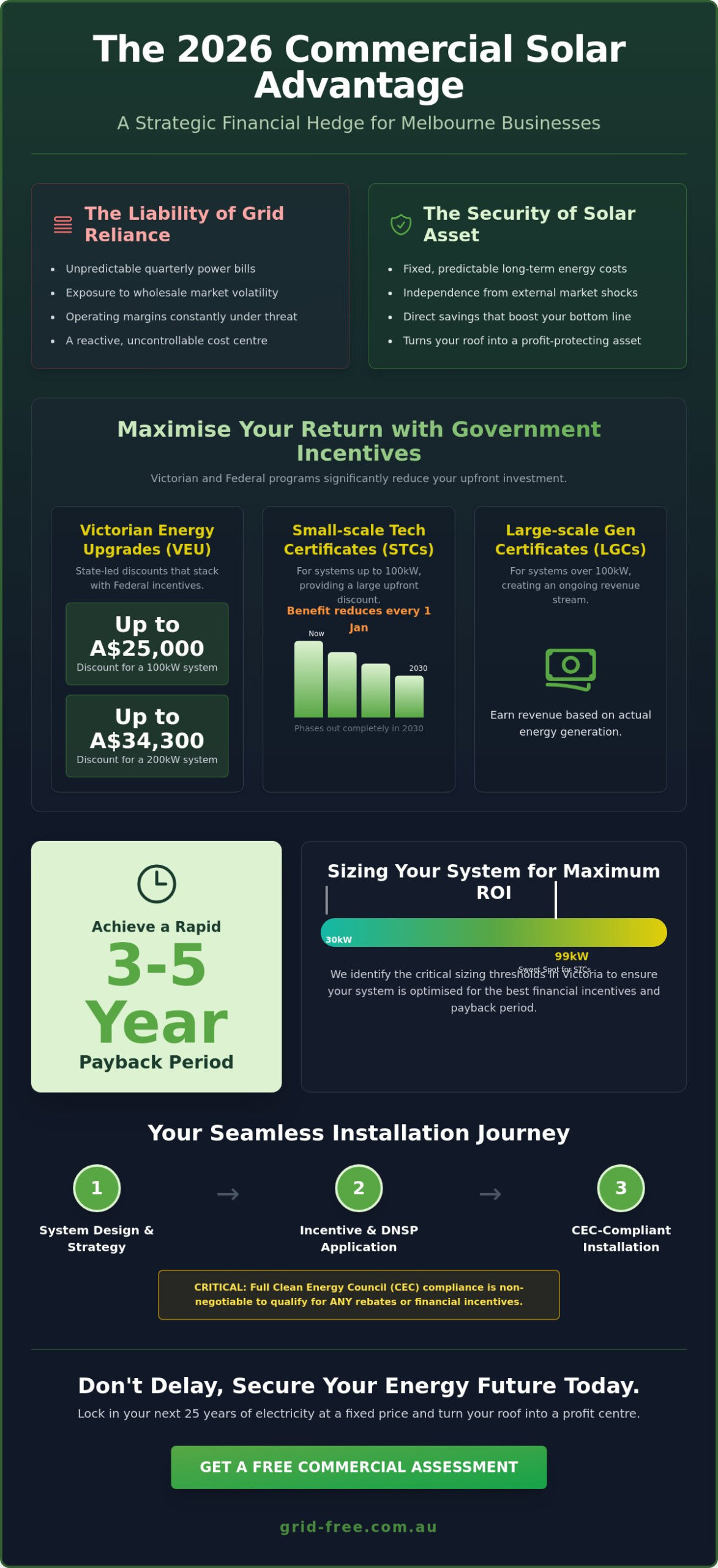
The financial landscape for a commercial solar installation Melbourne is shifting rapidly in 2026. Federal incentives are on a strict annual countdown. The Small-scale Technology Certificate (STC) scheme reduces its benefit every January 1st until it reaches zero in 2030. For systems up to 100kW, this means your upfront discount is significantly higher today than it will be in twelve months. If your project scales beyond 100kW, you move into the Large-scale Generation Certificate (LGC) framework. This creates an ongoing revenue stream based on your actual energy generation. It’s a powerful financial lever for high-consumption industrial sites.
Eligibility for any of these programs hinges on one non-negotiable factor: Clean Energy Council (CEC) approval. Using unapproved components or unqualified installers will instantly disqualify your business from thousands of dollars in rebates. Every panel and inverter must be on the approved list to meet Australian safety and performance standards. We ensure every component is compliant, protecting your eligibility and your investment. You can explore our commercial solar solutions to see how we integrate these incentives into a clear, high-performance ROI model.
Maximising the Victorian Energy Upgrades (VEU) Scheme
Melbourne businesses have a massive local advantage through the VEU program. This state-led initiative provides a substantial Victorian commercial and industrial solar panel (PV) discount that stacks with federal STCs. Since the activity was updated in late 2025, the program offers discounts of up to A$25,000 for a 100kW system and up to A$34,300 for a 200kW system. The process involves creating certificates based on the carbon offset of your installation. This effectively slashes the capital required to get your commercial solar installation Melbourne off the ground, making high-capacity systems more accessible than ever.
Tax Depreciation and Instant Asset Write-Offs
The fiscal benefits extend well beyond the initial purchase price. Under 2026 Australian tax laws, solar hardware remains a highly depreciable asset. Many Victorian businesses leverage accelerated depreciation schedules to offset taxable income and improve cash flow. If capital expenditure is a constraint, “solar-as-a-service” or Power Purchase Agreements (PPAs) allow you to install the hardware with zero initial outlay. You simply pay for the cheaper, renewable power the system generates. While we provide the technical and regulatory framework, you should always verify these structures with your financial advisor to ensure they align with your company’s specific tax strategy. For business owners with broader financial interests, such as those managing foreign income, consulting an advisory firm like Venta Belgarum can ensure your overall strategy maximises both freedom and profitability.
Sizing Your System for ROI: 30kW, 99kW, or Megawatt Scale?
Precision beats scale. Every time. Sizing a commercial solar installation Melbourne requires more than a tape measure and a roof map; it demands a granular analysis of your half-hourly interval data. For many Melbourne SMEs, the “sweet spot” aligns with regulatory and rebate thresholds that dictate the speed of your ROI. A 30kW system is frequently the gateway for small businesses. This is because Victorian DNSPs, such as United Energy or CitiPower, often set a 30kW inverter limit for standard three-phase connections. Staying within this limit simplifies the grid connection process and avoids the need for expensive network studies. If you’re operating a smaller enterprise and want a detailed breakdown of how to leverage state-backed incentives for your specific situation, our guide on solar energy for small business Victoria outlines the exact rebate tiers and payback strategies available in 2026.
Your energy profile is the true architect of your system. Daytime-heavy operations, such as manufacturing plants or professional offices, can often achieve a 3-5 year payback period by matching generation to immediate load. However, if your business runs 24/7, a solar-only setup leaves you exposed to high night-time tariffs. In 2026, integrating commercial solar battery storage into your ROI calculations is essential. It allows you to “peak shave,” using stored energy to avoid high demand charges when the grid is most stressed. By aligning your capacity with Victorian Government commercial solar incentives, you can optimise your upfront costs while securing long-term energy independence.
The 99kW Threshold: Why it Matters for Melbourne Businesses
The 99.9kW mark is the most critical strategic boundary in the Victorian market. Systems just under this 100kW limit qualify for the Small-scale Renewable Energy Scheme, providing upfront STC discounts that can range between A$25,000 and A$32,000 in 2026. Crossing into 100kW or more shifts you into the Large-scale Generation Certificate (LGC) territory. While LGCs provide an ongoing revenue stream, the immediate capital injection of STCs is often more attractive for SME cash flow. You must also consider that many Melbourne DNSPs require sophisticated grid protection or “zero export” devices for systems of this size to maintain network stability.
Industrial Scale: Megawatt Systems and Large-Scale Storage
Manufacturing hubs and large cold-storage facilities in suburbs like Dandenong or Campbellfield require megawatt-scale solutions. These installations transition from a simple rebate model to a sophisticated energy production strategy. Large-scale batteries are revolutionising industrial ROI in Victoria by capturing excess generation that would otherwise be wasted due to export limits. When your system exceeds 100kW, LGCs offer a long-term financial hedge against future price spikes. It’s about turning a heavy industrial load into a controlled, predictable, and high-performing asset that protects your margins for the next 25 years.
The Melbourne Installation Journey: Compliance and Grid Connection
Engineering audits are the non-negotiable foundation of a successful project. A commercial solar installation Melbourne involves adding significant static and dynamic loads to your facility. We conduct rigorous structural assessments and roof integrity checks before a single panel is moved. This prevents long-term structural fatigue and ensures your building insurance remains fully valid. We don’t guess; we calculate. Your facility’s safety depends on this initial technical precision.
Operational disruption is the enemy of productivity. We plan the physical installation in phases to ensure your business remains online throughout the process. Most heavy lifting and electrical cut-overs occur during off-peak hours or carefully scheduled downtime. A typical commercial project takes between two to four weeks depending on the system’s complexity. We manage every logistical variable to keep your staff working while we build your on-site power plant. Efficiency in the office is just as important as efficiency on the roof.
Dealing with Melbourne’s DNSPs: Citipower, United Energy, and AusNet
Your location dictates your network rules. Citipower manages the CBD and inner suburbs. United Energy covers the south-east and Mornington Peninsula. AusNet services the outer east and north. The grid connection application is the primary bottleneck for solar in Victoria. Melbourne’s grid is increasingly crowded. You face a choice between ‘Zero Export’ configurations, where you consume every watt produced, and ‘Negotiated Export’ limits. We handle these complex technical negotiations on your behalf. We fast-track the paperwork to ensure your system isn’t throttled by bureaucratic delays. Talk to our experts about your grid connection today to secure your capacity.
Safety, Compliance, and the 2026 Standards
Compliance is a moving target that requires specialist oversight. All 2026 installations must adhere to the latest AS/NZS 5033 standards for commercial PV arrays. These regulations include specific requirements for DC isolators, fire safety protocols, and system labelling. Independent inspections are mandatory. Every system we deploy is installed by CEC accredited professionals who understand the specific Victorian regulatory landscape. We don’t cut corners because your business reputation is at stake.
Modern systems require more than just a monthly bill check. Real-time data analytics are now the gold standard. You need to see exactly how your asset is performing every minute of the day. Our monitoring solutions provide granular insights into your energy ecosystem. This includes:
- Real-time generation matched against site consumption.
- String-level performance alerts to identify individual panel issues.
- Automated fault detection to prevent unexpected downtime.
- Battery state-of-health tracking for integrated commercial solar installation Melbourne projects.
Why GridFree Solar is Melbourne’s Trusted Commercial Partner
Expertise requires local context. A generic installer cannot navigate the specific voltage fluctuations of Dandenong’s industrial zones or the heritage constraints of the Melbourne CBD. We are specialists in commercial solar installation Melbourne. Our team bridges the gap between complex electrical engineering and commercial financial goals. We don’t just bolt panels to a roof; we build high-performing assets. We understand the Victorian grid because we work within it every day. This localized knowledge ensures your system is compliant, efficient, and optimized for maximum yield from day one.
Reliability is our hallmark. In an industry often clouded by “solar cowboys,” we stand as a definitive leader. We act as your trusted advisor, stripping away the complexity of technical processes to provide a seamless transition to renewable energy. Our approach is assertive and data-backed. We don’t offer vague promises of “savings.” We provide concrete financial projections based on your specific operational profile. You deserve a partner that is both a protective expert and a forward-thinking innovator. We are that partner.
Integrated Solutions: Beyond the Panels
The 2026 gold standard for Victorian business is the Integrated Solar Battery Solution. Solar panels alone are a partial fix; they leave you vulnerable when the sun goes down. By combining Tier-1 panels with advanced battery storage and Virtual Power Plant (VPP) readiness, we ensure you capture every excess watt. This stored energy is your hedge against peak demand charges. It transforms your facility into a smart, self-sustaining energy hub. We only use CEC-approved products. This is a non-negotiable standard that protects your rebate eligibility and ensures long-term hardware reliability. To understand how commercial solar battery storage transforms from a passive backup into a high-yield revenue asset, explore our comprehensive 2026 guide. The GridFree guarantee is built on three pillars:
- Absolute Professionalism: Every installer is a highly trained specialist focused on safety and precision.
- Total Transparency: No hidden costs or technical jargon; just clear, actionable data.
- High-Impact Results: Systems designed for a rapid 3-5 year payback period.
Get Started: Your 2026 Energy Audit
Your journey toward energy independence begins with a site-specific audit. We don’t rely on generic industry averages. Our engineers conduct a deep dive into your interval data, roof structure, and future growth plans. We model your potential ROI using actual Melbourne weather patterns and your specific 2026 tariff structures. This provides a clear, inevitable logic for your investment. You will see exactly how a commercial solar installation Melbourne will protect your margins for the next decade. Stop letting unpredictable energy costs drain your profitability. Book your commercial solar assessment today and secure your business’s financial future.
Command Your Energy Future and Secure Your Margins
Melbourne’s energy landscape is evolving. Grid reliance is a risk you no longer need to take. By integrating high-performance solar with advanced battery storage, you turn a volatile expense into a controlled asset. You’ve seen the power of Victorian incentives and the strategic value of the 99kW threshold. Now is the time to act. A commercial solar installation Melbourne is your definitive hedge against future tariff hikes and market instability.
We simplify the technical complexity of grid connections and rebate applications. As Victorian rebate specialists and CEC Accredited Installers, we provide a Tier-1 component guarantee on every project. Don’t leave your OpEx to chance. Secure your Melbourne business’s energy future with a free commercial audit and see the data for yourself. The path to energy independence is clear. Join the leaders who are already future-proofing their operations and protecting their bottom line for the next decade.
Frequently Asked Questions
How much does a commercial solar installation cost in Melbourne in 2026?
Total investment costs vary based on system capacity, component quality, and site-specific engineering requirements. While we don’t provide fixed pricing without a site audit, Victorian businesses can significantly offset their initial capital through the VEU program and federal STC discounts. As of late 2025, the VEU program offers discounts of up to A$25,000 for a 100kW system, making high-capacity hardware more accessible for local enterprises.
What is the average payback period for commercial solar in Victoria?
Most Melbourne businesses achieve a full return on investment within 3 to 5 years. This rapid payback is driven by high daytime energy consumption and the immediate reduction in quarterly power bills. Even with the projected 6% decrease in the Victorian Default Offer for July 2026, self-generation remains the most effective strategy to lock in long-term energy costs and protect your operating margins.
Do I need council approval for commercial solar panels in Melbourne?
Most commercial solar projects don’t require a planning permit if they meet standard height and placement regulations. However, you may need approval if your building is heritage-listed or if the installation requires significant structural modifications. We recommend verifying requirements with your specific local council, such as the City of Melbourne or United Energy’s service area, during the initial engineering audit phase.
Can my business still get the Victorian solar rebate in 2026?
Yes, the Victorian Energy Upgrades (VEU) program provides substantial upfront discounts for a commercial solar installation Melbourne. This activity was updated in September 2025 to specifically support businesses installing systems between 30kW and 200kW. To remain eligible, your system must use CEC-approved components and be installed by accredited professionals who adhere to the latest Victorian safety and performance standards.
What happens if my business roof is shaded or has limited space?
Shading and limited space require advanced engineering solutions like power optimisers or high-efficiency Tier-1 panels. Optimisers ensure that a single shaded panel doesn’t reduce the output of the entire string, maintaining high performance in complex urban environments. For sites with restricted roof area, we focus on high-density modules that generate more power per square metre to maximise your available footprint.
Is battery storage worth it for Melbourne businesses right now?
Battery storage is a high-value asset for businesses with night-time operations or those facing high peak demand charges. In 2026, batteries allow you to “peak shave” by using stored solar energy during the most expensive grid periods. This integrated approach provides a higher level of energy independence and ensures your facility remains operational during grid instability, making it a critical part of business continuity planning.
What is the difference between STCs and LGCs for my business?
The difference lies in the system size and how the incentive is paid. Small-scale Technology Certificates (STCs) apply to systems under 100kW and provide an immediate upfront discount on your installation cost. Large-scale Generation Certificates (LGCs) apply to systems over 100kW and are generated annually based on your actual energy production. LGCs offer an ongoing revenue stream but require more rigorous administrative reporting. For a comprehensive breakdown of how these certificates apply specifically to smaller Victorian enterprises, our 2026 strategic guide to solar energy for small business Victoria details the exact eligibility criteria and financial outcomes you can expect.
How long does the commercial solar installation process take from start to finish?
The total process typically takes 3 to 4 months, though the physical installation on-site usually only lasts 2 to 4 weeks. The longest phase is securing pre-approval from your Distribution Network Service Provider (DNSP), such as CitiPower or AusNet. We manage this bureaucratic process on your behalf to ensure your grid connection is approved quickly and your business experiences minimal disruption during the transition.