If your household income sits between $150,000 and $210,000, waiting until July 1, 2026, to secure your energy future will cost you exactly $1,400 in lost government rebates. It’s a high-stakes environment where the difference between a high-performing asset and a roof-mounted liability comes down to precise technical execution. You’ve likely felt the anxiety of choosing components that might fail in five years or worrying if your smart inverter is actually cyber-secure. Achieving a professional solar installation Victoria requires more than just mounting hardware; it demands a strategic alignment with the latest 2026 safety and regulatory standards.
We understand that navigating changing Solar Victoria eligibility and the shift from CEC to SAA accreditation feels like a full-time job. This article promises to cut through the noise, giving you the exact blueprint to master the financial and technical requirements of a modern setup. We’ll preview the critical June 30 application deadline, the new 2026 cyber security mandates for smart devices, and the shift toward high-yield self-consumption that defines today’s energy independence.
Key Takeaways
- Secure your $1,400 rebate before the household income threshold drops to $150,000 on July 1, 2026.
- Identify the five hallmarks of a professional solar installation Victoria to protect your home from emerging cyber security threats and hardware failure.
- Learn why Melbourne’s volatile weather requires specific wind-loading assessments and climate-resilient mounting for long-term system stability.
- Shift your focus from simple energy export to intelligent self-consumption to maximise ROI as energy retailers adjust feed-in tariffs.
- Verify your installer’s SAA accreditation and your retailer’s NETCC Approved Seller status to ensure full compliance with the latest safety standards.
The 2026 Landscape of Professional Solar Installation in Victoria
The era of “set and forget” solar is dead. In 2026, a simple array on the roof is no longer enough to claim true energy independence. Victorian households are moving toward sophisticated, integrated ecosystems that do more than just sit in the sun. The growth of Solar power in Australia highlights a clear trend toward these complex, smart-managed systems. A professional solar installation Victoria now includes intelligent software that dictates when your appliances run and how your energy is stored. This shift is directly impacting property values. Homes equipped with integrated management systems are commanding higher premiums in the Melbourne real estate market as buyers prioritise future-proofed energy security.
Passive generation used to be the standard. You’d pump power back to the grid and wait for a credit. That model has collapsed. With energy retailers now setting feed-in tariffs as low as 0.00 c/kWh, exporting energy is a financial loss. Professional installation ensures your system is tuned for maximum self-consumption. It’s about using every kilowatt you produce. This isn’t just a smart financial choice; it’s a requirement for grid-connected stability. High-quality installations are also safer. Independent audits show that unsafe installations in Victoria have plummeted to an average of just 0.2 per cent. This is the result of rigorous professional standards and the move away from cheap, unaccredited components.
Energy Independence in the 2026 Market
Victorian “prosumers” are the new energy leaders. They don’t just consume power; they produce and manage it with precision. Local generation is now a pillar of the state’s grid stability. By generating and storing power exactly where it’s used, we reduce the burden on aging infrastructure. Over 630,000 Victorian households have already made the switch, making 2026 the pivotal year for commercial solar adoption as well. Victorian businesses are realising that energy independence is their best hedge against volatile wholesale prices. They’re following the residential lead, turning commercial rooftops into high-yield power plants that support the entire local community. To see how these systems are implemented at scale across the country, you can visit G-Solar & Electrical to learn more about commercial-grade solar engineering.
The Shift Toward Smart, Integrated Systems
Modern professional solar installation Victoria goes far beyond the inverter. Home Energy Management Systems (HEMS) are now the central brain of the home. Professional installers prioritise hardware that is VPP-ready. This allows your battery to participate in Virtual Power Plants, potentially earning you credits while stabilising the wider grid. We’re seeing a total convergence of energy storage and smart home technology. While the industry adapts to the rise of electric vehicles, the focus remains on creating a cohesive unit that manages your home’s entire energy profile. It’s a seamless transition from old, wasteful methods to an advanced, modern solution.
Defining Professional Standards: More Than Just an Accreditation
Professionalism in the Victorian solar market is no longer defined by a simple badge. It’s a technical discipline. By 2026, the standard for a professional solar installation Victoria has shifted toward rigorous data security and grid-interactive intelligence. Many national volume installers rely on high-turnover models that sacrifice precision for speed. This often leads to failures that manifest just after the five-year mark. A Tier-1 Victorian installer operates differently. They follow a strict 5-point framework: NETCC Approved Seller status, SAA accreditation, adherence to the Solar PV audit checklist version 3.5, local grid expertise, and VPP-ready hardware integration.
Local experience is non-negotiable. Melbourne’s unique grid challenges and micro-climates require specific engineering that national “one-size-fits-all” companies often ignore. A professional installer understands the voltage fluctuations in regional Victoria and the specific wind-loading requirements for bayside properties. To remain eligible for Victorian solar rebates, your system must align with these evolving safety benchmarks. Consulting with a trusted solar advisor ensures your investment meets these high-performance criteria from day one.
Compliance with Solar Victoria’s 2026 Safety Standards
New safety and cybersecurity standards come into effect on July 1, 2026. These rules target smart energy devices to protect the Victorian grid from digital threats. A professional installation now requires smart inverters that meet strict encryption protocols. Technical mentoring is also mandatory. This ensures that every apprentice on-site is supervised by a senior SAA-accredited electrician. Mandatory safety shut-off protocols have been upgraded, ensuring residential systems can be isolated instantly during grid emergencies. These layers of protection turn a standard power system into a secure home asset.
The Role of Quality Components and Warranties
A 25-year panel warranty is now the professional minimum in Victoria. However, you must distinguish between performance and product warranties. A performance warranty only guarantees the panel’s output, while a product warranty covers the physical hardware against defects. Professional installers avoid “grey market” hardware. These are components imported outside official channels that often lack local warranty support. If a manufacturer doesn’t have a physical office in Australia, your warranty is effectively worthless. Demand Tier-1 hardware with proven resilience to the Victorian climate to ensure your ROI remains secure for decades.

Navigating Victorian Solar Rebates and Financial Incentives
Time is running out for higher-income households. If your combined taxable income sits between $150,000 and $210,000, you have until 5 pm on June 30, 2026, to lodge your rebate application. After this deadline, the eligibility ceiling drops to $150,000. This regulatory shift makes a professional solar installation Victoria a time-critical asset for thousands of Melbourne families. Securing your approval now locks in the $1,400 rebate and the optional interest-free loan of up to $1,400. It’s a binary choice: act before July or lose thousands in state-funded support.
Savvy homeowners are now “rebate stacking.” This involves pairing the solar panel rebate with the hot water incentive, which offers up to $1,000 for eligible heat pumps. This can rise to $1,400 if you select locally manufactured products. By coordinating these upgrades, you front-load your savings and drastically reduce the capital required for a complete energy transition. It’s a high-impact strategy that turns a standard roof upgrade into a comprehensive financial win.
Eligibility Criteria for the Solar Homes Program
Eligibility is precise. Your property must be valued below the current government threshold, and you must be the owner-occupier of the residence. For 2026, Solar Victoria has digitised the income verification process, linking directly to ATO records for near-instant assessments. Rental providers and apartment dwellers have unique pathways, with specific incentives designed to encourage landlords to share the benefits of solar with tenants. You must ensure your provider is a Clean Energy Council Approved Solar Retailer. Using an unaccredited retailer or installer will immediately disqualify your application, leaving you to foot the entire bill.
Maximising ROI with Battery Rebates and VPPs
The Victorian state government no longer offers a standalone battery rebate for new applicants. However, the federal “Cheaper Home Batteries Program” has stepped in, providing a 30 per cent discount on upfront battery costs. This incentive is not means-tested. Understanding how the Victorian Battery Rebate landscape has shifted is vital for accurate ROI modelling. Most professional solar installation Victoria projects now feature VPP integration. By joining a Virtual Power Plant, you allow your battery to assist the grid during peak demand. In exchange, you receive passive credits that can shorten your payback period by years. The “real” cost of your system is the net figure after federal discounts, state panel rebates, and these ongoing VPP earnings.
Designing Your System for Long-Term Victoria Climate Resilience
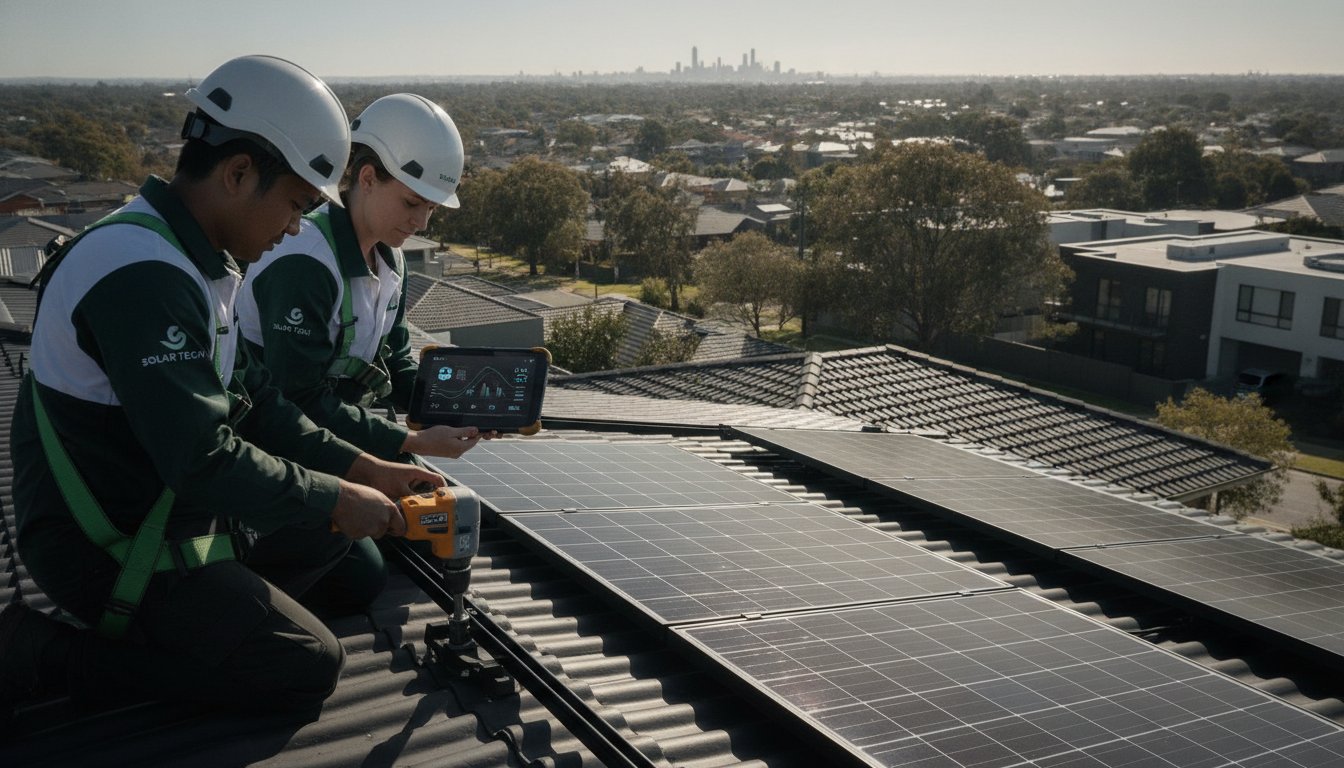
Victoria’s “four seasons in one day” is more than a cliché; it’s a hardware stress test. A professional solar installation Victoria must be engineered for extreme variability. Melbourne experiences significant wind loads, especially in bayside and high-altitude fringe suburbs. Generic mounting systems often fail under these pressures. We prioritise heavy-duty rail systems and reinforced attachment points that exceed Australian Standards. This isn’t just about safety. It’s about ensuring your panels don’t vibrate or micro-crack during a Bass Strait gale. Every component must be selected for its ability to withstand rapid thermal expansion and contraction.
Tilt and orientation are equally critical. Many installers use a “one-size-fits-all” approach that ignores Victorian geography. The sun sits lower in our winter sky compared to northern states. Adjusting the tilt or utilising east-west splits can often yield better results for self-consumption. We design for the specific footprint of your roof. This bespoke approach ensures your system delivers power when you actually need it, not just at solar noon. Ignoring these variables leads to underperformance and a direct hit to your long-term ROI.
Optimising for Victorian Weather Patterns
Established Melbourne suburbs present a unique challenge: deciduous trees. Shade management through micro-inverters or optimisers is essential. Without it, a single stray branch can cripple your entire array’s output. We also account for Victoria’s high UV index. Lower-tier backsheets degrade rapidly under our sun, leading to moisture ingress and system failure. If you live within 5km of the coast, salt-mist corrosion is your primary enemy. Professional standards dictate the use of corrosion-resistant anodised frames and sealed electrical enclosures to prevent premature failure.
Future-Proofing with Battery Storage Upgrades
The energy landscape is moving fast. By 2026, solar battery replacement has become a major focus for early adopters whose first-generation units have reached their cycle limits. If you aren’t ready for storage today, your system must be “battery-ready.” This means installing a hybrid inverter or ensuring there is physical space and electrical capacity for a future AC-coupled unit. It’s a strategic move that saves you thousands in future labour costs.
Scaling your energy footprint requires foresight. Choosing the best solar battery for home Australia in 2026 means evaluating top-performing LFP systems against your specific energy profile and VPP requirements before committing to a purchase. An integrated solar battery solution provides the most efficient conversion rates and the simplest management interface. It’s about building a foundation that grows with your family’s needs. Don’t settle for a system that only works when the sun is out. Request a climate-resilient system design to secure your energy future today.
The GridFree Approach: Victoria’s Choice for Professional Installation
GridFree isn’t just a name; it’s a methodology. We reject the “one-size-fits-all” approach of volume retailers. A professional solar installation Victoria requires a partner who acts as a trusted advisor, not a salesperson. Our Melbourne-based team lives and works in the same suburbs we service. We understand the specific voltage rise issues in established areas like Camberwell and the unique grid constraints of the Mornington Peninsula. We don’t just bolt panels to your roof. We engineer a solution that integrates seamlessly with the local distribution network. It’s a technical discipline that prioritises your long-term security over a quick sale.
We take the administrative weight off your shoulders. The Victorian rebate system is complex, especially with the 2026 income threshold changes. We handle the entire application process for you. From initial quote to final approval, we ensure you don’t miss out on the $1,400 panel rebate or the $1,000 hot water incentive. Our post-install monitoring keeps your system performing at its peak, long after the installers have left. You get a streamlined path to energy independence without the paperwork headaches.
Our Integrated Solar and Battery Design Process
Precision is our baseline. We use data-driven site analysis to model your exact energy consumption against 2026 tariff structures. This allows us to predict your savings with a high degree of accuracy. We don’t guess; we calculate. Your hardware is selected based on your specific energy profile, ensuring every component is ready for the next generation of energy storage. Whether it’s VPP-readiness or smart-home integration, your system is built to lead. This forward-thinking design ensures your investment remains relevant as the Victorian grid evolves.
Local Expertise and Ongoing Support
Service shouldn’t end at the fuse box. A local Melbourne-based service team is essential for long-term reliability. If your system flags an issue, we’re already on it. We provide annual performance health checks and system optimisations to ensure your ROI remains on track. We don’t leave you to deal with overseas call centres. You get direct access to Victorian specialists who know your system inside and out. It’s a proactive approach to maintenance that protects your hardware and your wallet. As part of a state where over 630,000 households have already adopted solar, we’re committed to ensuring your home leads the 2026 transition toward total energy independence with zero compromises on quality.
Secure Your Victorian Energy Future Today
The window for maximum government support is closing fast. With the income threshold for rebates set to drop to $150,000 on July 1, 2026, acting now is a matter of financial precision. You’ve seen how the landscape has shifted from passive generation to active, smart-managed ecosystems. A professional solar installation Victoria is no longer a luxury; it’s a strategic requirement for long-term property value and total energy independence. You need a system that’s VPP-ready and engineered to survive Melbourne’s volatile climate.
Don’t leave your energy security to chance or unaccredited volume installers. We are CEC Accredited Master Installers and specialists in Victorian Solar Homes Program claims. As 2026 VPP-ready hardware specialists, we ensure your system is a high-performing asset, not a liability. We take the complexity out of the technical process, offering you a seamless transition to modern, intelligent power.
Request your professional Victorian solar assessment from GridFree Solar to lock in your rebate eligibility before the June 30 deadline. Take control of your power and join the thousands of Victorians leading the charge toward a smarter, more resilient grid.
Frequently Asked Questions
What is the current household income limit for the Victorian solar rebate in 2026?
The current household taxable income limit is $210,000 per year, but this will decrease to $150,000 effective July 1, 2026. To be assessed under the higher $210,000 threshold, you must submit your application to Solar Victoria by 5 pm on June 30, 2026. This change means high-income households have a narrow window to secure the $1,400 rebate before eligibility rules tighten significantly.
How much can I save with a professional solar installation in Melbourne?
A typical 6.6kW solar system in Melbourne can pay for itself within three to five years through reduced power bills. While feed-in tariffs have declined, the real value lies in self-consumption and avoiding retail electricity rates that continue to fluctuate. By shifting your heavy appliance use to daylight hours, you maximise your return on investment and gain long-term protection against rising energy costs.
Do I need to upgrade my switchboard for a new solar system?
You will need a switchboard upgrade if your existing board is outdated, lacks safety switches, or has no physical space for new solar components. A professional solar installation Victoria requires a switchboard that meets current Australian safety standards to handle the two-way flow of electricity. Our technicians perform a detailed audit of your electrical infrastructure during the design phase to ensure your home is safe and compliant. If you are also considering broader electrical upgrades for your property, you can discover Foster Electrical and their specialist solutions for residential and commercial rewiring.
What is the difference between a CEC Accredited Installer and a CEC Authorised Retailer?
A CEC Accredited Installer is the individual technician, though this accreditation body was replaced by Solar Accreditation Australia (SAA) in February 2024. An Authorised Retailer is the business entity that must be a New Energy Tech Consumer Code (NETCC) Approved Seller to participate in the Solar Homes Program. You must use both an SAA-accredited installer and a NETCC-approved retailer to remain eligible for any state or federal rebates.
Can I still get a rebate if I am upgrading an old solar system?
You can only receive a solar panel rebate if you have not previously received one for your current property through the Solar Homes Program. If you are replacing an old system that was installed years ago without government assistance, you may still be eligible provided you meet the income and property value criteria. However, the program does not allow for “double dipping” if a rebate has already been claimed for that address.
How long does a professional solar installation take to complete in Victoria?
A standard residential solar installation is typically completed in a single day. More complex projects that involve large battery storage systems or extensive switchboard rectifications might require a second day of on-site work. Our local teams coordinate the entire process to ensure minimal disruption, from mounting the precision-engineered rails to commissioning the smart inverter and setting up your performance monitoring software.
What happens to my solar system during a Melbourne power outage?
Most solar systems automatically shut down during a power outage to prevent electricity from flowing back into the grid while technicians are performing repairs. If you want your lights and appliances to stay on during a blackout, you must install a battery system with “backup” or “island” mode capabilities. These integrated storage solutions allow your home to operate independently of the grid when the local Melbourne network fails.
Is solar still a good investment in 2026 with the current feed-in tariffs?
Solar remains an excellent investment because the financial benefit has shifted from exporting power to the grid to “self-consumption.” A professional solar installation Victoria allows you to use your own free energy instead of buying it from retailers at high rates. Even with feed-in tariffs as low as 0.00 c/kWh, the savings generated by not purchasing grid power ensure your system delivers a strong ROI for decades.