
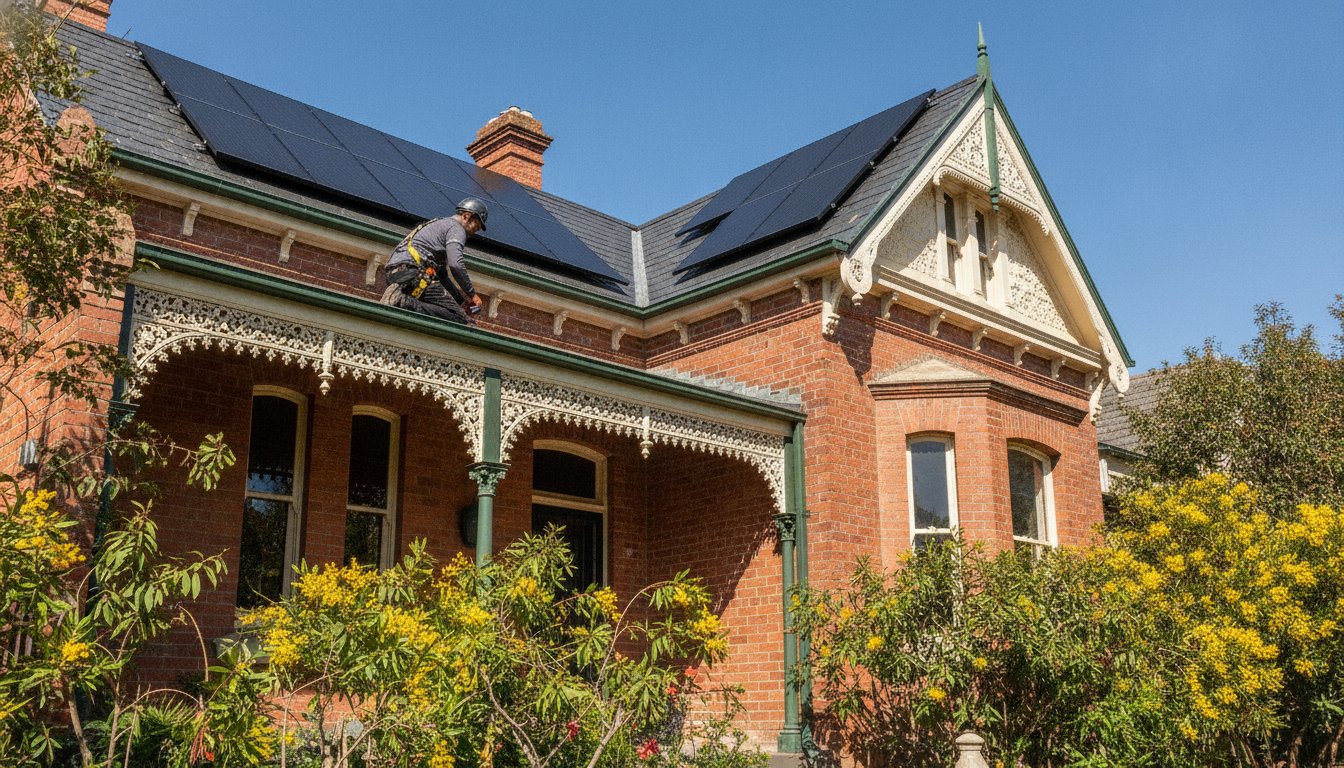
Your 100-year-old slate roof isn’t a barrier to the energy transition; it is an untapped asset. Owning a period property in Melbourne comes with a unique set of responsibilities and a fair share of anxiety regarding modern upgrades. You likely fear that a Heritage Overlay (HO) will lead to rejected permits or that modern hardware will scar your home’s historical character. It is a common frustration. Successfully installing solar for heritage homes Melbourne requires a specialist strategy that balances architectural preservation with aggressive energy savings. You shouldn’t have to choose between a beautiful facade and lower power bills.
This 2026 planning guide provides the roadmap to modernise your home without compromising its soul. We will show you how to navigate council approvals using the VicSmart process and how to claim the A$1,400 Victorian solar rebate alongside matching interest-free loans. Learn the technical secrets to achieving a system that is invisible from the kerb while delivering maximum efficiency. From protecting fragile terracotta tiles to meeting the latest 2027 electrification standards, we have the data-backed insights you need. It is time to secure your energy independence while honouring Melbourne’s rich architectural history.
Key Takeaways
- Navigate Melbourne’s Planning Overlays by applying the “invisible from the street” rule to bypass complex permit requirements.
- Identify the specific aesthetic hardware, such as all-black shingled cells, that maintains the architectural integrity of period facades.
- Protect your property’s structural value by using specialised mounting systems designed for delicate slate and terracotta roofing.
- Streamline your transition to clean energy by leveraging 2026 Solar Victoria rebates and interest-free loans for solar for heritage homes Melbourne.
- Future-proof your heritage home for 2027 electrification standards with integrated battery storage and high-efficiency electrical upgrades.
Navigating Solar for Heritage Homes in Melbourne
Owning a Victorian terrace in Fitzroy or a grand Federation home in Camberwell shouldn’t mean you’re locked out of the renewable energy revolution. For years, homeowners in Melbourne’s historic pockets felt trapped between soaring energy bills and rigid council restrictions. 2026 marks a definitive shift. Melbourne councils are now under immense pressure to meet aggressive net zero targets, leading to a more pragmatic approach toward sustainability in sensitive areas. Achieving successful solar for heritage homes Melbourne is no longer a matter of ‘if’, but ‘how’. It requires a sophisticated strategy that respects the past while securing your financial future.
The challenge in suburbs like Carlton or Middle Park is the density of Heritage Overlays. These aren’t designed to freeze your home in time. Instead, they serve to manage change so that the collective historical value of the street remains intact. Balancing your environmental responsibility with preservation is entirely possible with the right technical expertise. You can modernise your property and slash your carbon footprint without losing the architectural soul that makes your home valuable.
What is a Melbourne Heritage Overlay?
Local government planning schemes in Victoria use specific controls to protect areas of historical significance. Understanding Heritage Overlays is the first step for any homeowner. While a ‘Heritage Listed’ property usually refers to an individual building of state-wide importance on the Victorian Heritage Register, a ‘Heritage Overlay’ (HO) typically applies to a whole precinct or neighbourhood. An HO is a local planning control that requires a permit for any external changes visible from the street to ensure the historical character of the area is preserved. This means your primary focus must be on visibility and placement rather than the technology itself.
Common Myths About Heritage Solar
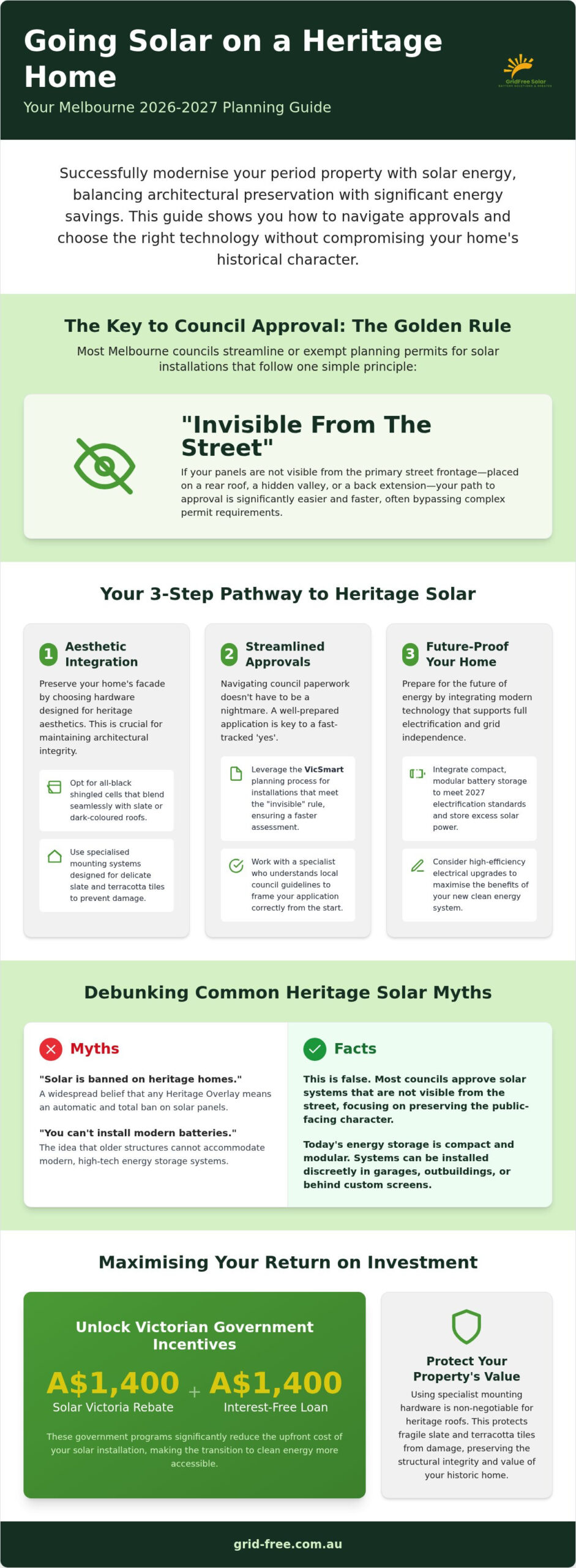
The biggest misconception is that solar is flat-out banned on heritage homes. This is false. Most Melbourne councils, including Yarra, Boroondara, and Melbourne City, have streamlined their processes for solar installations that aren’t visible from the primary street frontage. If your panels are tucked away on a rear extension or a hidden roof valley, you might not even need a planning permit.
Another common myth is that you can’t integrate modern batteries into older structures. High-tech energy storage solutions Melbourne are now more compact and modular than ever. These systems can be installed in garages, outbuildings, or behind custom screens that match your home’s aesthetic. You don’t have to sacrifice your home’s 100-year-old charm to achieve 21st-century grid independence. The technology has evolved; your planning strategy should too.
Understanding Melbourne Planning Overlays and Council Approvals
Securing approval for solar for heritage homes Melbourne doesn’t have to be a bureaucratic nightmare. Most homeowners assume a Heritage Overlay (HO) means an automatic rejection. This is a misconception. The Victorian Planning Scheme actually encourages sustainable upgrades, provided they don’t degrade the precinct’s historical significance. The distinction between a Building Permit and a Planning Permit is critical here. While almost every installation requires a building permit for structural safety, a planning permit is only triggered if the panels alter the external appearance in a way that impacts the HO objectives. Precision in your initial application is the difference between a fast-tracked ‘yes’ and a costly delay.
The “Invisible from the Street” rule is your golden ticket. Under current City of Melbourne solar planning rules, many councils offer exemptions or streamlined VicSmart assessments if panels are hidden from the primary street frontage. If your roof has a rear-facing pitch or a hidden valley, your path to approval is significantly shorter. Installing solar for heritage homes Melbourne requires more than just technical skill; it requires a deep understanding of local heritage guidelines. Success depends on how you present your case to the council assessors. Working with a specialist who understands the local administrative landscape ensures your application is framed correctly from day one.
The Council Approval Checklist
A professional application leaves nothing to chance. You must demonstrate exactly how the system interacts with the streetscape. Assessors look for detailed site plans that show panel orientation and tilt angles relative to the kerb. Photomontages are particularly effective. These visualisations prove the panels remain hidden from pedestrian sightlines. Additionally, include technical specifications for non-reflective hardware. High-efficiency, all-black panels are often preferred because they absorb light rather than reflecting it. This reduces glare for neighbours and maintains the muted aesthetic required in historic precincts.
State vs. Local: Navigating the Red Tape
Navigating the intersection of state incentives and local bylaws requires precision. While Solar Victoria provides the financial framework, your local council dictates the physical constraints. All hardware must be approved by the Clean Energy Council (CEC) to qualify for rebates, but heritage areas often require even higher standards of equipment. If you’re looking to maximise your ROI, you should also consider how storage fits into the plan. You can find detailed eligibility criteria in our guide to the Victorian Battery Rebate 2024 to 2026. Combining these incentives with a compliant design is the most efficient way to achieve grid independence. Before you submit your paperwork, consult with a Melbourne heritage specialist to ensure your design meets every local criterion.
Aesthetic Solar Solutions: Preserving Your Home’s Character
Visual appeal is not a secondary concern; for a heritage property, it is the primary design constraint. While many installers focus solely on kilowatt-hours, successful solar for heritage homes Melbourne requires a strict visual impact framework. You don’t have to settle for industrial-looking hardware that clashes with 19th-century craftsmanship. Modern technology has evolved to provide high-performance solutions that are architecturally sympathetic. By selecting the right materials and placement strategies, your solar system can enhance rather than diminish your property’s historical value.
The standard for period properties is now the all-black monocrystalline panel. Specifically, shingled cell technology has revolutionised the market. These panels eliminate the visible silver busbars and white backsheets that create a dated, checkered look. The result is a uniform, deep-black surface that mimics the aesthetic of dark slate or weathered terracotta. When paired with black anodised framing and racking, the entire array recedes into the roofline. This eliminates the high-contrast silver grid that typically signals a modern intrusion on a classic facade.
Placement remains your most powerful tool. Utilising rear-facing roof planes or hidden valleys ensures the system remains out of sight from the primary streetscape. Low-profile mounting systems are also vital. These allow panels to sit flush with the tiles rather than hovering on bulky, elevated brackets. This integrated look respects the original geometry of your roof. It ensures the addition feels like a deliberate design choice rather than an afterthought. Precision in layout is what separates a standard job from a heritage-standard installation.
Hardware Selection for Period Properties
The choice between matte and glossy finishes is critical for managing glare. Matte panels are increasingly preferred in Melbourne’s historic precincts. They absorb more light and produce fewer reflections for neighbours, which is a common concern for council assessors. Beyond the roof, the placement of modern tech like inverters and batteries must be carefully planned. A high-quality solar panel installation Melbourne specialist will hide this equipment in garages or behind custom-built screens. This keeps the modern brain of your energy system out of your historical interiors.
Alternative Siting Options
If the main dwelling is too sensitive for an array, consider alternative structures. Many Melbourne homes feature non-heritage garages or contemporary rear extensions added in later decades. These are perfect candidates for solar. For larger estates, ground-mounted arrays tucked behind landscaping can provide massive yields without touching the house. Solar pergolas are another innovative option. These structures provide functional garden shade while generating power, serving as a sympathetic addition to a Victorian-era garden. You get the benefits of renewable energy without compromising a single original slate.
Technical Challenges: Structural Integrity and Electrical Upgrades
Historical charm often hides technical obsolescence. While the aesthetic hurdles of solar for heritage homes Melbourne are significant, the physical engineering requirements are even more critical. Most period properties feature timber rafters that have been supporting heavy slate or terracotta for over a century. Adding a solar array introduces a new static load. You must ensure your roof’s skeleton can handle the extra weight without sagging or compromising the building’s envelope. A professional structural assessment is non-negotiable for any property built before 1930.
Mounting hardware on 100-year-old materials requires surgical precision. Unlike modern Colorbond, slate and terracotta are incredibly fragile. Standard ‘hook and rail’ systems can easily crack aged tiles, leading to catastrophic leaks. We utilise specialised mounting brackets that bypass the tile entirely or use custom flashing to maintain a watertight seal. This protects your home’s interior while securing the panels for the next 25 years. If your roof is already showing signs of delamination or brittle tiles, solar should not be installed until the surface is restored.
Your electrical infrastructure likely needs an overhaul too. “Old World” ceramic fuse boxes or early-generation switchboards are not designed for the bi-directional energy flow of solar and batteries. Upgrading to a modern, safety-compliant switchboard is a mandatory part of the process. For grand heritage estates with high cooling and heating requirements, a transition to 3-phase power is often necessary. This allows for larger solar capacities and faster battery charging, providing the robust foundation required for modern grid independence.
Roof Restoration Before Solar
Adopting a “Mount Once” philosophy is essential. You should never install high-efficiency panels over a failing roof. If your slate is slipping or your terracotta is fretting, the cost of removing and reinstalling solar for repairs later will be prohibitive. Coordinate your roof restoration with your solar installation. This ensures that every penetration is correctly sealed by trades who understand the unique properties of historical building materials. It is a protective investment in your home’s longevity.
Smart Energy Management in Older Homes
Heritage homes often struggle with poor thermal mass and massive insulation gaps. High ceilings and drafty windows mean your energy system has to work harder. We overcome these challenges with intelligent energy monitoring that tracks every watt in real-time. For larger residential footprints, we often adapt high-capacity commercial solar installation Melbourne techniques to manage complex loads. This level of sophistication ensures you maximise self-consumption even in a home that was never built for efficiency. To ensure your property is technically ready for the transition, book a comprehensive site audit with our specialist team today.
Maximising ROI: Rebates and Modern Energy Storage
Investing in solar for heritage homes Melbourne is a strategic financial move, not just an environmental one. The financial logic is clear. While the upfront cost for heritage-sensitive hardware is slightly higher than a standard installation, the long-term yield and government support create a compelling business case. You are not just buying panels; you are securing a fixed energy price for the next 25 years. GridFree Solar specialises in integrated, council-compliant energy solutions that bridge the gap between historical preservation and aggressive financial returns. We ensure your system is designed to meet strict Heritage Overlay requirements while qualifying for every available incentive.
Battery storage is the definitive key to ROI for period properties. Many Melbourne heritage homes have complex rooflines or limited north-facing planes that restrict the size of the solar array. A battery allows you to capture every watt of generation during the day and deploy it during expensive peak evening periods. This maximises your self-consumption. Current data from Solar Victoria shows that households can save up to A$1,000 a year by maximising their solar usage. Without storage, you are simply exporting valuable energy back to the grid for a minimal credit.
2026 Rebate Opportunities for Melbourne
The Victorian Solar Homes Program remains a robust pillar for homeowners. Eligible households can currently access a rebate of up to A$1,400 for solar PV systems. To qualify, your combined household taxable income must be less than A$150,000 per year, and the property must be valued at under A$3 million. You can also secure an interest-free loan of up to A$1,400, which is repayable over four years. While the previous battery loan program ended in May 2025, the new Cheaper Home Batteries Program now offers upfront rebates to reduce installation costs. For a detailed breakdown of current market rates, refer to our guide on solar battery cost Australia 2026.
The Heritage Value Add
Solar and battery integration significantly increases the market value of period homes. Modern buyers in Melbourne are increasingly wary of high-maintenance, energy-inefficient historical properties. By installing a high-performance, invisible solar system, you make your home competitive with modern builds in terms of running costs. You are future-proofing your asset against rising energy tariffs and the 2027 electrification standards. A heritage home that generates its own power is a rare and highly desirable commodity in the current real estate market. To start your transition, request a heritage-specialised solar assessment from GridFree Solar and secure your energy independence today.
Secure Your Home’s Energy Future Today
Melbourne’s period properties are more than just historical markers; they are the foundation for a sustainable future. You’ve seen that navigating council planning overlays is a matter of precision, not luck. By prioritising invisible placement and high-efficiency all-black hardware, you can bypass bureaucratic hurdles and slash your energy bills. Don’t let the complexity of 100-year-old rafters or fragile slate tiles stall your progress. Success requires a specialist who respects the past while engineering for the future.
As Melbourne-based heritage specialists, GridFree Solar understands the delicate balance of Victorian Planning Overlays. We provide the technical expertise needed to claim your A$1,400 Victorian rebate while protecting your home’s character. Installing solar for heritage homes Melbourne is an investment in both your property value and the planet. The transition to an all-electric home is inevitable. Take the lead and ensure your historical asset remains a high-performing home for decades to come.
Get a Heritage-Compliant Solar Quote from GridFree Solar and modernise your property with absolute confidence.
Frequently Asked Questions
Do I need council permission for solar panels in a Heritage Overlay?
Yes, you generally need a planning permit if the panels are visible from the street or a public park. However, if the installation is hidden from pedestrian sightlines, you are often exempt under Victorian planning rules. Many Melbourne councils now use the streamlined VicSmart process for heritage applications, which significantly reduces wait times. It is essential to verify your specific Heritage Overlay requirements before commencing any solar for heritage homes Melbourne project to avoid council fines.
Can solar panels be installed on a slate roof in Melbourne?
Solar panels can be installed on slate roofs, provided you use specialised mounting hardware and experienced trades. Slate is significantly more fragile than modern roofing materials and requires a non-penetrative approach or custom flashing to prevent leaks. We recommend a structural assessment of your 100-year-old timber rafters first. This ensures the roof can support the additional static load of the panels and mounting system without compromising the historical building’s structural integrity.
Are there specific solar panels that look better on old houses?
All-black monocrystalline panels with shingled cells are the gold standard for period properties. These panels eliminate the industrial-looking silver busbars and white backsheets found on standard hardware. By choosing a matte finish rather than a glossy one, you can also reduce glare for neighbours. This aesthetic choice is often a deciding factor for council assessors. It allows the solar array to blend seamlessly with dark slate or weathered terracotta tiles on traditional Melbourne roofs.
Will solar panels damage my heritage home’s roof?
Panels will not damage your roof if you use specialised installers who understand historical materials. Standard installation methods often involve walking on tiles or using heavy-handed mounting that cracks aged terracotta. Professional heritage installers use load-spreading techniques and custom brackets designed specifically for slate and tile. It is also vital to restore any failing tiles before installation. This mount once approach protects the home’s envelope and ensures the system remains watertight for decades.
Is there a specific rebate for heritage home solar in Victoria?
There is no exclusive heritage rebate, but you can access the standard Solar Victoria incentives. Eligible households can receive a rebate of up to A$1,400 for solar PV systems, plus a matching interest-free loan. Your property must be valued under A$3 million and your household income must be below A$150,000. These incentives are a powerful way to offset the slightly higher costs associated with the premium, aesthetic hardware required for solar for heritage homes Melbourne.
What happens if the only sunny part of my roof faces the street?
Street-facing installations require a formal Planning Permit and a high level of design sensitivity. You must demonstrate to the council that the visual impact is minimal. This usually involves using premium all-black panels that sit flush with the roofline and providing photomontages of the streetscape. If the council determines the impact is too great, we explore alternative siting options like non-heritage garages, contemporary rear extensions, or even solar pergolas in the garden area.
How do I find an installer who understands Melbourne heritage rules?
You should prioritise Melbourne-based installers who are Solar Victoria authorised and have a proven track record with Heritage Overlays. Ask for examples of their work on similar period properties in suburbs like Fitzroy or Camberwell. A specialist installer will handle the council application process, including the technical drawings and photomontages required for approval. They should also understand the structural nuances of Victorian and Edwardian roof framing to ensure a safe, compliant installation.
Can I put a solar battery in a heritage-listed cellar or basement?
Installing a battery in a cellar or basement is possible but requires strict adherence to Australian safety standards. The location must be well-ventilated, dry, and meet specific fire-clearance requirements. Older basements often have moisture issues, so you may need a system with a high IP rating for water resistance. It is often more efficient to install the battery in a garage or a custom-screened outdoor area to ensure long-term reliability and easier maintenance access.