
By January 2027, every new home in Victoria must be all-electric, making the current window to secure maximum solar incentives both narrow and critical. You’ve likely watched your electricity tariffs climb while feeling buried under the weight of complex government paperwork. It’s frustrating to face a system where a single administrative error can lead to a rejected application or a missed financial opportunity. We understand the pressure of choosing an accredited installer who actually delivers on the promise of long-term reliability and technical expertise.
This strategic guide reveals how to stack Victorian incentives, including the $1,400 PV rebate and the federal battery program, to achieve total energy independence. By following our solar rebate application checklist Victoria, you can secure approval on your first attempt and navigate the updated $150,000 household income threshold with confidence. We provide a definitive roadmap to $0 upfront costs via interest-free loans, ensuring you lock in the highest possible ROI. Discover how to transition your home into a high-performance energy hub before the 2027 mandate reshapes the Melbourne market forever.
Key Takeaways
- Master the 2027 all-electric mandate. Learn why 2026 is the critical window to secure peak Victorian incentives and future-proof your home.
- Maximise your financial leverage. Discover the exact strategy to stack solar PV and heat pump rebates for over $3,000 in total government support.
- Fast-track your approval. Use our solar rebate application checklist Victoria to navigate the updated $150,000 income threshold and avoid common paperwork errors.
- Optimise battery ROI. See how integrating modern storage with Virtual Power Plants (VPPs) converts your solar system into a consistent revenue-generating asset.
- Eliminate the red tape. Partner with a local Melbourne specialist to manage complex eligibility assessments and ensure your installation meets strict 2026 technical standards.
The 2026 Melbourne Solar Rebate Landscape: Navigating the All-Electric Shift
The Solar Homes Program remains the backbone of Victoria’s renewable transition in 2026. While the program has evolved, its core objective is helping households combat rising tariffs through smart technology. Melbourne is currently at a tipping point. Grid pressures and the phase-out of gas are forcing a rapid shift in how we power our lives. Solar power in Australia has never been more relevant, especially as Victoria leads the charge toward a fully electric future. Waiting until next year is a high-risk strategy. As the 2027 deadlines approach, installer demand will surge, likely driving up labour costs and extending wait times. Securing your position now ensures you lock in current rebate levels and avoid the inevitable bottleneck.
The 2027 All-Electric Mandate Explained
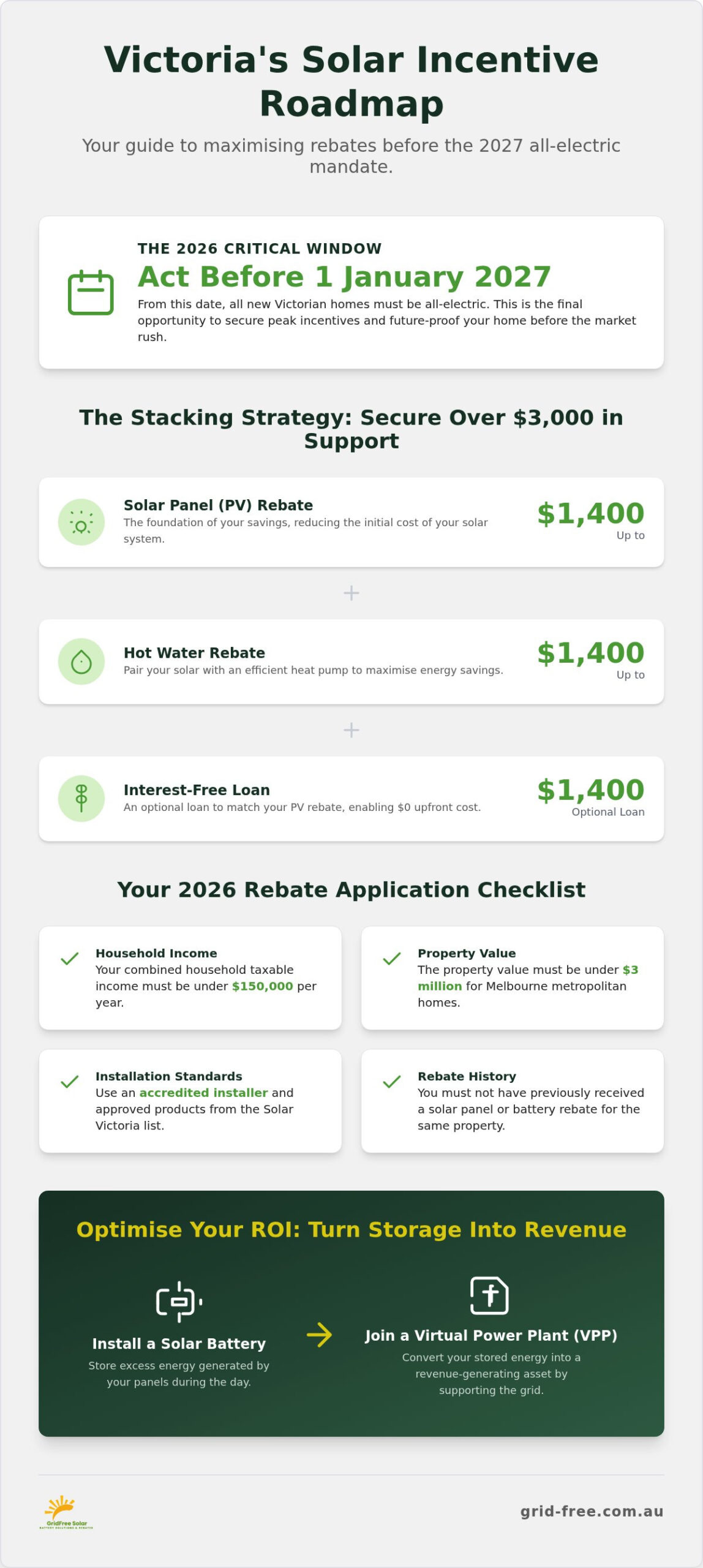
The Victorian government has set a firm deadline. From 1 January 2027, all new residential builds must be all-electric. This isn’t just about new homes; existing households face a March 2027 deadline to replace end-of-life gas hot water systems with efficient electric alternatives. Solar is no longer just an optional extra. It’s the essential foundation for a gas-free home. Transitioning early allows you to offset the increased electrical load of heat pumps and induction cooktops. If you don’t act now, you’ll be forced into a reactive upgrade when your gas appliances fail, often at a much higher price point.
2026 Eligibility and Property Value Caps
Navigating the administrative requirements is the first hurdle to securing your ROI. For 2026, the property value threshold remains at $3 million for Melbourne metropolitan homes, ensuring the vast majority of residents remain eligible. However, income rules have tightened. Your combined household taxable income must be less than $150,000 per year to qualify for the primary PV rebate. This data is a core component of your solar rebate application checklist Victoria. If you’re currently building, you can apply for the rebate before moving in, provided you meet the construction stage requirements. Proactive management of these details is what separates successful applicants from those stuck in the red tape cycle. It’s why many homeowners seek professional solar panel installation Melbourne experts to handle the eligibility assessment from day one.
To ensure you don’t miss out, confirm your eligibility early. The 2026 landscape rewards those who move quickly. By integrating solar and heat pump technology now, you bypass the 2027 rush and start saving on every kilowatt-hour immediately. The transition is inevitable; the only variable is how much you’ll save by acting before the mandate takes full effect.
The Stacking Strategy: Securing Over $3,000 in Victorian Incentives
Most Melbourne homeowners mistakenly believe they must choose between solar panels or a heat pump. This is a costly misconception. Strategic “rebate stacking” allows you to claim multiple incentives simultaneously, provided you follow the correct administrative sequence. By combining the Solar panel (PV) rebate with the Victorian hot water incentive, you can unlock over $2,800 in direct rebates alone. When you factor in the federal Small-scale Technology Certificates (STCs), the total financial support often exceeds $4,000. This is the most aggressive way to drive your upfront installation costs toward zero.
The math is simple but powerful. A standard PV rebate provides up to $1,400. Pairing this with an Australian-made heat pump adds another $1,400 to your savings. Solar Victoria also offers an optional interest-free loan of up to $1,400 to match the PV rebate. This loan is repayable over four years at just $29.17 per month. It’s a cash-flow positive move from day one. To manage this complexity, your solar rebate application checklist Victoria must prioritise securing an authorised quote that bundles both technologies. This ensures the eligibility assessment covers your entire system in one streamlined process.
The Panel and Hot Water Double-Play
Heat pumps are the ultimate efficiency partner for your solar array. They function as a thermal battery, using your excess solar generation during peak daylight hours to heat water for evening use. This prevents you from exporting power to the grid at low feed-in tariffs. To maximise your ROI, you must claim these products through a single, coordinated strategy. Claiming them separately often leads to technical conflicts in the Solar Victoria portal. Our team at GridFree Solar specialises in these multi-product applications, ensuring you don’t leave thousands of dollars on the table due to simple filing errors.
Rental Provider Rebates for Melbourne Landlords
Landlords are no longer excluded from the renewable transition. In 2026, Victorian rental providers can claim a rebate of up to $1,400 for a maximum of two properties per financial year. This is a sophisticated play for property investors looking to increase asset value without significant capital outlay. By implementing a “split-bill” arrangement, you can share the cost of the system with your tenant while providing them with significantly lower energy costs. It’s a win-win that improves tenant retention and future-proofs your investment against the 2027 all-electric mandate. Ensure your solar rebate application checklist Victoria includes the specific landlord-tenant agreement forms required for these investment property claims.
Victorian Battery Rebate and VPPs: Turning Storage into Revenue
Declining feed-in tariffs have fundamentally changed the Melbourne solar market. Storing your own energy is now significantly more profitable than selling it back to the grid for a few cents. While the standalone state battery rebate has transitioned, Victorian residents in 2026 can access the federal Cheaper Home Batteries Program. This initiative leverages Small-scale Technology Certificates (STCs) to reduce installation costs by approximately 30%. When you combine this with the Victorian Government Solar Panel Rebate, the financial case for storage becomes undeniable. Upgrading an aging battery or installing a new one is a high-ROI move that protects you against future tariff hikes.
Your solar rebate application checklist Victoria should specifically target VPP-compatible hardware to unlock secondary revenue streams. Simply having a battery is no longer the gold standard for savvy homeowners. We focus on the “GridFree Advantage,” which means designing systems for total energy independence and maximum market participation. By selecting from the list of eligible batteries for Victorian rebate programs, you ensure your system meets the strict technical requirements for both federal discounts and grid-sharing credits.
VPP Integration: The Rebate Multiplier
Joining a Virtual Power Plant (VPP) converts your battery from a passive storage tank into an active revenue generator. In 2026, Melbourne-specific VPP sign-up bonuses are reaching record highs as retailers compete for decentralised power. A VPP-integrated system often pays for itself years faster than a standard setup. You earn ongoing credits for allowing the grid to draw power during peak demand events, effectively stacking your earnings on top of your initial rebate savings. It’s a sophisticated way to turn a technical requirement into a consistent financial benefit.
LiFePO4 vs. Traditional Storage
Safety and longevity are non-negotiable in Victoria’s variable climate. Lithium Iron Phosphate (LiFePO4) technology has emerged as the clear winner for Victorian rebate approval due to its superior thermal stability and 10,000-cycle life expectancy. Unlike older chemistries, LiFePO4 batteries don’t suffer from the same degradation issues during Melbourne’s summer heatwaves. For a detailed breakdown of how these technical specs impact your investment, consult the solar battery cost Australia 2026 guide. Choosing the right chemistry is a critical step in your solar rebate application checklist Victoria to ensure long-term reliability and peak performance.
Your 2026 Solar Rebate Application Checklist: Fast-Track Approval
Securing government funding in 2026 requires more than just interest; it demands administrative precision. The Solar Victoria portal is an automated gatekeeper. It’s designed to reject applications that show even minor discrepancies in data. To ensure your system is installed without delay, your solar rebate application checklist Victoria must be complete before you even hit the “submit” button. Every piece of documentation, from your ATO records to your council rates, must align perfectly with your retailer’s quote. Administrative errors are the leading cause of delays, often pushing installations back by weeks or even months.
The first and most critical step is securing a formal quote from a Clean Energy Council (CEC) authorised retailer. This quote acts as the trigger for the entire eligibility process. Without it, you cannot generate an application token. Once you have this, you must gather your proof of income. For 2026, the combined household taxable income threshold is strictly $150,000. You’ll need your most recent Notice of Assessment from the ATO to verify this. Additionally, have a current Council Rates notice ready to prove property ownership and confirm the value is below the $3 million cap for Melbourne metropolitan homes.
Avoiding the “Solar Cowboy” Rejection
A quote that looks like a bargain often carries hidden risks. “Solar Cowboys” frequently use components that aren’t on the approved products list, leading to an immediate audit failure. If your installer isn’t CEC-accredited, Solar Victoria will not release your rebate or interest-free loan. These unaccredited systems often fail to meet the 2026 technical standards for grid stability and safety. Choosing a specialist ensures your quote is audit-proof from day one. Don’t risk your $1,400 rebate on a provider who cuts corners on hardware quality or government compliance.
The Application Timeline
Momentum is essential for a successful transition. In 2026, the average approval time for a well-documented Melbourne application is between three and five business days. Once your eligibility is confirmed, the installation can proceed. After the system is live, the focus shifts to the federal Small-scale Technology Certificates (STCs). This federal incentive is separate from the state rebate and usually provides a discount of roughly 30% on the total system cost. We handle this complexity for you, ensuring every available dollar is stripped from your upfront bill. To lock in your installation date and clear the red tape, book a consultation with our rebate experts today.
Why GridFree Solar is Melbourne’s Expert Rebate Partner
GridFree Solar isn’t just another installer. We’re your strategic partner in navigating the Victorian administrative landscape. While others leave you to struggle with the Solar Victoria portal, we take a proactive approach to managing every line of your paperwork. Our solar rebate application checklist Victoria ensures that every technical specification and income verification detail is flawless before submission. We understand that in 2026, approval speed is just as important as system quality. By choosing our experts for solar panel installation Melbourne, you’re investing in a team that prioritises your ROI above all else. We handle the red tape so you can focus on the savings.
Integrated Solar and Battery Solutions
We design for today’s incentives and tomorrow’s demands. Our energy storage solutions Melbourne are engineered for 2036 reliability, using high-performance hardware that exceeds standard grid requirements. We don’t just install panels; we build intelligent energy ecosystems. By aligning our custom designs with the specific technical quirks of the Victorian grid, we ensure your system remains stable and productive for decades. We maximise every cent of your government incentive by stacking state and federal programs with surgical precision. Our local Melbourne expertise means we know exactly which hardware configurations will pass the 2026 audits without a second glance.
Commercial Rebates for Melbourne Businesses
For business owners, the 2027 all-electric mandate isn’t a suggestion; it’s a looming operational shift. We specialise in commercial solar installation Melbourne, helping companies scale their renewable capacity while navigating complex tax depreciation rules. In 2026, the combination of instant asset write-offs and government rebates creates a unique window for high-ROI capital expenditure. We future-proof your operations by replacing inefficient gas systems with high-output solar arrays and battery storage. Our solar rebate application checklist Victoria for commercial clients is specifically tailored to handle the higher thresholds and property valuations of industrial sites. Don’t wait for the 2027 rush to drive up commercial labour rates. Act now to secure your energy independence and lock in long-term competitive advantages through smart, rebated technology.
Lock in Your 2026 Energy Independence
The 2027 all-electric mandate is no longer a distant prospect. It’s a firm deadline that will reshape Melbourne’s energy market. By acting now, you bypass the inevitable installation bottleneck and secure the highest possible ROI through strategic rebate stacking. Whether you’re combining solar PV with a heat pump or integrating a high-performance battery into a Virtual Power Plant, the financial benefits in 2026 are at their peak.
Success depends on precision. Utilising our solar rebate application checklist Victoria ensures your documentation meets strict Solar Victoria standards, preventing costly rejections and delays. We remove the complexity of the red tape, allowing you to focus on the long-term reliability of your system. As CEC Accredited Installers and specialists in Victorian rebate paperwork, we provide the local Melbourne support you need to transition with confidence.
Don’t let rising tariffs dictate your household budget. Maximise your Melbourne solar rebate today with a GridFree expert quote and secure your path to $0 upfront costs. The future of Victorian energy is all-electric; ensure your home is ready to lead the way.
Frequently Asked Questions
Can I claim the Victorian solar rebate if I already have an old system?
You can’t claim a second rebate for the same property if that address has already received a solar panel or battery incentive under the Solar Homes Program. However, if you’ve recently moved to a new home that hasn’t received a grant, you’re eligible to apply again. This is a key item on any solar rebate application checklist Victoria homeowners use. It’s designed to help you upgrade your energy independence as you move.
What is the maximum household income to qualify for the rebate in 2026?
The maximum combined household taxable income for all owners is $150,000 per year. This threshold was updated on 1 July 2026 to ensure the program supports those who need it most. You’ll need your most recent Notice of Assessment from the ATO to verify this during the application. If your income exceeds this limit, you won’t qualify for the $1,400 rebate or the interest-free loan. Always verify this figure before starting.
How do I stack the solar panel rebate with the hot water rebate?
Stacking rebates requires a coordinated approach with your authorised retailer. You’re eligible to claim both a solar PV rebate and a hot water rebate for the same property simultaneously. Your installer must upload a quote for both systems to the Solar Victoria portal together. This allows you to process the applications in one go, potentially securing over $2,800 in total state support. It’s the most efficient way to future-proof your home.
Is the Victorian battery rebate still available for Melbourne residents?
The standalone Victorian state battery rebate has been replaced by the federal Cheaper Home Batteries Program. Melbourne residents now access storage incentives through Small-scale Technology Certificates (STCs), which can reduce the total cost by roughly 30%. While the state no longer provides a direct cash rebate for batteries, the federal program remains a powerful tool for storage. Integrating your battery into a Virtual Power Plant (VPP) can further increase your revenue.
Do I have to pay back the interest-free solar loan?
Yes, the interest-free loan must be repaid over a four-year period. The loan matches the $1,400 rebate amount, resulting in monthly repayments of approximately $29.17. Most Melbourne households find that their monthly electricity bill savings significantly exceed this repayment cost. This makes the system cash-flow positive from the first month. It’s a strategic financial move that eliminates the need for any significant upfront capital expenditure for your new solar installation.
What property value qualifies for the Melbourne solar rebate?
To qualify for the rebate, your Melbourne property must have a capital improved value of less than $3 million. This value is determined by your most recent Council Rates notice. The threshold is generous enough to cover the vast majority of residential homes in the metropolitan area. Ensure your solar rebate application checklist Victoria includes a digital copy of your rates notice, as this is a mandatory document for the Solar Victoria identity check.
Can I claim a rebate for a rental property I own in Victoria?
Victorian landlords can claim a rebate of up to $1,400 for a maximum of two rental properties each financial year. This is a significant incentive for property investors looking to increase their asset’s value while lowering tenant energy costs. You’ll need to enter into a solar provider agreement with your tenants to share the financial benefits. It’s an excellent way to prepare your investment portfolio for the upcoming 2027 shift away from residential gas.
How does the 2027 all-electric mandate affect my solar rebate application?
The 2027 mandate makes your solar and heat pump application more urgent. From March 2027, existing Victorian homes must replace end-of-life gas hot water systems with electric alternatives. Applying for the $1,400 hot water rebate now allows you to complete this transition ahead of the rush. Solar acts as the foundation for this all-electric shift; it provides the cheap power needed to run your new heat pump and induction cooktop efficiently.