
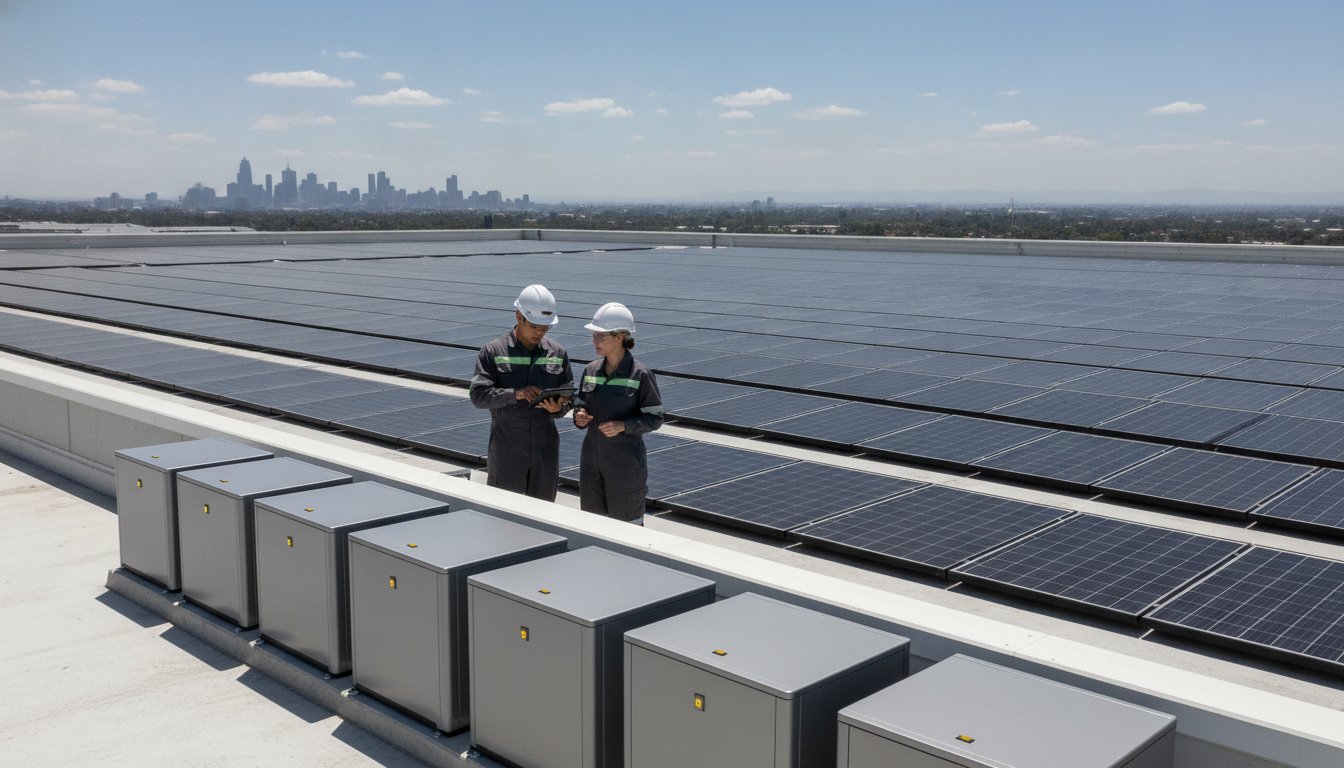
Why is your facility still at the mercy of Melbourne’s volatile energy market when it could be dictating the terms? For too long, local businesses have viewed electricity as an unavoidable tax on operations. The market has shifted. A strategic commercial solar battery upgrade Melbourne businesses deploy is no longer just a sustainability tick-box. It’s a sophisticated financial pivot. You aren’t just storing power. You’re capturing a dynamic asset that protects your machinery from grid surges and slashes those extortionate peak demand charges that haunt the Victorian manufacturing and retail sectors.
You likely already know that the push toward net-zero is accelerating. The pressure to decarbonise has never been higher. We agree that managing these shifting regulations while maintaining profitability is a significant hurdle for any operation. This 2026 ROI guide promises to show you exactly how to transform your business from a passive consumer into a proactive grid participant. We’ll break down the latest Victorian battery rebate structures, the revenue potential of Virtual Power Plant (VPP) participation, and how to future-proof your site for the inevitable transition to an EV fleet.
Key Takeaways
- Understand the 2026 shift from passive backup to active energy management for commercial systems ranging from 30kWh to over 1MWh.
- Identify why LiFePO4 chemistry is the non-negotiable standard for thermal stability and safety in Melbourne’s industrial environments.
- Master the financial mechanics of a commercial solar battery upgrade Melbourne leaders use to eliminate peak demand charges and capitalise on load shifting.
- Maximise your ROI by securing current Victorian government rebates and meeting specific distributor requirements for Powercor, AusNet, and United Energy.
- Learn why custom-engineered storage outperforms off-the-shelf solutions when future-proofing your facility for grid-arbitrage and VPP participation.
What is Commercial Solar Battery Storage and Why is it Essential in 2026?
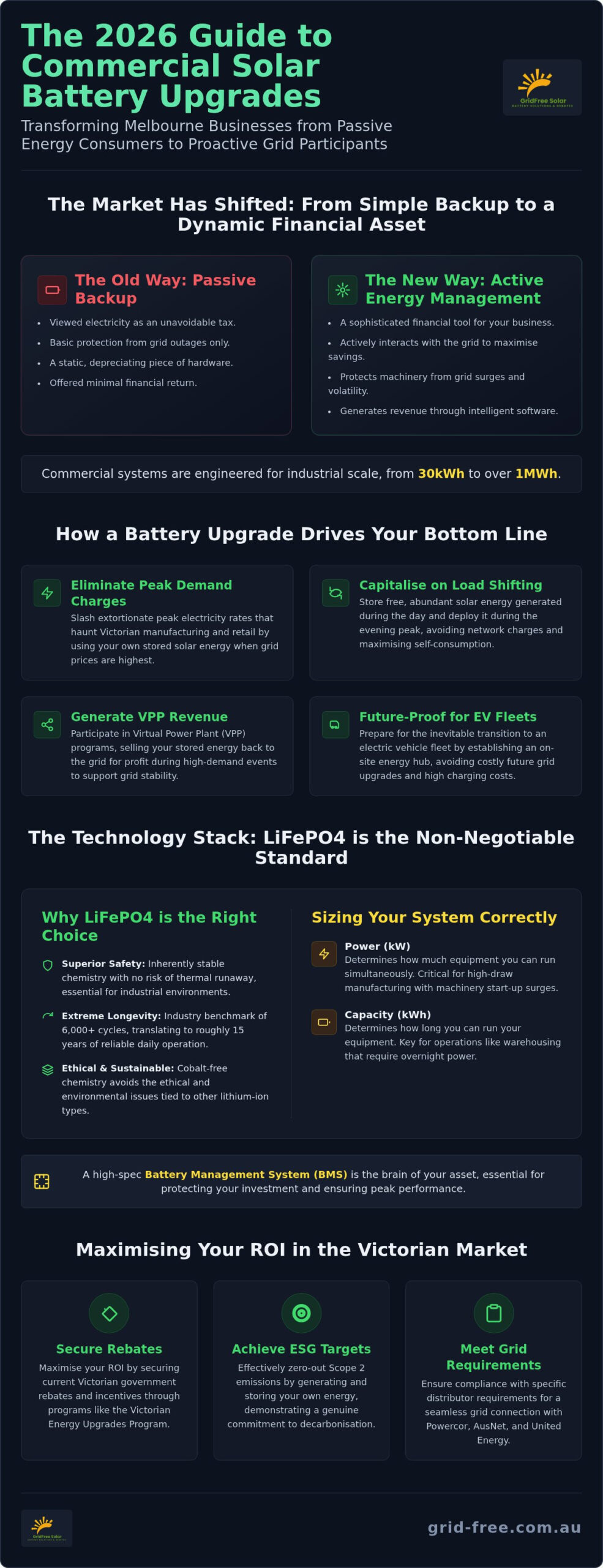
The market has shifted. Commercial energy storage is no longer a luxury for the eco-conscious. It’s a high-capacity battery energy storage system (BESS) engineered to handle the heavy-duty cycles of industrial operations. These systems typically start at 30kWh and scale well beyond 1MWh. In 2026, storage has moved from a passive backup solution to an active energy management tool. Your battery is now a digital asset. It interacts with the grid in real-time to protect your bottom line. It’s about intelligence, not just storage.
Melbourne businesses are at the epicentre of Australia’s energy transition. Local grid volatility is at an all-time high as we move away from coal-fired power. A commercial solar battery upgrade Melbourne leaders are now prioritising is the only way to decouple your operational costs from these price swings. It’s also a non-negotiable for Scope 2 compliance. Scope 2 emissions relate to the indirect energy you purchase from the grid. By generating and storing your own solar, you effectively zero out these liabilities. If your ESG targets demand genuine carbon reduction, you must store your own energy for use during peak evening periods when the grid is at its dirtiest.
Capacity vs. Power: Understanding Industrial Scale
You must distinguish between kW and kWh to avoid under-speccing your facility. Power (kW) determines how much equipment you can run at once. Capacity (kWh) determines how long you can run it. High-draw manufacturing sites often require high-power configurations to manage machinery start-up surges. Warehousing might prioritise capacity for overnight lighting and security. Modern modularity is the solution here. It allows you to expand your storage as your facility grows. This ensures you never pay for capacity you don’t yet need. A strategic commercial solar battery upgrade Melbourne wide is about matching these specs to your specific load profile.
The 2026 Melbourne Energy Landscape
The Victorian Renewable Energy Target (VRET) has fundamentally changed how our grid functions. While it brings more renewables online, it also introduces complexity in network pricing. Behind-the-meter storage is your strongest defence. It allows you to bypass network charges by using your own stored energy during the grid’s most expensive windows. For a comprehensive look at localised options, check our guide on energy storage solutions Melbourne businesses are using to stay competitive. Take control of your electrons before the market takes control of your profits.
The Technology Stack: Choosing the Right Commercial Battery Chemistry
Chemistry is destiny in the energy world. For a commercial solar battery upgrade Melbourne businesses can rely on, LiFePO4 (Lithium Iron Phosphate) has decisively won the race against traditional Nickel Manganese Cobalt (NMC) chemistries. The reason is simple. Safety and longevity. Industrial sites operate under high stress. You need a chemistry that doesn’t just store energy but does so without the risk of thermal runaway. LiFePO4 is inherently stable. It’s cobalt-free. It handles the high-current demands of heavy machinery without breaking a sweat.
Longevity is the second pillar. In 2026, the industry benchmark is 6,000+ cycles at 80% depth of discharge. This translates to roughly 15 years of daily cycling. If your current system is failing after five years, it’s likely using outdated chemistry or lacks a sophisticated Battery Management System (BMS). The BMS is the brain of your asset. It monitors cell voltage, balances loads, and regulates temperature in real-time. Without a high-spec BMS, your high-capacity cells are just expensive paperweights. Protecting your investment requires intelligence at the cell level. The Victorian Energy Upgrades Program underscores the need for these high-performance standards to ensure long-term grid stability and business reliability.
LiFePO4 vs. Alternative Storage Technologies
While solid-state and flow batteries are gaining headlines, they remain niche for 2026 Melbourne commercial applications. LiFePO4 offers the best balance of energy density and cost-efficiency right now. It is particularly effective in Melbourne’s climate. Unlike older lithium-ion variants, LFP maintains performance even when factory floor temperatures spike during a Victorian summer. For a deeper dive into the technical specifications and performance metrics, review our latest LiFePO4 battery data to see how these units stack up against the competition.
Inverter Technology and Grid-Forming Capabilities
Your battery cells are only half the story. The inverter is the engine. For Melbourne’s manufacturing and cold storage sectors, three-phase power is the standard. You need a commercial-grade inverter with grid-forming capabilities. Grid-following inverters simply shut down during a blackout. Grid-forming inverters create their own microgrid. This ensures your business stays online when the external network fails. It’s the difference between a minor blip and a catastrophic production halt. If you’re unsure which chemistry suits your site’s specific thermal profile, consult with our Melbourne engineering team for a technical review of your current infrastructure.
The Financial Case: How Commercial Storage Generates Revenue
Electricity is no longer just a cost. It’s a commodity to be traded. A commercial solar battery upgrade Melbourne businesses install in 2026 functions as a high-speed financial instrument. You aren’t just saving pennies; you’re capturing market volatility. Grid arbitrage is the cornerstone of this strategy. Smart software automatically buys energy when prices are negative or low and discharges when the Victorian grid is stressed. This “buy low, sell high” model turns your plant room into a profit centre. It’s an active revenue stream that traditional solar alone cannot touch.
Frequency Control Ancillary Services (FCAS) offer another sophisticated layer of income. The Australian Energy Market Operator (AEMO) pays participants to help stabilise grid frequency. Your battery can respond in milliseconds to sub-second fluctuations. This rapid response is highly valued. It provides a consistent revenue stream that is entirely independent of your facility’s energy consumption. You get paid simply for being ready to assist the network. It’s the ultimate hedge against rising operational overheads.
- Peak Shaving: Automatically discharging stored power during your site’s highest usage windows to slash maximum demand charges.
- Load Shifting: Moving your energy consumption from expensive peak periods to cheap off-peak or solar-heavy windows.
- Grid Arbitrage: Capitalising on price spreads within the National Electricity Market (NEM) through automated trading.
Virtual Power Plants (VPP) for Business
Joining a Virtual Power Plant (VPP) scales your impact. By aggregating your capacity with other local sites, you gain access to wholesale market rewards usually reserved for major power stations. Commercial VPP participation offers significantly higher financial incentives compared to residential schemes due to the scale of the assets involved. This strategy works best when integrated into a broader commercial solar installation Melbourne companies use to achieve grid independence. You provide the capacity; the VPP provides the market access.
ROI Calculations and Payback Periods
Peak shaving is the rapid reduction of maximum demand charges by discharging stored energy during peak grid stress, often cutting monthly network fees by up to 30% for high-draw Melbourne sites. Your ROI is further accelerated by Australian tax incentives. The instant asset write-off and accelerated depreciation for renewable technology remain vital tools for Victorian CFOs. Sites with high daytime loads and sharp demand spikes see the fastest payback. Most 2026 commercial upgrades reach cash-flow positivity within 4 to 6 years. Stop paying for peak demand. Start trading it.
Victorian Compliance: Rebates, Regulations, and Grid Connection
Compliance is the gateway to grid independence. It’s the difference between a system that sits idle and one that actively trades on the Victorian market. Navigating the regulatory landscape in Melbourne requires more than just a standard electrical licence. It demands a deep understanding of distributor-specific requirements. Whether your facility sits within the Powercor, AusNet, or United Energy networks, grid connection is a high-stakes negotiation. These distributors dictate your export limits and secondary protection settings. Getting this wrong can stall your commercial solar battery upgrade Melbourne project for months. You need an engineering partner who speaks the language of the network operators.
Safety standards have evolved rapidly. AS/NZS 5139 is the non-negotiable benchmark for battery energy storage system safety in Australia. For large-scale commercial systems, professional engineering sign-off is mandatory. This ensures that the installation meets rigorous thermal, structural, and electrical safety thresholds. In Victoria, Registered Professional Engineer (RPEQ) certification is often required for systems that exceed specific capacity limits or involve complex grid-forming configurations. This isn’t just red tape. It’s the technical foundation that protects your staff, your facility, and your long-term insurance standing.
Claiming Your Victorian Rebates
Government incentives are a primary driver for 2026 ROI. Solar Victoria offers specific business battery rebates that significantly lower the upfront capital expenditure. To qualify, you must select from a list of eligible batteries for Victorian rebate programs. For systems under 100kW, Small-scale Technology Certificates (STCs) provide an additional upfront discount. Larger systems move into the Large-scale Generation Certificate (LGC) market. Documenting your energy profile and showing clear peak-shaving potential is essential for a successful application. We handle the complex paperwork so your internal teams can focus on core operations.
Site Assessment and Safety Audits
Your physical infrastructure must be ready for the weight of innovation. Utility-scale battery cabinets are incredibly heavy. We assess the structural integrity of your concrete slabs to ensure they can support the concentrated load of a 100kWh+ system. Fire safety is equally critical. Indoor installations require specific ventilation and fire-rated enclosures, while outdoor units must be positioned away from high-traffic zones or hazardous materials. Your switchboard must also be “Solar Ready.” This often involves upgrading protection relays or busbars to handle the bidirectional flow of power. Before you commit to hardware, request a site compliance audit from our Melbourne engineering team to identify any hidden infrastructure gaps.
The GridFree Advantage: Expert Commercial Upgrades in Melbourne
Efficiency is the standard. Excellence is the differentiator. GridFree Solar isn’t just an installer. We’re specialists in the technical nuances of the commercial solar battery upgrade Melbourne market. Most providers focus on greenfield new builds because they’re simpler. We embrace the complexity of brownfield sites. We understand your existing infrastructure has value. Our mission is to extract that value while integrating modern, intelligent storage. Off-the-shelf solutions fail Melbourne industrial sites because they ignore the unique load profiles of local manufacturing. You need a custom-engineered asset. Not a generic box.
Our local Melbourne-based engineering teams provide a full-lifecycle partnership. From initial site audit to ongoing performance optimisation, we stay on-site. This isn’t a “set and forget” transaction. It’s a strategic alliance. By transitioning to a fully integrated solar panel installation Melbourne businesses can finally achieve true grid independence. We ensure your storage and generation work in perfect harmony. We lead where others follow.
Upgrading Existing Commercial Systems
Adding modern storage to an aging array requires precision. If your current system suffers from rapid voltage drops or inconsistent discharge, it’s a clear sign you need a solar battery replacement Melbourne experts should handle. We often utilise AC-coupling for legacy upgrades. This allows us to add high-capacity LiFePO4 storage without forcing you to replace perfectly functional existing inverters. It’s a cost-effective path to a high-performance commercial solar battery upgrade Melbourne facility managers appreciate for its minimal operational disruption.
Partnering with GridFree Solar for Future Growth
We prepare your facility for the next decade of energy demand. 2026 is the year of the electric fleet. Integrating high-draw EV charging requires significant buffer storage to prevent grid demand charges from skyrocketing. Our ongoing monitoring ensures your asset is always performing at its peak. We don’t just watch the data. We act on it. Don’t let your energy strategy become a liability. Organise a professional commercial energy audit with GridFree Solar today and secure your energy future with Melbourne’s leading specialists.
Command the Future of Your Facility’s Energy
Transitioning from a passive energy consumer to an active grid participant is the only way to insulate your business from 2026’s market volatility. You’ve seen how LiFePO4 chemistry provides the thermal stability required for industrial sites; smart software turns storage into a revenue-generating asset through arbitrage and VPP participation. Capturing the current Victorian rebates and navigating distributor requirements is a time-sensitive opportunity that requires expert engineering oversight.
A strategic commercial solar battery upgrade Melbourne businesses implement now will define their operational competitiveness for the next decade. As specialists in Victorian commercial energy upgrades, GridFree Solar provides RPEQ-certified engineering designs backed by a local Melbourne support team. We take the technical complexity out of the transition so you can focus on scaling your operations. Future-proof your Melbourne business with a custom commercial battery solution from GridFree Solar. The technology is ready; the incentives are active. It’s time to take control of your electrons.
Frequently Asked Questions
How much space does a commercial solar battery system require?
A standard 30kWh to 100kWh cabinet typically occupies the footprint of a large commercial refrigerator. Larger megawatt-scale systems require dedicated outdoor areas similar to a 20-foot shipping container. We assess your site’s clearance and ventilation requirements to ensure compliance with AS/NZS 5139 safety distances. Indoor installations often require fire-rated enclosures, while outdoor pads must be structurally engineered for the unit’s significant weight.
Can a commercial battery provide backup power for my entire factory?
Yes, provided your system is engineered with grid-forming inverters and sufficient discharge capacity. We prioritise your critical loads like cold storage or sensitive machinery to ensure they remain operational during a grid failure. Sizing the battery to carry the entire facility’s peak load requires precise engineering to avoid rapid depletion. Most Melbourne businesses opt for a tiered backup strategy that protects essential operations first.
What is the typical lifespan of a commercial-grade LFP battery?
You can expect 6,000 to 8,000 cycles from modern LiFePO4 cells. This typically translates to a 15-year operational lifespan under daily cycling conditions. Performance remains high throughout this period, with most Tier 1 systems retaining at least 80% of their original capacity after a decade of heavy industrial use. This longevity makes the 2026 ROI case significantly stronger than older lithium-ion technologies.
Are there specific Victorian government grants for commercial energy storage in 2026?
Solar Victoria continues to offer dedicated business battery rebates for eligible Melbourne entities. These incentives are often capped and operate on a first-come basis. Integrating a commercial solar battery upgrade Melbourne businesses apply for also generates Small-scale Technology Certificates (STCs) or Large-scale Generation Certificates (LGCs). These certificates provide an upfront financial offset that shortens your payback period by several years.
How does temperature affect the performance of outdoor commercial batteries in Melbourne?
Melbourne’s extreme summer peaks can degrade battery efficiency if active thermal management is absent. Our LFP systems include integrated liquid or air cooling to maintain an optimal internal temperature of 25°C. This protection ensures consistent discharge rates even when ambient temperatures on your factory floor or outdoor pad exceed 40°C. High-quality enclosures are essential for maintaining this stability in the Victorian climate.
Can I add more battery storage to my commercial system later if my energy needs grow?
Modern commercial storage is designed for modular scalability. You can start with a 50kWh unit and add identical modules as your facility expands or you transition to an EV fleet. This modularity prevents over-capitalisation while ensuring your infrastructure is ready for future growth. It allows your business to scale its energy independence in line with its operational budget and increasing power demands.
What is the difference between peak shaving and load shifting for businesses?
Peak shaving targets the short, expensive spikes in your energy usage to reduce network demand charges. Load shifting involves moving larger blocks of consumption from expensive peak hours to cheap off-peak or solar-heavy windows. Both strategies are automated by smart software to maximise your daily financial returns. While peak shaving protects against demand fees, load shifting slashes your total energy consumption costs.
Do I need to upgrade my commercial switchboard to install a large battery?
Most legacy switchboards require modifications to handle bidirectional power flows and new protection relays. We conduct a full electrical audit to determine if your existing busbars can manage the added current from a large-scale storage unit. Upgrading your board ensures your facility meets current Victorian service and installation rules. It’s a critical step to ensure the safety and compliance of your commercial solar battery upgrade Melbourne project.