
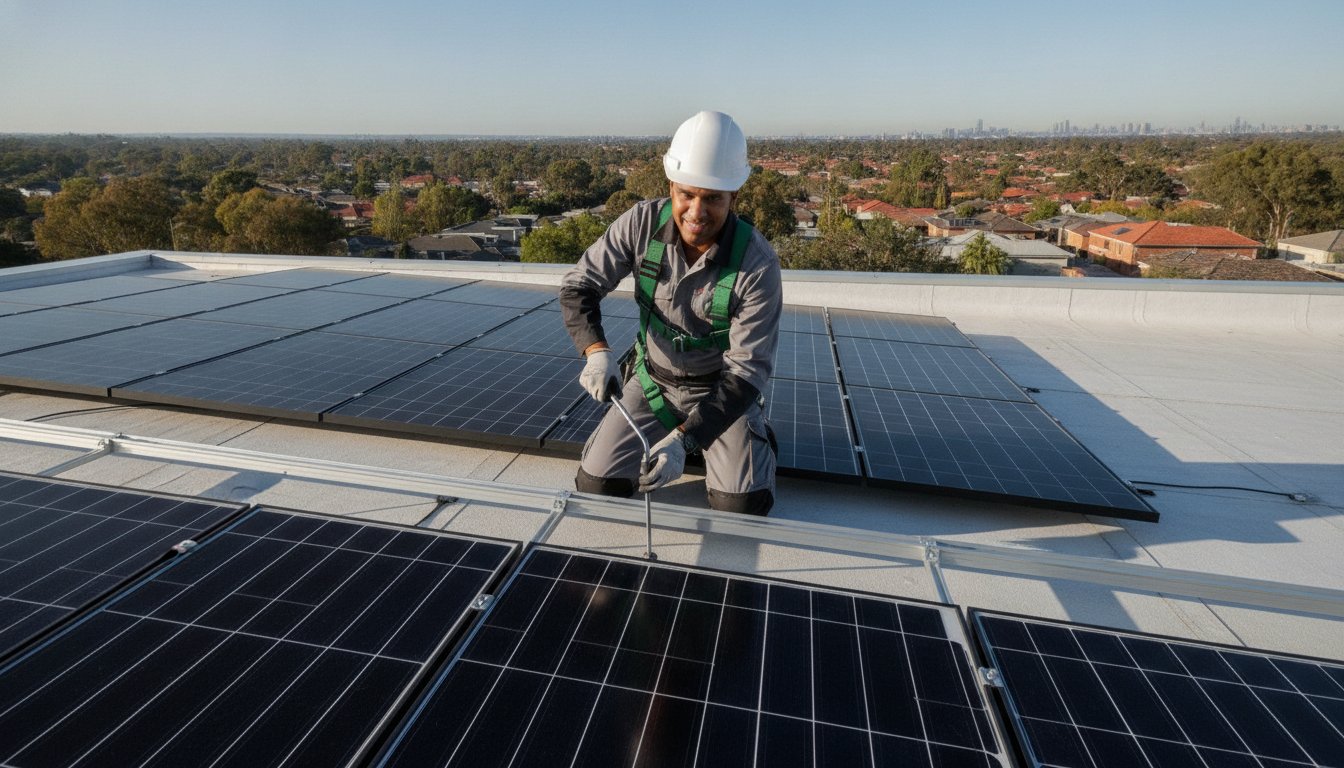
On 1 July 2026, thousands of Victorian families will lose access to solar incentives overnight. The window to capitalise on the current $210,000 income threshold is closing fast. As the state pivots toward the 2027 electrification mandates, the Victorian solar rebate 2026 represents your final opportunity to secure maximum funding before the cap drops to $150,000. It’s understandable to feel anxious about shifting regulations and the limited monthly rebate releases. You want lower power bills and a home that’s ready for a gas-free future.
We’re here to cut through the confusion. This guide provides a clear roadmap to securing up to $1,400 in rebates and an equivalent interest-free loan. You’ll learn how to stack state incentives with federal battery schemes to maximise your energy independence. We’ll outline the exact eligibility criteria and the application steps required to future-proof your home energy system before the 2027 mandates take effect. 2026 is no longer just about a discount; it’s a strategic race to electrify your home on the government’s dollar.
Key Takeaways
- Beat the 2027 mandates by understanding why 2026 is the final strategic window to secure government funding for your home’s energy transition.
- Master the new eligibility landscape, including the $150,000 income threshold, to lock in your Victorian solar rebate 2026 while monthly allocations remain.
- Identify the highest savings for your specific property type, whether you qualify for the $1,400 residential rebate or the $2,800 apartment incentive.
- Future-proof your system by stacking state rebates with Virtual Power Plants (VPPs) and smart battery storage to generate ongoing grid credits.
- Follow our clear, expert roadmap to navigate the Solar Victoria application process and ensure a seamless, compliant installation through an authorised retailer.
The 2026 Victorian Solar Landscape: Why This Year is Critical
2026 isn’t just another year for renewable energy in Victoria. It’s the final strategic window. The state is moving from optional incentives to mandatory electrification. This shift is rapid. It’s decisive. By securing the Victorian solar rebate 2026 now, you’re not just saving money; you’re future-proofing your property against the 2027 mandates. The current $1,400 rebate cap is a clear signal that government support is tapering. As adoption across the state nears 100 percent, these subsidies won’t last forever. The government is shifting its focus from encouraging early adopters to regulating the laggards.
Melbourne residents are already feeling the pressure. Authorised retailers are seeing a surge in bookings. Everyone wants to avoid the 2027 rush. Waiting until the mandates are in force is a gamble. It’s a race against time and rising installation demand. If you delay, you risk missing out on the monthly rebate releases that are already becoming more competitive. The goal is simple: get in before the rules get tighter and the queues get longer.
The 2027 All-Electric Mandate Explained
The Victorian government has set a clear deadline. From 1 January 2027, all new homes must be built all-electric. This isn’t just for new builds; existing properties face increasing pressure to ditch gas. Upgrading to solar and heat pump hot water systems is now a priority. The 2026 rebates act as a financial bridge. They help you meet future efficiency standards without the full upfront cost. Understanding the broader context of Solar power in Australia reveals that Victoria is leading this charge. Don’t get left behind. The transition is inevitable; the only variable is how much of it the government will pay for.
The July 2026 Income Threshold Pivot
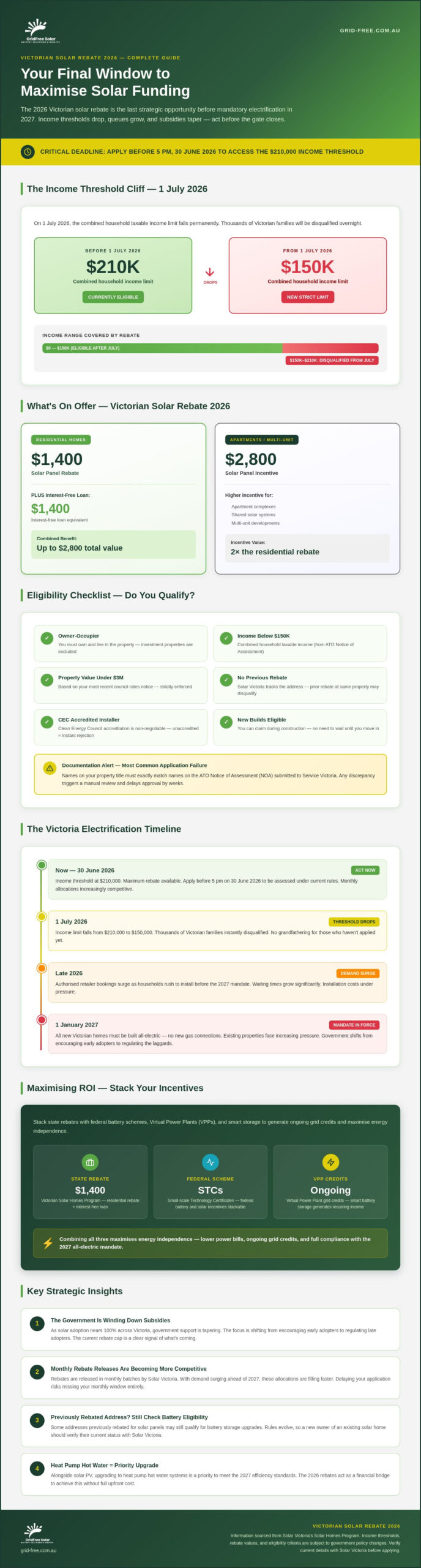
The most urgent deadline is 1 July 2026. On this date, the combined household taxable income limit drops. It’s falling from $210,000 to $150,000. This income cliff will disqualify thousands of Victorian families overnight. If your household earns between these two figures, your eligibility vanishes in July. You must apply before 5 pm on 30 June 2026 to be assessed under the old rules. There are limited exemptions for specific hardship cases and some Solstice Energy customers, but these are rare. Act now to lock in your status. The Victorian solar rebate 2026 is your best tool to lower upfront costs before the eligibility gate closes for good.
Victorian Solar Rebate Eligibility: Do You Qualify in 2026?
Eligibility isn’t a suggestion. It’s a rigid framework. To secure the Victorian solar rebate 2026, you must be an owner-occupier. The property value must sit below $3 million. This valuation is typically based on your most recent council rates notice. For Melbourne metro homes, this cap is firm. In regional Victoria, it’s equally strictly enforced. If your property exceeds this value, you won’t qualify for the primary residential stream. It’s that simple.
The “No Previous Rebate” rule is a common trap for new buyers. Solar Victoria tracks the address, not just the individual. If the property has previously received a rebate under the Victorian Government’s Solar Homes Program, it’s generally ineligible for a second PV discount. However, new owners of a previously “solared” home should still check their status. Rules change, and some addresses may qualify for battery upgrades even if the panels were rebated years ago.
Building a new home? Don’t wait until you move in. You can claim the rebate for systems under construction. This allows you to integrate solar into the build phase, often saving on installation complexities and costs later. Just ensure you use a Clean Energy Council (CEC) accredited provider. It’s non-negotiable. Without this accreditation, your application will be rejected instantly. Before you sign anything, verify your installer’s accreditation status to protect your investment and your rebate eligibility.
Financial Requirements and Documentation
Documentation is where most applications stall. You need your ATO Notice of Assessment (NOA) from the last financial year. It must prove a combined household taxable income of less than $150,000. This is a hard limit. Proving your income requires precision. Ensure all names on the property title match the names on the NOAs provided to Service Victoria. Any discrepancy will trigger a manual review and delay your approval by weeks.
Prepare your verification checklist early:
- Proof of identity for all owners (Driver’s licence or passport).
- Your most recent Council Rates notice.
- The ATO Notice of Assessment for the 2024-25 or 2025-26 financial year.
- A formal, itemised quote from an authorised solar retailer.
Interest-Free Loans: Doubling Your Upfront Savings
The rebate is only half the story. Eligible households can access an interest-free loan of up to $1,400. This matches the Victorian solar rebate 2026 dollar-for-dollar. It results in a $2,800 total reduction in your immediate out-of-pocket expenses. Repayment is simple. It’s usually a 4-year plan handled via small monthly instalments. These payments are often offset by the energy savings generated by the system itself. By removing interest costs, you accelerate your system’s payback period. It turns a long-term investment into an immediate cash-flow benefit for your household.
Residential vs. Apartments: Comparing Victoria’s 2026 Rebate Streams
Choosing the right rebate stream is a matter of property geometry and strategic stacking. For most detached homeowners, the Victorian solar rebate 2026 provides a $1,400 baseline discount on solar PV systems. It’s a proven, effective path to lower bills. However, if you live in a multi-unit development, the financial incentive doubles. The Solar for Apartments program offers up to $2,800 per household. This higher cap acknowledges the technical hurdles of strata-managed buildings. Landlords aren’t left out either. They can claim a $1,400 rebate for up to two rental properties per financial year, boosting property value while lowering tenant turnover.
According to official Solar Victoria rebate information, these streams ensure no Victorian is left behind in the electrification race. Whether you’re an owner-occupier in a suburban house or a tenant in a city unit, there’s a specific funding pool available. The key is knowing which one applies to your title. You must also understand how to stack it with other incentives like the $1,000 hot water rebate to maximise your ROI.
The Solar for Apartments Advantage
Apartments receive double the standard rebate because the logistics are tougher. Strata approvals and roof space sharing require precision. In 2026, eligible households in apartment blocks can access $2,800. This applies whether you install a shared solar system or individual units for specific apartments. Both qualify for the maximum grant. Navigating these complexities requires an authorised retailer with specific experience in multi-unit installations. They’ll handle the technical assessments. They’ll ensure the strata committee is on board with the plan. Don’t let strata red tape stop your transition to clean energy.
Stacking Incentives for Maximum Impact
Smart homeowners don’t just stop at PV. You can stack the solar panel rebate with a $1,000 heat pump hot water incentive simultaneously. This is a game-changer for gas-to-electric transitions. If you choose a Victorian-manufactured heat pump, that hot water rebate can even increase to $1,400. This “Locally Made” bonus supports local industry while slashing your upfront costs. To go further, you can combine these with federal battery storage discounts. Check our Victorian Battery Rebate 2024 to 2026 guide for storage-specific stacking strategies. Combining these streams effectively can reduce your total system cost by thousands. It ensures your home is fully electrified before the 2027 mandates arrive.
Maximising ROI: Stacking Rebates with VPPs and Smart Storage
Securing the Victorian solar rebate 2026 is just the baseline. It’s the foundation of your savings, not the ceiling. In 2026, real energy independence requires more than just panels. It requires smart storage. Without a battery, you’re forced to export excess power for minimal feed-in tariffs. In Melbourne, these export rates have plummeted. Self-consumption is now the only logical path to a rapid ROI. By storing your own solar energy, you avoid buying power during expensive peak windows. This is the “GridFree Advantage”. We integrate high-efficiency hardware with every available government incentive to ensure your system pays for itself faster than a basic, panel-only setup.
The math for Melbourne households is clear. Every kilowatt-hour you store and use yourself is worth significantly more than what you’d receive by selling it back to the grid. 2026 is the year where “smart” systems become mandatory for anyone serious about financial optimisation. It’s about shifting from being a passive consumer to an active energy manager. We design systems that don’t just generate power; they protect your bank account from rising retail electricity rates.
The Power of Virtual Power Plants (VPP)
Think of a VPP as a second rebate. It’s an ongoing financial incentive. By participating, you allow the Victorian grid to draw from your battery capacity during rare moments of extreme demand. In exchange, you earn significant credits. 2026 is the best year to join a VPP as Victoria stabilises its renewable grid. These payments act as a recurring subsidy for your hardware. It turns your home into a mini-power station that works for the community while padding your wallet. See our Solar Battery Cost Australia 2026 guide for detailed ROI breakdowns of these programs. Participation is the smartest way to accelerate your system’s payback period.
Smart Storage Optimisation
Hardware choice dictates your long-term success. We recommend LiFePO4 (Lithium Iron Phosphate) batteries. They are the gold standard for Victorian safety and longevity. They offer superior thermal stability. They handle the Melbourne climate without degrading over time. However, the battery is only as effective as the inverter managing it. Smart inverters automate your savings by charging during low-tariff windows and discharging when prices spike.
- Thermal Safety: LiFePO4 chemistry is inherently safer for residential areas.
- Cycle Life: These batteries last for thousands of cycles, ensuring a decade of reliability.
- Automated Logic: Smart systems switch between grid and battery power seamlessly.
GridFree Solar organises your entire system design to ensure full rebate compliance and maximum yield. Don’t settle for a basic setup that leaves money on the table. The Victorian solar rebate 2026 covers your entry, but smart storage secures your future. Request a custom ROI analysis for your home today.
How to Claim Your Victorian Solar Rebate: The GridFree Process
Securing the Victorian solar rebate 2026 is a race against administrative deadlines and monthly quota caps. It isn’t a passive wait. It’s a precise sequence of actions. The process is designed to be streamlined, but any clerical error can result in an immediate rejection. You need to move with purpose. The Victorian Government releases a set number of rebates each month. Once they’re gone, the portal closes until the next cycle. This delay doesn’t just stall your installation; it leaves you exposed to high energy prices for longer than necessary.
The GridFree roadmap simplifies the complexity. We’ve refined the application path into five clear stages:
- Step 1: The Authorised Quote. You cannot apply without a formal quote from a Solar Victoria authorised retailer. We provide an itemised, rebate-ready proposal that includes our unique retailer ID.
- Step 2: Eligibility Verification. You’ll use the Service Victoria app to verify your identity and income. Ensure your ATO Notice of Assessment is ready. Accuracy here is non-negotiable.
- Step 3: The Rebate Token. Once approved, Solar Victoria issues a digital token. This is your financial guarantee. It has an expiry date. You must act before it lapses.
- Step 4: Precision Installation. Our accredited teams perform the installation. We conduct a comprehensive safety audit. We ensure every component meets the 2026 efficiency standards.
- Step 5: Point-of-Sale Discount. We finalise the paperwork. The rebate amount is deducted directly from your invoice. You only pay the balance. Your energy savings commence the moment the system is commissioned.
Why Choice of Retailer Matters
Solar cowboys aren’t just a nuisance. They’re a financial liability. Unauthorised installers are disqualified from the Solar Homes Program. If you choose the wrong provider, you lose the rebate. It’s that simple. GridFree Solar takes the guesswork out of the equation. We handle the heavy lifting of technical documentation. We ensure your hardware is compliant with the latest grid requirements. Our Solar Panel Installation Melbourne services focus on long-term reliability and administrative ease. We don’t just install panels; we manage your transition to energy independence.
Next Steps for Melbourne Homeowners
The 2026 landscape is highly competitive. Monthly allocations are often exhausted within days of release. Waiting until the 2027 mandates are in full effect is a strategic mistake. You’ll face longer lead times and higher equipment costs. Book a site assessment today. We’ll determine your property’s true solar potential. We’ll identify the optimal configuration to maximise your Victorian solar rebate 2026 before the income threshold pivots on 1 July. Precision matters. Documentation is king. Don’t leave your savings to chance.
The window is closing. The incentives are tapering. Take control of your home’s energy future before the rules change again. Contact GridFree Solar today for a rebate-ready quote.
Secure Your Energy Independence Before the Window Closes
2026 is the final strategic opportunity to modernise your home with significant government support. The 1 July income threshold drop is a hard deadline. If your household earns between $150,000 and $210,000, your eligibility ends soon. Beyond the initial discount, the shift toward all-electric standards in 2027 makes solar and smart storage an essential upgrade rather than an optional one. By acting now, you lock in the Victorian solar rebate 2026 and protect your household from rising retail energy costs. It is the smartest financial move you can make for your property this year.
Don’t navigate the complex Solar Victoria portal alone. As a CEC Accredited Authorised Retailer, we are specialists in Victorian rebate navigation. Our expert Melbourne-based installation teams ensure your system is compliant, safe, and optimised for maximum yield. We handle the technical documentation so your claim is processed without delay. To ensure your roof is fully prepared for a new system, you can visit Leaf Stopper to discover gutter guard kits tailored for your roof profile. It’s time to stop paying for an expensive grid and start owning your energy. Take the first step toward a future-proofed home with a partner you can trust.
Secure Your 2026 Victorian Solar Rebate with GridFree Solar
Your path to a smarter, cheaper, and more reliable home energy system starts today. We look forward to helping you join the thousands of Victorians already saving with the sun.
Frequently Asked Questions
Can I get the Victorian solar rebate if I already have solar panels?
You generally cannot receive a second solar panel rebate for the same address. Solar Victoria tracks eligibility by property rather than the individual owner. However, you may still qualify for a battery rebate or a hot water incentive if those specific upgrades haven’t been subsidised at your location before. Check your property’s history to confirm your current status.
What is the household income limit for the 2026 Victorian solar rebate?
The combined household taxable income limit for the Victorian solar rebate 2026 is $210,000 for applications submitted before 5 pm on 30 June 2026. After this deadline, the threshold drops sharply to $150,000. This makes the first half of the year critical for many families. Act before the pivot to ensure you don’t lose access to funding.
How long does it take for the Victorian solar rebate to be approved?
Approval usually takes between two and five weeks. This timeline depends heavily on the accuracy of your documentation. Any errors in your ATO Notice of Assessment or council rates notice will cause delays. Providing a correct, itemised quote from an authorised retailer speeds up the verification process significantly.
Is there a specific rebate for solar batteries in Victoria in 2026?
Yes, but the focus has shifted toward federal support. From July 2025, the federal Cheaper Home Batteries Program provides a discount of approximately $3,720 for an eligible 10kWh battery system. You can stack this with state-level PV incentives to create a high-performance, hybrid energy system that maximises your independence from the grid.
Do I have to pay back the Victorian solar loan?
Yes, the interest-free loan must be repaid. It matches the $1,400 rebate amount. Most households repay the loan over a four-year period through manageable monthly instalments. Because there’s no interest, every dollar you pay goes directly toward the principal. This accelerates your system’s overall return on investment.
Can I claim the rebate for a rental property I own in Melbourne?
Yes, landlords can claim rebates for up to two rental properties per financial year. To qualify, the property must be valued at under $3 million. You’ll also need to sign a Solar Hub agreement with your tenants. It’s an effective way to increase property value while supporting the state’s transition to renewable energy.
What happens if the monthly rebate allocation for Victoria runs out?
You’ll need to wait for the next month’s release if the current allocation is exhausted. Solar Victoria releases a set number of rebates every month. Demand is often highest at the end of the financial year. Secure your quote and token early to avoid missing out during these peak periods.
Does the rebate cover the cost of a solar battery replacement?
The program supports battery installations for homes that already have solar but haven’t received a battery rebate before. It’s designed as a battery upgrade incentive. If your current storage system has failed and you meet the standard eligibility criteria, you can apply for the current battery subsidies to lower the cost of a modern replacement.