
In 2026, your Melbourne home is no longer just a place to live; it’s a high-performance power plant that should be working for your bank account. You’ve likely felt the frustration of soaring energy costs and the headache of deciphering complex rebate applications. Choosing an integrated solar battery solution shouldn’t feel like a gamble against obsolescence. We understand the pressure to get it right before the Victorian Solar Homes Program income cap drops to $150,000 on 1 July 2026.
This article proves that a unified system is the only way to guarantee total grid independence during peak times and secure automatic income through Virtual Power Plants. You’ll discover how to leverage the federal 30% discount while the latest 2026 technology orchestrates your energy trading behind the scenes. We’re stripping away the jargon to show you exactly how a single point of contact can manage your entire energy future, ensuring your investment remains at the cutting edge for years to come.
Key Takeaways
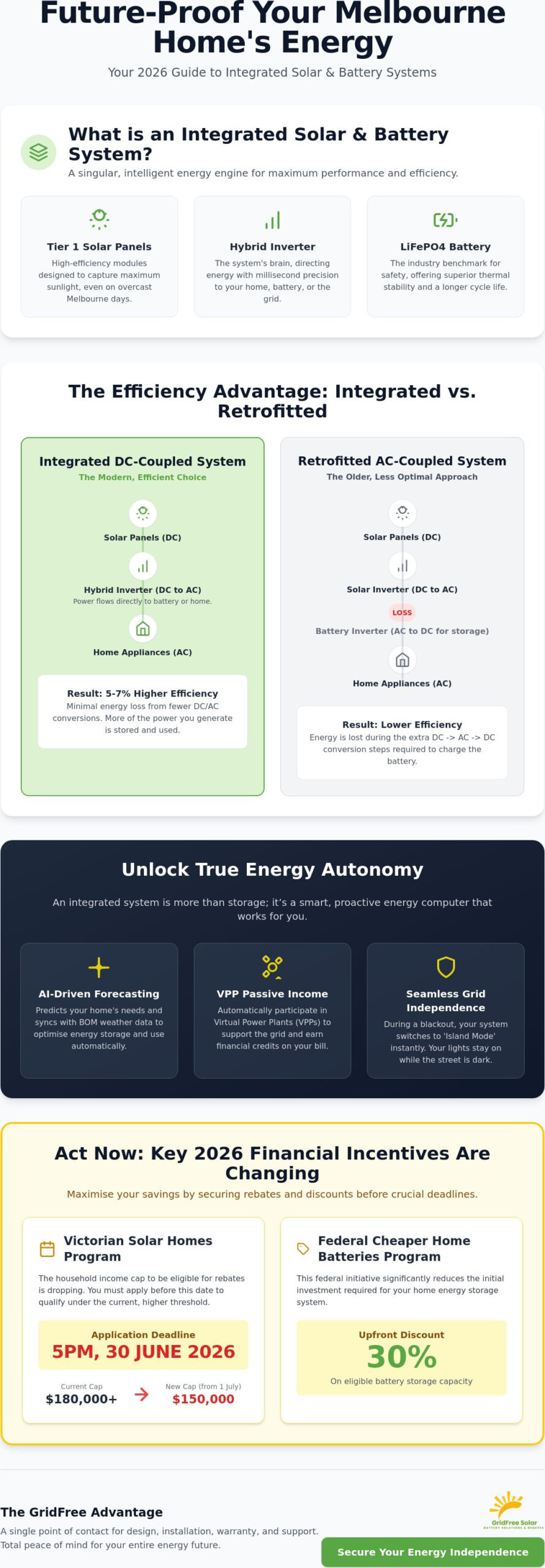
- Understand why a DC-coupled integrated solar battery solution provides a 5-7% efficiency boost over retrofitted systems by reducing energy conversion losses.
- Secure your financial future by applying for Victorian rebates before the household income cap decreases to $150,000 at 5 pm on 30 June 2026.
- Learn how AI-driven load forecasting and smart orchestration allow your home to automatically participate in Virtual Power Plants for passive income.
- Discover the ROI advantages of a unified energy ecosystem that combines panels, inverters, and storage into one streamlined, high-performance unit.
- Maximise your savings by leveraging the Federal Cheaper Home Batteries Program’s 30% upfront discount on eligible storage capacity.
What is an Integrated Solar Battery Solution?
Forget the clunky solar setups of the past. An integrated solar battery solution isn’t just a collection of separate parts bolted onto your roof; it’s a singular, intelligent energy engine. In 2026, Melbourne homeowners are moving away from piecemeal systems. They want hardware that speaks the same language from day one. This unified approach ensures your panels, inverter, and storage unit operate as a cohesive circuit. It eliminates the communication lag and compatibility friction found in older, mismatched setups.
The shift toward integration is driven by the Victorian Government’s mandate for all-electric new homes starting 1 January 2027. Forward-thinking residents are already adopting these systems as the current gold standard. By choosing an all-in-one build, you’re investing in a future-proofed asset. It’s about total command. Modern energy storage systems now rely on DC-coupling. This means the power generated by your panels flows directly into your battery without unnecessary conversions. It’s faster. It’s more efficient. It’s the only logical choice for a high-demand household.
The Components of a Modern Integrated System
Your system is only as strong as its weakest link. A premium integrated solar battery solution utilises three core pillars to maximise performance:
- Tier 1 Solar Panels: High-efficiency modules designed to capture every scrap of Melbourne’s variable sunlight, even on overcast days in the middle of July.
- Hybrid Inverters: The central nervous system. This single unit directs energy to your appliances, your battery, or the grid with millisecond precision.
- LiFePO4 Storage: Lithium Iron Phosphate batteries are the industry benchmark. They offer superior thermal stability and a longer cycle life than older lithium-ion variants.
Why Integration Beats the ‘Add-On’ Approach
Retrofitting a battery to an old solar array often feels like forcing a new engine into a vintage car. It works, but it isn’t optimal. Integrated systems win on efficiency. Every time you convert power from DC to AC and back again, you lose energy. Unified DC-coupled systems bypass these redundant steps. You keep more of the power you produce.
Simplicity is the other major win. You manage everything through a single monitoring app. No more juggling three different logins to see why your power bills are still high. Plus, if something goes wrong, you have one point of contact. One Melbourne-based team handles your warranty and support. It’s total peace of mind without the administrative run-around or finger-pointing between manufacturers.
Technical Advantages: Efficiency, VPPs, and Smart Orchestration
A modern integrated solar battery solution is far more than a storage tank for electricity. It’s a sophisticated energy computer. By using advanced Energy Management Systems (EMS), these units perform AI-driven load forecasting to predict your home’s needs before you even flick a switch. This isn’t guesswork. It’s a precise calculation that ensures you never pull from the grid when your battery can handle the load. You gain a level of autonomy that older, separate components simply cannot match.
Melbourne’s weather is notoriously erratic. One hour it’s clear skies; the next it’s a grey downpour. Integrated systems handle this volatility by syncing directly with Bureau of Meteorology (BOM) data. If the forecast predicts a week of storms, your system prioritises storage to keep your reserves high. During a Victorian summer heatwave, it knows to pre-cool your home using excess generation. This proactive approach turns your solar setup into a truly autonomous asset that reacts to the environment in real time.
The Power of Smart Orchestration
Orchestration is where the magic happens. Your system doesn’t just store power; it directs it where it’s needed most. It can automatically prioritise heavy-demand appliances like EV chargers or heat pumps during peak solar production. This ensures you’re running your home on free, clean energy rather than expensive grid power. If the grid fails, the transition to “Island Mode” is seamless. You won’t see a flicker on your TV or a reset on your oven clock. You stay powered while your neighbours sit in the dark.
VPP Participation in Victoria 2026
Your battery is a revenue-generating machine. By joining a Virtual Power Plant (VPP), you allow your system to support the grid during periods of extreme demand. In return, you receive financial credits or higher feed-in tariffs. This is only possible with VPP compatible solar batteries Victoria homeowners can rely on for rapid response times. It’s a community-led solution that stabilises the local Melbourne grid while slashing your remaining power bills.
Navigating these technical options is easier when you have the right local partner. To see how these smart features apply to your specific roofline, you can request a bespoke system design from our specialist team. We ensure your hardware is fully compliant with the latest Victorian rebates and incentives, maximising your ROI from day one. This isn’t just about saving money. It’s about taking total control of your energy future with a system that works as hard as you do.
Integrated vs. Retrofitted: Which Offers the Best ROI?
Deciding between a unified system and a staggered build is the most critical financial choice you’ll make for your home. A retrofitted system might look attractive on a spreadsheet today, but it’s often a false economy. An integrated solar battery solution provides a documented efficiency boost of 5-7% over AC-coupled retrofits. This isn’t just a technicality. Because power remains in DC format from the panels straight to the cells, you stop bleeding energy through redundant conversions. Over the ten-year life of your system, those savings add up to thousands of dollars back in your pocket.
Maintenance costs also diverge sharply. A retrofitted setup typically relies on two separate inverters. Each has its own internal fans, capacitors, and failure points. One might be five years older than the other, leading to mismatched performance and staggered replacement costs. An integrated system uses one high-performance hybrid unit to orchestrate the entire flow. You have half the hardware to monitor. You have half the risk of a component failing during a Melbourne summer peak. It’s cleaner engineering that leads to a more robust bottom line.
Financial Breakdown: The Cost of Integration
Labour is the hidden killer of ROI in two-stage builds. Installing panels now and a battery later means paying for two site visits, two sets of electrical permits, and two rounds of switchboard modifications. It’s inefficient. By choosing a unified install, you streamline the entire process into a single day. For a transparent look at the current market, check our solar battery cost Australia 2026 guide. We break down exactly why the upfront investment in integration pays for itself faster through reduced installation overheads and superior energy retention.
Warranty and Support Security
The “No Finger Pointing” advantage is your ultimate safety net. If a retrofitted system underperforms, the battery manufacturer often blames the solar inverter, while the solar installer points at the battery. You’re left stranded in the middle. With an integrated setup, there is only one neck to wring. Software updates are pushed as a single, verified package for the entire hardware stack. This ensures your system is always perfectly tuned for the latest advancements in VPPs and Smart Orchestration. Our local Melbourne support team handles the lot, so you can stop worrying about technical friction and start focusing on your savings.
Navigating Victorian Rebates and Incentives in 2026
The financial landscape for solar in Victoria has shifted dramatically this year. If you’ve been waiting for the “perfect time” to invest, the clock is officially ticking. As of June 2026, the Victorian Solar Homes Program continues to offer a rebate of up to $1,400 for eligible solar panel installations, alongside an interest-free loan of the same amount. However, the most urgent change arrives on 1 July 2026. On this date, the combined household taxable income cap for eligibility will drop from $210,000 to $150,000. You must submit your application by 5 pm on 30 June 2026 to be assessed under the more generous higher cap. Missing this window could cost your household thousands in lost incentives.
While the state-level interest-free battery loan has closed, the Federal Government has stepped in with the expanded Cheaper Home Batteries Program. This initiative provides an upfront discount of approximately 30% on the cost of an eligible integrated solar battery solution. Administered through the Small-scale Renewable Energy Scheme (SRES), this discount is not means-tested, making it accessible to all Melbourne homeowners. Since 1 May 2026, this rebate has followed a tiered structure. You receive the full rebate rate for the first 14kWh of capacity, with reduced rates applied to capacity between 14kWh and 50kWh. It rewards those who choose right-sized, efficient storage for their specific home needs.
Step-by-Step Rebate Application
Securing your funding shouldn’t be a bureaucratic nightmare. We’ve refined the process into three clear steps to ensure you don’t miss out on available funds:
- Professional Quote: We provide a detailed technical proposal for a CEC-approved system tailored to your property.
- Portal Verification: You upload your quote to the Solar Victoria portal to confirm your eligibility for the $1,400 rebate.
- Admin Handover: Our team manages the complex SRES federal paperwork to ensure your 30% battery discount is applied directly to your point-of-sale invoice.
Maximising the ROI of Your Rebate
2026 is a pivotal year for Melbourne. With the Victorian Government mandating that all new homes be all-electric from 1 January 2027, the demand for high-performance storage is skyrocketing. Smart homeowners are using current rebates to bridge the price gap between basic setups and premium integrated systems. This strategy ensures your home is ready for the 1 March 2027 requirement to replace gas hot water with electric alternatives. For a comprehensive breakdown of load shifting, self-consumption strategies, and how to maximise solar savings in 2026 as a Melbourne homeowner, our definitive guide covers every tactic available before the income threshold drops. For business owners, these incentives can be even more lucrative when paired with a commercial solar installation Melbourne wide, allowing for rapid depreciation and massive operational savings.
Don’t let the 30 June deadline pass you by while you’re still undecided. You can claim your rebate assessment now and lock in the $210,000 income cap before it disappears forever. Our specialists are ready to fast-track your application, ensuring your transition to a fully integrated energy ecosystem is seamless, compliant, and maximised for every available cent of government support.
The GridFree Advantage: Your Melbourne Integration Partner
Choosing the right hardware is only half the battle. You need a partner who understands the specific electrical architecture of Victoria. GridFree Solar specialises in designing bespoke energy ecosystems that thrive in our local conditions. We don’t believe in “cookie-cutter” solar. Every integrated solar battery solution we install is engineered to withstand Melbourne’s unique coastal winds and rapid temperature shifts. We use only Clean Energy Council (CEC) approved hardware. This isn’t just about compliance. It’s about ensuring your system outlives its warranty and delivers on its performance promises.
Quality matters most when your existing setup reaches its limit. If you have a legacy system that’s failing to keep up with 2026 energy demands, we provide expert solar battery replacement Melbourne services. We don’t just swap a box. We recalibrate your entire array to ensure your new storage unit performs at peak efficiency. Our end-to-end service covers everything. We handle the initial site assessment, the complex technical design, and the final VPP onboarding. You get a single point of contact for the life of your system. No middlemen. No excuses.
Our Local Melbourne Expertise
Melbourne’s grid is a patchwork of different distributors. Whether you’re on the United Energy, CitiPower, Powercor, or AusNet network, we know the local export limits and grid protection requirements. We don’t guess. We verify every technical detail. Our team designs customised mounting solutions for every roof type, from heritage terracotta tiles in Camberwell to modern Colorbond in Point Cook. Once installed, our ongoing monitoring ensures your ROI stays on track. We watch the data. If a panel underperforms or a setting needs tuning, we act. It’s proactive care that protects your investment.
Start Your Journey to Energy Independence
The path to total autonomy starts with data. We conduct a detailed energy audit for your property to map your 24-hour usage profile. This allows us to size your battery and panel array with surgical precision. Don’t settle for a system that leaves you drawing from the grid at 7 pm when prices are at their highest. We customise your integrated solution based on when you actually use power. Join the hundreds of Melbourne families already living grid-free. Take control of your bills. Secure your energy future today with a specialist team that puts your independence first.
Secure Your Energy Future Before the 30 June Deadline
The opportunity to maximise your financial return is rapidly narrowing. By 5 pm on 30 June 2026, the Victorian rebate income cap drops significantly, making immediate action essential for many households. An integrated solar battery solution remains the most efficient way to achieve total grid independence while staying ahead of the 2027 electrification mandates. You’ve seen the evidence. Unified systems save more energy, participate in VPPs automatically, and eliminate the technical friction of retrofitting. They are the definitive standard for the modern Melbourne home.
GridFree Solar is ready to fast-track your installation. As Clean Energy Council Accredited Installers and specialists in Victorian rebate claims, we handle the administrative burden so you don’t have to. We provide expert local Melbourne support to keep your energy engine running at peak performance for years to come. Don’t wait for the next power price hike to regret a delay. Take control of your energy destiny with a system designed for the future.
Get Your Custom Integrated Solar Quote Today
Your home deserves the most intelligent technology available. We’re here to make your transition to a grid-free lifestyle seamless, secure, and highly profitable.
Frequently Asked Questions
What is the difference between an integrated battery and an add-on battery?
An integrated battery shares a single hybrid inverter with your solar panels, whereas an add-on battery requires its own separate inverter to convert power. This unified approach reduces the physical footprint in your garage or on your exterior wall. It ensures that every component is designed to communicate perfectly, eliminating the technical glitches often found in mixed-brand retrofitted setups.
Can I participate in a VPP with any integrated solar battery solution?
No, participation requires specific hardware and software that can respond to grid signals in real-time. Choosing an integrated solar battery solution that is specifically listed as VPP-compatible is the only way to guarantee eligibility for these programs. These systems allow your provider to orchestrate energy trading during peak demand events to generate extra income for your household.
How long does a fully integrated solar battery system last in Melbourne?
A high-quality system should last between 10 and 15 years, provided it uses Lithium Iron Phosphate (LiFePO4) technology. Melbourne’s variable climate can stress older battery types, but modern integrated units feature advanced thermal management to maintain efficiency during summer heatwaves. Regular software updates from the manufacturer also help extend the operational life by optimising charge and discharge cycles.
Do I need to upgrade my switchboard for an integrated solar battery solution?
Most Melbourne homes built before 2010 will require a switchboard assessment to ensure they can safely handle the additional load of a battery. Your switchboard must have enough space for new circuit breakers and smart meters that monitor your energy flow. We include a comprehensive electrical audit in our site assessment to identify any necessary upgrades before the installation begins.
Are there still solar battery rebates available in Victoria for 2026?
Yes, significant incentives remain, though the rules are changing rapidly this month. You can still access the $1,400 Victorian solar panel rebate and the 30% federal battery discount through the SRES scheme. Remember that you must apply before 5 pm on 30 June 2026 to be eligible under the higher $210,000 household income cap before it drops to $150,000.
Will an integrated system work during a Melbourne power outage?
An integrated system will power your home during a blackout if it is configured with “Island Mode” or backup capabilities. Unlike standard solar-only setups that shut down during an outage for safety, these systems can automatically disconnect from the grid and use stored energy to keep your essential appliances running. It provides immediate security for your family without the need for manual intervention.
How much can I actually save with an integrated system compared to just solar panels?
Savings increase significantly because you stop selling excess solar to the grid for low feed-in tariffs and start using it yourself during expensive peak periods. While solar panels alone might save you money during the day, an integrated solar battery solution targets the high-cost evening window. When combined with VPP participation, many Melbourne homeowners report a substantial reduction in their remaining quarterly electricity bills.
Is an integrated system suitable for small Melbourne businesses?
Small businesses in Melbourne benefit immensely from integration, especially those with high evening operational costs or critical refrigeration needs. With the Victorian Government mandating all-electric transitions for new builds by 1 January 2027, installing a unified system now is a smart way to future-proof your commercial premises. It offers a single point of monitoring for your entire energy profile, making ROI tracking simple.