In 2026, chasing high feed-in tariffs is a losing game for Victorian homeowners. The real profit isn’t in what you sell back to the grid. It’s in what you never buy from it in the first place. Calculating your solar panel payback period Victoria has become more complex as the Essential Services Commission moves away from mandated minimum export rates. You’re likely frustrated by shrinking credits on your bill and the tightening A$150,000 household income cap for state rebates. It’s a confusing landscape that demands a smarter, data-driven approach to energy independence.
We agree that your investment should offer clear, predictable returns. You deserve to know exactly when your system starts putting money back into your pocket. This guide provides that clarity. We’ll use the latest 2026 rebate data and energy price forecasts to show you how a 6.6kW system can still pay for itself in 4 to 6 years. You will discover how to navigate the new federal battery discounts, capitalise on “solar soak” tariffs, and choose a system size that maximises your ROI in this deregulated market.
Key Takeaways
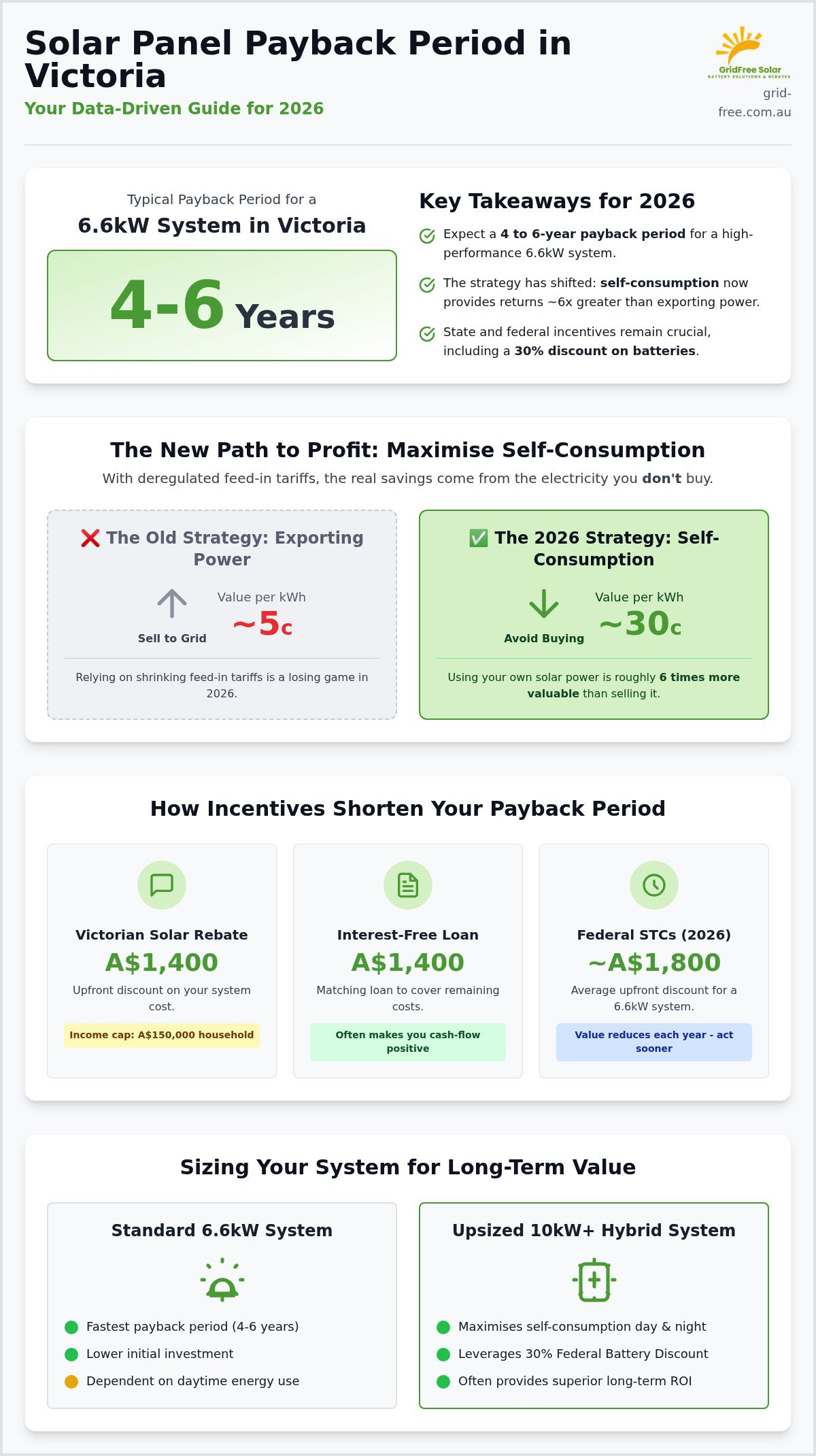
- Calculate your 2026 ROI with precision. Expect a standard solar panel payback period Victoria of 4 to 6 years for a high-performance 6.6kW system.
- Maximise local incentives. Secure up to A$1,400 in rebates and matching interest-free loans while navigating the updated A$150,000 household income threshold.
- Pivot to self-consumption. Learn why deregulated feed-in tariffs make “solar soaking” and smart load shifting the fastest path to energy independence.
- Leverage federal battery discounts. Access the 30% national subsidy to lower upfront costs and increase your system’s daily utility.
- Size for long-term value. Discover why bespoke 10kW hybrid designs often outperform entry-level kits in the current Victorian energy market.
What is a Solar Payback Period and Why Does Victoria Differ?
Understanding your return on investment begins with a simple definition. What is a Solar Payback Period? It’s the precise amount of time it takes for the cumulative electricity bill savings to equal the net upfront cost of your installation. While most Australians look at a generic national average, Victoria operates on an entirely different financial playing field. Determining your solar panel payback period Victoria requires looking at local variables that don’t exist in other states.
Victoria is unique because of the aggressive support from the state government. The current 2026 landscape features a combination of direct rebates and interest-free loans that significantly lower the entry barrier. However, the Essential Services Commission has deregulated feed-in tariffs, meaning you can’t rely on selling power back to the grid to make your money. Instead, the 2026 context is defined by rising retail prices. Every kilowatt-hour you generate and use yourself is worth significantly more than what a retailer will pay you for it. This shift has actually shortened payback periods for those who know how to optimise their consumption.
The Basic ROI Formula for Melburnians
Calculating your return isn’t just about the sticker price. You must use a localised formula: (Gross System Cost minus State and Federal Rebates) divided by Annual Energy Savings. In 2026, the “avoided cost” of grid power is roughly three times more valuable than the credit you receive for exporting energy. If you pay 30 cents per kWh to your retailer but only receive 5 cents for exporting, your ROI accelerates every time you run a heavy appliance during peak sun hours. Current Victorian energy price forecasts suggest retail rates will remain high, making the “avoided cost” your most powerful financial lever.
Why Net Zero Upfront Cost Changes the Math
The most compelling reason Victoria differs is the Solar Victoria interest-free loan. Eligible households can access a rebate of up to A$1,400 plus an additional interest-free loan of A$1,400. This effectively slashes the initial capital outlay. When you combine these incentives, many Victorian homeowners find themselves in a “cash-flow positive” position from the very first month.
- Immediate Savings: Your monthly bill reduction often exceeds the small loan repayment.
- Psychological Shift: You aren’t “paying off” a debt for five years; you’re simply redirecting existing utility spending into an asset you own.
- Asset Growth: The solar panel payback period Victoria becomes less about a distant break-even point and more about immediate monthly profit.
By leveraging these state-specific mechanisms, the transition to solar becomes a logical financial upgrade rather than a burdensome expense. You aren’t just buying panels; you’re locking in a lower cost of living for the next 25 years.
The Victorian Variables: Rebates, Loans, and Energy Prices
Your 2026 financial strategy must account for the recent tightening of state incentives. As of July 1, 2026, the combined household taxable income cap for the Victorian Solar Homes Program has been lowered to A$150,000. If you sit above this threshold, you lose access to the A$1,400 rebate and the matching interest-free loan. For eligible Melbourne residents, this government support remains the single biggest factor in compressing the solar panel payback period Victoria. It’s a “use it or lose it” opportunity that transforms a significant capital expense into a manageable, interest-free investment.
Federal incentives also play a critical role, though they are designed to phase out. Small-scale Technology Certificates (STCs) act as an upfront discount on your system. For a standard 6.6kW installation in 2026, these certificates provide a reduction of approximately A$1,600 to A$2,050. Because the STC multiplier reduces every January, the “solar discount” shrinks annually. Delaying your installation doesn’t just defer savings; it actively increases your net system cost. When you factor in the Victorian Default Offer (VDO) benchmark, which dictates the ceiling for retail prices, the urgency to lock in these subsidies becomes clear.
Navigating the Victorian Battery Rebate in 2026
The landscape for energy storage has shifted significantly. While the state-based loan program is now closed to new applicants, savvy homeowners are pivoting to the national “Cheaper Home Batteries” program. This provides a roughly 30% discount on upfront costs. You can find a detailed breakdown of these transitions in our guide to the Victorian Battery Rebate 2024 to 2026. Integrating a battery doesn’t just store power; it allows you to join Virtual Power Plants (VPPs), which can provide additional credits for discharging energy during grid peak events, further accelerating your ROI.
Feed-in Tariffs (FiT) in Victoria: The Hard Truth
Stop looking at your export rate as a primary income stream. The Essential Services Commission no longer mandates a minimum feed-in tariff, leaving retailers to offer as little as 0.00 cents per kWh. With the 2026 average retailer FiT sitting at a mere 0.8 cents, exporting power is no longer profitable. Contrast this with retail peak rates that can soar to 35 cents per kWh. Your financial success depends entirely on “Solar Noon” load shifting. By running high-draw appliances like dishwashers and heat pumps during the middle of the day, you’re “buying” your own power for free instead of selling it for crumbs. If you’re ready to optimise your energy consumption, we can design a system that targets this high-value self-consumption window.
Panels Only vs. Integrated Battery Systems: ROI Comparison
Choosing between a lean, panels-only setup and a robust hybrid system is the most critical decision for your 2026 ROI. A standard 6.6kW panel-only system remains the “classic” choice for rapid returns. It offers a solar panel payback period Victoria of roughly 4 to 6 years. It’s the fastest route to breaking even. However, we’re seeing a massive shift toward 10kW hybrid systems. This isn’t just about size. It’s about survival. As retail rates climb, the ability to store and use every single watt becomes more valuable than the speed of the initial payback. The grid is becoming your backup, while your roof becomes your primary powerhouse.
This introduces the “Battery Paradox.” A battery increases your upfront investment and technically extends the calendar days until you hit the break-even point. Yet, it provides absolute protection against future price hikes. In 2026, a typical Melbourne household using 20kWh per day can save significantly more annually with a hybrid system compared to panels alone. You’re trading a slightly longer wait for much higher total profit over the system’s 25-year lifespan. You aren’t just paying off a system; you’re building a fence around your finances to keep out rising utility costs.
Why Melbourne Weather Influences Your Payback
Melbourne’s infamous “four seasons in one day” makes component quality non-negotiable for ROI. Cloudy winters and sudden shifts in irradiance mean entry-level panels often fail to trigger the inverter. You need high-efficiency N-type panels to harvest energy in low-light conditions. The precision of your solar panel installation Melbourne directly dictates your winter yield. Poorly oriented or low-grade panels can extend your payback by years simply by underperforming when the sun isn’t at its peak. Don’t let a cheap kit turn a 5-year payback into a 10-year disappointment.
The ROI of Battery Replacements and Upgrades
For those with ageing systems, the math has changed. You might need to replace solar battery Melbourne if your current storage has lost more than 30% of its original capacity. Modern Lithium Iron Phosphate (LiFePO4) units offer significantly higher cycle life compared to early lithium-ion or lead-acid tech. Adding a new battery to an existing array “resets” your savings potential. It allows you to salvage the ROI of an older system that’s currently exporting too much cheap power to the grid. By upgrading the storage, you transform a legacy system into a modern, cash-saving asset.
5 Ways to Shorten Your Payback Period in 2026
Your solar panel payback period Victoria isn’t a static number. It’s a performance metric you can actively influence. Passive systems leave money on the table. In 2026, the gap between retail electricity costs and feed-in credits is wider than ever. Closing that gap requires a strategic shift from being a generator to being an intelligent consumer. You must move beyond the “set and forget” mindset to secure the fastest possible return.
- Master Load Shifting: Move your heavy lifting to the middle of the day. Programming your dishwasher, washing machine, and pool pump for 11:00 am ensures you use free solar power instead of expensive 35 cent grid power.
- Right-Size Your Array: Small systems often fail to cover base loads on cloudy Melbourne days. Over-sizing your system by 20% provides a “buffer” that keeps you off the grid during low-light periods, offering better long-term ROI.
- Deploy Smart Monitoring: Use real-time data to identify “energy vampires.” Hunting down old, inefficient fridges or phantom standby loads can shave months off your payback timeline.
- Commit to Maintenance: Victorian dust and pollen can sap your yield. A simple annual clean ensures your high-efficiency panels perform at their nameplate rating, protecting that vital 5% of potential ROI.
- Join a Virtual Power Plant (VPP): If you have a battery, capitalise on grid events. VPPs pay premium rates for your stored energy during peak demand, creating a passive revenue stream that shortens your break-even date.
Optimising for Time-of-Use (ToU) Tariffs
Victorian retailers are increasingly pushing Time-of-Use tariffs with aggressive evening peaks. You must avoid drawing from the grid between 4:00 pm and 9:00 pm. Modern smart inverters can automate this logic. They prioritise charging your battery and running appliances during the “solar sweet spot” while ensuring you remain self-sufficient during expensive peak windows. This hands-off optimisation is the fastest way to squeeze every cent of value from your hardware without changing your lifestyle. Implementing these active management strategies can slash your solar panel payback period Victoria by up to 18 months.
Commercial ROI: Payback for Victorian Businesses
For Melbourne enterprises, the math is even more compelling. A commercial solar installation Melbourne often sees a payback period of under 4 years. Businesses benefit from instant asset write-offs and accelerated depreciation schedules that residential users cannot access. More importantly, solar directly combats peak demand charges. These hidden fees are based on your highest point of usage. By shaving those peaks with solar, you don’t just save on kWh; you slash your entire tariff structure. If you’re ready to secure these returns, request a bespoke ROI audit for your property today.
Future-Proofing Your ROI with GridFree Solar
Generic solar kits are a financial gamble. They ignore your roof’s specific pitch, local shading, and your household’s unique consumption profile. A “cookie-cutter” approach can extend your solar panel payback period Victoria by several years through sheer inefficiency. At GridFree Solar, we reject the average. We focus on bespoke precision engineering that ensures every photon is captured and utilised. Expertise matters. Results follow.
Our commitment to high-efficiency components isn’t just about performance; it’s about endurance. We select hardware rated for 25+ years of service. This means once your system breaks even, you enjoy two decades of pure, tax-free profit. We also remove the administrative burden. Navigating the 2026 Solar Victoria rebate landscape is complex. We handle the applications for the A$1,400 rebate and matching interest-free loan on your behalf. We ensure your submission meets the A$150,000 income threshold requirements before the program reaches its capacity.
Local Melbourne support is our backbone. If your system requires optimisation or a technical check, our team is minutes away, not in a different time zone. We also specialise in battery upgrades for existing systems. This allows you to salvage the ROI of an older installation that’s currently underperforming in the new low-export market. We transform legacy arrays into modern, high-yield assets.
The GridFree Advantage: Precision Engineering
We use advanced shading analysis to ensure every panel earns its keep. Even a small amount of morning shadow from a chimney can cripple a standard system’s output. Our energy storage solutions Melbourne focus on achieving total grid independence. We don’t just hang panels on a roof; we integrate a smart energy ecosystem. Our professional installation protects your roof’s integrity and your long-term investment. We build systems that survive Melbourne’s harshest storms while maintaining peak efficiency.
Ready to Start Your Savings Journey?
Taking control of your energy costs requires a clear, methodical plan. We’ve streamlined the process to move you from uncertainty to energy independence as quickly as possible. Every day you wait is another day of paying high retail rates to the grid.
- Step 1: Free site assessment and a comprehensive ROI forecast tailored to your specific roof.
- Step 2: Rebate eligibility check and full application support for Victorian state incentives.
- Step 3: Precision installation by Melbourne’s solar leaders using Tier-1 components.
Don’t leave your financial future to chance. Get your personalised Victorian solar ROI forecast today and see exactly how much you can save in 2026.
Secure Your Energy Independence Today
The 2026 energy landscape in Melbourne is no longer about selling power to retailers for pennies. It’s about total grid independence and intelligent self-consumption. By leveraging the A$1,400 state rebate and mastering load shifting, you can achieve a solar panel payback period Victoria of just 4 to 6 years. This isn’t just a home improvement; it’s a strategic financial upgrade designed to shield your household from rising retail prices.
GridFree Solar brings Red Dot level design thinking to every Melbourne home. We are specialists in Victorian Battery Rebate claims and local Melbourne-based expert installers who understand our unique climate. We don’t just hang panels; we engineer ecosystems that deliver immediate cash-flow positivity. Don’t let confusing bills dictate your future. Take the first step toward a smarter, more efficient home today.
Maximise your Victorian solar savings-get a precision quote from GridFree Solar today.
Your path to permanent energy savings starts with a single, data-backed decision. Join the thousands of Victorians who’ve already secured their financial future through sunshine.
Frequently Asked Questions
Is solar still worth it in Victoria with lower feed-in tariffs?
Yes, solar remains a high-yield investment because the financial focus has shifted entirely to self-consumption. With retail electricity prices around 35 cents per kWh and feed-in tariffs often below 1 cent, your profit comes from avoiding grid purchases. By using your own power for heavy appliances, you lock in massive savings that far outweigh the loss of export credits. It’s about energy independence, not selling to the grid.
How much does the average solar system cost in Melbourne after rebates?
For a standard 6.6kW system, Melburnians can expect a net cost of approximately A$5,000 to A$5,500 after applying the A$1,400 Solar Victoria rebate. This figure varies based on component quality and installation complexity. Remember that the federal STC discount is already applied by most installers at the point of sale, further reducing the upfront capital required to start your savings journey in 2026.
Do I qualify for the Victorian solar panel rebate in 2026?
To qualify for the 2026 rebate, your combined household taxable income must be under A$150,000 per year. Additionally, the property must be valued at less than A$3 million and you must be the owner-occupier. Landlords can also apply for up to two rental properties per financial year. These tightening thresholds mean checking your eligibility early is vital to secure your funding before the caps are reached.
How long does a 6.6kW solar system take to pay for itself?
The typical solar panel payback period Victoria for a 6.6kW system is currently between 4 to 6 years. This timeline is heavily influenced by how much solar energy you consume during daylight hours. Households that shift their usage to “Solar Noon” see the fastest returns. Systems that qualify for the full state rebate and interest-free loan often reach cash-flow positivity almost immediately after installation.
Does adding a battery make the payback period longer or shorter?
Adding a battery generally extends the calendar payback period because of the higher initial cost. However, it significantly increases your total long-term savings by capturing power that would otherwise be exported for negligible credits. With the 30% national battery discount available in 2026, the “payback gap” between panels and hybrid systems is closing, offering much better protection against expensive evening peak rates and grid volatility.
What happens to my payback period if energy prices go up again?
Rising energy prices will shorten your payback period significantly. When the cost of grid electricity increases, the “avoided cost” of every kilowatt-hour your panels produce becomes more valuable. If retail rates jump by 10%, your annual savings increase proportionally, bringing your break-even point forward. Solar acts as a permanent hedge, ensuring your solar panel payback period Victoria improves even as utility costs become more unpredictable.
Can businesses claim different solar rebates than residential homes in Victoria?
Yes, Victorian businesses access different financial mechanisms than residential homes. While they don’t receive the standard Solar Homes rebate, they can utilise instant asset write-offs and accelerated depreciation schedules. Commercial installations often target peak demand charges, which are a major component of business energy bills. This often results in a payback period of less than 4 years for many enterprises due to higher daytime energy usage.
How do Victorian interest-free loans work for solar installations?
Solar Victoria provides an interest-free loan of up to A$1,400 to match the rebate amount. This loan is repaid in small instalments over a four-year period. It effectively removes the upfront cost barrier, allowing you to install a system using government funds. Because your monthly electricity savings often exceed the loan repayment, your household can become cash-flow positive from day one without any initial capital outlay.