
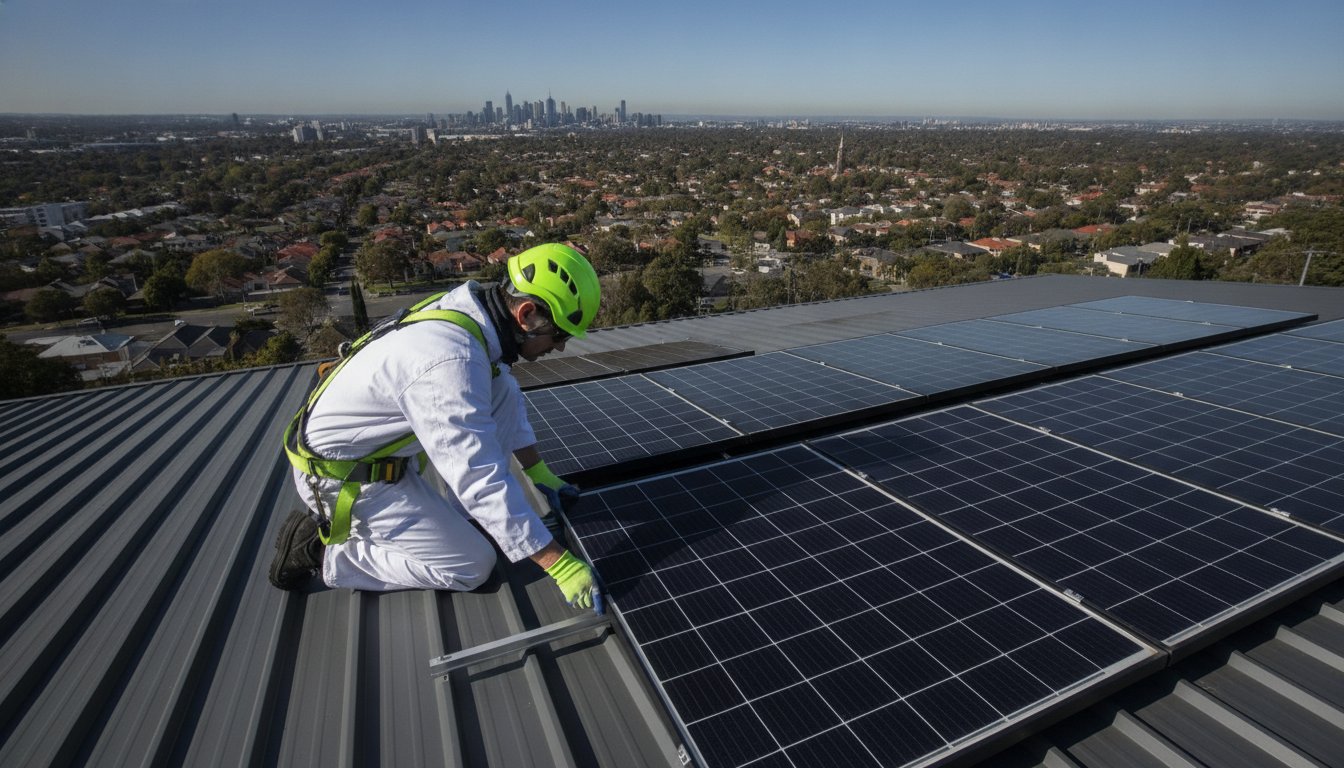
The cheapest quote on your desk is likely a financial trap. In a market where export tariffs have plummeted, chasing the lowest solar panel installation cost Melbourne 2026 has to offer often leads to failing components and missed ROI. You’re right to be wary of cut-price installers who vanish when the first Melbourne storm hits. With the Solar Victoria income cap now tightened to $150,000 as of July 2026, securing your energy independence requires a smarter, more technical approach than simply slapping panels on a roof.
It’s frustrating to watch electricity bills climb while rebates for your home seem to shrink. We understand the pressure to get this investment right before the federal STC deeming rate drops even further. This guide promises to cut through the noise, offering a definitive breakdown of how to maximise the $1,400 Victorian rebate and why a battery is no longer optional in 2026. We will preview current price ranges for various system sizes, evaluate the ROI of modern storage solutions, and show you how to select a local specialist who actually understands the Victorian grid.
Key Takeaways
- Identify the financial risks of “budget” quotes and learn how to select high-performance components engineered for Melbourne’s volatile weather conditions.
- Navigate the updated Solar Victoria eligibility rules, including the $150,000 income cap, to secure your $1,400 rebate and accurately project your solar panel installation cost Melbourne 2026.
- Compare the efficiency of microinverters and optimisers against traditional string systems to maximise energy yield on complex Melbourne rooflines.
- Understand why integrated battery storage has become the definitive strategy for 2026 to offset shrinking feed-in tariffs and achieve true energy independence.
- Follow a professional 2026 checklist to verify NETCC accreditation and ensure your installer provides a site-specific shading analysis before you sign.
The Real Cost of Solar in Melbourne: 2026 Market Analysis
Melbourne’s energy market has reached a critical junction. While the rest of the country looks at national averages, Victorian homeowners face a unique set of variables that dictate the true solar panel installation cost Melbourne 2026. It is no longer just about the hardware. It is about how that hardware interacts with a complex, aging grid and a regulatory environment that is shifting rapidly toward self-consumption. As Solar power in Australia continues its rapid expansion, Melbourne remains a distinct outlier due to its specific network requirements and architectural challenges.
Your local network distributor plays a massive role in your final quote. Whether you are under Citipower, Jemena, Powercor, or United Energy, each has different rules regarding export limits and grid protection devices. If you live in a high-density inner suburb, you might face strict zero-export mandates. This technical hurdle often requires sophisticated smart meters or phase balancing, adding a layer of complexity that “budget” installers often fail to mention until the day of installation. We also see a consistent “Melbourne Premium” in quotes for double-storey homes in newer estates and heritage-listed properties in the inner north. Scaffolding requirements and specialised mounting kits for slate or terracotta tiles can add significant labour costs that are non-negotiable for a safe, compliant build.
Why 2026 is Different for Melbourne Homeowners
The year 2026 marks a definitive shift in ROI calculations. We have moved past the era of “solar only” systems. With export tariffs deregulated and sitting at record lows, the financial logic has pivoted entirely toward storage-centric energy profiles. Waiting is a losing strategy. The federal STC rebate reduces every January, and by 2026, the “deeming period” has shrunk significantly. This means the upfront subsidy is lower than it was last year, and it will be lower again next year. Coupled with projected Victorian electricity tariff hikes, the cost of delay is now higher than the cost of the system itself.
Typical Price Ranges for Melbourne Systems
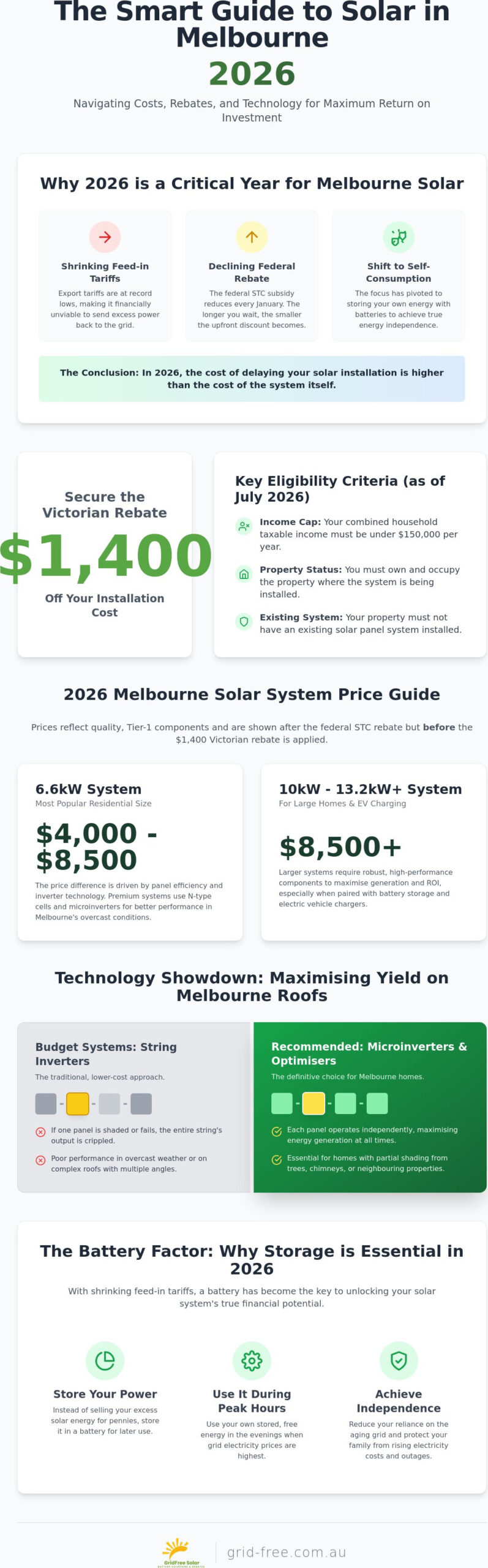
Quality matters more than ever in 2026. A standard 6.6kW system, which remains the most popular residential size, typically ranges from $4,000 to $8,500 after the federal STC rebate but before any Victorian state incentives. If you are looking at larger 10kW or 13.2kW systems to accommodate an electric vehicle or a large family, expect the baseline to start around $8,500 for premium tier-1 technology. There is a massive gulf between budget components and high-efficiency gear. Premium systems use N-type cells and advanced optimisers that perform better in Melbourne’s frequent overcast conditions. For a deeper look at the technical requirements, see our guide on Solar Panel Installation Melbourne: The 2026 Guide to Energy Independence.
Breaking Down the Bill: What Influences Your 2026 Quote?
Do not be fooled by a low sticker price. When evaluating a solar panel installation cost Melbourne 2026, the hardware configuration and engineering standards are the single biggest variables. While some competitors advertise systems for under $4,000, these quotes often rely on outdated string inverters and low-efficiency panels that struggle with Melbourne’s notorious “four seasons in one day” weather. A quality quote reflects the technical reality of your roof, not just a generic package price.
Your hardware choice dictates your long-term ROI. In 2026, we see a massive shift toward microinverters and optimisers. Unlike traditional string systems, these allow each panel to operate independently. This is crucial for Melbourne suburbs where morning fog or overshadowing from neighbouring double-storey homes can otherwise cripple your energy production. High-efficiency panels are also no longer a luxury. With smaller roof footprints in inner-city Melbourne, you need modules that generate more power per square metre to make the most of the available space. Factor in the Victorian solar panel rebate to offset these premium components, but never sacrifice hardware quality for a slightly lower upfront cost.
Tier 1 Panels vs. Value Brands
The term “Tier 1” has evolved. In 2026, it represents panels with lower degradation rates and superior thermal coefficients. We recommend high-performance glass-glass modules for the Victorian climate. These units handle the rapid temperature shifts and occasional hail better than standard back-sheet panels. Choosing unbranded components might save you $500 today, but the cost of a mid-winter failure and the subsequent labour for replacement will far exceed those initial savings.
Inverter Technology: The Brain of Your System
Your inverter is the most hardworking component of the system. In 2026, installing a standard solar inverter without battery-ready hybrid capabilities is a strategic error. GridFree Solar prioritises high-uptime, reliable inverter brands that offer seamless integration with modern storage. If you plan to add a battery next year, your current inverter must be able to handle that load without a costly full-system overhaul. For a detailed look at how to prepare your home, explore our Energy Storage Solutions Melbourne: Your 2026 Guide to Grid Independence. If you are unsure which hardware matches your energy profile, it’s worth requesting a technical assessment from a local expert who knows the Melbourne grid inside out.
Finally, never overlook labour and engineering. A compliant Melbourne installation requires a site-specific shading analysis and a structural integrity check of your roof; for an example of the professional standards required for long-term durability, you can visit Renegade Roofing Co.. Cheap quotes frequently skip these essential safety steps. Professional engineering ensures your system remains fixed during high-wind events and operates at peak efficiency for its 25-year lifespan. You are investing in a power plant for your home. Treat the engineering with the respect it deserves.
Maximising Victorian Rebates and Incentives in 2026
Securing a high-return investment requires more than just picking hardware; it requires a strategic approach to government incentives. The financial landscape for Victorian solar has shifted significantly this year. As of July 1, 2026, the Solar Homes Program has implemented a stricter income eligibility cap, reducing it from $210,000 to $150,000 for combined household taxable income. If you fall within this new threshold, acting immediately is vital to lock in the $1,400 rebate and the matching $1,400 interest-free loan. These state-level incentives directly reduce your out-of-pocket solar panel installation cost Melbourne 2026, but they are increasingly targeted toward early adopters who meet the new criteria.
Stacking these incentives is the only way to achieve the rapid ROI periods we see in the current market. By combining the federal STC discount with the Victorian rebate, homeowners can often shave over $4,000 off the gross system price. However, the process is administrative and requires precision. To qualify for these incentives, you must engage Clean Energy Council accredited installers who adhere to the highest safety and performance standards in the industry. GridFree Solar manages the complexity of these applications, ensuring you don’t miss out on available funds due to technical errors or missed deadlines.
The 2026 STC “Cliff”: Act Before the Next Drop
The federal Small-scale Renewable Energy Scheme is in a phase-out period that penalises delay. Every year on January 1st, the “deeming period” for Small-scale Technology Certificates (STCs) reduces. In 2026, this reduction means a 6.6kW system in Melbourne receives approximately $2,583 in federal support, which is hundreds of dollars less than the previous year. Small-scale Technology Certificates (STCs) function as a volatile form of environmental currency traded on the open market, rather than a fixed government cheque with a guaranteed value. Waiting until 2027 will result in another automatic drop in your subsidy, making the exact same system more expensive for no technical gain.
Victorian Battery Rebates and VPP Opportunities
While solar panels provide the generation, storage provides the control. In 2026, the focus has shifted toward Virtual Power Plants (VPPs) as a primary way to offset installation costs. By joining a VPP, you allow a small portion of your stored energy to support the grid during peak events in exchange for ongoing credits or upfront discounts. This modern strategy transforms your battery from a simple backup device into an active revenue stream. For a comprehensive breakdown of the latest storage incentives, see our Victorian Battery Rebate 2024 to 2026: The Complete Guide to Storage Savings. Combining these storage-specific savings with your solar incentives is the definitive way to reach energy independence this year.
The Battery Factor: Calculating the Cost of Energy Independence
Installing solar without storage in 2026 is a strategic error. The era of profiting from grid exports is officially over. In the current Melbourne market, feed-in tariffs have plummeted to negligible levels, while peak electricity prices continue to surge. This shift has fundamentally changed how we calculate the solar panel installation cost Melbourne 2026. You are no longer just buying panels to feed the grid. You are building a self-sustaining power plant that must function during the expensive evening peak. Exporting power is a waste. Keeping it behind the meter is the only way to win.
Popular 10kWh and 13.5kWh units now represent the technical sweet spot for Victorian households. A fully installed 13.5kWh unit, such as the latest Tesla Powerwall 3, typically ranges between $12,000 and $17,000 depending on site complexity. While this increases the initial capital outlay, the ROI is now driven by “self-consumption” rather than export credits. Every kilowatt-hour you store and use after sunset saves you the full retail price of power. This is far more lucrative than accepting the 4 to 8 cents per kWh retailers currently offer for your excess energy.
Retrofitting vs. New Integrated Systems
Adding a battery later often costs significantly more than a day-one installation. Retrofitting requires additional AC-coupling hardware and extra labour to integrate with older, non-hybrid inverters. If your existing Melbourne system is more than five years old, compatibility hurdles can arise, often necessitating a full inverter replacement. Installing an integrated solar and battery solution from the start streamlines the engineering and ensures you capture the maximum available rebates in one go. For a deeper dive into current pricing and technical specs, see our Solar Battery Cost Australia 2026: The Definitive Price & ROI Guide.
Blackout Protection and Grid Independence
Melbourne’s storm seasons are becoming more volatile, making grid reliability a major concern for homeowners. Residents in the Dandenong Ranges and the leafy eastern suburbs are increasingly prioritising blackout protection. A professional installation offers a choice between “Essential Circuits Only,” which keeps your lights and fridge running, or “Full Backup” for the entire home. GridFree Solar focuses on high-capacity storage solutions that meet the strict AS/NZS 5139 safety standards for Victorian fire compliance. Security is just as important as savings. Don’t settle for half-measures when the grid goes down.
Stop sending your valuable energy back to the grid for pennies. Organise a technical battery assessment with GridFree Solar to secure your energy future and eliminate bill shock for good.
Securing Your Melbourne Installation: A 2026 Checklist
Finalise your decision with technical precision. The solar panel installation cost Melbourne 2026 represents a significant investment in your home’s infrastructure; it is not a simple retail purchase. Don’t let the administrative complexity or high-pressure sales tactics derail your progress. Use this definitive 2026 checklist to vet your installer and protect your capital before signing any contract.
- Step 1: Verify NETCC Accreditation. Ensure your retailer is a signatory to the New Energy Tech Consumer Code. This is a non-negotiable requirement for accessing Victorian rebates and ensures the business adheres to strict ethical standards.
- Step 2: Demand a Site-Specific Shading Analysis. Generic satellite estimates are insufficient for Melbourne’s complex rooflines. Request a report that accounts for local obstructions (if you require professional tree trimming to resolve shading, click here) and the specific sun angles of the Victorian winter.
- Step 3: Audit the Triple-Layer Warranty. You need written guarantees for product (hardware), performance (energy yield over 25 years), and labour (installation quality). If the labour warranty is less than 10 years, the installer doesn’t trust their own work.
- Step 4: Confirm a Local Melbourne Presence. Verify the business has a physical warehouse and office in Victoria. Avoid “national” companies that rely on a rotating door of unknown sub-contractors and virtual offices.
Spotting “Solar Cowboys” in the Melbourne Market
The Melbourne market is currently saturated with high-pressure sales organisations chasing volume over quality. If a representative knocks on your door uninvited or insists on “today only” pricing to force a signature, walk away immediately. These “solar cowboys” often hide sub-contractor shortcuts behind a polished sales pitch. A “cheap” quote usually means the installer will be long gone before you realise your system isn’t hitting its performance targets. A professional, pre-installation site visit is mandatory. If they won’t inspect your switchboard and roof structure in person, they aren’t worth the risk.
The GridFree Solar Commitment
GridFree Solar operates with a “Right First Time” philosophy. We don’t just supply components; we engineer integrated energy solutions specifically for the Victorian climate. Our team takes the complexity out of the process by managing your rebate paperwork from start to finish. We ensure every technical detail, from grid connection approvals to smart meter configurations, is handled by local specialists who understand the Melbourne network. Take the final step toward true energy independence. Book your custom 2026 Melbourne solar assessment today and secure a system built for long-term reliability.
Secure Your Energy Future Today
The window for maximum Victorian government support is narrowing. With the stricter $150,000 income cap and the scheduled annual STC reduction, your out-of-pocket solar panel installation cost Melbourne 2026 is at its most competitive point right now. Success in this market requires moving beyond a simple “panels-only” mindset. Integrating high-performance storage is the definitive way to combat rising electricity tariffs and achieve genuine grid independence before the next price hike hits your letterbox.
Don’t leave your energy security to chance or unverified “budget” installers. GridFree Solar stands as your Melbourne-local installation expert. We are an Authorised Solar Victoria Retailer and specialists in high-ROI battery upgrades, ensuring your system is engineered for the specific demands of the Victorian grid. We handle the complex rebate paperwork so you can focus on the savings. It’s time to take control of your power bills with a system built for the next 25 years.
Get a Precision Solar Quote for Your Melbourne Home and join the thousands of Victorians already profiting from the sun. You’ve got the technical knowledge; now take the action that secures your home’s value and your family’s comfort.
Frequently Asked Questions
How much does a 6.6kW solar system cost in Melbourne in 2026?
Hardware tiers and site-specific engineering requirements define the total investment for your home. While a 6.6kW system remains the standard for Victorian households, the final solar panel installation cost Melbourne 2026 varies based on your choice between traditional string inverters and advanced microinverter technology. Premium systems prioritise long-term energy yield and reliability over the lowest possible upfront price.
Is the Victorian solar rebate still available for Melbourne residents in 2026?
Yes, the Solar Victoria rebate is active but subject to stricter eligibility rules as of July 1, 2026. Eligible households with a combined annual income of less than $150,000 can access a rebate of up to $1,400. A matching interest-free loan of up to $1,400 is also available to further reduce the initial capital outlay for your installation.
What is the average payback period for solar panels in Melbourne right now?
Most high-quality installations in Melbourne achieve full payback within 3 to 6 years. This timeline has shortened significantly due to recent electricity tariff hikes. Homes that integrate a battery and focus on self-consumption see the fastest return on investment by avoiding expensive peak-hour retail rates.
Does adding a battery to my Melbourne solar system make financial sense in 2026?
It is the most effective strategy for combating record-low feed-in tariffs. With retailers offering minimal credits for exported power, storing your own energy to use during the evening peak is the only way to eliminate bill shock. A battery allows you to use nearly 100 percent of the energy you generate rather than sending it back to the grid for pennies.
Why are solar installation costs higher in Melbourne than in other Australian cities?
Strict network compliance and architectural factors drive the “Melbourne Premium” in installation quotes. Local distributors like United Energy and Citipower have rigorous grid protection requirements that require specialised hardware. Additionally, Melbourne’s high proportion of double-storey homes and heritage rooflines increases the labour and safety equipment needed for a compliant install.
Can I get a solar rebate in Victoria if I have already had one previously?
The Solar Homes Program rebate is generally a one-off incentive for a single property. If you have already claimed a panel rebate for your current home, you cannot claim it again. However, you may still be eligible for specific battery incentives or Virtual Power Plant (VPP) credits if you are upgrading an existing system with new storage technology.
How long does the actual installation process take for a standard Melbourne home?
A standard residential solar installation is typically completed within a single business day. Our specialist teams arrive in the morning and usually have the system commissioned and the site cleared by late afternoon. More complex projects involving large battery arrays or difficult roof access may occasionally extend into a second day.
What happens to my solar installation cost if my Melbourne home has a heritage listing?
Heritage overlays can increase the solar panel installation cost Melbourne 2026 due to specialised mounting requirements and council permit fees. You might be required to use low-profile racking or specific panel placements to meet aesthetic guidelines. We recommend a site-specific engineering assessment to ensure your system meets all local planning requirements without sacrificing performance.