

Chasing the highest solar feed in tariff Victoria has to offer is actually the fastest way to lose money on your energy investment in 2026. While you might be hunting for an extra cent from your retailer, the market has fundamentally shifted. The days of “set and forget” export profits are over. It is a hard truth to swallow when you have invested heavily to go green.
You have likely noticed your credits dwindling while the complexity of time-varying offers and “solar soak” periods makes your head spin. It feels like the ROI on your panels is slowing down. We understand the frustration of watching your hard-earned energy vanish into a grid that pays you less every year. The rules have changed. Your strategy must change too.
This guide will help you master the 2026 Victorian landscape and explains why a high rate is no longer the smartest way to slash your bills. We will break down the latest ESC rules, identify the best current 8c/kWh offers, and show you how to future-proof your home using the new federal battery incentives. It is time to stop being a power provider and start being a power owner.
Key Takeaways
- Identify why the deregulation of the solar feed in tariff Victoria means you must now actively compare retail offers rather than relying on a mandatory government floor.
- Distinguish between flat and time-varying tariffs to align your export strategy with the high-value evening peak periods.
- Master the “Golden Rule” of self-consumption to ensure every kilowatt you generate provides maximum value compared to dwindling export credits.
- Explore how battery storage and Virtual Power Plants (VPPs) allow you to bypass low retail rates and reclaim your energy independence.
The 2026 Victorian Solar Landscape: Why the Rules Changed
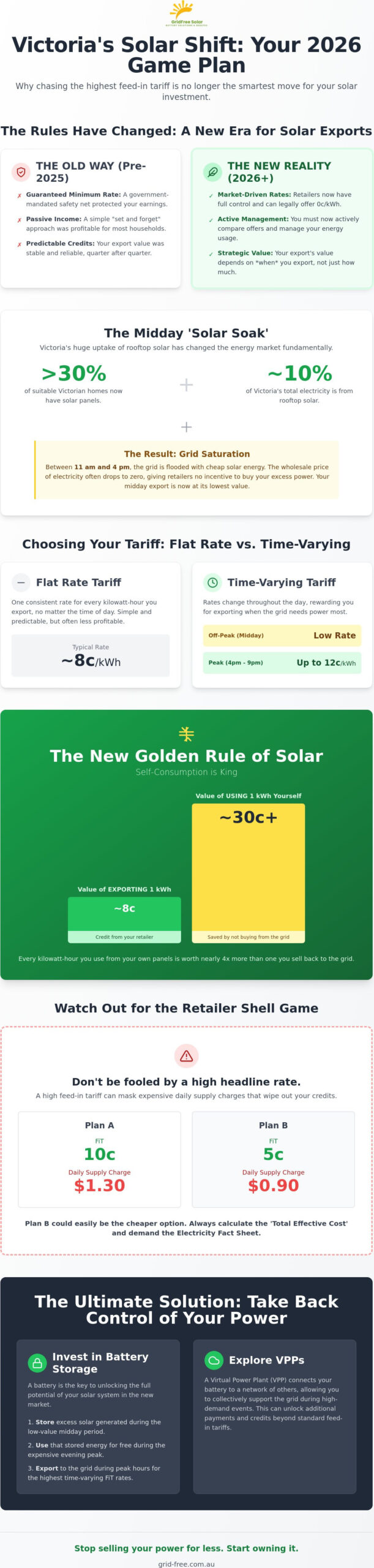
A feed-in tariff (FiT) is the credit you receive for excess energy sent to the grid. For a decade, Victorian households viewed this as a guaranteed rebate. It was a reliable way to pay off a system. That era is officially over. In 2026, the solar feed in tariff Victoria provides is no longer a government-backed incentive. It has become a volatile market commodity.
The Essential Services Commission (ESC) Shift
The landscape shifted permanently on 1 July 2025. This was the date the Essential Services Commission (ESC) removed the regulated minimum export rate. Previously, retailers were forced by law to pay a baseline price for every kilowatt-hour you sent back. Now, the safety net is gone. Retailers have total control over what they pay for your power.
This “Zero Cent” reality is the new baseline. While retailers cannot charge you for exporting yet, they are legally permitted to offer a 0.00c rate. Most major players like AGL and EnergyAustralia still offer around 8c/kWh, but these rates are no longer protected. The History of Australian Feed-in Tariffs highlights how we moved from 60-cent premiums to this deregulated environment. For Melbourne families, this means the “set and forget” approach to solar is dead. You must now actively shop for rates or risk receiving nothing for your surplus generation.
Grid Saturation and the ‘Death of the Midday Export’
The reason for this change is simple supply and demand. Victoria’s rooftop solar adoption has skyrocketed. More than 30% of suitable Victorian homes now have panels. During the “solar soak” period between 11 am and 4 pm, the grid is saturated with cheap renewable energy. Rooftop solar now contributes roughly 10% of Victoria’s total generation.
When the sun is at its peak, the wholesale price of electricity often drops to zero or goes negative. Retailers are essentially being paid to take power from the grid, so they have no financial incentive to buy yours. This is why we are seeing the rise of “solar soak” tariffs that offer the lowest electricity rates during the middle of the day. The market is telling you to use your power, not sell it. In 2026, the ESC functions as a monitor to ensure retailers provide notice of rate changes rather than acting as a price-setter that dictates your export value.
Comparing Victoria’s Feed-In Tariff Structures: Flat vs. Time-Varying
Choosing the right solar feed in tariff Victoria offers is no longer a simple task. In 2026, the market is split between two distinct structures. You must decide between the simplicity of a flat rate and the strategic potential of time-varying offers. Most major retailers like AGL and EnergyAustralia have settled on a flat rate of approximately 8c/kWh. This “set and forget” model treats every exported unit the same. It is predictable. It is also often suboptimal for modern energy users.
Is a Time-Varying Rate Better for You?
Time-varying tariffs reward you for when you export, not just how much. These plans divide the day into peak, off-peak, and shoulder windows. The evening peak, typically 4 pm to 9 pm, is the new gold mine. While midday exports might only fetch a few cents, evening exports can reach as high as 12c/kWh with retailers like Energy Locals.
This structure is a massive win for households with east or west-facing panels that capture the late afternoon sun. It is even more lucrative for those who can discharge a battery during these high-value windows. If your home is empty during the day and you aren’t “soaking” your solar into a hot water system or EV, a time-varying rate is likely your best path to a lower bill. It aligns your exports with grid demand. It turns your surplus into a premium product.
The Retailer Shell Game: Daily Supply Charges vs. FiTs
Don’t be fooled by a headline-grabbing export rate. This is the most common trap in the Victorian market. A retailer might offer a 10c FiT but quietly hike your daily supply charge to $1.30 or more. Conversely, a plan with a 5c FiT and a 90c supply charge could leave you significantly better off at the end of the quarter. It’s a numbers game where the house usually wins if you don’t look closely.
You must calculate the “Total Effective Cost” of your plan. This means weighing the export credits against the fixed daily costs and the price you pay to pull power from the grid at night. Always demand the Electricity Fact Sheet before signing. If the math feels overwhelming, you might want to organise a professional system review to see how your current generation matches these new retail structures. Across Melbourne’s networks, from the dense CitiPower inner-suburbs to the sprawling Powercor regions, the difference between a “good” plan and a “bad” one can exceed $400 a year.
- CitiPower/Powercor: Higher competition often leads to better time-varying peaks.
- United Energy/Jemena: Watch for aggressive “solar soak” midday import discounts.
- AusNet: Regional distances can lead to higher supply charges; prioritise self-consumption.
Maximising Your Solar ROI: Beyond the Export Credit
Every unit you consume is worth roughly three times what you receive as a solar feed in tariff Victoria credit. If your retailer pays you 8c to export but charges you 30c to buy back power, you’re losing 22c on every kilowatt. Stop focusing on the credit. Focus on the offset. This shift in mindset is the difference between a system that barely breaks even and one that pays for itself in record time. In 2026, the grid is no longer your piggy bank; it’s a backup generator for when your own supply runs dry.
Smart monitoring has become non-negotiable for anyone serious about savings. You can’t manage what you can’t measure. Modern energy apps provide real-time data on your consumption versus your generation. If you see a spike in generation at 1 pm, that’s your signal to turn on the air conditioner or charge your devices. Using data to drive your habits ensures you aren’t accidentally exporting power while your dishwasher sits idle until the evening peak.
Strategies for High Self-Consumption
Self-consumption is the most powerful tool for Victorian solar owners in 2026. Automation is the easiest way to achieve this without changing your lifestyle. Modern dishwashers, washing machines, and pool pumps often feature delay timers. Set these to run between 11 am and 4 pm. This is the “solar soak” window where your panels are most active and grid demand is lowest.
Electric hot water systems are another secret weapon for Melbourne homes. They act as thermal batteries. By heating your water during the day using free solar energy, you avoid using expensive grid power for evening showers. It’s a simple, high-impact way to store energy without the cost of a chemical battery. Combining these small shifts creates a massive reduction in your quarterly bill that no feed-in tariff could ever match.
Commercial Solar Export Limits in Victoria
Businesses face a different set of hurdles that residential users often overlook. While households can usually export up to 5kW, commercial sites in Melbourne often face strict zero-export or limited-export mandates from distributors like CitiPower or United Energy. These 5kW or 30kW inverter limits can cripple your ROI if you don’t have a plan. You might have a massive roof, but if you can’t export the surplus, that extra capacity goes to waste.
Managing these restrictions requires intelligent design and local expertise. A tailored commercial solar installation Melbourne businesses rely on focuses on matching panel capacity to daytime baseloads. This ensures you aren’t paying for energy you can’t use or sell. By prioritising self-sufficiency over export, Victorian businesses can bypass grid restrictions and lock in long-term savings regardless of the current solar feed in tariff Victoria landscape. It’s about building a system that works for your bottom line, not the retailer’s profit margin.
Virtual Power Plants (VPPs) and the Future of Victorian Exports
The standard solar feed in tariff Victoria provides is no longer the ceiling for your earnings. It is the floor. In 2026, savvy Melbourne homeowners are bypassing low retail export rates by joining Virtual Power Plants (VPPs). A VPP is a network of decentralised home batteries that work together as a single, massive power plant. By allowing a VPP provider to occasionally tap into your stored energy, you help stabilise the grid when demand spikes. In return, you receive financial rewards that far exceed a typical export credit.
This is energy trading in its most sophisticated form. You aren’t just selling excess electrons; you are selling grid stability. For the Victorian market, this represents a shift from passive generation to active participation. Thousands of households across Melbourne’s suburbs are already using this model to reclaim the ROI that declining feed-in tariffs took away. It is the logical next step for any high-performance solar system.
How VPPs Supplement Your Feed-In Tariff
A standard FiT pays you a flat rate for every kilowatt-hour you send to the grid. A VPP adds a “participation credit” or a premium discharge rate on top of that. During a summer heatwave in Melbourne, when air conditioners are pushed to their limits, the grid faces immense pressure. A VPP can discharge your battery during these critical windows to prevent blackouts.
In these scenarios, your effective earnings can double or even triple compared to a standard 8c retail rate. You essentially become a micro-utility. However, your equipment must be VPP-ready. Most modern, smart-controlled batteries installed in 2026 are compatible, but older systems may require a gateway upgrade to communicate with the VPP network. This connectivity is what turns a simple storage unit into a revenue-generating asset.
Risks and Rewards of Energy Trading
Energy trading involves a calculated trade-off. You are giving up some control over your battery for higher financial rewards. The VPP provider decides when to discharge your power based on market prices and grid needs. This means you might find your battery empty when you expected it to be full, though most providers guarantee a “reserve” amount for your personal use.
You must also consider battery cycling. Frequent discharging through a VPP can impact the long-term lifespan of your cells. It is vital to weigh the upfront participation credits against the potential for slightly faster hardware depreciation. Before signing any 2026 VPP agreement, check for contract lengths and exit fees. Many Victorian offers now provide “no lock-in” terms, but some still tie incentives to 12 or 24-month commitments. To understand how storage fits into your broader energy strategy, explore our guide on Energy Storage Solutions Melbourne.
Ready to see if your home qualifies for the latest Melbourne energy trading incentives? Speak with our specialists to audit your battery’s VPP compatibility today.
The Ultimate FiT Hack: Investing in Battery Storage
Stop hunting for fractions of a cent. In 2026, the smartest move isn’t finding a better retailer; it’s cutting the retailer out of the equation entirely. Every time you export surplus energy, you are essentially donating high-value power to the grid for a pittance. While you might secure a solar feed in tariff Victoria rate of 8c/kWh, you are still buying that same power back at night for 30c or 35c. This 27c gap is a “tax” on your lack of storage. Storing your own energy is the only way to protect your investment from a deregulated market that no longer prioritises the producer.
The financial logic is undeniable. Storing 5c power (the opportunity cost of not exporting) to avoid buying 35c power is an instant 30c win. That is nearly four times the value of the best export rate available today. To make this transition affordable, you can leverage the Victorian Battery Rebate and federal incentives like the Cheaper Home Batteries Program. These schemes can provide a discount of around 30% on eligible systems. GridFree’s approach focuses on custom-sized storage. We ensure your capacity matches your consumption patterns to drive maximum independence.
Upgrading vs. Replacing Your Solar Battery
If you installed a battery five or six years ago, it might be costing you money. Aging systems often suffer from capacity fade, which means you are exporting more power than you intend because the battery simply can’t hold it anymore. Modern LiFePO4 (Lithium Iron Phosphate) technology is the gold standard for Melbourne climates. It offers superior thermal stability and a significantly longer cycle life than older lithium-ion or lead-acid chemistries. If your system is struggling to get you through the night, it’s time to consider a Solar Battery Replacement Melbourne specialists recommend for 2026 standards.
Achieving Total Grid Independence
A correctly sized battery can reduce your grid exports to near zero. This is the ultimate goal. By capturing every stray electron during the day, you insulate your household from price hikes and the volatility of the solar feed in tariff Victoria market. Beyond the balance sheet, there is a profound emotional benefit to energy security. You gain blackout protection. When the Melbourne storm season hits and the local lines go down, your home stays bright.
The era of relying on the grid for ROI is over. Success in 2026 requires a proactive strategy that prioritises self-sufficiency. If you are ready to stop donating your power and start owning it, the first step is a comprehensive energy audit. Book a professional solar panel installation Melbourne audit to see how a modern storage solution can turn your current system into a 24/7 power station. It is time to take control of your energy future.
Secure Your Energy Independence Today
The 2026 energy market has sent a clear signal. Relying on a high solar feed in tariff Victoria retailers offer is now a losing strategy for your hip pocket. Market deregulation means export credits will continue to fluctuate while import prices remain high. You have seen the data. The most profitable kilowatt is the one you never have to buy from the grid. Transitioning from a passive exporter to an active energy owner is the only way to lock in long-term savings.
Success requires a shift toward self-sufficiency. Whether you are shifting your load to the midday “solar soak” window or joining a sophisticated VPP, the goal is total control. As an Authorised Solar Victoria retailer and specialists in battery ROI optimisation, GridFree Solar helps you navigate this complex landscape. Our expert Melbourne-based installers ensure your system is primed for the next decade of energy innovation. Don’t let your surplus generation go to waste. Maximise your solar ROI with a GridFree Battery Upgrade today. You have already built the power station. It’s time to own the storage.
Frequently Asked Questions
What is the minimum solar feed-in tariff in Victoria for 2026?
There is no longer a mandatory minimum solar feed in tariff Victoria retailers must pay. Since July 2025, the Essential Services Commission (ESC) has allowed retailers to set their own rates, with a floor of 0.00c per kWh. You must now actively compare market offers to find retailers still providing credits, which currently hover around 8c per kWh for flat rates.
Why has my solar feed-in tariff dropped so much recently?
Your rate has dropped because the Victorian grid is saturated with solar energy during the middle of the day. When rooftop solar contributes significantly to the total generation, wholesale electricity prices often drop to near zero. Retailers no longer have a financial incentive to buy your midday surplus, leading to the removal of the government-mandated minimum rate.
Is it better to have a flat or time-varying feed-in tariff in Melbourne?
A time-varying tariff is generally superior if you can export energy during the 4 pm to 9 pm peak window. This structure rewards households with battery storage or west-facing panels that capture the late afternoon sun. If you don’t have a battery and export most of your power at midday, a flat rate might provide more predictable credits, though these rates are also trending downwards.
Can I get a feed-in tariff if I have a battery storage system?
Yes, you can still receive a solar feed in tariff Victoria credit if you have a battery. In fact, a battery allows you to be more strategic with your exports. You can store your energy during the day and only send it to the grid during high-value peak periods or through a Virtual Power Plant (VPP) to maximise your financial returns.
Do commercial properties get the same feed-in tariffs as residential homes?
Commercial properties often face different retail structures and much stricter export limits. Many Victorian distributors impose zero-export mandates or tight 30kW inverter caps on business sites to maintain grid stability. While some retailers offer commercial export credits, the primary ROI for businesses in 2026 comes from offsetting expensive daytime operational costs rather than export revenue.
How do I switch to a retailer with a better solar feed-in tariff?
You can switch by requesting the Electricity Fact Sheet from potential providers to compare their export rates against their daily supply charges. Use the Victorian Energy Compare website to run a side-by-side analysis of your actual usage data. Be careful not to chase a high export rate if it comes with a significantly higher daily connection fee.
Will the Victorian government bring back a regulated minimum FiT?
There are no current plans for the Victorian government to reinstate a regulated minimum feed-in tariff. The policy direction has shifted permanently toward encouraging self-consumption and grid stability. Incentives like the “solar soak” period and the Midday Power Saver program are designed to make energy cheapest when it is most abundant, rather than subsidising exports.
Is solar still worth it in Victoria with low feed-in tariffs?
Solar is still highly profitable because the value of offsetting your own consumption is roughly 30c to 35c per kWh. This is nearly four times the value of the best export credits. By using your own power to run appliances or charge a battery, you avoid the high cost of buying grid electricity, ensuring your system continues to pay for itself quickly.