
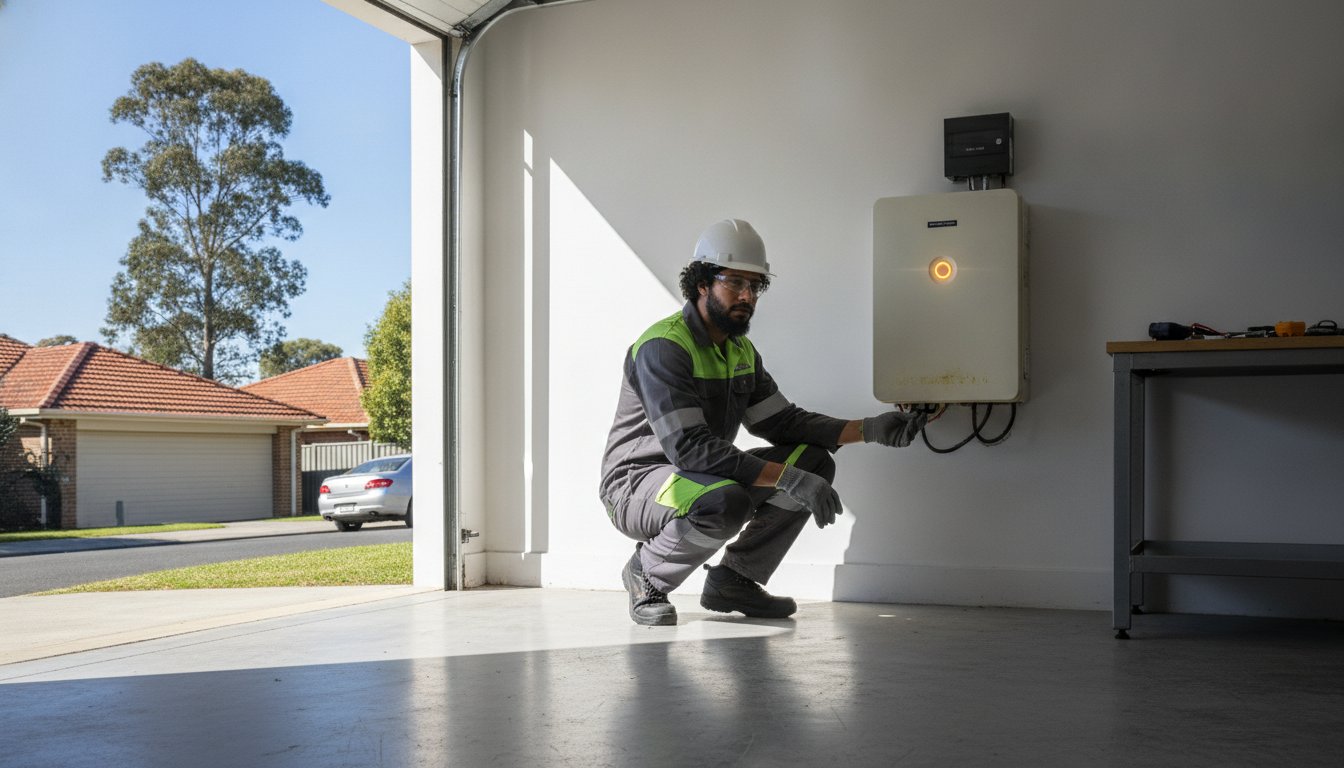
Why are you still paying premium peak rates when your garage is housing a high-end battery system? It’s a frustrating reality for many local homeowners who are now noticing the first signs you need solar battery replacement Melbourne wide. You likely invested in energy independence to escape the grid’s volatility, yet those evening blackouts and confusing “State of Health” alerts on your app suggest your aging unit is waving the white flag.
We understand that deciphering battery data is complex, especially when your electricity bills continue to climb despite your solar array. This expert guide cuts through the technical jargon to help you determine if your storage is truly failing or just needs a simple configuration tweak. You’ll gain a clear understanding of the return on investment for a modern upgrade and how to secure the latest incentives available to Victorians.
We’ll break down the critical performance red flags, the physical warning signs to watch for, and how the 2026 federal rebate landscape makes upgrading to LiFePO4 technology a smart move. From SoH percentages to the latest eligibility rules for the federal point of sale discount, here’s your definitive checklist for 2026.
Key Takeaways
- Identify the critical signs you need solar battery replacement Melbourne homeowners must watch for, especially as first-generation systems reach their twilight years.
- Recognise performance red flags like early evening depletion and persistent charging lags that suggest your lithium-ion unit is losing its capacity.
- Spot physical warning signs ranging from casing anomalies to excessive fan noise that signal urgent hardware degradation in the Melbourne heat.
- Master a simple DIY “Full Cycle Test” to verify your battery’s actual state of health against its original installation specifications.
- Discover the efficiency gains of modern LiFePO4 technology and how to leverage current Victorian rebates for a high-performance system upgrade.
Is Your Melbourne Solar Battery Reaching Its Twilight Years?
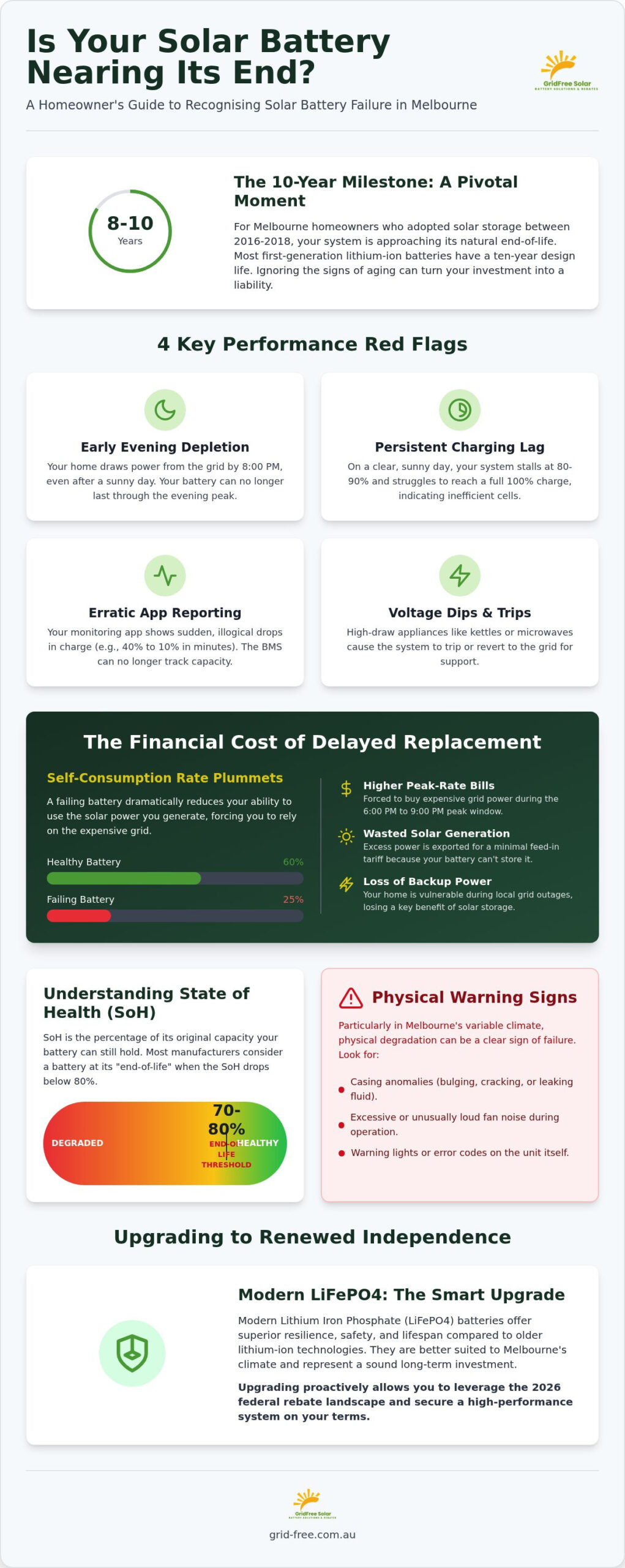
For Melbourne homeowners who joined the first wave of energy storage adoption between 2016 and 2018, 2026 represents a pivotal crossroads. Most residential lithium-ion units operate on a ten-year design life. As these systems approach their decade of service, the chemical components inside reach their natural limits. Understanding the signs you need solar battery replacement Melbourne wide is no longer just a matter of curiosity; it’s a financial necessity. Energy independence is only as reliable as the chemistry that supports it.
A battery energy storage system doesn’t usually fail overnight. Instead, you’ll likely witness a “slow fade” where the unit holds progressively less charge each month. However, sudden hardware failures in the Battery Management System (BMS) are also common in older units. Ignoring these warnings leads to a sharp increase in grid reliance, effectively turning your high-tech investment into an expensive wall ornament while your solar generation goes to waste.
The 10-Year Milestone: Why It Matters
Tier 1 manufacturers typically provide a 10-year warranty for a reason. By year eight or nine, the internal resistance in first-generation lithium-ion cells increases significantly. This process often accelerates in Melbourne’s variable climate, where garages act as heat traps during summer and cold sinks in winter. Modern LiFePO4 (Lithium Iron Phosphate) units are far more resilient than the 2017-era technology currently reaching its end-of-life. If your system was installed during the initial Victorian rebate booms, it’s likely approaching its performance floor. You’ll notice the system struggles to maintain voltage under load, leading to frequent “low battery” errors even after a sunny day.
The Financial Cost of Delayed Replacement
Every day you operate a failing battery is a day you lose money. When your storage capacity drops, your self-consumption rate plummets from a healthy 60% back down to the 25% average of a battery-free home. You’re forced to export excess power for minimal feed-in tariffs while buying it back at peak evening rates. Proactive replacement allows you to navigate the 2026 rebate landscape on your terms. Waiting for a total failure often results in rushed decisions and higher emergency installation costs. Consider these financial leaks:
- Increased grid dependency during the expensive 6:00 PM to 9:00 PM peak window.
- Wasted solar generation that your degraded battery can no longer capture.
- Loss of backup power security during local network outages.
Secure your ROI by identifying the signs you need solar battery replacement Melbourne before the system goes dark permanently.
4 Performance Red Flags: Why Your Storage Is Not Lasting the Night
Your home should be a fortress of self-sufficiency. If your smart meter shows you’re drawing from the grid by 8:00 PM, your storage capacity has likely cratered. This is one of the primary signs you need solar battery replacement Melbourne homeowners report when their systems hit the eight-year mark. It isn’t just about capacity; it’s about reliability. You shouldn’t have to choose between running the dishwasher and keeping the lights on during the evening peak.
Charging lag is equally telling. On a cloudless Victorian afternoon, your system should hit 100% with ease. If it stalls at 85% despite hours of peak sun, the internal cells are struggling to store energy efficiently. You might also notice erratic reporting. If your app shows a jump from 40% to 10% in minutes, the Battery Management System (BMS) can no longer accurately track the chemical state of the cells. Finally, watch for voltage dips. If high-draw appliances like kettles or hair dryers cause the system to trip or revert to the grid, the battery can no longer provide the necessary discharge current required for modern living.
Analysing Your Monitoring App Data
Check your dashboard for State of Health (SoH) metrics. State of Health (SoH) is the percentage of original capacity a battery can still hold in 2026. Most manufacturers consider a battery “end-of-life” when this figure drops below 70% or 80%. Don’t confuse this with seasonal drops. In winter, you generate less, but the battery’s ability to hold what it captures should remain stable. For more help on interpreting these figures, the Australian Government’s Solar Consumer Guide provides excellent foundational advice on system performance and maintenance.
The “Ghost Drain” Phenomenon
Have you noticed your battery losing 5% to 10% charge overnight when the house is silent? This “ghost drain” occurs when internal resistance within the cells turns stored energy into wasted heat. It’s a sign of chemical degradation that can’t be fixed with a software update. Tracking your overnight grid import is the best way to prove failure. If you’re importing power while the battery claims to have a “reserve,” the unit is failing to discharge. If you’re seeing these performance signs you need solar battery replacement Melbourne experts can help you organise a professional battery health assessment to confirm if an upgrade is your most cost-effective path forward.
Physical Warnings and the Melbourne Garage Heat Trap
Software diagnostics provide a digital snapshot, but the physical state of your hardware often tells the real story of degradation. Identifying the physical signs you need solar battery replacement Melbourne property owners should look for involves a simple five-minute visual inspection. Start with the casing. If you notice any swelling, bulging, or warping of the outer shell, the internal cells have likely begun outgassing. This is a non-negotiable red flag. A battery should remain perfectly rectangular; any deviation suggests internal pressure that the structure can no longer contain.
Listen to your hardware. While most modern units are quiet, a persistent buzzing or a cooling fan that runs 24/7 even on mild Victorian nights indicates a struggling system. This constant thermal management suggests internal resistance is generating excessive heat. Smell is equally important. A sudden “sweet” or pungent chemical odour near the unit often points to electrolyte leakage. Finally, inspect the terminals for corrosion or greenish-white oxidation. If moisture or chemical residue is visible on the connections, the seal has likely been compromised, necessitating an immediate professional assessment.
Melbourne Climate Factors: Heat vs. Battery Life
Melbourne’s unique climate plays a significant role in hardware longevity. Industry performance data shows that batteries installed in uninsulated Melbourne garages often fail 20% faster than those in climate-controlled environments. During a 40-degree January afternoon, a closed garage can reach temperatures exceeding 50 degrees, placing immense stress on aging lithium-ion chemistry. High-humidity days further accelerate terminal corrosion. Modern energy storage solutions Melbourne homeowners are now adopting use advanced liquid cooling or superior thermal venting to mitigate these local environmental risks.
Safety First: When to Power Down
If you identify physical degradation, safety must be your absolute priority. Never attempt to “re-jump” or force-charge a solar battery that appears physically damaged or has been dead for several months. This can trigger a thermal runaway event. We recommend using the Clean Energy Council consumer resources to find a vetted professional who can perform a safe decommissioning. If you spot any of the following “Red Zone” signs, power down the system at the isolation switch immediately:
- Visible smoke or scorched marks on the casing or cables.
- Liquid leaking from the bottom of the battery housing.
- The unit is hot to the touch while idle.
- Rapidly flashing red error lights that persist after a reboot.
Catching these signs you need solar battery replacement Melbourne early prevents a performance issue from becoming a significant household safety hazard.
How to Confirm Failure: DIY Diagnosis vs Professional Testing
Don’t rely on guesswork. If you’ve observed the signs you need solar battery replacement Melbourne homeowners often overlook, it’s time for a systematic audit. Start by performing a “Full Cycle Test”. Wait for a clear Melbourne day with high solar yield. Ensure your battery reaches a 100% state of charge by mid-afternoon. Once the sun sets, monitor how many hours your home runs on stored power before hitting the grid. Compare this discharge duration against your original installation specifications. If your 10kWh unit is now depleted by 7:30 PM under normal loads, the capacity loss is undeniable.
Next, audit your system’s total cycle count. Most lithium-ion batteries are rated for 6,000 to 10,000 cycles. If you’ve been an active participant in a Virtual Power Plant (VPP), your cycle count may be significantly higher than a standard user’s. Finally, verify your warranty status. Most Tier 1 brands offer a 10-year performance guarantee, but this usually requires the battery to maintain at least 70% of its original capacity. If your DIY testing suggests you’re well below this threshold, you have a strong case for a claim.
The VPP Impact: Has Your Battery Worked Too Hard?
Virtual Power Plants are excellent for grid stability and earning credits. However, they accelerate chemical wear. Every time the grid “calls” on your battery to discharge during a peak event, it adds to the total cycle count. Calculate your VPP earnings against the potential cost of an early replacement. In 2026, many Melbourne residents are finding that the wear and tear from excessive VPP participation outweighs the monthly credits. If your battery is already showing performance lag, consider opting out of non-essential VPP cycles to preserve the remaining cell life.
Understanding Your Warranty Rights in Victoria
Victorian consumers are protected by strict performance standards. It’s vital to distinguish between a “product warranty” (covering hardware defects) and a “performance warranty” (covering capacity retention). Document your cycle tests and app screenshots diligently. Having a history of professional solar installation Victoria wide makes this process seamless. Installers with a strong local presence can advocate for you with manufacturers. If your DIY results are inconclusive, book a professional battery health check today to secure a definitive technical report for your warranty claim.
Upgrading Your Storage: The Path to Renewed Independence
Once you’ve identified the signs you need solar battery replacement Melbourne homeowners face, the transition to modern technology is remarkably swift. In 2026, the industry has shifted decisively toward Lithium Iron Phosphate (LiFePO4) chemistry. This isn’t just a marginal improvement; it’s a fundamental leap in safety and longevity. Unlike the cobalt-based lithium batteries of 2017, LiFePO4 units offer superior thermal stability and can handle thousands more cycles before performance degrades. This means your next investment won’t just replace your current storage. It will significantly outperform it from day one.
A common concern is whether you can retain your existing inverter. If you have a high-quality hybrid inverter installed in the last few years, a simple battery swap is often possible. However, older string inverters may require an AC-coupled battery solution or a full system upgrade to unlock modern features like mandatory VPP readiness. Navigating the Victorian battery rebate 2024-2026 is essential here. While some state-based loan programs have closed, federal point-of-sale discounts for systems under 14kWh remain a powerful incentive for those upgrading aging infrastructure.
Maximising Your New ROI
Modern storage density has improved dramatically. A 2026 model takes up less wall space while offering higher usable capacity than its 2017 predecessor. Smart energy management software now comes standard, using intelligent algorithms to predict Melbourne weather patterns and optimise your charge cycles. This intelligence directly reduces internal resistance and wear, extending the life of your cells. When calculating your new payback period with current solar battery cost Australia wide, remember that increased self-consumption and VPP participation can significantly shorten your ROI compared to older tech.
Next Steps for Melbourne Homeowners
Don’t settle for a generic “one size fits all” solution. Right-sizing your new battery to your current energy profile is critical for long-term savings, especially if you’ve recently added an electric vehicle or induction cooktop. GridFree Solar specialises in these complex upgrades. We ensure your new storage integrates perfectly with your existing panels while meeting the latest AS/NZS 5139 safety standards. Take control of your energy future before your current system fails completely. Organise your professional battery health check with GridFree Solar today.
Secure Your Energy Future with Modern Storage
The “twilight years” of your first-generation battery shouldn’t mean a return to skyrocketing electricity bills. By identifying the performance red flags and physical signs you need solar battery replacement Melbourne, you can transition to high-efficiency LiFePO4 technology before a total system blackout occurs. Modern storage delivers superior thermal management and deeper discharge cycles; it ensures your home remains powered throughout the expensive evening peak.
Don’t let aging cells compromise your ROI. As CEC Accredited Installers and Victorian Rebate Specialists, GridFree Solar provides the technical precision required to integrate advanced storage into your existing array. We are the local expert in solar battery replacement Melbourne homeowners trust to help them reclaim their energy independence.
Take the first step toward a more reliable home. Book Your Expert Battery Health Check & Replacement Quote with our specialist team today. It’s time to swap your degraded unit for a smarter, safer solution built specifically for the Victorian climate.
Frequently Asked Questions
How long does a solar battery typically last in Melbourne?
Most residential lithium-ion units last between eight and twelve years. Melbourne’s variable climate, especially heat in uninsulated garages, often accelerates degradation toward the ten-year design life. While modern LiFePO4 units are rated for significantly longer service, first-generation systems from the late 2010s are currently reaching their performance floor. Regular monitoring of your State of Health (SoH) is the best way to track your specific unit’s longevity and performance.
Is it worth replacing a solar battery that is still 70% healthy?
A 70% State of Health is the typical industry threshold for replacement under performance warranties. While the unit still functions, you’ve lost nearly a third of your original energy independence. If your evening electricity consumption has increased or you’ve added an electric vehicle, upgrading now allows you to capture more solar generation. Modern 2026 models offer better efficiency and smarter software, making the ROI of an early upgrade increasingly attractive.
Can I replace just one module in a modular battery system?
Technically yes, but it’s rarely recommended for aging systems. Mixing a brand-new module with degraded ones creates a bottleneck effect where the older modules limit the performance of the new one. This imbalance places extra stress on the Battery Management System (BMS). In most cases, a full system replacement is more cost-effective as it ensures uniform cell chemistry and a renewed manufacturer warranty across the entire storage unit.
Does the Victorian battery rebate apply to replacements or only new installs?
In 2026, the federal Cheaper Home Batteries Program provides a point-of-sale discount for systems under 14kWh, which can apply to replacement units. While the previous Victorian battery loan program is closed, homeowners can still access incentives for upgrading to VPP-ready technology. Navigating these rules is one of the key signs you need solar battery replacement Melbourne experts to assist with, ensuring you maximise available financial support for your upgrade.
What happens to my old solar battery after it is replaced?
Responsible disposal is mandatory under Australian safety standards. Your old unit is decommissioned and transported to a specialised recycling facility where up to 95% of materials like lithium, cobalt, and copper are recovered. Never dispose of a solar battery in general waste. We manage the entire removal process, ensuring your degraded hardware is handled according to Victorian environmental regulations while clearing space for your high-performance, modern upgrade.
Will a failing battery damage my solar panels or inverter?
A degraded battery won’t damage your solar panels, but it can place significant stress on your hybrid inverter. As the battery struggles to maintain voltage, the inverter works harder to manage the DC-to-AC conversion and grid switching. This increased workload can lead to premature inverter failure. Proactively replacing a failing battery protects your broader system infrastructure and ensures your solar panels don’t waste generation by exporting to the grid for minimal returns.
How much does solar battery replacement cost in Melbourne in 2026?
Replacement costs vary based on your required capacity and whether your existing inverter is compatible with modern LiFePO4 chemistry. Factors such as switchboard upgrades and the complexity of your current wiring also influence the final investment. While 2026 technology is more efficient than first-gen systems, identifying the signs you need solar battery replacement Melbourne homeowners face is the first step toward a tailored quote that right-sizes the system to your budget.
Can I upgrade to a larger battery capacity than I had before?
Upgrading to a larger capacity is a common and strategic move for Melbourne homeowners. If your energy needs have grown since your initial installation, a larger unit ensures you remain off the grid during peak evening hours. Modern 2026 storage models offer higher energy density, meaning you can often double your storage capacity without requiring additional wall space. We help you audit your current usage to determine the optimal size for your renewed independence.