
A 20% internal rate of return isn’t a speculative forecast; it’s the new benchmark for savvy Victorian enterprises. While many directors still view panels as a mere sustainability badge, the reality is that solar has evolved into a high-performance financial asset. You’ve likely watched your operational costs climb as the National Electricity Market remains volatile. It’s frustrating to see profits eroded by grid price spikes while trying to calculate your commercial solar ROI Australia amidst the complex 2026 rebate shifts. You need certainty, not guesswork.
This guide will show you how to master the financial mechanics of modern energy to slash your overheads and secure total independence. We’ll provide a bankable roadmap for the current landscape. We’ll break down the SRES expansion to 1MW, the critical 99.9kW threshold, and why integrated battery storage is now the only way to protect your bottom line from falling feed-in tariffs. From Victorian Energy Upgrades to enhanced ESG credentials, learn to turn your roof into a profit centre. The era of passive energy consumption is over; the era of the intelligent energy producer has arrived.
Key Takeaways
- Learn why commercial solar has transitioned from a sustainability goal to a high-yield financial instrument, delivering a benchmark 20%+ internal rate of return for Victorian enterprises.
- Master the strategic 99.9kW threshold to maximise upfront STC rebates while preparing for the 2026 federal expansion that covers systems up to 1MW.
- Discover how integrated battery storage eliminates expensive peak demand charges and protects your bottom line from falling feed-in tariffs.
- Unlock the “Victorian Double Dip” by combining federal incentives with state-specific rebates to significantly accelerate your commercial solar ROI Australia forecast.
- Understand the importance of local engineering expertise to navigate the specific grid requirements of Victorian networks like Western Power and United Energy.
The State of Play: Why Australian Businesses are Pivoting to Solar in 2026
Energy volatility isn’t a temporary glitch. It’s the new operational reality. By August 2026, wholesale price spikes and rising network charges have turned electricity from a predictable overhead into a volatile liability. Australian businesses can no longer afford to be passive consumers. The state of solar power in Australia has shifted from early adoption to a mandatory financial hedge. Solar is your defensive asset. It locks in your energy costs for 25 years or more. This provides a level of fiscal certainty that the grid simply cannot match.
Calculating your commercial solar ROI Australia starts with understanding this defensive posture. You aren’t just saving cents per kilowatt-hour; you’re mitigating a systemic risk to your margins. High-performance solar systems act as a shield against the National Electricity Market (NEM) and its unpredictable pricing cycles. It’s about taking control of your primary production costs.
Combating Rising Grid Tariffs in Victoria
Victorian businesses face a unique set of pressures. As the NEM transitions, network charges in regions served by United Energy and Western Power are under constant revision. These charges often make up nearly half of your total bill. On-site generation bypasses these costs entirely. The landscape is also expanding. From October 1, 2026, the SRES eligibility threshold grows from 100kW to 1MW. This change is expected to reduce the upfront cost of eligible commercial systems by approximately 20%. Immediate action is required to secure these benefits and offset the annual phase-out of certificates.
ESG and Net-Zero: Meeting the 2026 Standard
Sustainability is no longer a marketing “nice-to-have.” It’s a supply chain requirement. Tier-1 contractors and government bodies now demand proof of carbon reduction from their partners. On-site generation provides verifiable, real-time data that simplifies your sustainability reporting. It also transforms your physical assets. Solar-equipped buildings command higher valuations and attract premium tenants who are looking for “Green Star” rated facilities. For Australian SMEs in 2026, ESG compliance is the documented process of aligning operational energy use with net-zero targets to maintain market access and financial eligibility.
- Property Value: Assets with lower operational costs see immediate valuation uplifts.
- Green Star Ratings: Achieve higher certification levels without complex structural overhauls.
- Tenant Retention: Offer eco-conscious businesses lower operating costs through behind-the-meter energy.
Decoding the Math: Calculating Your Commercial Solar ROI and Payback
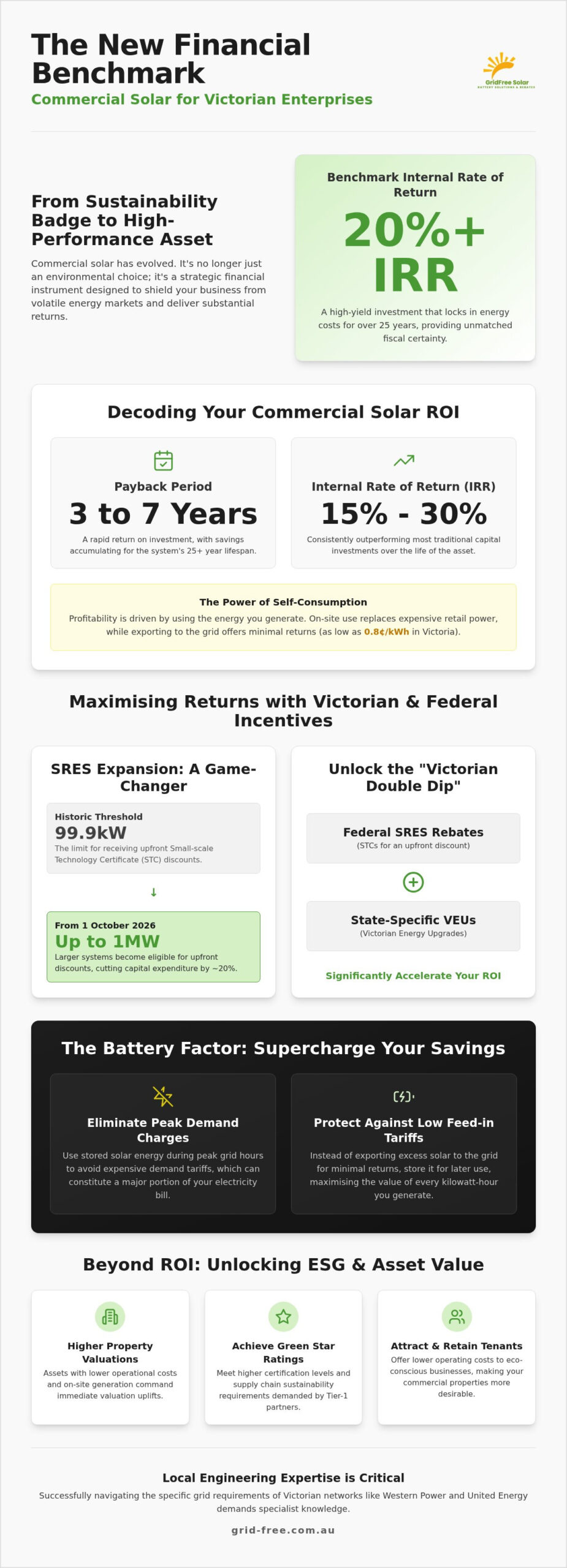
Simple payback periods for Australian businesses currently sit between 3 to 7 years. While that’s a solid metric, it doesn’t tell the whole story. To understand the true value, you must look at the Internal Rate of Return (IRR). A high-performance system often delivers an annual return of 15% to 30% over its 25-year lifespan. This comfortably outperforms most traditional capital investments. Your commercial solar ROI Australia forecast is primarily driven by your self-consumption ratio. Every kilowatt-hour you generate and use on-site replaces expensive retail power. In Victoria, where the average minimum feed-in tariff for 2026/27 has dropped to just 0.8c/kWh, exporting energy to the grid is a losing game. The profit is in the “behind-the-meter” savings.
Sizing your system correctly is a balancing act of rebate access and load matching. Historically, the 99.9kW threshold was the hard limit for Small-scale Technology Certificates (STCs). Staying under this cap ensured an upfront discount without the administrative burden of the Large-scale Renewable Energy Target (LRET). However, the landscape is evolving. From October 1, 2026, the SRES eligibility expands to 1MW. This allows larger facilities to claim upfront discounts on much larger arrays, potentially reducing CAPEX by 20%. You can now scale a bespoke commercial solar solution to match your actual daytime demand without hitting a rebate ceiling.
STCs vs. LGCs: Which Incentive Strategy Wins?
STCs function as a point-of-sale discount, lowering your initial investment immediately. LGCs are different; they’re created based on actual generation and sold annually. While LGCs can provide a long-term revenue stream, most SMEs prefer the cash-flow certainty of STCs. Timing is critical here. The STC multiplier reduces every January 1st as part of a scheduled phase-out. Delaying your installation until 2027 will cost your business thousands in lost upfront incentives. Secure the higher multiplier now to lock in your payback period.
Tax Depreciation and Asset Write-offs
Solar is a Tier-1 depreciable asset that significantly improves your Year 1 cash flow. Whether you utilise the Instant Asset Write-off or standard diminishing value methods, the tax benefits are substantial. It effectively turns a necessary utility cost into a tax-effective business strategy. Model these figures with your accountant to see the impact on your EBITDA. When you combine energy savings with tax offsets, the business case for solar becomes an inevitable financial logic. It’s about making your roof work as hard as your balance sheet.
The Battery Factor: How Storage Supercharges Commercial ROI
By 2026, installing a solar-only system is often a sub-optimal financial move. With Victorian feed-in tariffs hovering around a negligible 0.8c/kWh, exporting excess energy to the grid provides almost zero benefit. You’re essentially giving away your production. The real commercial solar ROI Australia now relies on your ability to store and dispatch energy strategically. Integrated storage allows you to capture every photon and use it when it’s most valuable. This isn’t just about sustainability; it’s about aggressive cost control.
The GridFree advantage lies in our focus on load shifting. This process involves moving your solar-generated power from the middle of the day to the high-cost windows of the early morning or evening. By doing so, you avoid paying retail rates that are significantly higher than your generation costs. It’s a method of arbitrage that turns your physical battery into a profit engine. You become less of a customer of the grid and more of an independent energy operator.
Demand Charge Reduction: The Hidden Profit Centre
Most commercial and industrial power bills include a demand charge. This is a fee based on the single highest point of consumption during a billing period. If your machinery all starts at once, that brief spike can dictate 30% or more of your total monthly bill. Batteries allow for “peak shaving,” where the stored energy kicks in to handle those spikes instead of the grid. By strategically deploying a 30kW battery to cap these spikes, a Victorian business can often save more in avoided demand charges over a few years than the entire capital cost of the battery itself. It’s a surgical approach to bill reduction that panels alone cannot achieve.
Backup Power and Business Continuity
Energy security is a tangible form of ROI. For businesses with sensitive equipment, cold storage, or critical IT infrastructure, a single grid outage can result in thousands in lost productivity or spoiled stock. Modern commercial storage provides UPS-grade continuity. This protection ensures your operations remain seamless even when the local network fails. If your current storage is underperforming or nearing the end of its life, the Battery Replacement Melbourne path offers a rapid way to restore your system’s resilience. Upgrading to high-density lithium technology ensures your facility stays online while your competitors are left in the dark.
Maximising the Victorian Advantage: Rebates, Tax Breaks, and ESG
Victoria is currently the most financially rewarding state for energy upgrades. The “Victorian Double Dip” allows businesses to stack Federal Small-scale Technology Certificates (STCs) with state-specific incentives like the Victorian Energy Upgrades (VEU) program. For a 100kW system, the VEU discount can be around $9,100; for larger 200kW arrays, that incentive jumps to approximately $34,300. This layering of support is a primary driver for an accelerated commercial solar ROI Australia forecast. It effectively slashes the initial capital outlay before the first kilowatt-hour is even generated. You’re starting your journey with a significantly lower cost base than competitors in other states.
Local expertise is the final piece of the ROI puzzle. Melbourne-based installers provide rapid support that national providers simply can’t match. When a component fails, every hour of downtime is lost profit. Choosing a specialist who understands the specific administrative landscape of Victoria ensures your system stays online and optimised. It’s about maintaining peak performance throughout the system’s lifecycle.
Solar Victoria Business Rebate Eligibility
Melbourne SMEs across manufacturing, retail, and agriculture are currently prioritised for state support. To qualify, your business must operate from non-residential premises and meet the current VEU criteria. Navigating the application for Victorian battery rebates requires precision. Your chosen hardware must appear on the Solar Victoria “Approved Products” list. This list is strictly regulated to ensure grid safety and performance standards. Working with an authorised provider ensures your paperwork is compliant from day one, preventing costly delays in rebate approval.
Local Grid Constraints and ROI
The Victorian grid is under pressure. Distribution Network Service Providers (DNSPs) like United Energy and Western Power often impose strict export limits or even zero-export requirements on new commercial connections. This can throttle your returns if your system isn’t engineered correctly. A professional Melbourne solar installation focuses on internal load matching rather than grid export. If you can’t sell power back to the grid, you must use it on-site. This makes battery integration essential. It turns a potential grid constraint into a high-yield storage opportunity. To secure your 2026 incentives, you should book a Victorian energy audit with our commercial team today.
Executing Your Energy Strategy with GridFree Solar
Strategy is only as good as its execution. In the competitive Victorian market, off-the-shelf solutions are a recipe for mediocrity. Maximising your commercial solar ROI Australia requires a bespoke engineering approach that accounts for your specific load profile and roof geometry. Efficiency is the goal. Results are the metric. GridFree Solar provides a streamlined path from initial feasibility to active generation. We don’t just install panels; we engineer profit centres.
Our end-to-end management removes the administrative friction that stalls most commercial projects. We handle the complex rebate applications, DNSP negotiations, and grid connection approvals. This allows your team to focus on core operations while we secure your energy future. Post-installation, our focus shifts to performance maintenance. We ensure your system remains optimised for its entire 25-year lifespan. It’s a partnership built on long-term reliability and data-backed performance.
Why a Local Melbourne Partner Matters
Proximity is a performance factor. When you’re managing a high-yield asset, you can’t wait days for a technician to travel from interstate. GridFree is Melbourne-based. We offer rapid response times for monitoring and maintenance that national firms can’t match. Our team possesses deep knowledge of the Victorian administrative landscape, from Solar Victoria’s latest requirements to the specific technical standards of United Energy and Western Power. Local Victorian businesses have already used this expertise to achieve sub-4-year payback periods by perfectly aligning their systems with state incentives and operational needs.
Future-Proofing with Battery Upgrades
The energy landscape will continue to evolve. A system that is perfect today might need more capacity tomorrow as your business scales. We make it easy to upgrade existing commercial systems to incorporate higher storage volumes. Smart monitoring is the key. By identifying “ROI leaks” in real-time, we can recommend precise battery expansions that further decouple your business from the grid. This proactive approach ensures your investment never becomes obsolete. Secure your 2026 energy independence now. Request a comprehensive GridFree site audit and business case to lock in your path to profitability.
Lock in Your Competitive Energy Advantage
The transition from passive consumer to intelligent energy producer is the most significant financial pivot your business can make in 2026. By mastering the 99.9kW strategic threshold and integrating high-density storage, you protect your margins from a volatile grid. Your commercial solar ROI Australia forecast is no longer tied to unpredictable feed-in tariffs; it’s anchored in self-consumption and peak-shaving arbitrage. Victorian enterprises are uniquely positioned to lead this shift by stacking federal and state incentives to accelerate payback periods.
Success depends on precision. As certified commercial installers with deep expertise in Victorian rebates, GridFree Solar provides the local Melbourne support needed to navigate complex grid requirements. We ensure your system is engineered for maximum yield and long-term reliability. Don’t leave your profitability to the whims of the National Electricity Market. Take control of your operational overheads and secure your 20%+ internal rate of return now.
Get Your Free Commercial Solar Business Case Audit
The era of cheap grid power is over. The era of energy independence starts with a single audit. We look forward to helping your business thrive.
Frequently Asked Questions
What is the average payback period for commercial solar in Australia in 2026?
The typical payback period for commercial solar systems in Australia currently ranges between 3 to 7 years. This timeline is heavily influenced by your daytime energy load and the efficiency of your system design. High-performance installations that focus on self-consumption often deliver an annual return on investment of 15% to 30%. This makes solar a highly competitive financial asset for Victorian businesses seeking to stabilise their long-term operational overheads.
How does the 99.9kW rule affect my commercial solar ROI?
Staying under the 99.9kW threshold was historically necessary to access Small-scale Technology Certificates (STCs) and avoid complex reporting. However, from October 1, 2026, the SRES eligibility expands to 1MW. This change is a game-changer for commercial solar ROI Australia calculations. Larger facilities can now claim upfront discounts of roughly 20% on much bigger systems, allowing for greater economies of scale without the administrative burden of the large-scale certificate market.
Can Victorian businesses still claim the Solar for Business rebate in 2026?
Victorian businesses access support primarily through the Victorian Energy Upgrades (VEU) program in 2026. For installations between 30kW and 200kW, these incentives remain a potent tool for slashing capital costs. A 100kW system typically receives a discount of approximately $9,100, while a 200kW array can attract roughly $34,300. These state-level benefits are designed to work alongside federal incentives, provided your hardware meets the specific “Approved Products” list regulated by Solar Victoria.
What is the difference between STCs and LGCs for my business?
Small-scale Technology Certificates (STCs) act as an immediate point-of-sale discount for systems up to the new 1MW limit. In contrast, Large-scale Generation Certificates (LGCs) are created annually based on the actual electricity your system produces. While LGCs can provide a long-term revenue stream, most SMEs prefer STCs because they provide instant cash-flow relief. Choosing the right certificate strategy depends on your business’s long-term financial goals and specific tax structure.
How do solar batteries improve the ROI of a commercial system?
Batteries supercharge ROI by increasing your self-consumption ratio and mitigating expensive peak demand charges. Since Victorian feed-in tariffs have dropped to an average of 0.8c/kWh, exporting energy is no longer profitable. Storage allows you to use your own solar power during expensive evening peaks or early morning starts. This “behind-the-meter” strategy ensures you extract the maximum financial value from every kilowatt-hour your panels generate rather than exporting it for minimal return.
What are demand charges, and how does solar reduce them?
Demand charges are fees based on the highest point of energy consumption during a billing cycle. They often account for a large portion of a commercial power bill. Solar combined with battery storage allows for “peak shaving,” where the battery discharges to handle high-load events instead of drawing from the grid. This lowers your recorded peak demand, leading to significant, permanent reductions in your monthly network charges and overall energy spend.
Is commercial solar maintenance expensive?
Commercial solar is a low-maintenance asset, but it isn’t “set and forget.” While there are no moving parts, annual electrical inspections and performance monitoring are essential to protect your ROI. Ensuring your inverter is operating at peak efficiency and panels are free from significant debris prevents “generation drift.” Most businesses find that the cost of professional monitoring and minor preventative maintenance is tiny compared to the lost revenue from an underperforming system.
What tax incentives are available for commercial solar in Australia?
Australian businesses can utilise powerful tax incentives, including standard depreciation schedules or the Instant Asset Write-off for eligible entities. Solar arrays and battery storage are classified as Tier-1 depreciable assets. This allows you to offset the capital cost against your taxable income, which significantly boosts your cash flow from the first year. Consult your accountant to model how these tax offsets specifically impact your commercial solar ROI Australia business case.