As of October 2026, federal eligibility for solar incentives has surged to include systems up to 1MW, yet many Victorian businesses are still overpaying for grid power. It’s a frustrating reality. Rising operational overheads are tightening margins across Melbourne, while the complex overlap of state and federal schemes often creates more confusion than clarity. You’re likely worried about missing the window on time-sensitive rebates or choosing the wrong path for your facility. We understand the pressure to perform while shifting toward smarter energy solutions.
This guide is your definitive roadmap to slashing energy overheads by leveraging the latest commercial solar panel grants Victoria provides. You’ll discover how to intelligently stack Victorian Energy Upgrades (VEU) discounts with federal certificates to drive your payback period to under three years. We’ll demystify the 2026 incentive landscape, providing a clear, strategic plan to transform your roof into a high-yield financial asset. It’s time to stop the bleed and start optimising your energy future with modern, intelligent innovation.
Key Takeaways
- Identify the 30kW to 200kW “sweet spot” to maximise your claim under the expanded VEU program.
- Master the strategic stacking of federal STCs and state-based VEECs to secure the most competitive commercial solar panel grants Victoria provides.
- Confirm your site’s eligibility by navigating the strict NMI requirements and non-residential premises criteria.
- Secure your incentives through an Accredited Person to ensure every Victorian Energy Efficiency Certificate is correctly processed and paid.
- Optimise your ROI with a turn-key strategic roadmap designed to lower your payback period to under 3 years.
The 2026 Landscape of Commercial Solar Panel Grants in Victoria
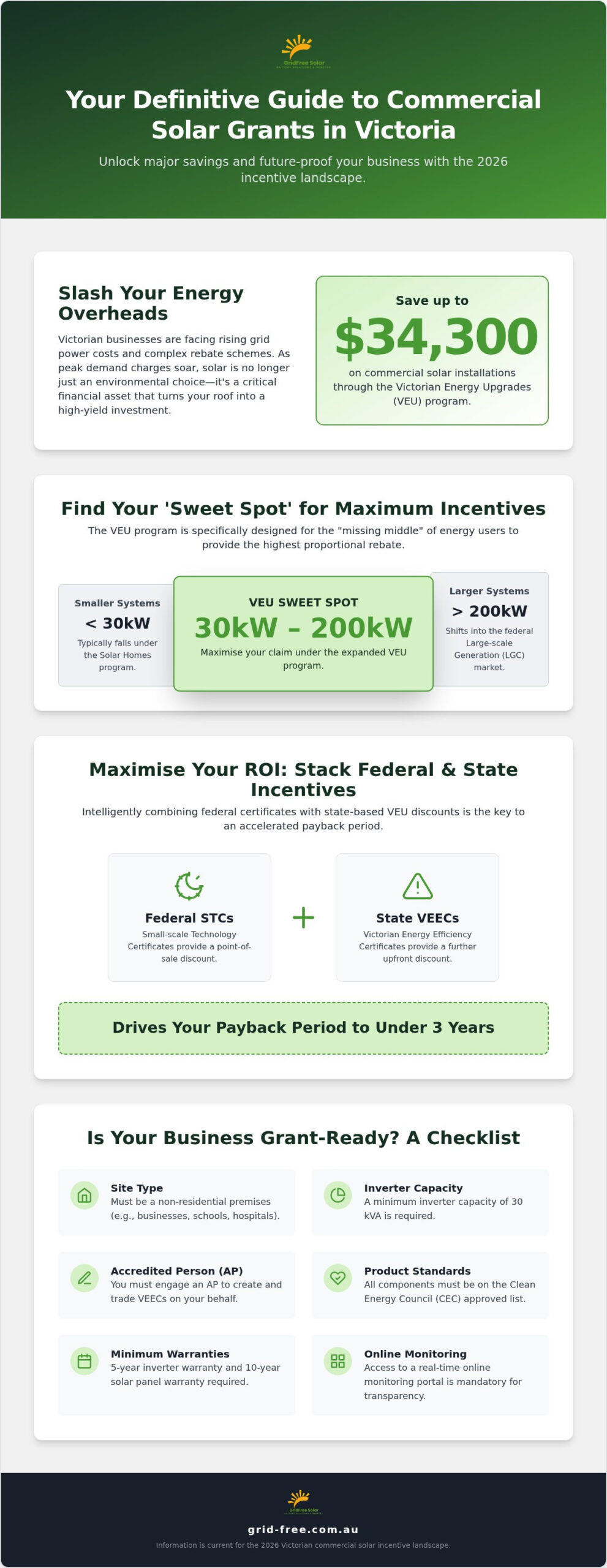
The 2026 energy market is unforgiving for businesses reliant on the grid. In Victoria, the landscape of commercial solar panel grants Victoria offers has undergone a massive transformation. The Victorian Energy Upgrades (VEU) program has recently expanded, specifically targeting the “missing middle” of energy users. Systems between 30kW and 200kW represent the strategic “sweet spot” for state incentives, offering the highest proportional reduction in capital expenditure. This shift is a game-changer. It moves away from the traditional, slow rebate model toward immediate financial relief. Victorian businesses are electrifying at record rates to lock in these discounts before certificate prices fluctuate. You can’t afford to wait while your competitors optimise their cost structures.
What is the VEU Commercial Solar Discount?
The VEU discount isn’t a government cheque in the mail. It’s a sophisticated financial mechanism using Victorian Energy Efficiency Certificates (VEECs). Every megawatt-hour of carbon avoided generates certificates with real market value. In 2026, these are traded by Accredited Persons to provide an immediate reduction on your installation invoice. This program specifically supports non-residential sites, including schools, hospitals, and community buildings. By participating, Victorian businesses may save up to $34,300 on commercial solar installations through the VEU program this year. It’s a pragmatic, results-oriented solution for modern energy management that bypasses administrative delays.
Why Business Energy Costs Demand Solar Now
Peak demand charges are the silent killers of Victorian commercial margins. As retailers move toward time-of-use tariffs, the cost of drawing power during business hours has skyrocketed. Solar provides a direct hedge against this volatility. By generating power on-site, you bypass the grid during the most expensive periods of the day. Solar power in Australia has reached record levels, with 791 MW installed in the first quarter of 2026 alone. This momentum is driven by a simple truth: solar is no longer just an environmental choice. It’s a strategic financial asset. Transitioning to self-consumption protects your bottom line from 2026 grid price swings and turns a passive roof into a revenue-generating powerhouse.
Decoding the Victorian Energy Upgrades (VEU) Program
Accessing the Victorian Energy Upgrades (VEU) program requires more than just a purchase receipt. It’s a regulated market. You must engage an Accredited Person (AP) to create and trade Victorian Energy Efficiency Certificates (VEECs) on your behalf. These APs are your only legal gateway to the commercial solar panel grants Victoria offers. They ensure your installation meets the rigorous measurement and verification standards mandated by the Essential Services Commission. Without an AP, your project is ineligible for the upfront price reduction. It’s a professionalised process designed to guarantee carbon abatement and system performance.
System Size and Capacity Requirements
The program targets a specific capacity range. Your system must be between 30kW and 200kW to qualify for these specific state-level commercial solar panel grants Victoria provides. If your requirements are smaller, you’ll likely fall under the Solar Homes program. If you need an array larger than 200kW, the project shifts into the federal Large-scale Generation Certificate (LGC) market. Crucially, the VEU also mandates a minimum inverter capacity of 30 kVA. This ensures the system is substantial enough to contribute meaningful efficiency gains to the Victorian grid while maintaining infrastructure stability.
Strict Product and Warranty Standards
Compliance is non-negotiable. Every component must appear on the Clean Energy Council (CEC) approved products list. This isn’t just about safety; it’s about long-term reliability for your facility. To be eligible, your hardware must carry a minimum 5-year inverter warranty and a 10-year solar panel warranty. We use the Solar Panel Validation Initiative to confirm you’re receiving genuine, Tier 1 technology rather than inferior, unverified imports. These standards protect your investment and ensure the certificates generated carry maximum market value.
Transparency is another core requirement. You must have access to an online monitoring portal. This allows you to track real-time generation and verify that your investment is performing as promised. Meeting these Victorian distribution network contracts ensures your system integrates safely with the local infrastructure. Navigating these technical hurdles is simpler when you partner with a specialist in Commercial Solar Solutions who manages the compliance audit from start to finish. Don’t let administrative complexity block your path to lower overheads.
Federal vs. State: Stacking Your Incentives for Maximum ROI
Strategic stacking is the only way to achieve a sub-3-year payback period in 2026. While many providers focus on a single scheme, the most profitable installations leverage both federal and state mechanisms simultaneously. In Victoria, you aren’t forced to choose. By combining commercial solar panel grants Victoria provides through the VEU with federal certificates, businesses can often cover 40% to 60% of their total project costs. This isn’t just a minor saving. It’s a fundamental restructuring of your capital expenditure that turns a decade-long investment into a rapid-return asset. You’re effectively securing a high-performance power plant at a fraction of its market value.
STCs and LGCs: The Federal Backbone
The Small-scale Renewable Energy Scheme (SRES) remains a powerhouse for upfront relief. From 1 October 2026, eligibility for the SRES has been expanded to include solar PV systems up to 1 MW. This is a massive increase from the previous 100 kW cap. This change allows larger industrial sites to claim Small-scale Technology Certificates (STCs) as an immediate point-of-sale discount. For systems exceeding this new threshold, Large-scale Generation Certificates (LGCs) provide ongoing revenue based on actual generation. Federal STCs typically reduce the upfront price by approximately 30%. When you layer this with the Victorian state discount, the financial logic becomes undeniable. The 2026 certificate market trends show strong demand, making this the ideal window to lock in your pricing.
The 2026 Battery Storage Incentive Expansion
Energy storage is no longer optional for Victorian businesses facing midday price slumps and evening peak surges. The 2026 Cheaper Home Batteries Program now offers a 30% discount for small business storage solutions. This federal push complements the local landscape perfectly. Storage allows you to capture excess generation during the “midday power saver” window and deploy it when grid prices are highest. Integrating this federal discount with the Victorian battery rebate 2024 to 2026 creates a comprehensive energy shield for your facility. It’s the modern standard for Victorian SMEs looking to eliminate grid dependency. We specialise in designing these integrated systems to ensure you claim every cent of available funding from both levels of government. Don’t leave money on the table by ignoring the synergy between these programs.
Eligibility Checklist: Is Your Business Grant-Ready?
Eligibility for commercial solar panel grants Victoria provides isn’t a given. It requires precise technical alignment and administrative accuracy. Many Victorian businesses assume a standard ABN is enough. It isn’t. Your facility must be a non-residential premise, including industrial sites, schools, or community buildings. The most critical anchor for your claim is the National Meter Identifier (NMI). The VEU program operates on a strict “one solar system per NMI” rule. If your site has multiple meters, your strategy must account for this limitation to avoid immediate rejection. We ensure your documentation is airtight before the first panel arrives on site.
The Technical Pre-Requisites
Your site must be connected to the Victorian distribution network. This sounds simple, but navigating your specific Distribution Network Service Provider (DNSP), such as Powercor or United Energy, is a mandatory first step. Pre-approval for your grid connection is non-negotiable. Additionally, your business must be an active, tax-paying entity registered in Victoria. For VEU eligibility, your inverter capacity must align with the negotiated contract, typically requiring a minimum of 30 kVA. This ensures the system is substantial enough to meet the program’s efficiency benchmarks. We manage these technical hurdles to confirm your site is ready for a high-performance array.
Common Pitfalls in Grant Applications
Small errors cause significant delays. The use of non-CEC approved components is the fastest way to void your incentive. Every piece of hardware must be verified against the Clean Energy Council list at the time of installation. Another common failure point is the ‘New Installation’ rule. While the VEU program is a game-changer for new arrays, upgrading an existing system follows different, often stricter, protocols. Missing the creation deadline is also a risk; Victorian Energy Efficiency Certificates (VEECs) must be created post-installation with perfect data accuracy. Incomplete monitoring data remains a hidden reason for grant rejection. If your system isn’t reporting generation correctly from day one, your claim is at risk.
Avoid these costly administrative traps. Secure your funding by partnering with a local specialist who understands every nuance of the Victorian regulatory landscape. If you’re ready to verify your site’s potential, contact our team for a professional assessment of your Commercial Solar Solutions today. Don’t let your business miss out on the most aggressive incentives in a decade due to a simple paperwork error. It’s time to lock in your savings and future-proof your operational costs.
Future-Proofing: Implementing a Strategic Commercial Solar Solution
A hardware-only approach is a liability in 2026. While purchasing panels might seem straightforward, the administrative burden of securing commercial solar panel grants Victoria offers is significant. You need a turn-key solution. A strategic partner manages the engineering, the grid connection, and the complex certificate creation process simultaneously. This ensures your capital is protected and your incentives are guaranteed. Relying on a commercial solar installation Melbourne specialist means moving from a passive energy consumer to an active, intelligent producer. It’s about securing a long-term asset that performs from day one.
Selecting an Accredited VEU Partner
Experience with VEEC creation is vital for your cash flow. If your installer lacks the accreditation to trade certificates directly, you’ll face months of delays and potential rejection. The GridFree Solar advantage lies in end-to-end grant management. We take the complexity out of the process, acting as your trusted advisor from initial design to final certificate registration. Ensuring your solar panel installation Melbourne project meets 2026 standards requires deep local knowledge. We navigate the VEU landscape daily, ensuring every technical specification aligns with current grant requirements. We don’t just install hardware; we secure your financial return.
The ROI of Grid Independence
Virtual Power Plants (VPPs) are the next frontier for Victorian SMEs. By integrating smart batteries, your business can earn extra revenue by discharging power back to the grid during peak demand events. This transforms your system from a cost-saving measure into a genuine profit centre. When you calculate your payback period with stacked commercial solar panel grants Victoria provides, the results are typically under three years. High-performance energy storage solutions Melbourne businesses are adopting today protect against the volatility of 2026 energy prices. It’s a pragmatic, results-oriented transition from old methods to advanced, modern solutions.
Secure your 2026 grant allocation today. The next steps are simple. We start with a comprehensive local site assessment to verify your infrastructure’s capacity and map out a strategic roadmap for your installation. Don’t wait for the next price hike to take action. The window for maximum incentives is open now, but it won’t stay that way forever. Join the ranks of forward-thinking Victorian businesses that have already digitised and decarbonised their energy supply. It’s time to take control of your overheads once and for all.
Secure Your Competitive Advantage in 2026
The window for maximum energy savings is open. By strategically stacking federal and state incentives, your business can achieve a sub-3-year payback period. We’ve decoded the VEU program and the expanded federal SRES eligibility to show you exactly how to slash overheads. Compliance is the only barrier. Navigating NMI requirements and certificate creation requires precision. Don’t let administrative complexity stall your progress. Our Melbourne-based installation team provides expert VEU accredited guidance to ensure you don’t leave money on the table. We are specialists in business ROI maximisation, turning technical hurdles into financial wins.
It’s time to act. Grid prices won’t wait, and neither should your transition to energy independence. Take the first step toward a high-performance, future-proof facility today. Claim Your Commercial Solar Grant Assessment and discover the full potential of commercial solar panel grants Victoria provides for your site. Let’s optimise your energy future together.
Frequently Asked Questions
Can my business claim both the Victorian VEU discount and Federal STCs?
Yes, you can stack both federal and state incentives to maximise your returns. Victorian businesses often leverage the Small-scale Renewable Energy Scheme (SRES) alongside the Victorian Energy Upgrades (VEU) program. This dual-layered approach is the most effective way to secure commercial solar panel grants Victoria provides. By combining these certificates, you can significantly reduce capital expenditure and drive your payback period to under three years. It’s a pragmatic strategy for intelligent energy management.
What is the maximum system size eligible for the Victorian commercial solar grant?
The maximum threshold for the current VEU commercial solar incentive is 200kW. This specific state-based program targets systems ranging from 30kW up to 200kW on non-residential premises. If your facility requires a larger array, you’ll transition into different federal frameworks. Maintaining your system within this “sweet spot” ensures you qualify for the maximum upfront discount through Victorian Energy Efficiency Certificates. We help you size your array to optimise these available state incentives.
Do non-profit organisations and schools qualify for the VEU solar discount?
Yes, schools, non-profits, and community buildings are all eligible for the VEU discount. The program is designed for non-residential sites across Victoria, provided they have a valid National Meter Identifier (NMI). This includes hospitals and industrial facilities looking to optimise their energy efficiency. It’s an excellent opportunity for community-focused organisations to transition from old power methods to modern, advanced solutions. We specialise in navigating these administrative landscapes for educational and non-profit sectors.
Is there a specific grant available for commercial solar batteries in Victoria in 2026?
As of 2026, you can access a federal 30% discount through the Cheaper Home Batteries Program. This federal incentive is specifically designed for small business storage solutions and integrates seamlessly with local Victorian battery rebates. Adding storage allows you to capture abundant midday solar generation and deploy it during expensive evening peak periods. It’s the modern standard for grid independence. Combining these commercial solar panel grants Victoria offers with battery storage creates a resilient energy shield.
How long does the application process for commercial solar grants typically take?
The timeframe varies, but the financial benefit is delivered as an upfront discount on your invoice. Because the VEU program works through Accredited Persons (APs), they handle the creation and trading of certificates behind the scenes. This removes the administrative wait for the business owner. Once your site assessment and grid connection approvals are finalised, the installation and discount application move quickly. We manage the entire turn-key process to ensure your cash flow remains protected throughout.
What happens if my business solar system is larger than 200kW?
Systems larger than 200kW fall under the federal Large-scale Generation Certificate (LGC) market or the expanded SRES. From 1 October 2026, the SRES eligibility has increased to include solar PV systems up to 1MW. This fills the gap for industrial-scale installations that exceed the Victorian state-based cap. While you won’t claim the VEU discount for these larger arrays, the federal certificates still provide significant capital relief for your high-capacity energy project.
Is the commercial solar grant an upfront discount or a tax rebate?
It is an upfront discount rather than a deferred tax rebate. When you work with an accredited provider, the value of the Victorian Energy Efficiency Certificates is deducted directly from your installation quote. This provides immediate capital relief, allowing you to bypass the long wait times associated with traditional government grants. It’s a results-oriented mechanism designed to encourage rapid adoption of renewable technology. You see the savings on your bottom line from day one.
Do I need to own the building to apply for a commercial solar grant in Victoria?
You don’t necessarily need to own the building, but you must have the owner’s consent. Many Victorian businesses operating from leased industrial or commercial spaces successfully apply for solar grants. The primary requirement is that the installation occurs on a non-residential premise with its own National Meter Identifier. We recommend discussing the long-term asset value with your landlord. Solar increases property value while lowering your operational overheads, creating a win-win scenario for both parties.