
Energy independence in the National Electricity Market (NEM) is no longer a luxury. It’s a survival strategy. With volatile wholesale prices and shifting network charges, your bottom line is under constant siege. You likely already know that the commercial solar cost Victoria businesses face is a moving target, influenced by evolving state incentives and federal STC multipliers. It’s a complex landscape where the upfront capital expenditure often feels like a barrier rather than a bridge to profitability.
This guide cuts through the noise. You’ll discover the precise variables driving system pricing in 2026 and how to leverage the latest Victorian rebates to slash your payback period. We’ll provide a clear forecast for ROI. This ensures you understand exactly how a high-capacity solar and battery installation transforms a mounting overhead into a predictable asset. From per-kW benchmarks to federal tax benefits, here is everything you need to secure your commercial energy future.
Key Takeaways
- Benchmark your investment using current price-per-watt data and learn why hardware markets have stabilised for the 2026 calendar year.
- Identify the critical site variables, from switchboard capacity to roof material, that dictate your final commercial solar cost Victoria quote.
- Secure maximum funding by navigating the latest eligibility criteria for Solar Victoria business rebates and federal STC incentives.
- Forecast your fiscal performance with precise ROI calculations based on modern self-consumption ratios and volatile NEM price trends.
- Build for longevity with custom designs that integrate battery storage and prepare your facility for future vehicle-to-grid innovation.
Benchmarking Commercial Solar Costs in Victoria for 2026
Hardware costs in 2026 have entered a phase of relative stability. Global manufacturing efficiencies have finally offset local inflationary pressures. For a business owner, this means the commercial solar cost Victoria market is more predictable than it was three years ago. Price-per-watt remains the primary benchmark for assessing value. Small-scale systems typically carry a higher per-unit cost than industrial installations exceeding 100kW due to fixed overheads. The Levelised Cost of Energy (LCOE) for Victorian businesses is the total cost of installing and operating a solar system divided by its expected lifetime energy output.
System Sizing vs. Capital Outlay
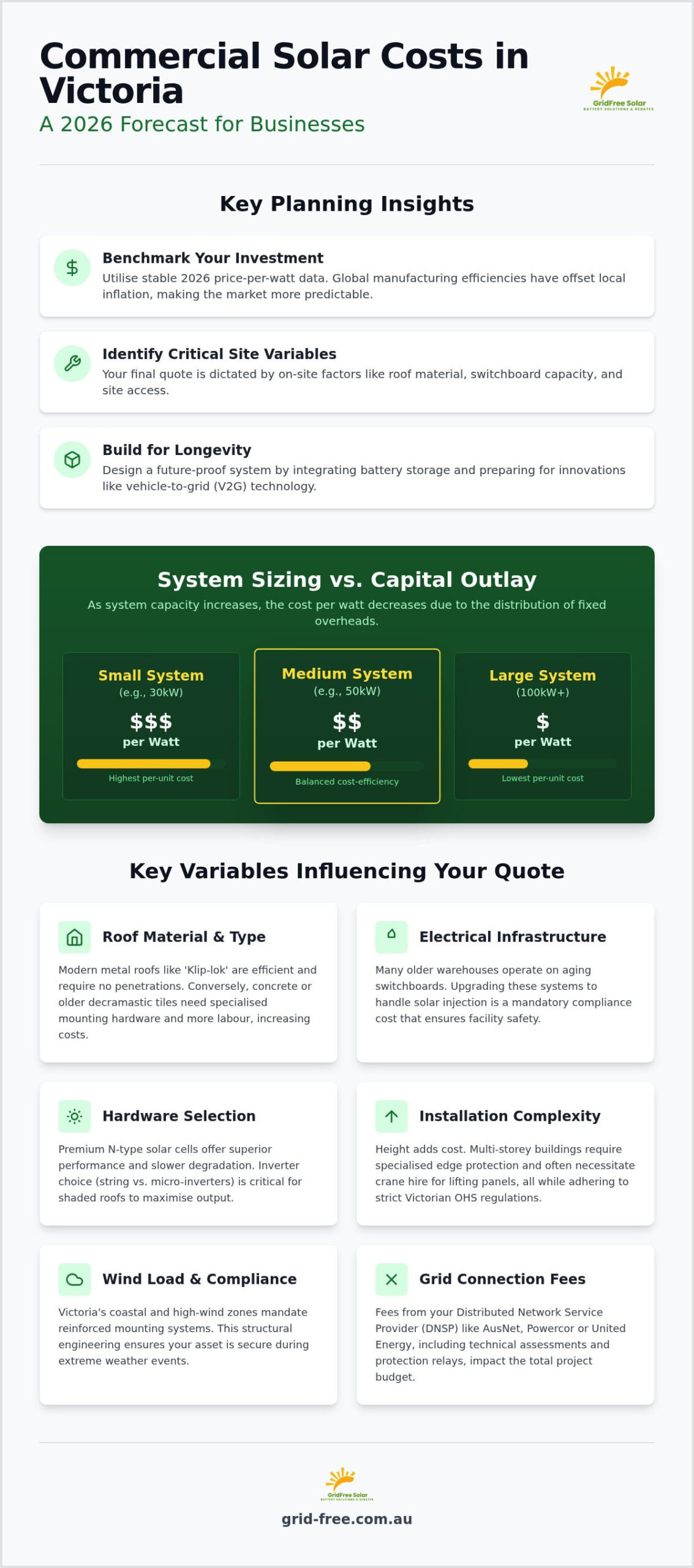
Scale dictates your efficiency. A 30kW system requires similar administrative and engineering groundwork to a 50kW system. As you scale toward 100kW and beyond, the cost of Tier 1 modules and high-efficiency inverters is distributed across a larger generation capacity. This reduces the per-panel impact on your budget. Premium hardware often commands a higher initial investment. However, the superior degradation rates and local warranty support of Tier 1 brands ensure the system remains a performing asset for 25 years. Lowering the commercial solar cost Victoria companies face is often about selecting hardware that minimises long-term operational expenditure.
The “Melbourne Factor”: Local Pricing Influences
Victoria presents unique logistical challenges that influence a quote. Local labour rates for accredited installers reflect the high standard of safety and compliance required in our state. Structural engineering is another critical variable. Melbourne’s wind loads and the prevalence of older warehouse stock mean that mounting systems must be customised for specific roof types. You cannot ignore grid connection fees. These are determined by your Distributed Network Service Provider (DNSP). Whether your facility sits in the United Energy, AusNet, or Powercor network, technical assessment fees and potential protection relay requirements will influence your total project budget. These local factors are why a generic online estimate rarely matches the reality of a site-specific commercial solar cost Victoria proposal.
Key Variables Influencing Your Commercial Solar Quote
Site-specific variables dictate the final investment figure. A generic per-watt estimate rarely accounts for the physical reality of a Victorian industrial facility. Your roof material is the first major factor. Fixing panels to a modern “Klip-lok” metal roof is efficient and requires no penetrations. Conversely, concrete or older decramastic tiles require specialised mounting hardware and increased labour. These logistical details can shift the commercial solar cost Victoria businesses see on a final quote by several thousand dollars.
Electrical infrastructure is the hidden variable. Many Melbourne warehouses operate on aging switchboards that lack the capacity for high-capacity solar injection. Upgrading these systems is a mandatory compliance cost. It ensures your facility can safely handle the bidirectional energy flow. Additionally, corporate ESG reporting now demands precision. Integrated data logging and smart meters are essential for accurate carbon accounting. While these add to the initial outlay, they’re vital for transparent sustainability benchmarking.
Hardware Selection and Reliability
Efficiency has a price. N-type solar cells offer superior performance in high temperatures compared to older P-type technology. They degrade slower, securing your ROI over decades. Your choice of inverter technology also matters. String inverters are the standard for clear, north-facing roofs. However, if your site suffers from shading caused by parapets or HVAC units, micro-inverters or DC optimisers are necessary. Spending more on high-end electronics prevents the catastrophic 5-year failure costs common with budget components. For a site-specific assessment of your infrastructure, you can consult with our local Melbourne team to avoid hidden expenses.
Installation Complexity and Site Access
Height adds cost. Multi-storey installations require specialised edge protection and often necessitate crane hire for panel lifting. Safety is non-negotiable under Victorian OHS regulations. If your facility operates 24/7, you might require after-hours installation to avoid disrupting heavy machinery or logistics. This ensures zero downtime but carries a premium labour rate. We also factor in wind-load compliance. Coastal Victorian zones require reinforced mounting systems to withstand high-velocity gusts. These engineering requirements ensure your system remains secure during extreme weather events. This level of planning is what separates a standard commercial solar cost Victoria estimate from a professional, risk-mitigated proposal.
Navigating Victorian Rebates and Financial Incentives
The financial architecture of a solar project determines its ultimate success. In Victoria, this involves stacking federal incentives with state-specific grants to minimise your net outlay. Federal Small-scale Technology Certificates (STCs) remain the most significant upfront lever for systems under 100kW. These certificates act as a direct discount on your quote. However, timing is critical. The STC deeming period reduces by one year every January, which systematically lowers the subsidy value and increases the net commercial solar cost Victoria businesses face if they delay their investment.
For industrial-scale projects exceeding 100kW, the incentive structure shifts to Large-scale Generation Certificates (LGCs). Unlike the upfront nature of STCs, LGCs are created based on actual energy generation and sold on the open market. This creates an ongoing revenue stream rather than a single point-of-sale discount. Understanding which tier your system falls into is the first step in accurate fiscal modelling. We ensure your project is registered correctly to harvest every available cent from the Clean Energy Regulator.
Federal vs. State Support
Maximising your ROI requires a dual-track approach. While STCs handle the federal side, the Solar Victoria Business Rebate provides a targeted boost for small-to-medium enterprises. Eligibility typically hinges on having fewer than 50 employees and operating from non-residential premises. This state rebate can be combined with federal incentives to significantly reduce the capital gap. If you are also considering energy security, explore the Victorian battery rebate 2024 to 2026: The Complete Guide to Storage Savings to see how storage incentives further enhance your site’s resilience.
Tax Benefits and Financing Options
Smart financing transforms solar from a capital expense into an operational saving. Victorian CFOs should look closely at the current instant asset write-off provisions. These allow for the immediate depreciation of eligible hardware, providing a substantial tax shield in the first year of operation. For businesses prioritising cash flow, Environmental Upgrade Finance (EUF) is a powerful local alternative. Available through many Victorian councils, EUF allows you to secure a loan that is repaid via your property’s rates. This ties the debt to the building rather than the business. Alternatively, a Chattel Mortgage offers full ownership from day one. This allows you to claim both the interest and the depreciation as tax deductions. Each pathway alters the commercial solar cost Victoria businesses record on their balance sheets, making expert financial structuring as important as the engineering itself.
Calculating the Real ROI: Payback Periods for Victorian Businesses
ROI is the only metric that truly validates a capital project. In the 2026 Victorian market, the payback period for high-consumption commercial sites has compressed significantly. While the commercial solar cost Victoria businesses face depends on system complexity, most professionally engineered installations achieve full cost recovery within three to five years. This acceleration is driven by the widening gap between solar generation costs and escalating retail electricity tariffs. To see how these timelines apply to your specific facility, you can request a custom ROI projection from our analysts.
Self-consumption is the engine of your internal rate of return. Every kilowatt-hour you generate and use on-site offsets a retail purchase, often saving you between 25 and 40 cents. Conversely, Victorian feed-in tariffs (FiT) have remained low, often hovering below 5 cents per kWh. This disparity means that “oversizing” a system for the sake of export is a poor fiscal strategy. We focus on matching system capacity to your daytime load profile to ensure every panel contributes to your bottom line rather than the grid’s profit margins.
Energy Tariff Analysis
Commercial energy bills are more than just usage charges. Demand charges, calculated on your peak kVA usage, can account for up to 40% of a Victorian business’s monthly invoice. A strategic solar installation acts as a “peak shaver,” reducing your maximum draw from the grid during high-tariff windows. This provides a secondary financial benefit that generic calculators often miss. When forecasting 2026 energy price hikes, we model for continued volatility in the NEM, making on-site generation a critical hedge against future operational cost blowouts.
The Cost of Inaction
Delaying your transition to renewables is a choice to continue subsidising the grid. Sticking with 100% grid reliance over the next decade exposes your business to compound price increases and carbon penalties. Beyond immediate savings, solar is a proven capital improvement. Research into Victorian commercial assets suggests that high-efficiency energy systems increase property yield and attract higher-quality tenants who prioritise ESG compliance. By choosing a Commercial Solar Installation Melbourne: Future-Proof Your Business in 2026, you transform a mounting overhead into a high-yield asset. Factoring in minimal maintenance and quarterly cleaning, the total cost of ownership remains low while the cumulative savings grow annually.
Scaling for the Future with GridFree Solar
Off-the-shelf solar kits fail the complexity test of Victorian industry. They ignore the specific thermal properties of your facility and the unique grid constraints of your local DNSP. Real value comes from custom engineering. By tailoring the array layout and inverter selection, we drive down the effective commercial solar cost Victoria businesses pay over the life of the system. Our Melbourne-based engineering team focuses on maximising yield per square metre while ensuring your infrastructure is ready for the next wave of innovation. This includes Vehicle-to-Grid (V2G) capabilities and integrated EV fleet charging. Don’t build a system that’s obsolete in five years.
The transition from a quote to a commissioned system requires precision. We manage the entire administrative burden, from grid connection applications to rebate processing. This allows your team to focus on operations while we handle the technical heavy lifting. Our local presence means we understand the specific Victorian compliance landscape. We don’t just install panels; we build high-performance energy assets that empower your business to move away from grid dependency. It’s about securing your fiscal future with intelligent, assertive energy management.
Integrating Commercial Battery Storage
2026 is the year commercial storage becomes a non-negotiable asset for Victorian facilities. As network charges rise, the ability to store excess daytime generation for use during peak evening windows is vital. This isn’t just about backup power. It’s about intelligent demand management. By discharging your battery during peak tariff periods, you can effectively “flatten” your load profile and slash your kVA demand charges. For a detailed breakdown of the investment required, read our Solar Battery Cost Australia 2026: The Definitive Price & ROI Guide. This integrated approach ensures your commercial solar cost Victoria investment delivers maximum utility 24/7.
Getting a Customised Victorian Quote
Precision modelling requires high-quality data. We start by analysing your 12-month interval data to map your consumption habits against local solar irradiance. This ensures we don’t undersize your system or waste capital on capacity you won’t use. Following the data analysis, our team conducts a comprehensive site audit. We inspect your switchboard, roof structure, and cable runs to ensure there are no hidden electrical surprises during the build. This transparency is why Victorian businesses trust our process. Ready to see the numbers for your facility? Book a Commercial Solar Feasibility Study with GridFree Solar today and secure a definitive roadmap to energy independence.
Secure Your Energy Independence Today
The window for maximum state and federal subsidies is narrowing. As the STC deeming period continues its annual decline, delay only increases your net capital outlay. Determining the definitive commercial solar cost Victoria businesses will pay in 2026 requires a site-specific lens. It’s about more than just panels. It’s about engineering a high-yield asset that integrates battery storage to hedge against volatile NEM pricing.
Our Melbourne-based commercial teams specialise in navigating complex Victorian grid connections. We don’t offer generic packages. We provide custom, data-backed energy solutions designed by CEC Accredited Designers. By matching system capacity to your interval data, we ensure your ROI is both rapid and reliable. This is a critical fiscal upgrade. It transforms a mounting operational expense into a predictable, long-term revenue driver.
Stop subsidising the grid. Take control of your facility’s energy future with a partner who understands the local administrative and technical landscape. Request a Custom Commercial Solar ROI Analysis for Your Victorian Business today. The path to energy independence starts with a single, intelligent decision.
Frequently Asked Questions
How much does a 100kW solar system cost in Victoria in 2026?
The total investment for a 100kW system depends on hardware selection and the complexity of your facility’s electrical infrastructure. High-efficiency N-type modules and commercial-grade inverters represent the primary hardware costs. While economies of scale reduce the per-watt rate for larger arrays, site-specific factors like crane hire and switchboard upgrades remain critical variables in your final quote.
Are there still business solar rebates available in Victoria?
Yes, Solar Victoria continues to provide targeted rebates for eligible small businesses to help manage the upfront commercial solar cost Victoria companies face. These incentives are specifically designed for SMEs operating from non-residential premises. Eligibility generally hinges on employee headcount and property type, so it’s vital to verify the current rebate caps before finalising your project budget.
What is the average payback period for commercial solar in Melbourne?
Most Melbourne businesses achieve a full return on investment within three to five years. This rapid timeline is driven by high self-consumption ratios where on-site generation offsets expensive peak retail tariffs. By matching the system size to your daytime load profile, you maximise the internal rate of return and transform a mounting operational overhead into a performing asset.
Do I need a structural engineering report for commercial solar in Victoria?
A structural engineering report is a mandatory requirement for most commercial installations under Victorian building regulations. This assessment ensures your roof can safely support the additional dead load and withstand local wind uplift forces. Professional engineering protects your physical asset and ensures the mounting system is fully compliant with Australian safety standards.
Can I install commercial solar if I lease my business premises?
Installation on leased premises is common and usually requires formal landlord consent. Many Victorian tenants use Environmental Upgrade Finance (EUF) to tie the solar repayments to the property’s rates, which benefits both the tenant and the owner. This arrangement increases the building’s capital value and ESG rating while providing the tenant with immediate energy savings.
What is the difference between STCs and LGCs for Victorian businesses?
STCs provide an upfront discount for systems under 100kW and are applied at the point of sale. LGCs apply to systems exceeding 100kW and are generated annually based on your actual energy production. The choice between these two schemes depends on your total capacity and whether you prefer an immediate reduction in commercial solar cost Victoria or an ongoing revenue stream.
How much does it cost to add a battery to an existing commercial solar system?
Adding storage involves the cost of the battery units plus an AC-coupled inverter or a hybrid upgrade. While this increases the initial outlay, it allows your business to avoid high peak demand charges by discharging stored energy during expensive tariff windows. It’s a strategic move for 24/7 operations looking to achieve total energy independence and resilience.
Is commercial solar worth it for businesses with low daytime energy use?
Solar delivers the highest value when energy is consumed as it’s generated. If your daytime use is low, the investment is usually only viable if paired with a commercial battery system to store energy for evening shifts. Without storage, the reliance on low feed-in tariffs significantly extends the payback period and reduces the overall fiscal benefit of the installation.