
Table of Contents
- How Solar Batteries Work for Home Backup
- AC vs DC Coupled Solar Batteries: Which Suits Your Home?
- Solar Battery Backup Capacity: How Much Do You Actually Need?
- Top Solar Batteries for Australian Homes Compared
- Solar Battery Cost Australia: Rebates and Real Pricing
- Lithium Iron Phosphate vs Other Battery Chemistries
- Installation, Compliance, and EV Charger Integration
- Which Solar Battery for Home Backup Should You Choose?
- Frequently Asked Questions
Last Updated: August 9, 2026
Choosing the best solar battery for home backup is one of the most consequential decisions an Australian homeowner will make in the next decade. Grid outages are becoming more frequent, electricity prices continue to climb, and the federal government’s Cheaper Home Batteries Program has made storage more accessible than ever. At GridFree Solar, we’ve guided thousands of Victorian homeowners through this decision, and the right answer is rarely the most expensive one.
This guide cuts through the marketing noise. Below, we compare the top batteries available in Australia right now, explain what the specifications actually mean for your home, and show you how to claim the rebates that reduce your upfront cost significantly.
Quick Picks:
- Best All-in-One: Tesla Powerwall 3, integrated inverter, seamless backup, strong brand support
- Best Value Modular: Sungrow SBR Series, excellent round-trip efficiency, scalable capacity
- Best for Scalability: BYD Battery-Box Premium HVM, expandable to 66.2 kWh across three stacks
- Best Safety Features: AlphaESS SMILE5, built-in aerosol fire suppression system
- Best Long Warranty: Enphase IQ Battery 5P, 15 years or 6,000 cycles
- Best Budget Entry: GoodWe Lynx Home U Series, LFP chemistry, plug-and-play installation
How Solar Batteries Work for Home Backup
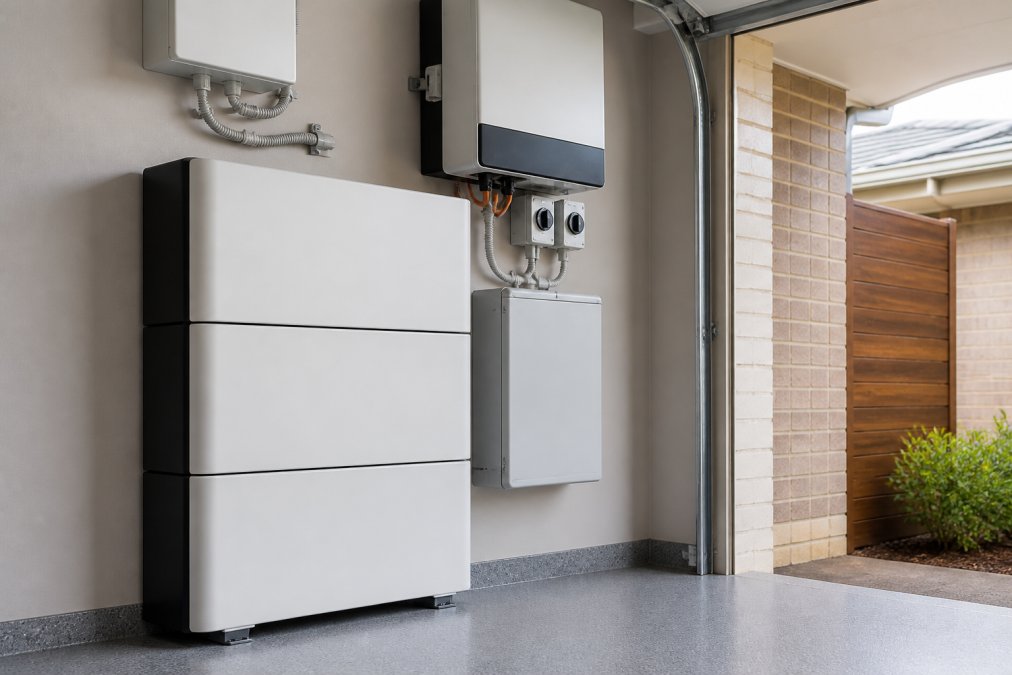
A solar battery captures surplus electricity generated by your photovoltaic array during daylight hours and releases it when the sun isn’t shining or when the grid fails. The battery management system (BMS) governs charge and discharge cycles, monitors cell voltage and temperature, and prevents thermal runaway.
During normal grid-tied operation, the battery prioritises self-consumption: it fills from your solar panels first, then exports excess energy to the grid. When a grid outage occurs, the system switches to backup mode, isolating your home from the network and supplying stored energy to your critical loads.
Battery Management Systems and Safety
The battery management system is the intelligence layer of any energy storage system. A well-designed BMS performs cell balancing, enforces safe operating limits for voltage and temperature, and communicates state-of-charge data to your inverter and monitoring portal.
Australian installations must comply with AS/NZS 5139:2019, Electrical installations for battery systems. All batteries listed in this guide are Clean Energy Council approved, meaning they have been independently assessed against these requirements.
Never install a battery that isn’t on the Clean Energy Council’s approved product list. Non-compliant batteries may void your home insurance and create serious fire risk. Your installer should provide a Certificate of Electrical Safety upon completion.
Emergency Power Supply (EPS) Switching Speeds
EPS switching speed measures how quickly the battery transitions from grid-tied mode to backup mode after a grid failure. Most lithium iron phosphate systems switch in under 20 milliseconds. The Enphase IQ Battery 5P achieves particularly fast switching due to its distributed architecture, which is valuable for households with medical equipment or home offices.
AC vs DC Coupled Solar Batteries: Which Suits Your Home?
The AC vs DC coupled question determines whether you need to replace your existing inverter or can retrofit storage onto your current system.
DC-coupled systems connect the battery directly to the solar array before the inverter. Energy flows: solar panels → charge controller → battery → inverter → home. DC-coupled systems achieve higher round-trip efficiency. The BYD Battery-Box Premium HVM and Sungrow SBR Series are DC-coupled and require a compatible hybrid inverter.
AC-coupled systems connect the battery to the home’s AC circuit after the inverter. Energy flows: solar panels → inverter → home/battery. AC coupling allows the battery to work with virtually any existing solar setup. The Enphase IQ Battery 5P is AC-coupled, which suits homeowners who already have a functioning solar system and don’t want to replace their inverter.
| Coupling Type | Round-Trip Efficiency | Inverter Requirement | Best Retrofit Option |
|---|---|---|---|
| DC-coupled | Higher (up to 97%) | Hybrid inverter required | No, needs compatible inverter |
| AC-coupled | Slightly lower (90-95%) | Works with existing inverter | Yes, broad compatibility |
If you’re installing solar and storage together from scratch, DC-coupled is more efficient. If you already have a working solar system, AC-coupled avoids the cost of replacing a functional inverter.
Solar Battery Backup Capacity: How Much Do You Actually Need?
Solar battery backup capacity is measured in kilowatt-hours (kWh). For most Australian households, a usable capacity of 10-15 kWh covers overnight consumption and short grid outages without drawing from the grid at peak tariff times.
Check your electricity bill for daily average consumption, subtract what your solar panels generate during daylight hours, and the remainder is your overnight demand. A typical Victorian household uses between 15 and 25 kWh per day. A 13.5 kWh battery, like the Tesla Powerwall 3, covers most of that overnight gap.
Depth of Discharge and Round-Trip Efficiency
Depth of discharge (DoD) is the percentage of total capacity the manufacturer allows you to use before recharging. A 10 kWh battery with 90% DoD delivers 9 kWh of usable energy. The Sungrow SBR Series claims 100% usable energy capacity, which is a genuine differentiator.
Round-trip efficiency measures how much energy you get back for every unit you put in. If you store 10 kWh and retrieve 9.2 kWh, round-trip efficiency is 92%. Higher efficiency directly reduces the payback period on your investment.
For most Victorian households, prioritise usable capacity and round-trip efficiency over headline kWh figures. A battery with 100% DoD and 95% round-trip efficiency will outperform a nominally larger battery with lower efficiency ratings.
Top Solar Batteries for Australian Homes Compared
Six batteries stand out for Australian residential use in 2026. Each suits a different household profile, inverter situation, and budget.
Tesla Powerwall 3: Best All-in-One Integrated System
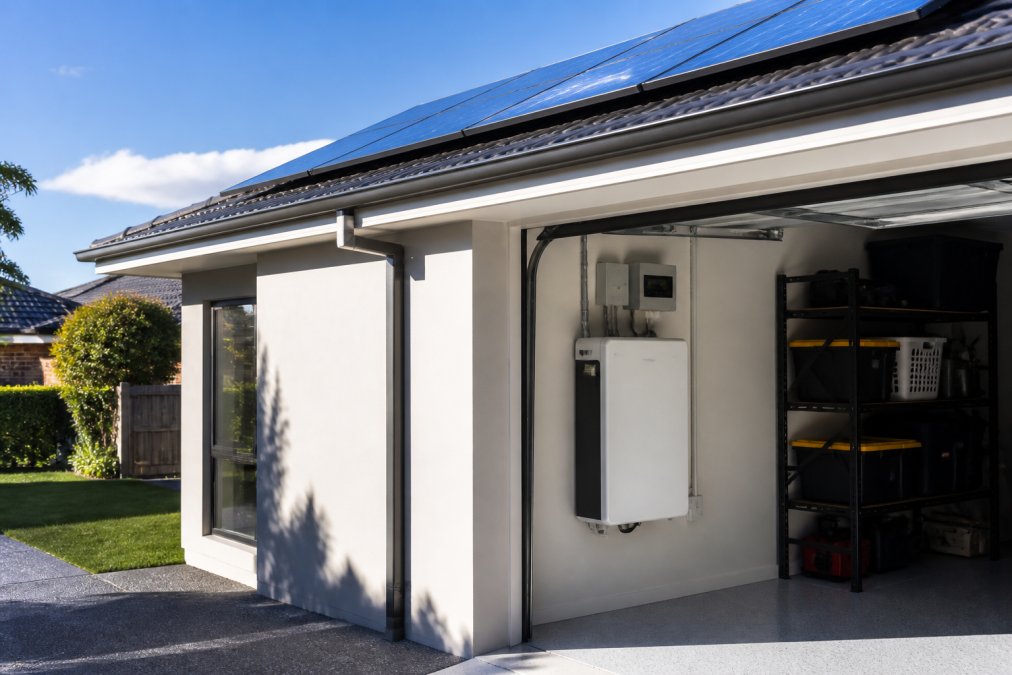
The Powerwall 3 is the benchmark against which every other residential battery is measured. Its 13.5 kWh usable capacity pairs with a fully integrated inverter, eliminating a separate component and simplifying installation. Backup switching is seamless, and the integrated design reduces cost and complexity.
The limitation is cost, it’s one of the higher-priced options. Confirm your installer is CEC accredited and that the installation meets AS/NZS 5139:2019 requirements.
Best for: Homeowners who want a complete, integrated system from a recognised brand with strong backup capability.
Key specs: 13.5 kWh usable capacity, integrated inverter, 10-year warranty, wall-mounted indoor/outdoor.
Sungrow SBR Series: Best Value Modular Storage
The Sungrow SBR Series delivers over 90% round-trip efficiency and 100% usable energy capacity at a price point that consistently undercuts comparable Tesla configurations. The modular design scales from 6.4 kWh to 25.6 kWh by adding modules, allowing you to start with what you need today and expand later. Built-in mobile monitoring gives real-time visibility over energy flows and self-consumption rates.
The SBR Series is only compatible with Sungrow SH-series hybrid inverters. For new installations or existing Sungrow customers, this isn’t a barrier.
Best for: Homeowners with existing or new Sungrow SH-series inverters who want scalable, high-efficiency storage at competitive pricing.
Key specs: 6.4-25.6 kWh modular, 100% DoD, 90%+ round-trip efficiency, mobile monitoring.
BYD Battery-Box Premium HVM: Best for Scalability
No other battery on this list matches the BYD Battery-Box Premium HVM for raw scalability. Starting at 2.76 kWh per module, the system expands to 22.1 kWh per stack, and you can connect up to three stacks for a maximum of 66.2 kWh. For large households or anyone planning to add EV charging, this flexibility is significant.
BYD uses lithium iron phosphate chemistry, delivering enhanced thermal stability. The IP55 rating means the unit handles both indoor and outdoor installation without modification.
Best for: Large households, properties with high consumption, and homeowners planning to add EV charging who need room to grow.
Key specs: 8.3-66.2 kWh (3 stacks), LFP chemistry, IP55, DC-coupled.
AlphaESS SMILE5: Best Built-in Safety Features
The AlphaESS SMILE5 includes a built-in aerosol fire suppression system as standard. The SMILE5 is an all-in-one hybrid system, integrating the solar inverter and battery storage in a single unit. Capacity scales from 13.99 kWh to 41.99 kWh, and the system is VPP-ready, meaning it can participate in Virtual Power Plant programs that generate additional revenue by sharing stored energy with the grid during peak demand.
Best for: Homeowners who prioritise fire safety, all-in-one simplicity, and VPP participation potential.
Key specs: 13.99-41.99 kWh, integrated inverter, aerosol fire suppression, VPP-ready.
Enphase IQ Battery 5P: Best Long Warranty
The Enphase IQ Battery 5P carries the strongest warranty in this comparison: 15 years or 6,000 cycles, whichever comes first. Most competitors offer 10 years. The AC-coupled design works with virtually any existing solar installation, including older string inverter setups, so you don’t need to replace a functioning inverter to add storage.
The integrated IQ8 microinverters contribute to fast EPS switching speeds and high system reliability. The trade-off is that it’s one of the more expensive options on a per-kWh basis.
Best for: Homeowners with existing solar systems who want maximum warranty protection and broad compatibility.
Key specs: 5 kWh per module (scalable to 40.32 kWh), AC-coupled, 15-year warranty, UL 9540A certified.
GoodWe Lynx Home U Series: Best Budget Entry Point
The GoodWe Lynx Home U Series starts at 5.4 kWh and scales to 32.4 kWh, making it the most accessible entry point for homeowners who want to start small and expand later. Plug-and-play wiring and automatic module recognition make installation straightforward, typically reducing labour costs. LFP chemistry provides genuine safety and cycle stability. The IP65 rating is the best weatherproofing specification in this comparison.
The constraint is inverter compatibility: the Lynx Home U Series works only with GoodWe ES and SBP inverters.
Best for: Cost-conscious homeowners with GoodWe inverters, or those starting with a small storage system and planning to expand.
Key specs: 5.4-32.4 kWh modular, LFP chemistry, IP65, plug-and-play installation.
| Battery | Capacity Range | Chemistry | Coupling | Warranty | Best For |
|---|---|---|---|---|---|
| Tesla Powerwall 3 | 13.5 kWh | LFP | AC (integrated) | 10 years | All-in-one simplicity |
| Sungrow SBR Series | 6.4-25.6 kWh | LFP | DC | 10 years | Value + efficiency |
| BYD Battery-Box Premium HVM | 8.3-66.2 kWh | LFP | DC | 10 years | Maximum scalability |
| AlphaESS SMILE5 | 13.99-41.99 kWh | LFP | AC (integrated) | 10 years | Built-in fire safety |
| Enphase IQ Battery 5P | 5-40.32 kWh | LFP | AC | 15 years | Long warranty |
| GoodWe Lynx Home U Series | 5.4-32.4 kWh | LFP | AC/DC | 10 years | Budget entry point |
Solar Battery Cost Australia: Rebates and Real Pricing
Solar battery cost in Australia varies considerably based on capacity, inverter compatibility, and installation complexity. Pricing for specific systems is best confirmed with your installer. Contact GridFree Solar for a current quote tailored to your home.
Small-scale Renewable Energy Scheme and Cheaper Home Batteries Program
Two federal mechanisms reduce your upfront solar battery cost in Australia.
The Small-scale Renewable Energy Scheme (SRES) creates small-scale technology certificates (STCs) for eligible solar and battery installations. Your installer typically deducts the STC value from the purchase price upfront.
The Cheaper Home Batteries Program provides a subsidy equivalent to approximately 30% of battery costs for eligible residential installations. The program applies to batteries installed by accredited installers on homes that already have, or are simultaneously installing, a solar system.
Victoria also offers state-level support through the Solar Homes Program. Check the Solar Victoria rebate eligibility requirements for current income thresholds and product eligibility.
Combine federal and state rebates where eligible. A Victorian household claiming both the Cheaper Home Batteries Program subsidy and a Solar Victoria battery loan can reduce the net cost of a mid-range system substantially. Your installer should handle the paperwork; if they won’t, that’s a red flag.
Lithium Iron Phosphate vs Other Battery Chemistries
Every battery in this comparison uses lithium iron phosphate chemistry. LFP has become the dominant chemistry for residential energy storage in Australia for good reason.
LFP (Lithium Iron Phosphate) uses iron phosphate as the cathode material. The chemistry is thermally stable, far less susceptible to thermal runaway than nickel manganese cobalt alternatives. LFP batteries tolerate higher temperatures and have longer cycle life. For Australian conditions, where ambient temperatures can be extreme and fire risk is genuine, LFP is the correct choice for most homes.
Real-World Degradation and Cycle Life Data
LFP batteries generally retain around 80% of their original capacity after 3,000-4,000 cycles under typical residential conditions. A daily cycling household would reach that threshold in roughly 8-11 years. Most 10-year warranties guarantee 70% capacity retention at end of warranty period, which aligns with this degradation curve.
High ambient temperatures accelerate degradation in all lithium chemistries. Installing your battery in a shaded, ventilated location rather than a west-facing wall exposed to afternoon sun meaningfully extends cycle life.
End-of-Life Recycling Programs in Australia
Battery recycling infrastructure remains patchy outside major metropolitan areas. BYD, Tesla, and Enphase each have take-back or recycling partnerships in Australia. When selecting a battery, ask your installer about end-of-life options before you commit.
Installation, Compliance, and EV Charger Integration
Residential battery installation in Australia is regulated work. The system must be installed by a licensed electrician who is also a Clean Energy Council accredited battery installer. The installation must comply with AS/NZS 5139:2019 and AS/NZS 3000, and the installer must issue a Certificate of Electrical Safety upon completion.
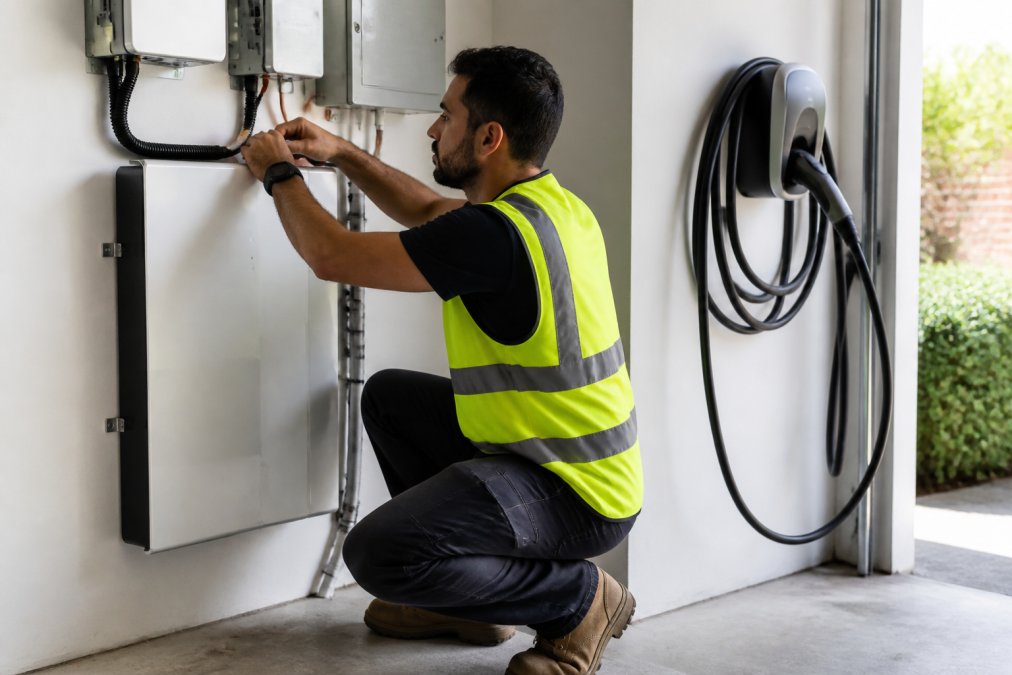
EV charger integration is increasingly common in new battery installations. If you’re load shifting with a battery, you can time your EV charging to coincide with peak solar generation or off-peak grid tariffs, rather than charging from the grid at peak rates.
The technical requirement is smart energy management: your battery system, EV charger, and solar inverter need to communicate through a shared energy management platform. Most modern hybrid inverters support this via Modbus or a proprietary API. The Sungrow SBR Series, BYD HVM, and AlphaESS SMILE5 all support smart energy management protocols that can integrate with compatible EV chargers.
System sizing matters here. Adding an EV to your household energy profile increases daily consumption significantly. If EV integration is part of your plan, choose a modular storage system that can scale.
Which Solar Battery for Home Backup Should You Choose?
The best solar battery for home backup depends on three factors: your existing inverter, your required capacity, and your budget after rebates.
If you’re starting from scratch and want the simplest possible system, the Tesla Powerwall 3 or AlphaESS SMILE5 eliminate the inverter compatibility question entirely.
If you have an existing Sungrow inverter, the SBR Series is the obvious choice: better value, high efficiency, and modular expandability.
If you already have a working solar system and want to add storage without replacing your inverter, the Enphase IQ Battery 5P’s AC-coupled design makes it compatible with virtually any setup, and the 15-year warranty is unmatched.
If you’re planning for EV charging or high household consumption, the BYD Battery-Box Premium HVM’s 66.2 kWh maximum capacity gives you genuine room to grow.
If budget is the primary constraint, the GoodWe Lynx Home U Series offers LFP safety and modular expansion at the lowest entry price.
What every household benefits from is professional guidance on system sizing, rebate eligibility, and installation compliance. Getting those three elements right determines whether your battery investment pays off within a reasonable timeframe.
Choosing the right battery is the first step; making sure it’s installed correctly and connected to every available rebate is where the real financial returns come from. GridFree Solar’s CEC-accredited team handles the full process: system design, rebate paperwork for the Cheaper Home Batteries Program and Solar Victoria, compliant installation to AS/NZS 5139:2019 and AS/NZS 3000, and ongoing smart monitoring to ensure your system performs as specified. Connect Now to get a tailored quote for your home.
Frequently Asked Questions
Do all solar batteries provide backup power during a blackout?
No. Not every solar battery automatically provides backup during a blackout. Systems must include backup or emergency power supply (EPS) functionality, and some require a separate gateway or switchboard work to isolate backed-up circuits. Before purchasing, confirm the battery and inverter combination supports blackout protection, and check the EPS switching speed, faster switching (under 20 milliseconds) keeps sensitive appliances running without interruption.
What is the difference between AC-coupled and DC-coupled solar batteries?
DC-coupled batteries connect directly to your solar panels via a hybrid inverter, converting energy once and losing less to conversion. AC-coupled batteries connect to your home’s existing AC wiring and work with virtually any solar system already installed. DC-coupled systems are generally more efficient for new installations, while AC-coupled systems suit retrofits where replacing the existing inverter is impractical or costly.
How much does a solar battery cost to install in Australia?
Installed solar battery costs in Australia vary considerably depending on capacity, brand, and complexity. As a general guide, a 10 kWh system can range from around $7,500 to over $15,000 installed, before rebates. The federal Cheaper Home Batteries Program and the Small-scale Renewable Energy Scheme can reduce upfront costs. Contact GridFree Solar for a tailored quote that accounts for current rebates applicable to your situation.
Which solar battery is best for blackout protection in Australian homes?
The best solar battery for home backup depends on your household’s load requirements and existing solar setup. Systems with fast EPS switching, high continuous power output, and sufficient kilowatt-hour capacity to cover overnight essentials perform best during outages. Lithium iron phosphate chemistry is preferred for safety and longevity. A CEC accredited installer can size your system correctly and ensure compliance with AS/NZS 5139:2019 for safe, reliable blackout protection.
Are solar batteries worth it for Australian households?
For many Australian homeowners, a solar battery improves self-consumption, reduces grid reliance during peak tariff periods, and provides backup during outages. Financial returns depend on your electricity tariff structure, daily usage, and available rebates. Victorian households can benefit from feed-in tariff opportunities and Virtual Power Plant programs. A properly sized system installed by a CEC accredited installer typically delivers meaningful bill reductions over its warranted lifespan of 10 or more years.
This article was written using GrandRanker