
What if the solar panels on your roof are only doing half the job they could be? Thousands of Australian homeowners generate clean energy every day, then watch it disappear back into the grid for a fraction of what they pay to buy it back at night. It’s a frustrating cycle, and residential solar battery storage is the smart solution that breaks it.
You’re not alone if you’ve felt overwhelmed by the options. Battery chemistry, system capacity, rebate eligibility, installation requirements — it’s a lot to take in, and the stakes feel high when you’re making a significant financial decision. That frustration is completely valid.
This guide cuts through the noise. By the time you’ve finished reading, you’ll understand exactly how home battery storage works, which battery types suit different households, how to access available rebates in Australia, and what to look for when choosing a qualified installer. Whether you’re retrofitting a battery to an existing solar system or starting fresh, you’ll have the clarity and confidence to make the right call for your home and your budget.
Key Takeaways
- Residential solar battery storage lets you store the energy your panels generate during the day and use it at night, dramatically reducing your reliance on grid power and cutting your electricity bills.
- Not all battery types are created equal — understanding the differences between lithium-ion, lead-acid, and other chemistries will help you match the right system to your household’s energy demands and budget.
- Victorian homeowners may be eligible for battery rebate programmes that significantly reduce upfront costs, but eligibility criteria and qualifying systems are specific, so knowing the rules before you buy is essential.
- A professional site assessment is a critical first step in the installation process — it determines which battery system will perform best for your home’s unique setup and energy usage patterns.
- Choosing a local Melbourne installer with proven expertise in both battery systems and rebate navigation can be the difference between a seamless upgrade and a costly, complicated experience.
Understanding Residential Solar Battery Storage: Types and Benefits
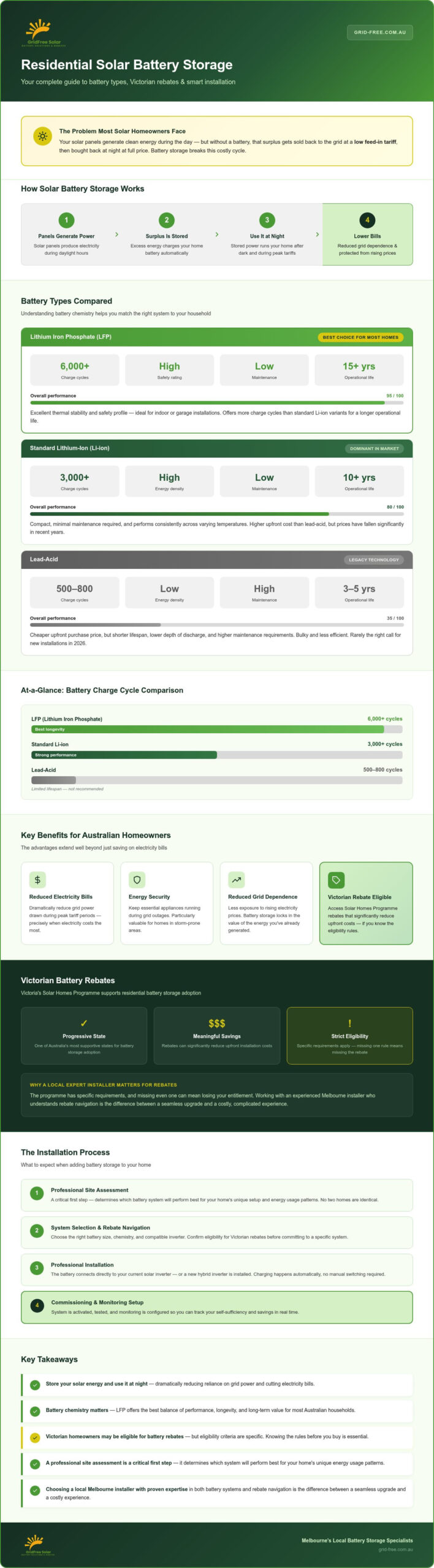
At its core, residential solar battery storage is exactly what it sounds like: a system that captures the surplus electricity your solar panels generate during daylight hours and stores it for use when the sun goes down. Instead of feeding excess energy back to the grid at a low feed-in tariff, you hold onto it. You use it on your own terms. The result is a smarter, more self-sufficient home energy setup that puts you in control of when and how you consume the power you’ve already generated.
Integrating a battery with an existing solar system is more straightforward than many homeowners expect. Most modern battery systems connect directly to your current solar inverter or come with their own hybrid inverter, allowing the battery to charge automatically when your panels are producing more than your household is consuming. No manual switching. No complicated configuration. The system manages itself.
Types of Solar Batteries: Pros and Cons
Battery chemistry matters more than most people realise. The type of battery you choose directly affects performance, lifespan, and long-term value. Here’s how the main technologies compare:
- Lithium-ion (Li-ion): The dominant technology in today’s residential market. Lithium-ion batteries offer high energy density, excellent round-trip efficiency, and a long usable lifespan. They’re compact, require minimal maintenance, and perform consistently across varying temperatures. The trade-off is a higher upfront cost, though prices have fallen significantly over recent years as the technology has matured.
- Lithium iron phosphate (LFP): A subtype of lithium-ion chemistry that’s gaining serious traction in Australian homes. LFP batteries are known for their thermal stability and safety profile, making them a strong choice for indoor or garage installations. They typically offer more charge cycles than standard lithium-ion variants, which translates to a longer operational life.
- Lead-acid: The older, more established technology. Lead-acid batteries are cheaper to purchase initially, but they come with meaningful drawbacks: shorter lifespan, lower depth of discharge, and higher maintenance requirements. They’re bulky and less efficient. For most Australian homeowners evaluating a new installation in 2026, lead-acid is rarely the right call.
The practical takeaway: lithium-based chemistries, particularly LFP, represent the best balance of performance and long-term value for most households.
Benefits of Solar Battery Storage for Homeowners
The advantages extend well beyond simply saving on electricity bills, though the bill savings alone are compelling. A well-sized battery system can dramatically reduce the amount of grid power your household draws during peak tariff periods, which is precisely when electricity costs the most.
- Energy security: A battery-backed solar system can keep essential appliances running during grid outages, depending on the system’s blackout protection capability. For households in areas prone to storms or network disruptions, that reliability is genuinely valuable.
- Reduced grid dependence: The less you rely on the grid, the less exposed you are to rising electricity prices. Battery storage locks in the value of the energy you generate.
- Rebate eligibility: Victorian homeowners may have access to battery rebate programmes that reduce upfront costs considerably. Navigating that eligibility correctly is critical, and it’s an area where working with an experienced local installer makes a real difference.
Done right, residential solar battery storage doesn’t just pay for itself. It reshapes how your home interacts with energy, permanently.
Victorian Battery Rebates: How to Maximise Your Savings
Victoria is one of the most progressive states in Australia when it comes to supporting residential solar battery storage adoption. The Victorian Government’s Solar Homes Programme includes a battery storage rebate that can meaningfully reduce the upfront cost of adding a battery to your home energy system. Getting that money on the table, though, requires knowing exactly what qualifies, who’s eligible, and how to submit a claim that doesn’t get knocked back.
This is where many homeowners lose out. The programme has specific requirements, and missing even one can delay or void your application entirely.
Eligibility for Battery Rebates in Victoria
Not every household or battery system automatically qualifies. The Victorian battery rebate is means-tested, which means your eligibility depends partly on your household income. As of 2026, the rebate is available to households with a combined annual income below a set threshold, so you’ll need to confirm the current figure directly with Solar Victoria, as income limits are subject to periodic review.
Beyond income, the key eligibility criteria include:
- Property ownership: You must own the property where the battery is being installed. Renters are not eligible under the current programme structure.
- Existing solar system: In most cases, you’ll need an existing solar panel system already installed at the property. The battery rebate is designed to complement solar generation, not replace it.
- Approved battery systems: Only battery products listed on Solar Victoria’s approved product list qualify. Installing a system that isn’t on that list means forfeiting the rebate, regardless of how good the product is.
- Approved installer: The installation must be carried out by a Solar Victoria-registered installer. This isn’t optional. An unregistered installer disqualifies the entire claim.
For documentation, you’ll typically need proof of property ownership, recent electricity bills, and income verification such as a Notice of Assessment from the ATO. Have these ready before you start your application.
Claiming Your Rebate: Step-by-Step Process
The application process runs through the Solar Victoria portal. Here’s how it works in practice:
- Check your eligibility using the Solar Victoria online eligibility checker before committing to a system or installer.
- Choose an approved battery and installer from Solar Victoria’s registered lists. Skipping this step is the most common and costly mistake applicants make.
- Submit your application through the Solar Victoria portal before installation begins. Rebate applications must be approved prior to the work being done, not after.
- Receive your approval and proceed with the installation within the timeframe specified in your approval notice.
- Installer lodges completion paperwork with Solar Victoria. The rebate is then applied as a point-of-sale discount, reducing what you pay the installer directly.
Approval timelines vary depending on application volumes, but processing can take several weeks. Don’t leave this until the last minute, particularly heading into peak seasons when installer schedules tighten and portal queues lengthen.
Navigating rebate rules alongside system selection is genuinely complex territory. Working with a local expert who understands both sides of the equation makes the process significantly smoother. Talk to a Melbourne battery specialist who can confirm your eligibility and guide your application from the start.
The Installation Process: What to Expect
Most homeowners are surprised by how organised a professional battery installation actually is. There’s no guesswork, no disruption for days on end. When you work with an experienced installer, the process follows a clear sequence from first conversation to fully commissioned system. Knowing what’s ahead removes the anxiety and helps you ask the right questions at every stage.
Consultation and Site Assessment
Everything starts with a thorough site assessment. This isn’t a formality. A qualified installer needs to evaluate your existing solar setup, your switchboard configuration, available wall or floor space for the battery unit, and how your household actually consumes energy across the day. These factors directly determine which battery system will perform best for your specific situation.
During your consultation, ask your installer the following:
- Is my current inverter compatible with a battery, or will I need a hybrid inverter? Compatibility affects both cost and installation complexity.
- What usable capacity do I actually need? Oversizing a battery is an unnecessary expense; undersizing means you’re still drawing heavily from the grid at peak times.
- Where will the battery be located, and does that affect warranty or performance? Thermal conditions in garages and outdoor enclosures vary significantly across Melbourne’s seasons.
- Is this system on Solar Victoria’s approved product list? Critical if you’re pursuing a rebate, as covered in the previous section.
Roof orientation and available solar generation data from your existing system also feed into this assessment. A good installer won’t recommend a system size without reviewing your actual consumption data first.
Steps Involved in Battery Installation
Once the site assessment is complete and your system is selected, the installation itself is typically a single-day job for a straightforward residential solar battery storage retrofit. Here’s the sequence:
- Preparatory work: The installer confirms all components are on-site and checks that your switchboard meets current safety standards. Upgrades to the switchboard may be required before work begins.
- Physical installation: The battery unit is mounted and secured. Cabling runs are completed between the battery, inverter, and switchboard. All work is carried out to Australian Standards, with the system isolated from the grid during active wiring.
- Testing and commissioning: Once connected, the installer runs a full system test. This includes verifying charge and discharge cycles, confirming monitoring app connectivity, and checking that any blackout protection features are functioning correctly.
- Handover and documentation: You’ll receive compliance certificates, warranty documentation, and a walkthrough of how to monitor your system’s performance.
Post-installation, battery systems require minimal ongoing maintenance. Check your monitoring app periodically to confirm the system is cycling correctly, and keep the battery’s ventilation area clear. Most manufacturers recommend a professional inspection every few years, though your installer can advise on the specific schedule for your chosen system.
A smooth installation comes down to preparation and expertise. Speak with the GridFree Solar team to arrange a site assessment and get a clear picture of what your installation will involve.
Maintaining Your Solar Battery: Tips for Longevity
A well-maintained battery system doesn’t just last longer. It performs better, cycles more efficiently, and protects the return on your investment year after year. The good news: residential solar battery storage requires far less ongoing attention than most homeowners expect. But “low maintenance” doesn’t mean “no maintenance.” A few consistent habits make a measurable difference over the life of your system.
Routine Maintenance Tasks
Physical inspections should happen at least once a year. Check the battery unit for dust accumulation around ventilation points, signs of moisture ingress, loose cable connections, or any visible corrosion on terminals. Keep the area around the battery clear. Restricted airflow causes heat build-up, and heat is the primary enemy of battery longevity regardless of chemistry.
Software is equally important. Most modern battery systems, particularly lithium-based units, rely on a battery management system (BMS) that governs charge and discharge behaviour. Manufacturers release firmware updates periodically to improve efficiency, address performance issues, and extend cycle life. Check your monitoring app or manufacturer portal regularly and apply updates as they become available. Ignoring firmware updates is one of the most overlooked causes of gradual performance decline.
Your monitoring app is your first line of defence. Review it monthly. Look for unusual charge patterns, unexpected drops in daily output, or cycles that don’t align with your typical household consumption. Catching anomalies early is far cheaper than addressing them after they’ve compounded.
Signs Your Battery Needs Attention
Capacity fade is normal over time, but accelerated decline is a warning sign. If your battery is depleting noticeably faster than it did twelve months ago, or if it’s no longer covering your overnight energy needs despite similar solar generation, that’s worth investigating. Other indicators include:
- Frequent error codes or alerts in your monitoring app that weren’t present previously
- Unusually warm casing during normal operation, which may point to a cell imbalance or cooling issue
- Inconsistent charge cycles where the battery isn’t reaching its expected state of charge from day to day
- Unexpected shutdowns or the system reverting to grid power during periods when the battery should be supplying load
Don’t attempt to diagnose internal battery faults yourself. These systems operate at voltages that require a licensed electrician. If something seems off, contact a qualified installer for a professional inspection before the issue worsens.
Warranty coverage is your safety net, but it has conditions. Most manufacturers require that the battery be installed by a registered installer, operated within specified temperature ranges, and maintained according to their guidelines. Deviating from those conditions can void your claim. Keep your installation documentation, warranty certificate, and any service records in one place.
When performance has declined beyond what’s recoverable, a battery upgrade or replacement is the logical next step. A specialist can assess whether your existing inverter and system infrastructure can support a newer unit, often making the upgrade more cost-effective than a full system replacement. Talk to GridFree Solar about battery upgrade and replacement options tailored to your current setup.
Why Choose GridFree Solar for Your Battery Storage Needs?
Choosing the right installer is just as important as choosing the right battery. The technology only delivers on its promise when the people fitting it know exactly what they’re doing. GridFree Solar brings together local Melbourne expertise, hands-on experience with battery upgrades and replacements, and a genuine understanding of the Victorian rebate landscape. That combination is rarer than it should be.
Our Expertise in Solar Solutions
GridFree Solar specialises in residential solar battery storage installation, battery upgrades, and battery replacements. That focus matters. A specialist who works with these systems day in, day out develops a depth of knowledge that a generalist simply can’t match. The team maintains partnerships with leading battery manufacturers, which means access to approved products that qualify under Solar Victoria’s programme, fitted by registered installers who meet every requirement for a valid rebate claim.
Melbourne’s energy market has its own rhythms, its own regulatory requirements, and its own grid dynamics. GridFree Solar operates locally, which means the advice you receive is grounded in real conditions. Not generic guidance written for a national audience. Actual knowledge of how Victorian households consume energy, what the Solar Homes Programme requires right now, and which systems perform reliably across Melbourne’s seasonal temperature swings.
Customer Success Stories
The proof is in the outcomes. Melbourne homeowners who’ve worked with GridFree Solar consistently report two things: the installation process was smoother than expected, and the savings showed up faster than anticipated. Customers who initially felt overwhelmed by rebate eligibility requirements have found the process straightforward with proper guidance from the GridFree team from the very first conversation.
Several customers have navigated the Solar Victoria battery rebate successfully with GridFree Solar’s support, reducing their upfront costs considerably and commissioning systems that now cover the bulk of their overnight energy needs. Others have upgraded ageing batteries to newer lithium iron phosphate units, restoring performance and extending the life of their existing solar infrastructure without a full system replacement.
What customers consistently highlight isn’t just the technical outcome. It’s the clarity. Knowing exactly what to expect, having someone manage the rebate paperwork correctly, and receiving honest advice about system sizing rather than a upsell. That’s the GridFree Solar approach.
If you’re ready to stop sending your solar energy back to the grid for a fraction of what it’s worth, the next step is straightforward. Contact GridFree Solar today to arrange a site assessment and find out exactly which battery system and rebate options are right for your home.
Your Smarter Energy Future Starts Now
Residential solar battery storage isn’t a future technology. It’s a proven, accessible upgrade that Melbourne homeowners are using right now to cut bills, reduce grid dependence, and take genuine control of their energy. The battery chemistries are mature, the Victorian rebate programme is active, and the installation process is far simpler than most people expect.
Three things to carry forward: match your battery to your actual consumption, not just your panel capacity; check rebate eligibility before you commit to any system or installer; and choose a specialist who knows Melbourne’s energy market from the inside out.
GridFree Solar brings all of that together. Local expertise, proven rebate guidance, and a track record of successful installations that Melbourne homeowners consistently recommend. The right advice at the start saves time, money, and frustration at every stage that follows.
Don’t send another kilowatt back to the grid for less than it’s worth. Contact GridFree Solar today for a consultation on solar battery storage and find out exactly what’s possible for your home.
Frequently Asked Questions About Residential Solar Battery Storage
What are the benefits of solar battery storage for my home?
Solar battery storage lets you use the energy your panels generate during the day rather than sending it back to the grid at a low feed-in tariff. The practical upside is lower electricity bills, reduced exposure to rising grid prices, and greater energy independence. Systems with blackout protection capability can also keep essential appliances running during grid outages, which is particularly valuable in areas prone to network disruptions.
How do I know if I’m eligible for a battery rebate in Victoria?
Victorian eligibility under the Solar Homes Programme depends on several factors: you must own the property, your household income must fall below the current threshold set by Solar Victoria, and you’ll generally need an existing solar panel system already installed. The battery and installer must both appear on Solar Victoria’s approved lists. Check your eligibility through the Solar Victoria portal before selecting a system, and confirm current income limits directly with Solar Victoria as these are reviewed periodically.
What types of solar batteries are available for residential use?
The main options are lithium-ion, lithium iron phosphate (LFP), and lead-acid. Lithium-ion batteries dominate the residential market due to their compact size, high efficiency, and long cycle life. LFP is a lithium-ion subtype with strong thermal stability, making it well-suited to garage and indoor installations. Lead-acid batteries carry a lower purchase price but come with shorter lifespans, lower depth of discharge, and higher maintenance demands, making them a less competitive choice for most Australian households in 2026.
How long does a solar battery last before needing replacement?
Lifespan varies by chemistry and usage patterns. Lithium-ion and LFP batteries are typically rated for a set number of charge cycles, often translating to ten or more years of operational life under normal residential use. Factors that accelerate degradation include consistently high temperatures, frequent deep discharges, and ignored firmware updates. Monitoring your system’s capacity over time is the most reliable way to track performance and identify when a battery upgrade or replacement makes financial sense.
What should I expect during the installation of a solar battery?
For a straightforward residential solar battery storage retrofit, installation is typically completed in a single day. The process covers switchboard checks, physical mounting of the battery unit, cabling between the battery and inverter, and full system commissioning including monitoring app setup. You’ll receive compliance certificates and a handover walkthrough before the installer leaves. If your switchboard requires upgrading to meet current safety standards, that work will be completed before the battery is connected.
Can I add a battery to my existing solar system?
Yes, in most cases. The key variable is inverter compatibility. Some existing solar inverters can integrate directly with a battery; others require a hybrid inverter to be installed alongside or instead of the current unit. A qualified installer will assess your existing setup during a site visit and advise on the most cost-effective path. Don’t assume compatibility without a professional assessment, as the wrong pairing can affect both performance and rebate eligibility.
What maintenance is required for solar battery systems?
Residential solar battery storage systems are low-maintenance by design, but not maintenance-free. Annual physical checks covering ventilation clearance, cable connections, and signs of moisture or corrosion are recommended. Applying manufacturer firmware updates as they’re released helps maintain efficiency and cycle performance. Review your monitoring app monthly for unusual charge patterns or error alerts. If something seems off, contact a licensed electrician rather than investigating internally, as these systems operate at voltages that require professional handling.