
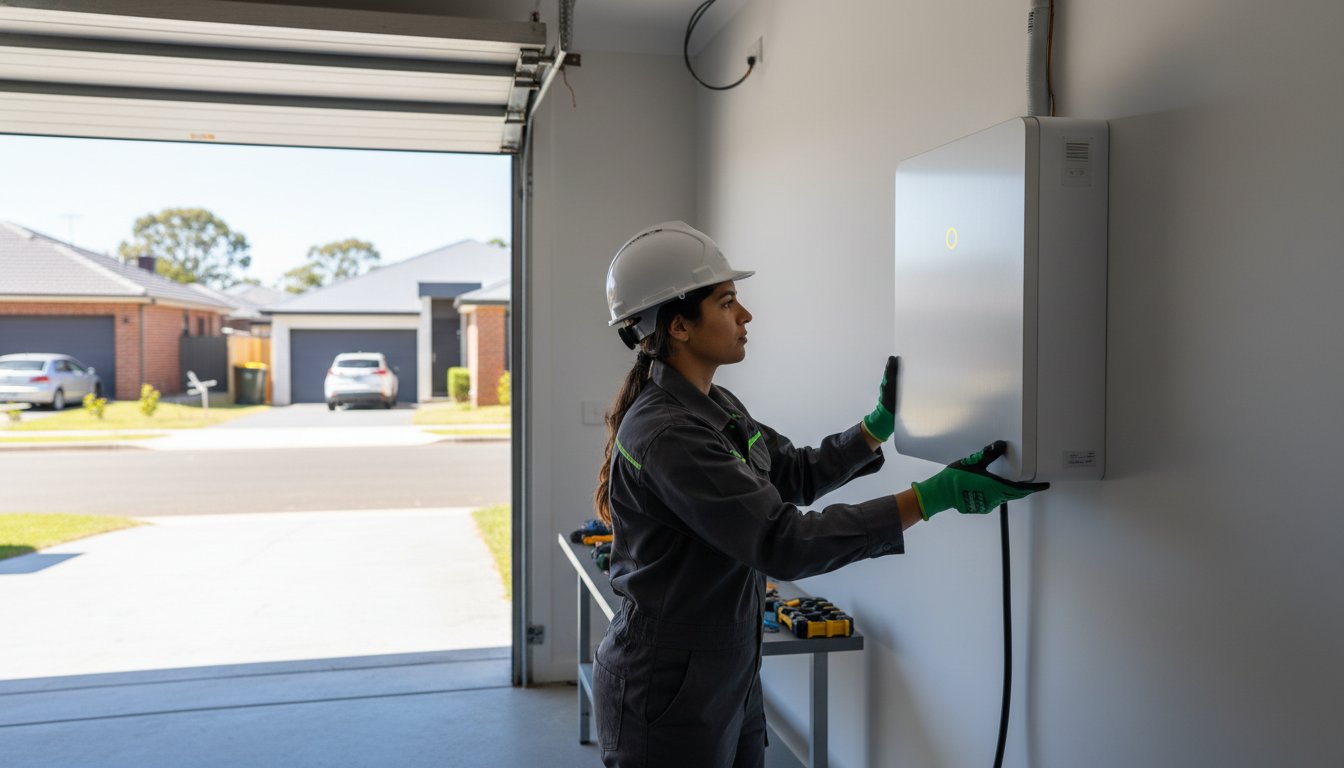
Your ageing solar battery is likely hitting a wall, leaving you exposed to soaring peak rates and a measly 0.04c/kWh feed-in tariff. If you’re watching your electricity bills climb despite having panels on the roof, it’s time to face the reality of declining capacity and outdated safety standards. A professional solar battery replacement Melbourne ensures you aren’t just fixing a fault. You’re upgrading to a 2026-standard powerhouse. It turns your home into a self-sufficient energy hub that works for you, not the retailers.
It’s frustrating to feel tethered to the grid when you’ve already invested in renewable technology. You deserve total independence and a system that pays for itself through modern Virtual Power Plant (VPP) participation. Discover how to swap your old unit for a high-performance system that integrates seamlessly with your existing inverter. We’ll outline how to claim the A$336 per kWh federal rebate and restore your home’s energy autonomy before the Victorian rebate income threshold drops to A$150,000 this July. It’s time to secure your ROI and future-proof your home with the latest Lithium Iron Phosphate (LFP) technology.
Key Takeaways
- Identify critical failure signals like rapid discharge and physical swelling to determine if your unit has reached its economic end of life.
- Future-proof your energy storage by upgrading to 2026-standard Lithium Iron Phosphate (LFP) technology for enhanced safety and modular scalability.
- Secure a professional solar battery replacement Melbourne to restore total grid independence and integrate seamlessly with your existing solar panel array.
- Maximise your return on investment by joining a Virtual Power Plant (VPP), which can provide up to A$500 in annual credits for supporting the grid.
- Audit your current inverter compatibility to decide between AC-coupled and DC-coupled retrofit strategies for a high-efficiency system overhaul.
Signs Your Melbourne Home Needs a Solar Battery Replacement
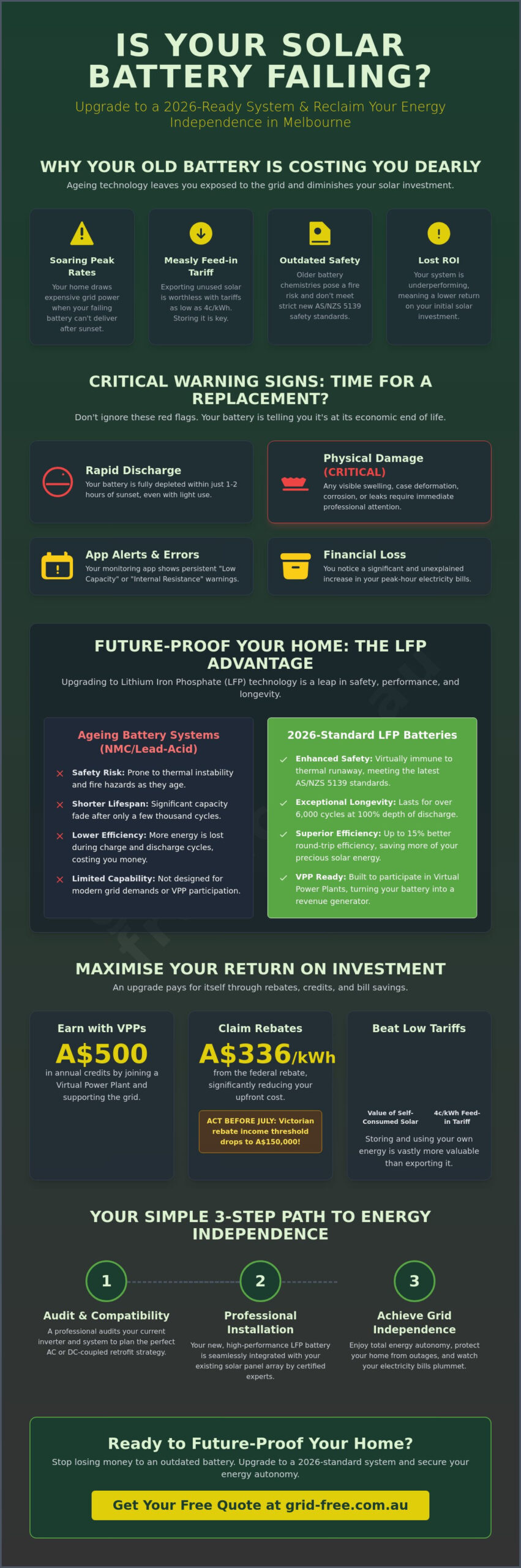
Your solar storage shouldn’t be a guessing game. If your home is drawing from the grid shortly after sunset, your system is flagging. Rapid discharge and a failure to hold a meaningful charge are the first indicators that you need a solar battery replacement Melbourne. Don’t ignore physical changes either. Any signs of casing deformation or swelling are critical red flags that require immediate isolation. Melbourne’s volatile climate, with its sharp temperature swings, often accelerates the degradation of older rechargeable battery technology, particularly legacy lead-acid or early-generation lithium units.
There’s a difference between a unit that functions and one that performs. We call this the “Economic End of Life.” When your storage efficiency drops, you’re essentially paying a hidden tax to the grid. With the Victorian feed-in tariff projected at a low 0.04c/kWh for 2025/26, every bit of solar energy you can’t store is a lost financial opportunity. Check your monitoring app. If you see a consistent downward trend in daily “self-consumption” percentages, a solar battery replacement Melbourne becomes a strategic financial move rather than just a repair. The maths no longer stacks up for your old unit.
Performance Decay vs. Complete Failure
Most batteries don’t just die; they fade. Over a 10-year cycle, the Depth of Discharge (DoD) capacity naturally shrinks. You might notice your 10kWh battery now only provides 5kWh of usable power. It’s also vital to distinguish between a dying cell and a faulty inverter. If your app shows “Battery Communication Error” or “No DC Input,” the issue might be the brains, not the brawn. However, if the system charges fully but drains in two hours of light TV use, the cells are spent. Understanding how long a solar battery last under real Australian conditions can help you accurately identify whether you’re experiencing normal capacity fade or a premature failure that warrants immediate replacement.
Safety Risks of Ageing Storage Systems
Safety is non-negotiable. Older chemistries are more prone to thermal instability as they age. Internal resistance builds up over thousands of cycles, generating heat that your system’s cooling might no longer manage. The 2026 safety standards (AS/NZS 5139) are much stricter than those in place a decade ago. A professional assessment is the only way to ensure your legacy system isn’t a fire risk. Upgrading ensures you meet modern compliance and protects your home from the hazards of internal short-circuits.
- Rapid Discharge: Battery depletes within 1-2 hours of sunset.
- Physical Damage: Visible swelling, corrosion, or leakage.
- App Alerts: Persistent “Low Capacity” or “High Internal Resistance” warnings.
- Financial Loss: Significant spike in peak-hour electricity bills.
Choosing the Best Replacement Battery: 2026 Technology
Selecting the right hardware for your solar battery replacement Melbourne requires a shift in thinking. The market has moved beyond bulky, static units. Today, the focus is on modularity and chemical stability. If your current unit is a first-generation NMC (Nickel Manganese Cobalt) battery, you’ve likely seen significant capacity fade over the last five to seven years. Switching to Lithium Iron Phosphate (LiFePO4) is the logical move for 2026. These units aren’t just safer; they’re designed for the long haul in Melbourne’s variable climate. They handle the heat of a Victorian summer without the degradation issues that plagued early lithium-ion models.
High peak power output is another critical benchmark for modern upgrades. If you want your home to stay operational during a network outage, your battery must handle the “inrush” current of heavy appliances like water pumps or air conditioners. Modern 2026 models offer superior discharge rates compared to their predecessors. They also come “VPP-ready” out of the box. This allows you to trade your stored energy during peak demand events, essentially turning your storage into a revenue generator. While you’re planning these upgrades, it’s worth checking the latest Victorian Government battery loans to see how they can offset your initial capital outlay.
LiFePO4: The New Standard for Melbourne Homes
Safety and longevity define the LiFePO4 era. Unlike older chemistries, LFP batteries are virtually immune to thermal runaway. This makes them ideal for residential installations where proximity to living spaces is a factor. They also boast a cycle life often exceeding 6,000 cycles at 100% depth of discharge. LFP delivers up to 15% better round-trip efficiency than legacy lithium-ion counterparts while maintaining a 100% Depth of Discharge without rapid degradation. If your existing system still has functional panels but a failing storage unit, you may be a strong candidate to upgrade your existing solar battery to modern LiFePO4 technology rather than pursuing a full system replacement.
Achieving peak efficiency isn’t just about the battery; it’s about reducing the load on your system through better insulation. You can discover Window Galaxy USA to see how modern window replacements help maintain a stable indoor temperature and lower energy demand.
Capacity Planning for Your Household
Don’t just replace like-for-like. Your energy needs have likely changed since your last installation. Perhaps you’ve added an induction cooktop or a pool pump. Sizing your solar battery replacement Melbourne should start with a 24-hour load profile analysis. Modular systems are the hero here. They allow you to start with a base capacity, such as 5kWh or 10kWh, and stack additional modules as your budget or family grows. Ensure your storage capacity aligns with your solar PV array size. A massive battery is useless if your panels can’t generate enough surplus to fill it during a cloudy Melbourne winter. If you’re unsure about your current system’s potential, you can explore high-performance upgrade options that match your existing setup.
Maximising ROI with Victorian Rebates and VPPs
The financial landscape for solar in Victoria has shifted. Exporting power is no longer the path to profit. With the minimum feed-in tariff projected at just 0.04c/kWh for 2025/26, sending energy back to the grid is essentially giving it away. Your solar battery replacement Melbourne is the only way to shield your household from high peak rates. By prioritising self-consumption, you retain the full value of every kilowatt-hour your panels produce. This is where the real ROI lives. You aren’t just saving pennies; you’re avoiding A$0.30+ charges from the retailers during the evening peak. It’s about keeping your energy where it’s most valuable: inside your home. Business owners facing the same grid cost pressures may also want to explore how a commercial solar installation Melbourne can deliver comparable financial protection against volatile tariffs.
Speed is essential. The Federal Cheaper Home Batteries Program offers a significant rebate of approximately A$336 per kWh of usable capacity in 2026. For a standard 10kWh unit, that’s a substantial reduction in your upfront investment. However, there’s a catch. To access this funding, your new system must be VPP-capable. This requirement aligns with the broader trend of turning home storage into a distributed grid asset. Combining these federal incentives with Victorian-specific schemes can slash your payback period to between 5 and 12 years. It’s a strategic move that turns a depreciating asset into a high-performance financial tool.
Solar Victoria Battery Incentives
Check your eligibility immediately. From 1 July 2026, the combined household income threshold for Solar Homes rebates drops to A$150,000. If your household earns between A$150,000 and A$210,000, you must submit your application by 5 pm on 30 June 2026 to secure current funding levels. Authorised retailers play a vital role here. They must upload your quote to the Solar Victoria portal before you can confirm your eligibility. Ensure you have your latest taxable income statements and property value assessments ready. Properties valued under A$3 million currently qualify, making this a prime window for a high-capacity upgrade before the rules tighten.
The VPP Advantage: Earning While You Store
Virtual Power Plants (VPPs) represent the next frontier of energy independence. By joining a VPP, you allow a network to tap into your solar battery replacement Melbourne during grid stress events. In exchange, Melbourne homeowners typically receive between A$200 and A$500 in yearly bill credits. Some providers also offer upfront sign-on bonuses to incentivise participation, which can further offset your initial upgrade costs. This creates a dual-revenue stream: you save by not buying grid power, and you earn by supporting the network. It’s a proactive strategy that transforms a static appliance into a dynamic financial asset, ensuring your storage works as hard as your panels.
The Replacement Process: Retrofitting and Compatibility
Executing a solar battery replacement Melbourne is a precision engineering task. It isn’t a simple “unplug and play” procedure. Your existing solar inverter is the first point of audit. Many legacy inverters operate on low-voltage architecture, whereas 2026-standard batteries typically require high-voltage communication. If your current inverter is more than seven years old, it likely lacks the sophisticated software protocols needed to manage modern Lithium Iron Phosphate cells. We assess whether your current hardware can be “flashed” with new firmware or if a hybrid upgrade is the more cost-effective path for your home. Homeowners who want to retain their existing panels and inverter while modernising their storage should review the full technical options available when you upgrade an existing solar battery system using AC or DC coupling strategies.
Safety compliance is the second pillar of a successful retrofit. Victorian electrical safety regulations have tightened significantly with the AS/NZS 5139 standards. Your home’s switchboard must be capable of handling the increased bidirectional loads of a high-performance battery. This often involves installing dedicated fire-rated backing or upgrading circuit breakers to meet modern isolation requirements. Don’t leave your home’s safety to chance. You can book a professional battery retrofit assessment to identify exactly which components of your legacy system are compatible with 2026 technology.
AC vs. DC Coupling for Upgrades
Deciding between AC and DC coupling defines your system’s future efficiency. AC-coupled batteries are the most common choice for a solar battery replacement Melbourne. They sit on the “appliance side” of your home, meaning they work independently of your solar inverter. This is the easiest way to add storage to an older system without ripping out functional panels. However, if you want maximum efficiency, a DC-coupled hybrid system is superior. It reduces energy loss by keeping power in a DC format for longer. Mixing hardware brands can sometimes lead to communication “jitter,” so we prioritised verified hardware pairings to ensure your monitoring app provides 100% accurate data.
Responsible Disposal and Recycling in Melbourne
Your old battery is hazardous waste and must be handled with extreme care. Old lithium-ion or lead-acid units contain heavy metals that pose significant environmental risks if leaked. GridFree Solar manages the entire logistics chain of removal and EPA-compliant disposal. We ensure that every legacy unit is transported to a certified Victorian recycling facility where components like cobalt, lithium, and lead are recovered. Certified battery recycling in Victoria prevents up to 95% of toxic heavy metals from entering landfill while supporting a circular economy for future renewable tech. This professional removal process is non-negotiable for maintaining the safety and environmental integrity of your property.
GridFree Solar: Melbourne’s Battery Upgrade Specialists
GridFree Solar is more than an installation firm. We are specialists in the technical complexity of legacy system optimisations. Many providers shy away from retrofitting older solar arrays, preferring simple new builds. We take the opposite approach. Our team excels at the precise engineering required for a solar battery replacement Melbourne. We are authorised installers for the definitive leaders of 2026 hardware, including Tesla, BYD, and Enphase. Every project begins with a comprehensive system health check. We verify your existing wiring, inverter health, and panel efficiency to ensure your new storage unit performs at its peak from day one.
Reliability is our hallmark. We provide local support and a rapid response for Victorian homeowners who refuse to settle for second-rate energy security. Our deep understanding of legacy hardware allows us to bridge the gap between 2016 solar panels and 2026 battery intelligence. We don’t just swap boxes. We recalibrate your entire energy ecosystem for maximum self-consumption. This proactive approach ensures your investment is protected by the latest safety protocols and firmware updates, giving you a definitive edge over the rising costs of grid power.
Why Local Expertise Matters
Melbourne’s energy grid has strict technical boundaries. Navigating the specific requirements of Victorian distributors like United Energy, Citipower, or Powercor requires localised knowledge. We manage these grid connection applications daily, ensuring your system remains compliant and VPP-ready. As Clean Energy Council (CEC) Approved Retailers, we adhere to a rigorous code of conduct that goes beyond basic licensing. Our Melbourne-based office handles the entire rebate management process. We take the administrative burden off your shoulders, ensuring your Solar Victoria and federal incentives are processed with surgical precision.
Ready to Organise Your Upgrade?
The transition to high-performance storage starts with data, not guesswork. Book a technical site audit to have our specialists assess your existing solar infrastructure. We don’t provide generic estimates. We deliver a customised ROI forecast based on your household’s unique energy usage patterns and current tariff structure. You will see the clear financial path to grid independence before you commit. Secure your energy future and capitalise on 2026 efficiency standards while rebates remain at their peak. Request your Melbourne solar battery replacement quote today and reclaim control of your power bills.
Secure Your Energy Independence for 2026
Don’t let an ageing battery drain your household’s financial potential. The window for a high-impact solar battery replacement Melbourne is closing fast as rebate thresholds tighten this July. Upgrading to 2026-standard Lithium Iron Phosphate technology eliminates safety risks and unlocks the revenue-generating power of Virtual Power Plants. You’ve already invested in the sun. Now, ensure your storage hardware is capable of capturing its full value.
GridFree Solar provides the technical expertise needed to bridge the gap between legacy panels and modern energy intelligence. As a Clean Energy Council Approved Retailer with a dedicated local Melbourne installation team, we ensure your retrofit is seamless and compliant. We are VPP integration specialists focused on turning your static storage into a dynamic asset. Take the next step toward total grid autonomy and long-term reliability today.
Get a Professional Battery Replacement Quote for Your Melbourne Home
Your home is ready for a smarter, more efficient future.
Frequently Asked Questions
How much does it cost to replace a solar battery in Melbourne?
Typical industry costs for a 10-13.5 kWh solar battery in the Melbourne market range from A$8,400 to A$15,750 including installation. Premium units like the Tesla Powerwall 3 generally sit between A$12,600 and A$17,850. These figures vary based on your existing switchboard configuration and whether you require a hybrid inverter upgrade to support the new cells.
Can I replace my old battery with a different brand?
You can transition to a different manufacturer during a solar battery replacement Melbourne by using an AC-coupled strategy. This method allows the new storage unit to operate independently of your original solar inverter. It provides the freedom to choose the most efficient 2026 technology without being restricted by the brand of your existing solar panels or legacy hardware.
Does Solar Victoria offer rebates for battery replacements?
Solar Victoria primarily targets new installations, but the Federal Cheaper Home Batteries Program provides a significant rebate of approximately A$336 per kWh of usable capacity in 2026. This incentive is not means-tested and is designed to encourage homeowners to upgrade to VPP-capable systems. You should also check your eligibility for Victorian Government battery loans to further offset the upfront capital cost.
How do I dispose of my old solar battery safely in Melbourne?
Old solar batteries must be processed through EPA-compliant recycling facilities to prevent environmental contamination from heavy metals. You shouldn’t attempt to dispose of these units in standard waste streams. Professional installers manage the decommissioning, removal, and transport of legacy lithium or lead-acid batteries to certified Victorian centres where up to 95% of the materials are recovered.
Will a new battery work with my 10-year-old solar panels?
Modern battery systems are fully compatible with older solar panel arrays through AC-coupling technology. Your 10-year-old panels will continue to generate DC power, which is converted by your existing inverter before being stored in the new battery. This allows you to maintain your original investment while benefiting from the superior discharge rates and safety standards of 2026 storage units.
How long will a replacement solar battery last?
A high-quality 2026 replacement battery using Lithium Iron Phosphate (LFP) chemistry typically lasts between 10 and 15 years. Most tier-one manufacturers provide warranties covering 6,000 to 10,000 cycles at 100% depth of discharge. This represents a significant improvement over first-generation lithium-ion units, which often showed substantial capacity decay after just five to seven years of daily use. For a detailed breakdown of what affects these timelines in the Australian climate, see our 2026 Australian solar battery lifespan guide.
What is the best solar battery for Melbourne conditions in 2026?
The Tesla Powerwall 3 and BYD Battery-Box are leading choices for the Melbourne climate due to their high thermal stability. These LFP-based systems handle Victorian heatwaves without the safety risks associated with older chemistries. They also offer the modularity required for a successful solar battery replacement Melbourne, allowing you to scale your storage capacity as your household energy consumption grows.
Do I need to upgrade my inverter when I replace my battery?
An inverter upgrade is not strictly mandatory if you choose an AC-coupled battery, but it’s often a strategic move for better efficiency. If your current inverter is over a decade old, it may lack the communication protocols needed for advanced monitoring and VPP participation. Moving to a modern hybrid inverter can reduce energy conversion losses and provide a more streamlined, single-app management experience for your entire system.