
Last Updated: November 19, 2026
Quick Summary
A DIY solar panel maintenance checklist covers only safe, non-technical work: visual inspections, cleaning with water and a soft brush, debris removal, vegetation trimming and monitoring your inverter and app output. Anything involving wiring, inverter internals or roof-mounted electrical components belongs to a licensed professional. Record findings in a log with dates and photos.
- Ask three questions before any task: does it touch live electrical parts, require height work, or only involve looking, rinsing, brushing or recording.
- Clean panels quarterly in early morning or late afternoon, never at peak sun when panels are hot.
- Build a seasonal baseline by recording AC output, daily energy and peak output on one clear day each season.
- Book a professional inspection yearly, or sooner if you find cracked panels, corrosion or a performance drop cleaning does not fix.
Table of Contents
- What Belongs on a DIY Solar Panel Maintenance Checklist
- Your Solar Panel Maintenance Schedule: Monthly, Quarterly and Yearly
- Solar Panel Cleaning Tools and the Washing Method That Works
- Solar Panel Maintenance Safety: What to Do Before You Touch Anything
- Visual Inspections: Catching Panel Damage, Debris and Shading Early
- Solar Inverter Monitoring and Spotting a Performance Drop
- Mounting Hardware, Cables and Connectors: What to Check and Record
- Book a Professional Inspection When the Checklist Says So
- Frequently Asked Questions
What Belongs on a DIY Solar Panel Maintenance Checklist
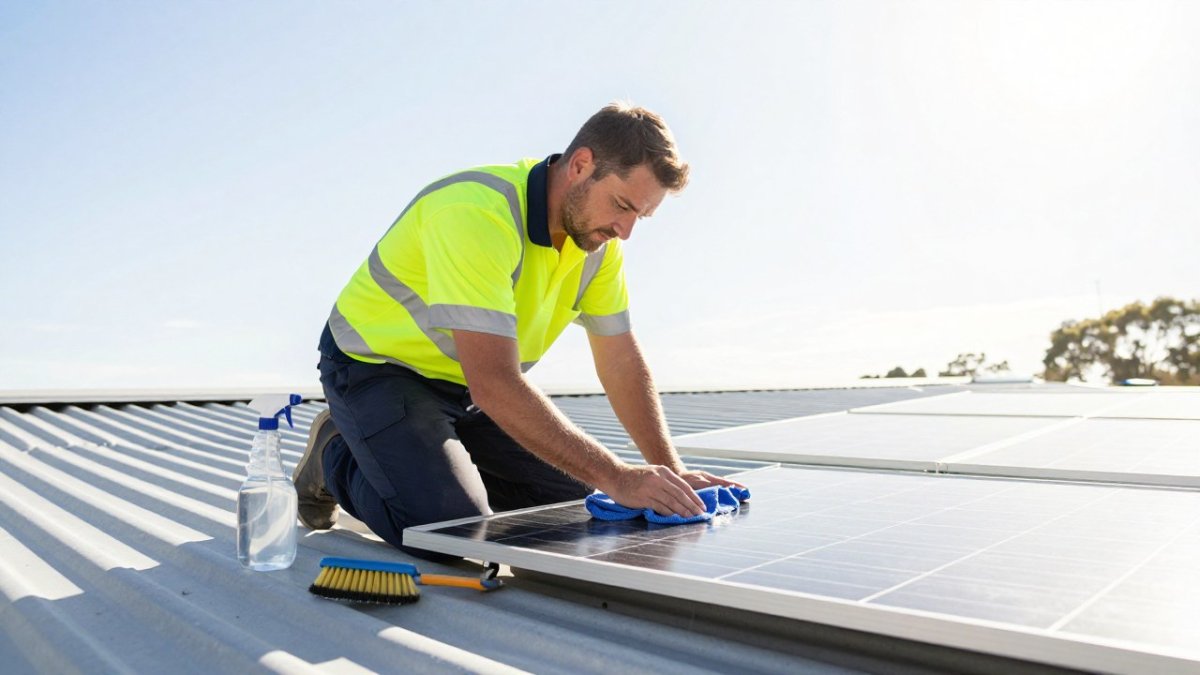
A DIY solar panel maintenance checklist covers the safe, non-technical work you can do yourself: visual inspections, cleaning, debris removal and monitoring. That boundary is especially useful when cleaning, where a step-by-step cleaning guide can help keep routine work separate from tasks that call for a licensed professional.
This guide from GridFree Solar sets out exactly where that line sits.
The DIY-versus-professional decision framework
Before any task, ask three questions in order:
- Does it require touching a live electrical component, opening an enclosure, or loosening a connector? If yes, stop: it is professional work.
- Does it require leaving the ground or working at height without a stable platform and harness anchor? If yes, stop: it is professional work or a job for a harness-trained person.
- Is the task limited to looking, rinsing, brushing or recording? If yes, it is within DIY scope.
That framework keeps the boundary objective. A task is not DIY because it looks simple; it is DIY because it passes all three questions.
The tasks you can safely handle yourself
You can manage these without touching a single electrical component:
- Visual inspection of panel surfaces from ground level
- Cleaning with water and a soft brush
- Removing leaves, twigs and bird droppings
The tasks that need a licensed professional
Stop and call an electrician for anything involving:
- Opening the inverter casing
- Testing or replacing isolators
- Inspecting DC cabling and connectors
Task-specific safety triggers
Some tasks are DIY in principle but become professional work under specific conditions. Stop and call a licensed professional if any of these apply:
- The roof is wet, mossy, steep or has no safe anchor point for a harness
- The array is on a two-storey or higher roof and you cannot clean it safely from a platform or long pole from the ground
- You see scorch marks, a burning smell, or discoloured connectors
Watch out: touching DC wiring on a live array can deliver a fatal shock, even on an overcast day. Panels generate voltage whenever there’s light, so treat every panel and cable as live.
Adapt the checklist to your system and conditions
The same checklist does not fit every system. Adjust frequency and scope for:
- Ground-mounted arrays: easier and safer to inspect and clean, so quarterly cleaning is realistic
- Roof-mounted arrays: favour ground-level inspection and long-pole cleaning; leave roof access to professionals unless you have a harness and anchor
- Coastal sites: salt and wind-driven spray make more frequent rinsing worthwhile
Record which conditions apply to your site at the top of your log so the schedule you follow matches the system you actually have.
Your Solar Panel Maintenance Schedule: Monthly, Quarterly and Yearly
A solar panel maintenance schedule splits naturally into three rhythms. Monthly checks take minutes. Quarterly tasks take an afternoon. Annual work is where a professional earns their fee.
| Frequency | Task | Who does it | Time needed |
|---|---|---|---|
| Monthly | Read inverter display, check app output | You | 5 minutes |
| Monthly | Ground-level visual scan for damage | You | 10 minutes |
| Quarterly | Clean panels and clear debris | You | 1-2 hours |
| Quarterly | Trim vegetation, check shading | You | 30 minutes |
| Yearly | Full professional inspection | Licensed installer | Booked visit |
| Yearly | Electrical and isolator testing | Licensed electrician | Booked visit |
For a fuller seasonal breakdown, our solar maintenance tips seasonal guide walks through what changes month to month.
Solar Panel Cleaning Tools and the Washing Method That Works
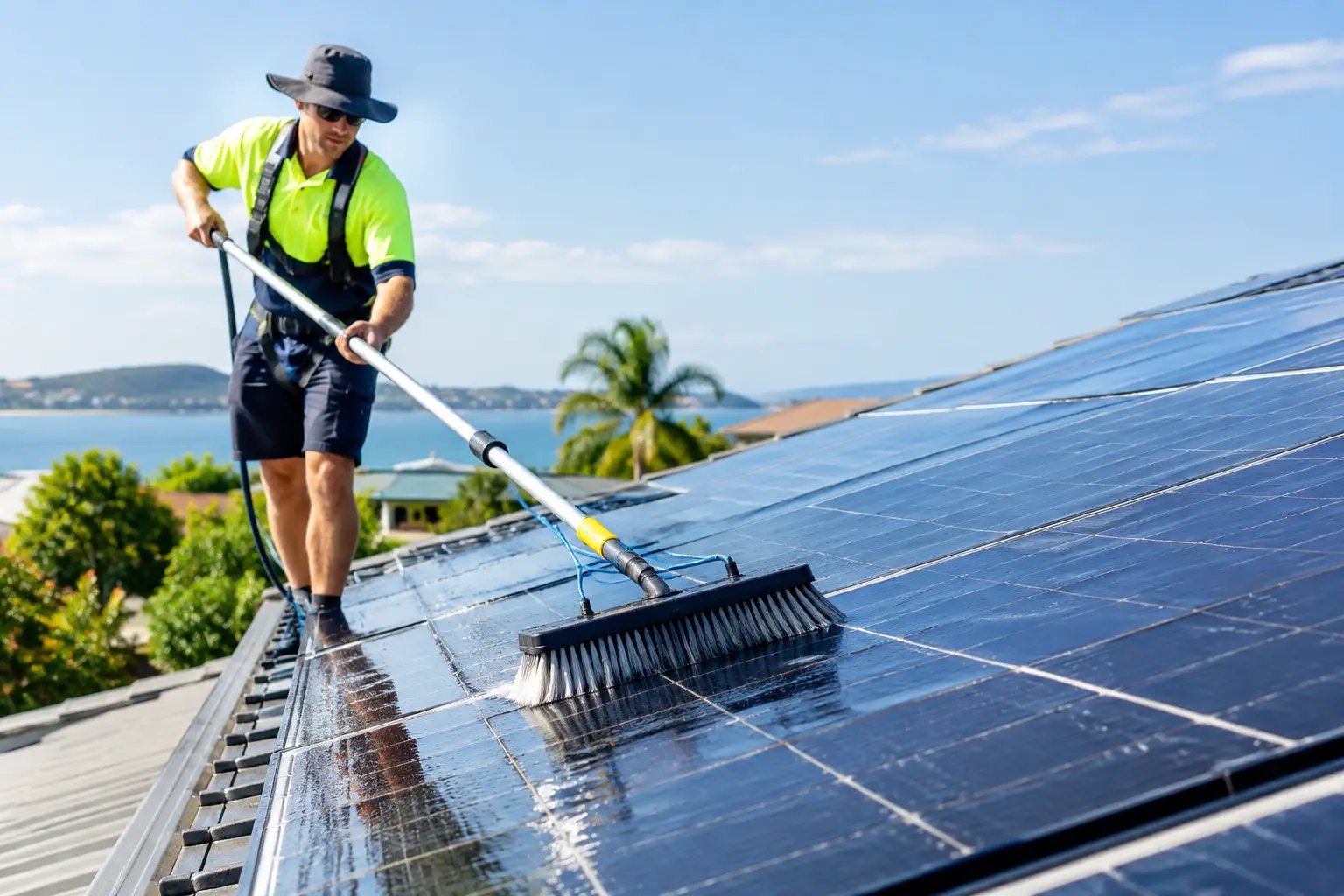
The right solar panel cleaning tools are simple and cheap: a long-handled soft brush, a garden hose, a squeegee and a bucket. Skip the pressure washer and skip anything abrasive.
Here’s the method we recommend:
- Clean early morning or late afternoon, never at peak sun when panels are hot.
- Rinse the whole array first to float off loose dust.
- Work top to bottom with the soft brush and plain water.
- Spot-clean bird droppings with a sponge and a little dish soap.
- Rinse again and squeegee to avoid water spots.
- Stay off the roof if it’s wet, steep or you lack a harness.
Watch out: a hot panel hit with cold water can crack. Always cool the surface first.
Solar Panel Maintenance Safety: What to Do Before You Touch Anything
Solar panel maintenance safety starts before you climb anything. Check the weather, check your roof access, and check you know where the isolator is without touching it.
Before any work:
- Confirm the forecast is dry and mild
- Check your roof is stable and not wet or mossy
- Set up a harness or stay on the ground
- Wear rubber-soled shoes and gloves
Never remove panel covers or open junction boxes. The solar panel safety standards set out what installers must comply with, and they exist for good reason. Our installs are designed to comply with AS/NZS 3000, and every job finishes with a Certificate of Electrical Safety.
Visual Inspections: Catching Panel Damage, Debris and Shading Early
A visual inspection is a slow walk around your array, looking for anything that’s changed. It’s the highest-value task on the whole checklist, and it costs nothing.
Look for:
- Cracks, chips or shattered glass
- Brown or discoloured cells, which often signal hotspots
- Leaves, twigs and bird droppings sitting on the glass
- New shade from trees or new buildings
Shading is the quiet killer. If you’ve noticed new shade, our guide on solar panel shading and output explains how much it costs you and how to fix it.
Record anything unusual with a photo and the date. That record matters if you claim on warranty later.
Solar Inverter Monitoring and Spotting a Performance Drop
Solar inverter monitoring is your early warning system, but only if you compare the right numbers. Reading the display tells you what the system is doing now; comparing it with a baseline tells you whether that is normal.
Build a baseline before you need it
Pick one clear, unshaded day in each season and record three figures from your inverter or monitoring app at the same time of day (for example, midday):
- Instantaneous AC output in kilowatts
- Total energy generated for that day in kilowatt-hours
- Peak output reached during the day
Write these into your log with the date and weather. After a full year you have a seasonal baseline for your own system, which is far more useful than a generic ‘expected output’ figure because it accounts for your roof pitch, orientation, shading and local conditions.
Compare like with like
When you suspect a drop, do not compare a cloudy Tuesday with a clear Sunday. Compare a recent clear day with the closest clear day in your baseline for the same season. A common pattern is a gradual decline of a few per cent over several months, which usually points to soiling, new shading or a failing string rather than a hard fault.
As a rough guide to what warrants investigation:
- A gradual decline that cleaning does not recover: book an inspection
- A sudden drop with an error code on the inverter: record the code, reset once, and call if it returns
- Output that is normal in the morning but collapses in the afternoon: suspect new shading or a hot inverter derating
- Output that is lower than your baseline on every clear day for a week: treat as a fault, not weather
Read the inverter’s own signals
Check these monthly alongside your numbers:
- Error messages and warning lights, and write down the exact code
- Fan noise or unusual heat from the inverter casing
- Whether output recovers after a single reset
- Whether the monitoring app has lost connection to the inverter
Watch out: repeated resetting of a faulted inverter can mask an underlying electrical problem. Reset once, record the result, and if the fault returns, stop and book a licensed electrician rather than resetting again.
If your app shows a clear performance drop that cleaning and a reset do not fix, compare a sunny day this month to the same season in your baseline. Our system performance monitoring guide shows how to track output and home energy use properly.
Mounting Hardware, Cables and Connectors: What to Check and Record
Mounting hardware and cabling checks are visual only for DIY. You’re looking, not touching.
From the ground or a safe vantage point, check for:
- Rust or corrosion on mounting bolts and rails
- Sagging or loose roof attachments
- Cables hanging loose or rubbing on edges
- Cracked or discoloured connectors
Write down what you see, with dates and photos. Keep this log with your system paperwork. It’s proof of preventive maintenance if a warranty question ever comes up, and it helps your installer spot trends.
Never pull, wiggle or reseat a connector yourself. DC connectors carry live voltage and a poor connection can arc.
Book a Professional Inspection When the Checklist Says So
Book a professional inspection when your checklist flags something you can’t fix, or once a year regardless.
Call a licensed professional if you find:
- Cracked or broken panels
- Persistent error messages after a reset
- Corrosion on mounting hardware
- Damaged cables or connectors
Before you book, it helps to know what servicing involves. Our guide on solar panel maintenance costs and long-term savings covers what to expect and how maintenance pays back over the system’s service life.
At GridFree Solar, our CEC Accredited Installers handle the professional side, and our smart energy monitoring helps you keep track of performance.
The real challenge isn’t knowing what to check. It’s knowing when to stop and call someone qualified.
GridFree Solar can take the professional side off your hands.
Frequently Asked Questions
How often should solar panels be cleaned and checked?
Most homes need a visual check every month and a proper clean every six to twelve months. In dusty or bushfire-prone areas, or where birds gather, clean quarterly. Rain helps but does not replace cleaning, because it leaves dust streaks and does not shift bird droppings. Pair each clean with a look at the inverter display and a quick check of the mounting rails and cabling you can see safely from the ground.
What is safe to use to clean solar panels?
Use plain water and a soft brush or microfibre squeegee. A garden hose with a gentle nozzle is fine. Skip hard water blasting, abrasive pads, detergent concentrates and anything with solvents. Clean early morning or late afternoon when panels are cool, because cold water on hot glass can stress the panels. Never stand on the glass itself, and stay off the roof if it is wet, steep or you have no fall protection.
How do I know whether my solar panels are working properly?
Check your inverter or monitoring app daily for output against a clear sunny day the week before. A sudden drop of more than 10 to 15 per cent on a comparable day points to shading, soiling or a fault. Cross-check the inverter for error messages and confirm the isolator is on. If output stays low after cleaning and clearing shade, book a licensed solar electrician to test the strings and connections.
When should I call a solar professional instead of doing maintenance myself?
Call a CEC accredited installer or licensed electrician for anything involving the inverter wiring, isolators, DC cabling, connectors or roof penetrations. Also call if you see cracked glass, scorch marks, a burning smell, water pooling near the inverter, or loose mounting bolts you cannot reach safely. DIY solar panel maintenance covers cleaning, ground-level observation and monitoring only. Electrical work on a solar PV system is not a homeowner task.
