
Last Updated: November 5, 2026
Quick Summary
Solar panel maintenance typically costs $150-$700 per professional clean, $150-$400 for an annual inspection, and $1,200-$3,000 for an inverter replacement once over 25 years. Budgeting for these costs alongside bill savings gives a realistic payback picture, and a worked 6.6 kW example turns net positive around year 10.
- Cleaning runs $150-$350 for easy single-storey access and $350-$700 for two-storey, tile, coastal or heavily soiled roofs.
- A quote bundling maintenance into one annual fee without itemising tasks makes installer comparison harder.
- Panels typically degrade about 0.5% per year, so year 25 output is roughly 88% of year one.
- The worked 6.6 kW model uses $7,000 installed cost, $1,300 annual savings and a $2,000 inverter replacement in year 12.
- Check the monitoring app weekly for sudden output drops and book an inspection if output falls without obvious cause.
Table of Contents
- What Solar Panel Maintenance Really Costs Over Time
- Your Solar Panel Maintenance Checklist for Each Year
- What Solar Panel Cleaning Cost Looks Like and When to Pay It
- Solar Inverter Replacement Cost and Repair Versus Replace
- How Degradation and Panel Quality Affect System Performance
- Working Out Your Solar System Payback Period
- A Year-by-Year Total Cost of Ownership Model
- Planning Your Maintenance and Monitoring With GridFree Solar
- Frequently Asked Questions
What Solar Panel Maintenance Really Costs Over Time
Solar panel maintenance costs and long term savings are two sides of the same ledger, and most homeowners only ever look at one of them. At GridFree Solar, we see the pattern constantly: a system quoted on headline price alone, then a decade of small surprises that eat into the return. The panels themselves are the low-maintenance part of a rooftop solar system.
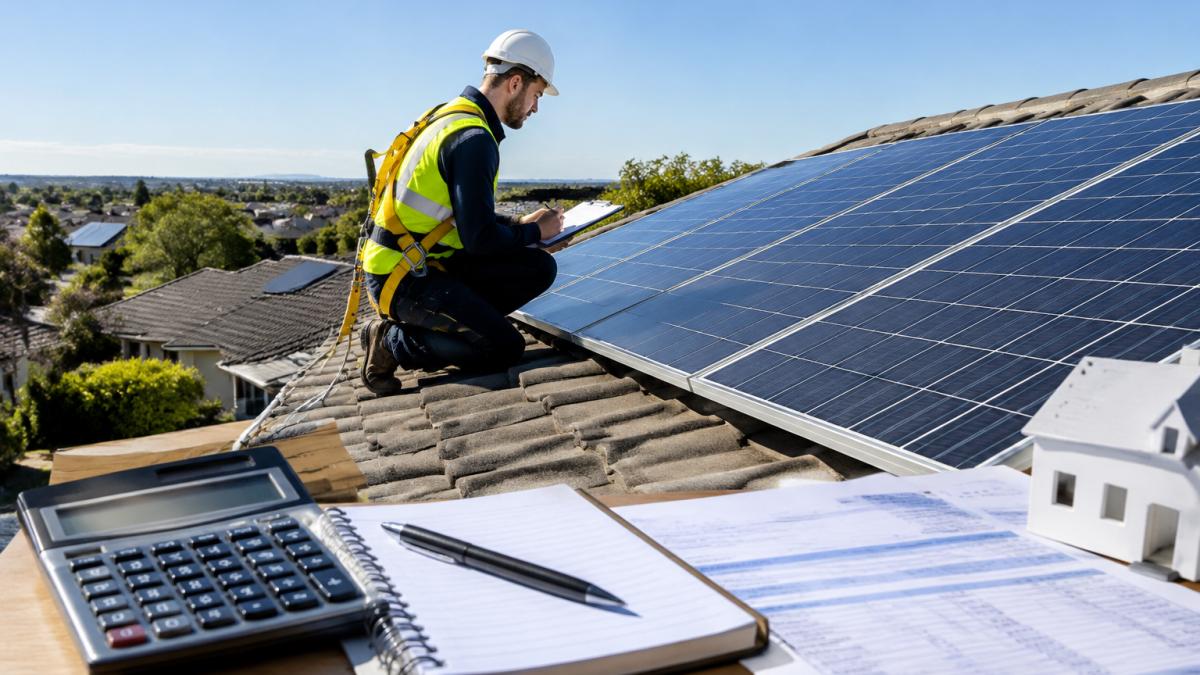
Three cost buckets matter: cleaning, inspection and repairs or replacement. Cleaning is the smallest and most predictable. Inspection is the one homeowners skip and later regret. Repairs and component replacement, particularly the inverter, are where the real lifetime spend lands.
| Task | How often | Typical cost range (AUD) | What it covers |
|---|---|---|---|
| DIY visual check and monitoring review | Weekly to seasonally | $0 | App output trends, ground-level panel inspection, gutter and edge debris, inverter error codes |
| Professional clean (single storey, easy access) | Every 12-24 months | $150-$350 | Deionised water wash, frame and edge debris removal, pre-clean safety check |
| Professional clean (two storey, tile roof, coastal or heavy soiling) | Every 6-12 months | $350-$700 | Access equipment, harness work, salt or dust removal, gutter clearing |
| Annual professional inspection | Annually | $150-$400, often bundled with a clean | Visual and thermal check, DC isolators, mounting hardware, cabling, inverter log review |
| Minor repair (connector, clamp, isolator, cabling) | As needed | $150-$600 | Replace failed MC4 connector, tighten or replace mounting clamp, replace DC isolator |
| Inverter repair (component-level) | As needed | $300-$900 | Fan, board or communication module replacement where the unit is still serviceable |
| Inverter replacement (like-for-like) | Typically once over 25 years | $1,200-$3,000 installed | New string inverter, labour, commissioning and electrical certificate |
| Battery replacement or augmentation | Once over 25 years, if fitted | $4,000-$12,000+ | Replacement cells or added capacity, depending on original battery size and chemistry |
The inverter is a piece homeowners can easily overlook.
Watch out: a quote that bundles ‘maintenance’ into a single annual fee without itemising cleaning, inspection and call-out charges makes it harder to compare against another installer. Ask for the task list and the per-visit price separately.
Regional factors can affect how often a system needs attention. Coastal properties dealing with salt spray may need more frequent cleaning than inland suburban roofs, and homes under trees can face heavier litter and bird activity.
Your Solar Panel Maintenance Checklist for Each Year
A solar panel maintenance checklist is the cheapest insurance you can buy for system performance. It costs nothing to run yourself and catches the problems that quietly erode savings.
- Check the monitoring app weekly for sudden output drops
- Visually inspect panels from ground level each season for cracks, hotspots or soiling
- Clear leaf litter, bird droppings and debris from gutters and panel edges
- Confirm no new tree growth is shading the array
- Check the inverter display or app for error codes
- Book a professional inspection if output falls noticeably without an obvious cause
The shading point matters more than most guides admit. Shade on even part of an array can drag down the output of the whole string, and afternoon shade is a common reason a system underperforms. For systems under tree cover, our guide to solar panel maintenance under tree cover covers the specific cleaning and trimming routine that keeps output up.
What Solar Panel Cleaning Cost Looks Like and When to Pay It
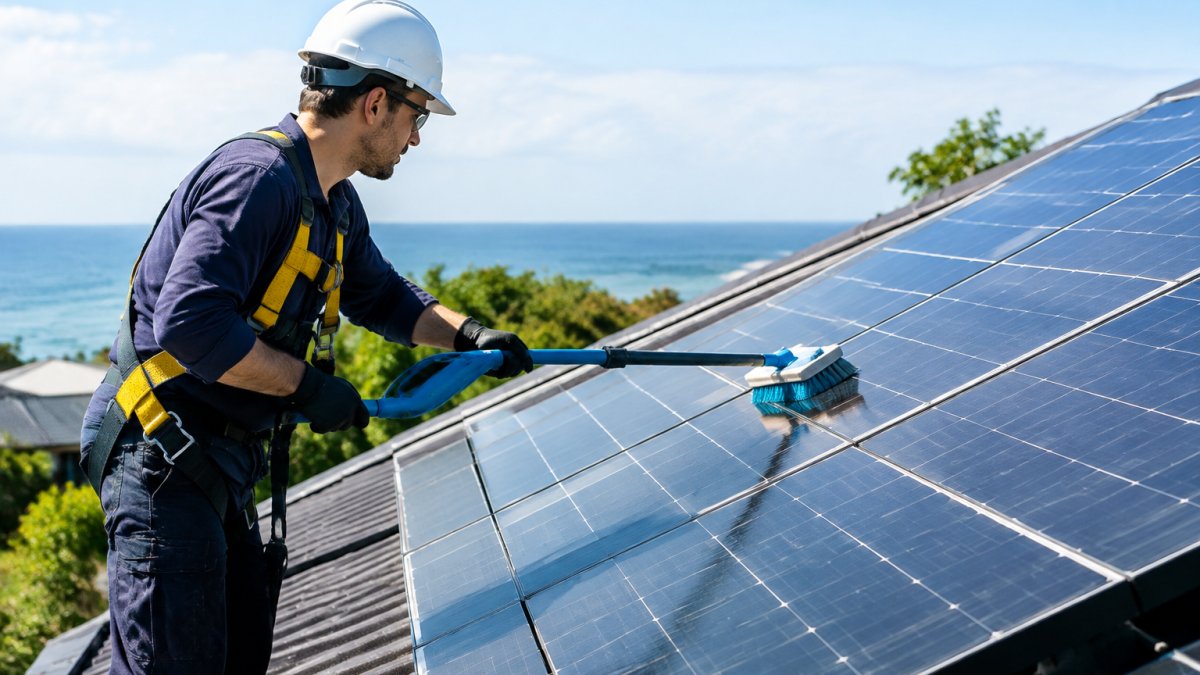
Solar panel cleaning cost is usually the smallest recurring expense in the whole system, and it is the one most easily avoided by doing it yourself on a single-storey roof.
Watch out: never walk on panels or use abrasive tools, and never clean with a high-pressure hose aimed at the frame seals. The risk is not just a scratched panel; it is water ingress and electrical hazard.
If you want the full routine, our solar panel cleaning guide for Australian homes walks through safe DIY cleaning and the point at which professional maintenance is the smarter choice.
Solar Inverter Replacement Cost and Repair Versus Replace
An inverter replacement can be one of the larger maintenance events a homeowner faces, and it is easily left out of payback calculations. Because budgeting for an inverter replacement depends partly on anticipating wear across the system, a maintenance frequency guide can help keep those costs in view.
Repair makes sense when the fault is a single component and the unit is still within its service life. Replace like-for-like when the inverter is ageing and out of warranty. Upgrade when you are adding battery storage or want monitoring features the old unit lacks.
The decision usually comes down to age and warranty status. An inverter near the end of its service life is rarely worth repairing; the next failure is usually not far behind. A newer unit with a known fault is a different calculation.
How Degradation and Panel Quality Affect System Performance
Solar panels lose a small amount of output each year as a normal part of ageing, and panel quality determines how steep that decline is. Higher-quality panels degrade more slowly and hold their output longer, which matters directly to long-term savings.
Panel quality also affects how gracefully a system handles heat and soiling. If you want to understand what the efficiency ratings on a quote actually mean, our explainer on solar panel efficiency ratings and what they mean for your output covers how panel quality affects long-term performance.
Working Out Your Solar System Payback Period
Solar system payback period is the time it takes for bill savings to equal the upfront cost of the system, and it is the single most useful number for judging whether a quote is worth signing.
The mistake most homeowners make is using the headline system price without the maintenance and replacement costs. A payback calculated on installation cost alone is optimistic.
To model your own numbers, use our solar payback period calculator and enter your actual tariff and usage.
A Year-by-Year Total Cost of Ownership Model
Total cost of ownership is the only honest way to compare solar quotes.
Assumptions used in the worked example (all AUD):
- Upfront installed cost after any applicable federal or state incentives: $5,500-$9,000, with $7,000 used as the midpoint.
- Annual bill savings from self-consumption plus a feed-in tariff: $900-$1,800, with $1,300 used as the midpoint. This depends heavily on your tariff, your daytime usage and your export rate.
- Cleaning allowance: $250 per year averaged across the life, reflecting a mix of DIY years and professional cleans.
- Annual inspection: $200 per year, sometimes bundled with cleaning.
- Inverter replacement: $2,000 in year 12, with a second replacement possible around year 24 if the first unit lasts a full service life.
- Minor repairs: $300 per decade, averaged.
- Panel degradation: assume roughly 0.5% output loss per year, which is typical of mainstream warranted panels, so year 25 output is around 88% of year one.
| Period | Cumulative costs (AUD) | Cumulative bill savings (AUD) | Net position (AUD) |
|---|---|---|---|
| Year 1 | $7,450 (install + first clean and inspect) | $1,300 | -$6,150 |
| Year 5 | $9,250 | $6,400 | -$2,850 |
| Year 10 | $11,500 | $12,600 | +$1,100 |
| Year 15 | $15,800 (includes inverter replacement) | $18,300 | +$2,500 |
| Year 20 | $18,300 | $23,400 | +$5,100 |
| Year 25 | $20,800 (second inverter possible) | $28,000 | +$7,200 |
A useful way to judge any quote is to model cumulative costs and savings together, including maintenance and replacement, rather than relying on installation cost alone.
Two costs are commonly missed. The first is the inverter replacement, which lands in the middle of the system’s life and is the largest single maintenance event. The second is the opportunity cost of not monitoring: a system running below capacity for months before anyone notices is pure lost savings, and it does not appear in any quote because nothing has broken visibly.
How the model changes with your circumstances. The worked example is a midpoint, not a universal answer.
Repair versus replace. When an inverter fails, repair is worth considering when the fault is a single component and the unit is still within its service life.
Planning Your Maintenance and Monitoring With GridFree Solar
Monitoring is what turns a maintenance plan from guesswork into a schedule. A system with live monitoring flags a drop in output within days, not months, and that early warning is often the difference between a cheap fix and an expensive one.
At GridFree Solar, we install Clean Energy Council approved batteries and work to AS/NZS 5139:2019 and AS/NZS 3000 standards, with a Certificate of Electrical Safety issued on completion. To understand how monitoring protects your savings, see our guide to the benefits of home energy monitoring systems.
Frequently Asked Questions
How much does solar panel maintenance cost?
Most households spend little in the early years. Professional cleaning pricing depends on system size, roof access and how much soiling has built up, so ask for a quote rather than assuming a flat rate. Budget separately for the bigger items: inverter replacement around the 10 to 15 year mark and any repairs after storm damage. Spreading these known costs across the system’s life gives a realistic annual maintenance figure instead of a surprise bill.
How often should solar panels be cleaned and inspected?
A practical schedule is a visual check every few months, a professional inspection every one to two years, and cleaning when you can see a film of dust, bird droppings or leaf litter. In dusty or coastal areas, cleaning may be needed more often. Rain clears light dust but does not remove baked-on droppings or grime along the frame edges. Pair each clean with a look at the inverter display and your monitoring app so performance drops get caught early.
Do solar panels still save money after maintenance costs?
Yes, in most cases. Maintenance is a small fraction of the value a working system produces, particularly once self-consumption and battery storage are factored in. The costs that hurt savings are neglect and delayed repairs, not routine cleaning. A dirty array or a failing inverter quietly reduces electricity generation, which shows up as higher grid electricity purchases. Keep the system performing and the long term savings stay intact.
Can dirty solar panels reduce electricity savings?
They can. Dust, pollen, bird droppings and leaf litter block light reaching the cells, which lowers solar output. The effect is usually modest but grows if cleaning is skipped for years, and it is worse on shallow-pitched roofs where rain does not wash panels effectively. Because lost generation means more grid electricity bought at retail rates, soiling eats directly into monthly savings. Checking output against your monitoring baseline is the simplest way to spot it.
How long do solar panels and inverters last?
Panels typically carry performance warranties of 25 years or more and degrade gradually, so panel durability is rarely the weak point. Inverters are generally the shorter-lived component. Battery storage has its own cycle life, which varies by battery. Planning for one inverter replacement and possibly a battery replacement over a 25 year horizon gives a more honest cost of ownership picture.
What maintenance can I safely do myself?
Safe tasks are visual: check the inverter for error lights, look for shade growth from trees, note any cracked glass or loose framing from the ground, and review your monitoring data for unexplained drops in generation. Leave roof access, panel cleaning at height and anything involving wiring or the isolator to a CEC accredited installer. Working on a roof or around DC wiring carries real electrical and fall risks, and DIY interference can void warranties.
The challenge with solar is not buying panels. It is knowing what the system will cost you to own over 25 years, and catching problems before they eat your savings. GridFree Solar handles the design, the rebate guidance, the compliant installation and the monitoring support that keeps output where it should be. Get started with GridFree Solar and build a system whose lifetime numbers actually stack up.
