
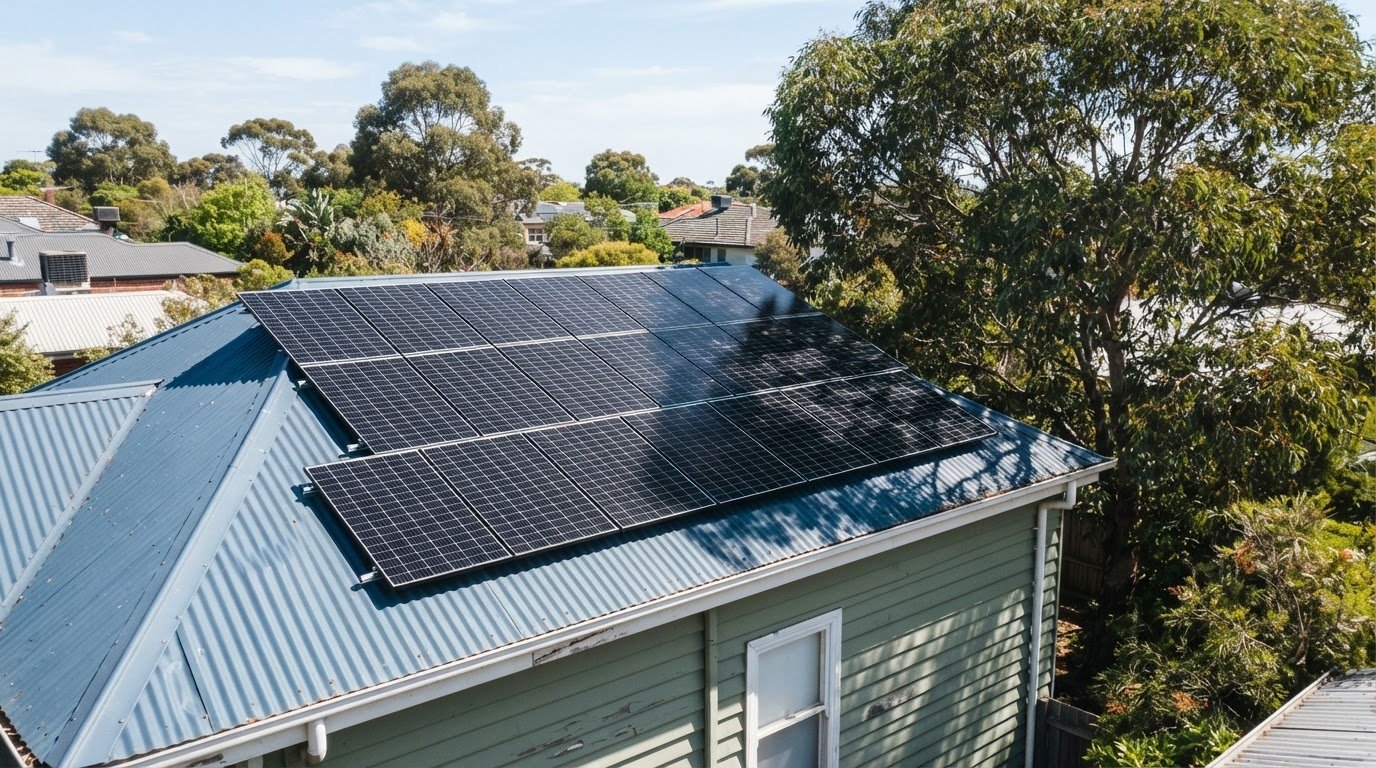
A small shadow can cause a disproportionately large drop in solar generation. The impact of shading on solar panel output varies with the shaded area, how long the shadow lasts, and the system design. A 50% production loss is a working estimate for any period a panel is shaded, but it isn’t a fixed result for every roof or solar array.
It’s understandable to focus on whether a roof gets good sunlight. But shadows from trees, chimneys and nearby buildings shift throughout the day and across the seasons, changing how much electricity a system produces. The key is to account for those patterns when designing the system.
This guide explains how shade affects panels connected in series, how bypass diodes limit losses, and why system layout matters. You’ll also learn what a shading assessment should consider, including seasonal sun paths and the potential for trees to grow and cast new shadows over time.
Key Takeaways
- Partial shade can affect more than the covered cells, especially when panels are connected in a series string.
- Bypass diodes create an alternate path for current, helping limit the effect of shade on a panel.
- Shading can change a panel’s electrical output and contribute to hotspots when uneven shade is repeated.
- Good system design accounts for changing shadows across the day and seasons, as well as future tree growth.
How shading effects the productivity of solar panels & how to avoid it?
Solar cells need sunlight to generate electricity, so shade can reduce their output. The impact depends on the shaded area, how long the shade lasts, panel layout and system design.
Effects on Photovoltaic Cells
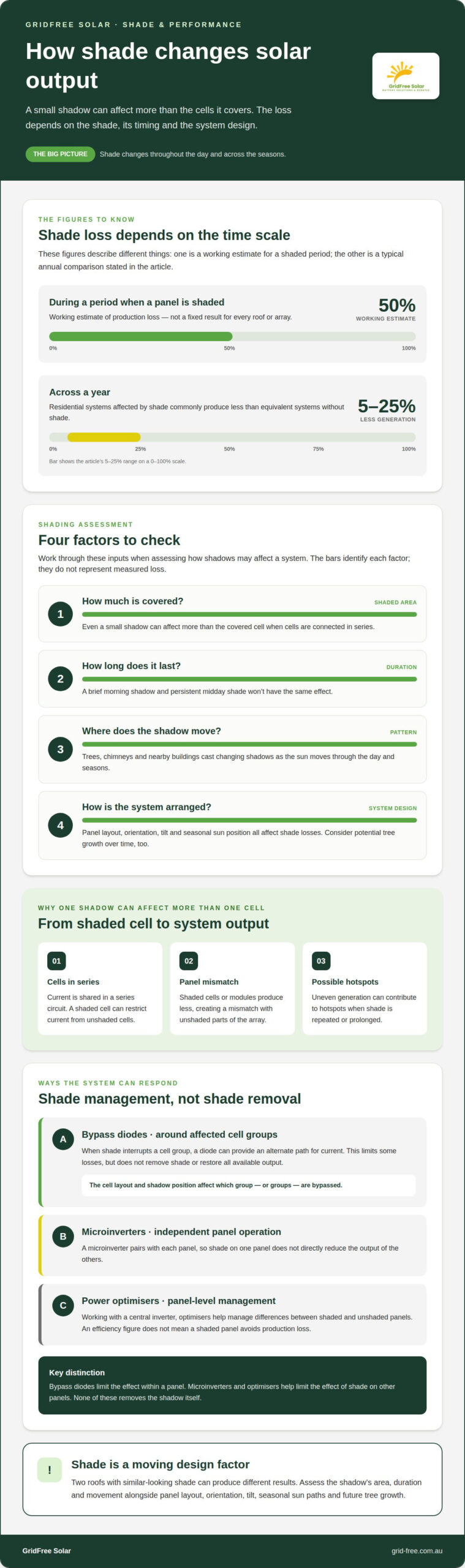
Photovoltaic cells convert sunlight into electricity, and the cells within a module are connected in series. Because current is shared in a series circuit, a shaded cell can restrict the flow from unshaded cells. Even a small shadow from a leaf or chimney can affect more than the covered cell. The shadow’s position can therefore influence the output of the whole panel.
Changes in Panel Output
Partial shading reduces the sunlight available to some cells, lowering the panel’s electrical output. A working estimate is a 50% production loss for any period a panel is shaded, but actual losses vary with shade and system configuration. Across a year, shading-affected residential systems commonly produce 5% to 25% less than equivalent systems without shade. A brief morning shadow and persistent midday shade won’t have the same effect.
Electrical Losses from Partial Shade
Electrical losses occur when shaded cells or modules produce less than their full capacity, creating a mismatch with unshaded parts of the array. In a string-inverter system, one shaded panel can reduce production from other panels connected in the same series string. Bypass diodes provide an alternate current path around affected cell groups, limiting some losses. They reduce the impact, but don’t remove the shade or restore all available output.
Assess shade by considering how much of a panel it covers, how long it lasts and whether it moves. Tree branches, roof features and nearby buildings cast different shadows as the sun moves. Panel orientation, tilt and seasonal sun position also affect losses. These factors explain why two roofs with similar-looking shade can produce different results.
Shading can reduce generation over time, but it doesn’t determine warranty coverage by itself. The relevant panel and system warranty terms govern coverage, so don’t assume shade-related output loss is covered.
What Are Bypass Diodes on Solar Panels and How Do They Reduce Shading Problems?
Bypass diodes provide an alternate route for current when shade restricts a cell group. They limit the electrical effect to the affected section instead of forcing current through it.
Bypass Diodes and Shaded Cell Groups
A bypass diode is connected across a group of photovoltaic cells, creating a path around that section when shade interrupts its current. When sunlight reaches the panel evenly, the diode is blocked and current flows through the cells. In shade, it can conduct instead. The affected group contributes less, while current from other groups can continue through the solar system.
Cell Technology and Bypass Diodes
Cell layout determines which cells share a bypass-diode path, so the position of a shadow matters. A small shadow may affect one protected group or cross several groups, changing how much of the panel is bypassed. Half-cut modules arrange cells differently from conventional layouts, making module design relevant when assessing how partial shade affects operation.
A single-diode photovoltaic model represents a panel’s electrical behaviour using an equivalent circuit with one diode. In uniform sunlight, it can describe the relationship between current and voltage. Partial shading makes modelling more complex because shaded and unshaded cell groups receive different amounts of sunlight. Modelling those groups separately helps explain how bypass diodes change the panel’s operating point and available output.
When a bypass diode conducts, it creates a voltage drop, so it doesn’t preserve every watt the unshaded cells could otherwise produce. In one example, the conducting diode has an approximate voltage drop of -0.6 V; the module voltage is 19.4 V while its other two substrings each contribute 10 V. Even with this loss, the alternate path leaves output higher than it would be without the diode. Diodes limit shading losses; they don’t remove shade or make the panel operate as if fully illuminated.
Shading impacts on current-voltage and power-voltage curves
Shade changes a photovoltaic module’s electrical behaviour, not just the amount of sunlight it receives. Current-voltage and power-voltage curves show how that change affects generation.
An I-V curve plots current against voltage. Shade on a cell group reduces the current the module can supply, while bypass diodes can create steps in the curve as shaded sections are bypassed. A P-V curve plots power against voltage. Those steps can produce several possible peaks, so the inverter must find the operating point that delivers maximum power.
Uneven generation also matters inside the module. A shaded section may limit current while other sections continue producing, creating mismatch and potential overheating. Repeated or prolonged uneven shade can contribute to hotspots. The shadow’s position and movement affect which cells operate differently and how much electricity the module can deliver.
Module-level power electronics can reduce the effect on other panels. A microinverter pairs with each panel, allowing panels to operate independently; shade on one therefore doesn’t directly reduce the output of the others. Power optimisers work at panel level with a central inverter, helping manage differences between shaded and unshaded panels. A whitepaper describes optimiser datasheet efficiency values around 99%, but that figure doesn’t mean a shaded panel avoids production loss.
Microinverters and optimisers are worthwhile for roofs where panels experience different shade patterns, because they help limit the effect on unaffected panels. Their price depends on the system and is provided after a quote request; equipment choice, system size and installation requirements affect cost.
A battery stores electricity produced by the solar system; it doesn’t replace generation lost to shade. System design should address the shadow pattern first, then match the inverter architecture to how the panels are affected.
Shading analysis during system design
For a Melbourne property, estimating the impact of shading on solar panel output starts with mapping how shadows cross the roof. A useful assessment considers sunlight throughout the day and across seasons, rather than relying on a single snapshot.
Nearby trees, chimneys and buildings cast moving shadows as the sun changes position. Morning shade may have less effect if panels receive stronger sunlight later, but the outcome depends on the roof and system layout. A design assessment considers each shadow’s size and timing alongside panel orientation and tilt.
Seasonal modelling matters in Melbourne. The sun’s path changes through the year, so a roof that appears clear in summer may receive shade in winter. Assessing conditions around the winter solstice gives a fuller picture than checking only current or summer conditions. Designers should also account for trees that may grow and cast new shadows during a solar system’s 25-year lifespan.
Before installing panels, shade mapping can compare potential positions. Where roof space allows, placing panels away from regularly shaded areas can reduce losses. The assessment should also consider how panels are connected, since shade on one module can affect others in a series string. Bypass diodes limit some cell-group losses, but cannot remove the shadow.
For system design, the aim is to avoid shading when irradiance is above 500 W/m². This focuses attention on shadows during stronger sunlight, when blocked production can matter more. Understanding the impact of shading on solar panel output means weighing the shadow’s timing, movement and extent against the available roof area and system configuration.
A shading assessment turns roof observations into a clearer production estimate and helps guide panel placement. Plan a shading-aware solar installation around your Melbourne roof’s changing conditions.
Shade mapping and seasonal modelling can estimate solar output losses by tracking how shadows move across the roof and affect potential panel positions throughout the year.
GridFree Solar: Residential Solar Panel Installation
GridFree Solar installs residential solar panels for Melbourne homes, taking roof shade into account during system design. Shadow patterns can affect panel placement, electrical configuration and expected production, making shading analysis a practical part of planning a new system in Victoria.
For an existing solar setup, a battery upgrade or replacement can address changing storage needs, but a battery won’t restore electricity lost when panels are shaded. GridFree Solar also provides commercial solar solutions and solar and battery installation for properties in Melbourne and Victoria.
If you’re planning solar or reviewing a shaded roof in Melbourne or Victoria, contact GridFree Solar to discuss your installation.
Make your next solar decision with confidence
Understanding the impact of shading on solar panel output starts with treating the roof as part of system design, not an afterthought. The next step is to connect the production estimate to your household’s energy priorities. Consider when you use electricity, what you want the system to support and how those needs may change. This context makes the design discussion more practical than focusing on panel capacity alone.
Bring your questions about the roof, expected production and system configuration together before settling on a plan. A clear discussion can help you understand the trade-offs and decide which design best fits your property and energy goals.
Contact GridFree Solar for solar advice and take the next step towards a system planned around your needs. A well-informed design decision is a strong start.
Frequently Asked Questions
Do solar panels work in shade?
Yes, solar panels can still generate electricity in shade, but reduced sunlight lowers their output. Diffuse light on a cloudy day differs from a hard shadow covering cells, such as a chimney’s shadow crossing a module. If a roof has both shaded and sunny areas, the system’s wiring and inverter design influence how those panels contribute to total generation.
Does Partial Shading Affect the Whole Solar System?
It can, particularly when shaded panels are connected in the same series string. For example, a shadow over one panel may constrain the string’s output, even if other connected panels receive full sunlight. Systems with microinverters allow each panel to operate independently, limiting the effect on other panels. The result depends on how the array is connected and which equipment it uses.
How Much Output Can Shading Actually Cost You?
There’s no single output loss that applies to every shaded roof. A small, moving shadow across one module differs from a nearby building shading several modules during strong sunlight. Assess the shaded area, affected panels and duration across the year to understand lost generation. The financial effect also depends on when the home uses solar electricity and how surplus power is handled.
Morning vs Afternoon Shading: Does It Matter?
Yes. Morning shade may have less effect on daily generation if panels receive stronger sunlight later. A shadow during strong sunlight can block more potential production, so timing matters as well as duration. For example, compare a tree shadow that clears early with a neighbouring building that shades the roof through the sunniest part of the day.
What Are the Different Types of Shading and Which Ones Cause the Most Damage?
Near shading comes from obstacles such as trees, chimneys and nearby buildings. Micro-shading occurs when dust, leaves or bird droppings block sunlight on small parts of a panel. Persistent shade affecting multiple panels during strong sunlight can cause substantial generation losses. However, no obstacle type is automatically the worst: position, coverage, duration and effect on the array all matter.
What Technology Options Exist When Shading Can’t Be Avoided?
Bypass diodes let current flow around shaded cell groups, while microinverters allow each panel to operate independently. Power optimisers can also manage panel-level differences in systems with a central inverter. These options address different parts of the shading problem, but none removes the shadow itself. Compare the roof’s shade pattern with the system layout to understand which approach may best limit effects on unaffected panels.