
Table of Contents
- How Solar Battery Storage Reduces Peak Demand Charges
- Understanding Peak Demand vs Time-of-Use Tariffs
- Solar Battery Peak Shaving: Matching Supply with Evening Demand
- Sizing Your Battery for Evening Use and Peak Periods
- Battery Charge and Discharge Settings for Peak Optimisation
- How Long Does a 10 kWh Solar Battery Last During Peak Hours
- Calculating Real Savings and Payback Period
- Frequently Asked Questions
Last Updated: October 6, 2026
How Solar Battery Storage Reduces Peak Demand Charges
Solar battery storage for peak demand is one of the most effective ways Australian homeowners can cut electricity costs. Your panels charge the battery during the day, and in the evening you draw that stored energy instead of buying expensive grid power.
Peak periods typically run 4pm-9pm, when households cook, run appliances and use lighting at once, so electricity costs jump. Using stored solar energy then avoids peak-rate charges.
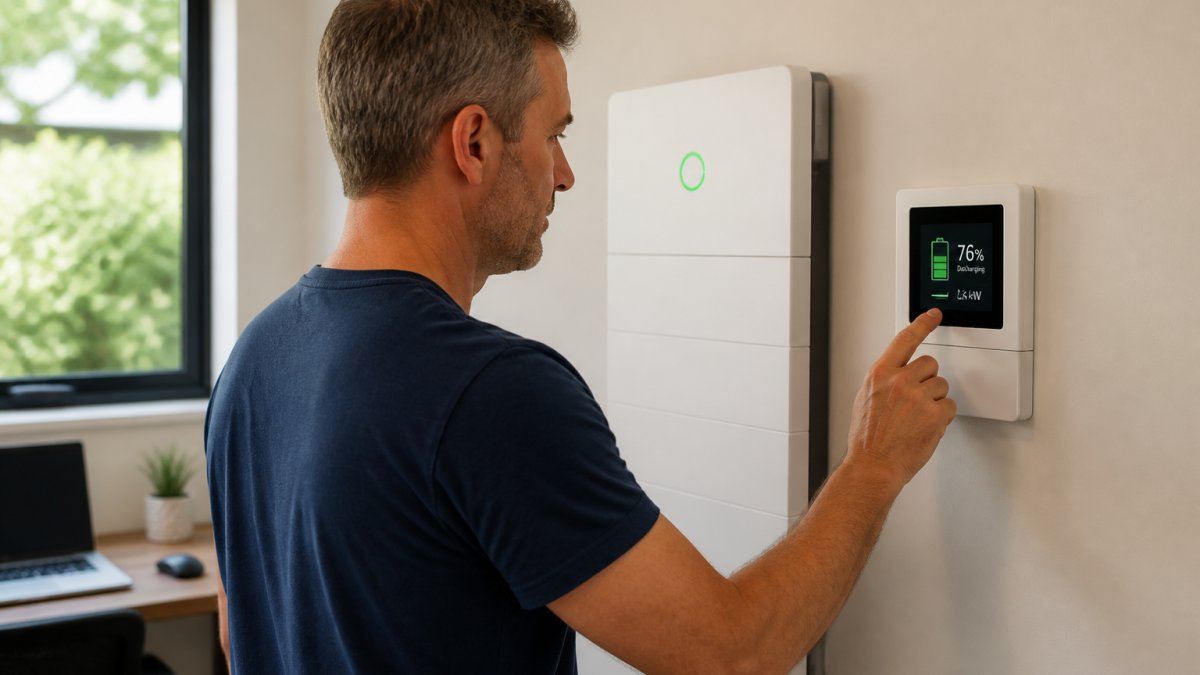
The maths is straightforward: if your retailer charges 50¢ per kWh at peak and you use battery energy instead, you save 50¢ per kWh, and those savings compound over a year.
Battery storage also protects you from grid outages, keeping essential circuits running when the power goes down.
Understanding Peak Demand vs Time-of-Use Tariffs
Understanding the difference between peak demand charges and time-of-use tariffs is crucial before sizing your battery.
Peak demand charges are based on your single highest 30-minute power draw in a billing period. Run the oven, dishwasher and air conditioning together for 30 minutes one evening and that peak sets your demand charge for the whole month, one bad evening can cost an extra $50-150.
Time-of-use tariffs charge different rates by time: off-peak (typically 11am-2pm and late evening) costs less, peak (4pm-9pm) costs significantly more, and some retailers offer shoulder rates between. Shift as much consumption as possible to off-peak windows.
The key difference: peak demand is about instantaneous power draw, time-of-use is about when you consume. Many households face both, and a battery helps with both.
Check your bill: a separate “demand charge” line item means peak demand reduction is your priority, while rates varying by time of day mean time-of-use optimisation matters more. Many households benefit from addressing both.
Solar Battery Peak Shaving: Matching Supply with Evening Demand
Peak shaving means using stored energy to reduce your household’s peak power draw during high-cost periods, the most direct way solar battery storage for peak demand saves money.
In practice, your panels produce maximum energy around midday when household use is low, so the battery charges from the excess.
The battery doesn’t need to cover your whole evening, just keep grid draw below a threshold. If your peak demand usually hits 8 kW and battery discharge cuts it to 5 kW, you’ve significantly reduced your demand charge.
Peak shaving works best with a clear daily pattern: if you’re home in the afternoon, use air conditioning heavily or run appliances at predictable times, a battery can be sized for those moments.
GridFree Solar designs systems to target your household’s peak-demand profile, analysing your consumption patterns and sizing the battery to flatten peaks.
Sizing Your Battery for Evening Use and Peak Periods
Choosing the right solar battery size for evening use requires analysing your actual consumption data and tariff structure. The method below uses interval-meter data, peak load, usable capacity and expected discharge duration.
Step 1: Pull your interval-meter data
Get 12 months of interval-meter data in 30-minute increments from your distributor’s portal or retailer, the resolution you need for both time-of-use and demand-charge analysis, and export it to a spreadsheet.
Step 2: Identify your peak window and peak load
Filter to your tariff’s peak hours (commonly 4pm-9pm weekdays, check your network tariff). For each day, find the highest 30-minute average draw in kW: that’s your peak load. Note both the monthly average and the single worst day, since demand charges are usually set by the worst interval.
Step 3: Calculate the energy you need to shift
For each peak-window interval, subtract your target grid draw (say 1.5 kW) from actual draw and sum the positive differences. That total in kWh is the energy your battery must deliver. Repeat across representative summer and winter days, since heating and cooling loads differ sharply.
Step 4: Convert to nameplate capacity
Divide the required delivered energy by two factors:
- Usable capacity ratio. Most lithium batteries allow 90-95% depth of discharge, so a 10 kWh nameplate unit delivers roughly 9-9.5 kWh. Check the datasheet rather than assuming.
- Round-trip efficiency. Expect 85-92% for a modern AC-coupled or DC-coupled system. If you need 8 kWh delivered, you must put in roughly 8.7-9.4 kWh.
A worked example: if your peak window requires 7 kWh of delivered energy and your battery has 92% usable capacity and 90% round-trip efficiency, the nameplate size is 7 ÷ 0.92 ÷ 0.90 ≈ 8.5 kWh. Round up to the nearest available model, typically 10 kWh.
Step 5: Check your solar can recharge it
A battery only saves money if it refills most days. As a rule of thumb you need roughly 1.3-1.5 kW of solar per 1 kWh of battery to recharge reliably year-round. A 5 kW array will struggle to cycle a 15 kWh battery daily in southern states; 6.6 kW of solar with a 10 kWh battery is a common balanced pairing.
Step 6: Match power output, not just energy
Energy capacity (kWh) determines how long the battery lasts; power output (kW) determines how much load it carries at once. A 5 kW continuous battery can’t cover a 7 kW draw from an oven, ducted air-conditioning and a pool pump together. Check continuous and peak power ratings, and whether your inverter is single- or three-phase, since phase limits which circuits the battery supports.
A battery sized to cover 60-80% of your peak-window consumption usually delivers the best return. Sizing to 100% adds cost that rarely pays back, because the last few kilowatt-hours are only needed on the handful of worst days each year.
GridFree Solar runs this calculation using your actual interval data, solar yield modelling and network tariff, sizing to your peak profile and flagging when a smaller battery plus load shifting beats a larger one.
Battery Charge and Discharge Settings for Peak Optimisation
Once installed, your battery’s settings determine how effectively it reduces peak demand. Most batteries let you configure charge and discharge times.
Charging strategy: Charge from solar during the day, especially 10am-3pm when output peaks. Many systems let you set a minimum state of charge, say 80% by mid-afternoon, so there’s room to absorb all available solar.
Discharge strategy: Discharge during your peak-demand window, for 4pm-9pm rates, start at 4pm and stop at 9pm. Some systems use time-based scheduling; others use load-sensing to discharge only above a demand threshold, which is more flexible and responds to real-time consumption.
Reserve capacity: Leave 10-20% in reserve for emergencies or unexpected high-demand days. A 10 kWh battery with 20% reserve uses 8 kWh for daily peak shaving and keeps 2 kWh for outages.
Energy management software can automate these settings using weather forecasts and consumption trends. GridFree Solar systems include dashboards showing state of charge, daily discharge cycles and estimated savings in real time.
How Long Does a 10 kWh Solar Battery Last During Peak Hours
A 10 kWh solar battery’s duration during peak hours depends on your household’s power draw, the critical question for whether it’s large enough.
At 2 kW draw, a fully charged 10 kWh battery lasts 5 hours; at 4 kW, 2.5 hours. Most Australian households draw 2-4 kW at peak, so a 10 kWh battery typically covers 2-5 hours.
The battery needn’t cover your whole evening, only reduce grid draw during the peak window.
Usable capacity matters: most lithium batteries deliver 90-95% of stated capacity, so a 10 kWh unit may have only 9.5 kWh usable. Check the specs for usable, not just nameplate, capacity.
Degradation also affects duration: lithium batteries retain 80-90% of capacity after 10 years of daily cycling, so a 10 kWh battery delivering 9 kWh usable initially may drop to 7.2-8.1 kWh by year 10.
Calculating Real Savings and Payback Period
Understanding your potential savings helps justify the upfront investment in solar battery storage for peak demand. The example below states every assumption so you can substitute your own figures.
Step 1: Establish your tariff structure
Pull a recent bill and record:
- Peak usage rate (¢/kWh) and the hours it applies
- Off-peak and shoulder rates (¢/kWh)
- Any demand charge ($/kW per month) and how it is measured
- Feed-in tariff (¢/kWh) for exported solar
- Daily supply charge
A typical east-coast tariff might show peak around 45-55¢/kWh, off-peak 18-25¢/kWh, and a feed-in tariff of 3-8¢/kWh for new customers. Household demand-charge tariffs are less common but exist on some networks.
Step 2: Estimate energy shifted from peak to battery
If your household uses 6 kWh in the 5-hour peak window and the battery covers 70%, you shift 4.2 kWh daily. At a 50¢ peak rate: 4.2 kWh × 50¢ = $2.10 per day, or roughly $766 per year.
Step 3: Subtract what you gave up
Two adjustments matter:
- Lost feed-in tariff. Energy diverted to the battery is energy you no longer export. Exporting 4.2 kWh at 5¢/kWh would earn about 21¢ per day, or roughly $77 per year.
- Round-trip efficiency losses. At 90% efficiency you charge about 4.7 kWh to deliver 4.2 kWh; that extra 0.5 kWh is solar you’d otherwise have exported, adding a small further opportunity cost.
Net saving here: roughly $766 − $77 ≈ $689 per year from peak shifting alone.
Step 4: Add demand-charge reduction if applicable
If your tariff includes a $15/kW monthly demand charge and your peak interval drops from 6 kW to 3 kW, you save 3 kW × $15 × 12 = $540 per year. Check your bill first, not every household has one.
Step 5: Account for degradation and seasonal variation
Lithium batteries retain 80-90% of usable capacity after 10 years of daily cycling, so model savings declining 1-2% per year rather than flat. Solar yield also drops 30-50% in southern winters, so a battery that fully cycles in summer may half-cycle in June and July; a realistic annual average is often 70-85% of the summer peak.
Step 6: Work out payback
Divide net installed cost (after rebates or certificates) by first-year net saving, then adjust upward for degradation. A $9,000 system saving $900 in year one gives simple payback around 10 years, closer to 11-12 once annual decline is included. Rising retail tariffs shorten this; falling feed-in tariffs lengthen it.
Be sceptical of payback figures under five years for a battery-only addition. They usually assume the highest possible peak rate, ignore lost feed-in tariff, and assume perfect daily cycling. A defensible model shows the assumptions.
Rebates and certificates to include
The Cheaper Home Batteries Program provides a point-of-sale discount on eligible battery installations, and Small-scale Technology Certificates can be created for eligible solar and battery systems. Confirm current rates before finalising your calculation.
Frequently Asked Questions
How can a solar battery help reduce peak electricity demand?
A solar battery stores excess energy generated during peak sunlight hours, then releases that stored energy during evening peak demand periods when grid electricity is most expensive. Instead of drawing power from the grid when demand charges apply, you use your own stored energy, lowering both your consumption charges and demand-charge penalties. This shift from grid reliance to stored energy directly reduces the peak demand your home registers with the electricity network.
What size solar battery do I need to cover evening peak demand?
Battery size depends on your household’s evening energy consumption and your peak demand window. Most homes need 8-15 kWh of usable capacity to cover 4-6 hours of evening use. Calculate your peak-period consumption by checking your electricity bill for demand charges and identifying the hours when rates peak (typically 5-9pm). GridFree Solar’s CEC Accredited Installers can assess your specific load profile and design a battery system matched to your needs and tariff structure.
How long will a 10 kWh battery last during peak usage?
A 10 kWh battery with typical household evening consumption of 2-3 kW will last roughly 3-5 hours before depletion. Actual duration depends on your power output during peak periods and your battery’s usable capacity (not all nameplate capacity is available). Battery discharge settings and load-shifting strategies also affect runtime. Professional monitoring and optimised dispatch settings help maximise the usable energy delivered during peak demand windows.
Can I use a battery to store off-peak electricity and use it during peak periods?
Yes, if your tariff includes off-peak charging rates. Some time-of-use tariffs offer cheaper electricity during specific hours (often 11am-2pm or overnight). You can charge your battery during these windows and discharge it during peak periods, effectively arbitraging the price difference. However, battery charging efficiency (typically 85-95%) means you lose some energy in the process. Check your specific tariff terms and consult GridFree Solar to confirm whether off-peak charging aligns with your system design and local regulations.