
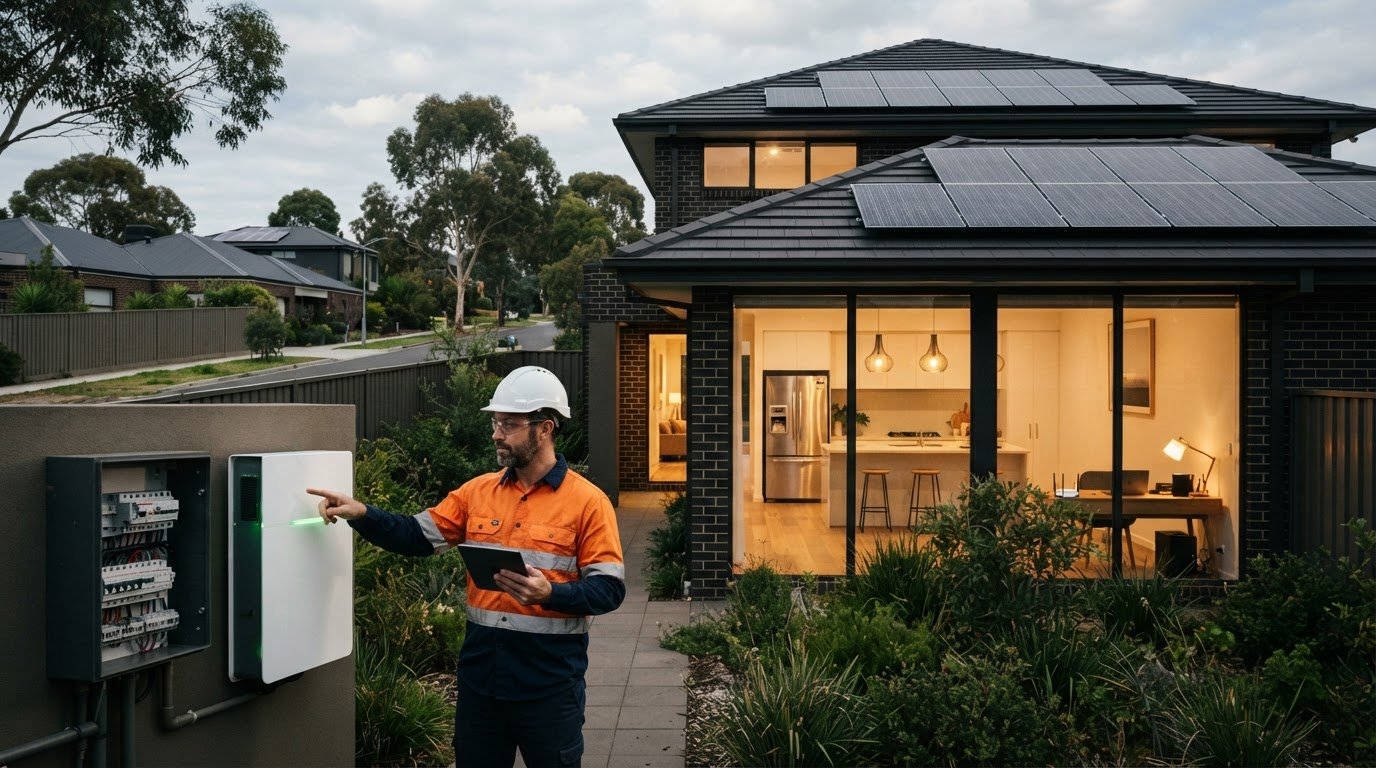
A larger battery doesn’t automatically mean more of your home stays on during a blackout. Peace of mind with solar battery backup Melbourne households can count on starts with the right backup design, not capacity alone. Will your fridge, lights, internet and other essentials keep running when the grid goes down? It depends on whether your system is configured for backup, which circuits are connected and how much power your appliances use.
Solar storage can help you use more of your own energy, but storing power for evening use and supplying power during an outage aren’t the same thing. The difference matters when you compare battery proposals or decide which household essentials take priority.
This guide explains what battery backup can and can’t do, how to plan around power demand and stored energy, and what to ask a Melbourne installer before you commit. You’ll learn how to compare backup circuits and system designs against your household’s outage priorities, rather than choosing by headline capacity. GridFree Solar can assess your property, existing solar system and backup priorities together, helping you understand which design may suit your home.
Key Takeaways
- Check how a proposed system responds to a grid failure, including how it isolates from the grid and which loads it supplies.
- Compare battery energy capacity with output capability to assess both how long backup may last and which appliances it can run.
- Use peace of mind with solar battery backup Melbourne as a design goal: match backed-up circuits and solar charging compatibility to your household priorities.
- Before a site assessment, record your existing solar equipment, switchboard details, household usage and essential loads.
- Compare essential-load, broader-circuit and whole-home backup claims carefully. Ask the installer what the proposed design can support during an outage.
Solar battery backup in Melbourne: what peace of mind really means
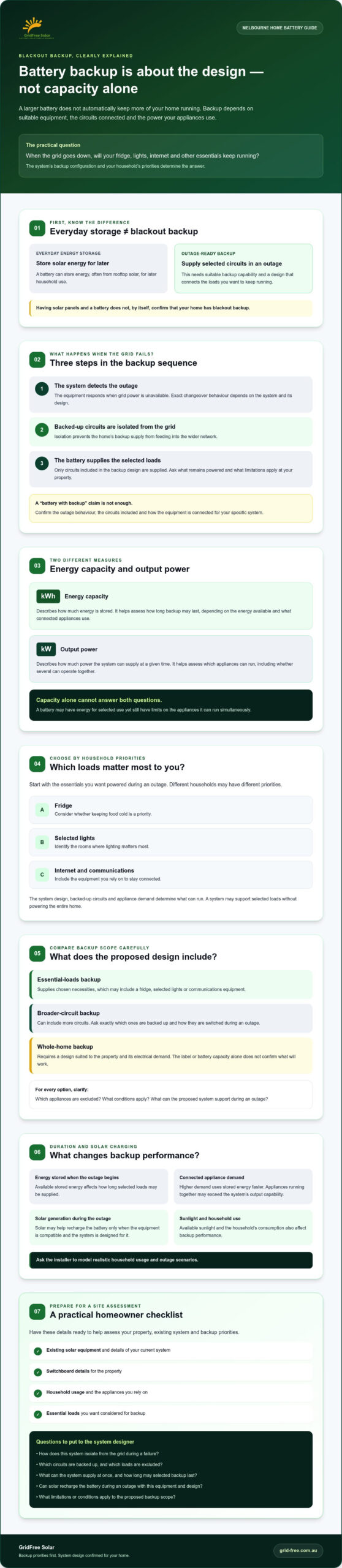
Solar battery backup is a system configured to supply selected household loads from stored energy when grid power is unavailable. It’s different from simply having solar panels and a battery. Everyday energy storage doesn’t automatically mean your home has blackout backup. The system needs suitable backup functionality and must be designed to supply the circuits you want to keep running.
A battery stores energy for later use, often from rooftop solar. That’s the basic role of home energy storage systems. Outage-ready backup adds equipment and circuit arrangements that allow designated loads to receive power when the grid is down. A battery’s capacity headline alone can’t tell you which appliances will operate or for how long.
Does a solar battery keep working during a blackout?
Not necessarily. Grid-connected solar and battery systems generally need suitable backup capability to operate during an outage. When the grid fails, the system must separate the backed-up circuits from the grid before supplying them. This isolation prevents the home’s backup supply from feeding into the wider network. Ask the system designer to explain what happens at your property, which circuits remain powered and what limitations apply.
Get the outage behaviour confirmed for the specific system being proposed. Don’t rely on a general claim that a battery “has backup”. The design and connection of the equipment determine what that means in practice.
What does peace of mind look like for a Melbourne household?
Start with what matters most to your household. You might prioritise keeping the fridge running, having lights in key rooms and maintaining access to communications. Another household may have different needs. Backup performance depends on the system design, the circuits connected and the appliances drawing power.
That’s why peace of mind with solar battery backup Melbourne households seek comes from clear priorities and a confirmed design, not an assumption that every appliance will keep working. A system may support selected loads without powering the entire home. Tell your installer which essentials matter, then ask them to show how the proposed design addresses those priorities. This gives you a practical basis for comparing options before committing.
How solar battery backup works when Melbourne loses grid power
During a grid outage, a backup-enabled system detects that grid power is unavailable, isolates the backed-up part of the home from the network, then supplies those selected circuits from the battery. The exact changeover behaviour depends on the equipment and design, so ask the installer what to expect when the power fails.
Backup performance depends on equipment configuration and selected loads. Battery size alone can’t tell you what will run. Energy capacity, measured in kilowatt-hours (kWh), describes how much energy is stored. Output power, measured in kilowatts (kW), describes how much the system can supply at a given time. A battery may hold enough energy for hours of selected use but still have limits on the appliances it can run simultaneously.
Backup circuits, essential loads and whole-home claims
An essential-loads circuit supplies chosen necessities, which may include a fridge, selected lights or communications equipment. Broader backup can include more circuits, while whole-home backup requires a design suited to the property and its electrical demand. Neither the label nor the battery capacity confirms what will work in your home.
Ask which circuits are backed up and how they’re switched during an outage. Have the system designer clarify whether any appliances are excluded and what conditions apply to whole-home operation.
What affects backup duration and performance?
Backup duration depends on the energy stored when the outage begins, the demand from connected appliances and whether the system can draw on solar generation. Solar may help recharge a battery during an outage only if the equipment is compatible and the system is designed for it. Available sunlight and household consumption also matter.
High-demand appliances running together can draw more power than the system is designed to supply, while sustained use consumes stored energy faster. Ask the installer to model realistic household usage and outage scenarios, including which appliances you’d run at the same time and how solar might contribute. For peace of mind with solar battery backup Melbourne households can plan around, request a property-specific explanation of the proposed system’s limits. A solar and battery system assessment can help bring your property, existing equipment and backup priorities into the same conversation.
Compare solar battery backup options by loads, capacity and system fit
Compare backup designs by what they’re intended to support, not by battery capacity alone. A larger usable energy figure may provide more stored energy, but it doesn’t automatically mean higher output or more circuits backed up. Ask each provider to specify usable energy, output capability, backed-up circuits and whether solar can contribute during an outage.
| Backup approach | Usable energy and output | Backed-up circuits | Solar charging compatibility | Main consideration |
|---|---|---|---|---|
| Essential-load backup | Designed around selected loads; confirm the system’s usable energy and output limits. | A limited set of priority circuits, such as refrigeration, selected lighting or communications. | Depends on the system design and compatibility. | Can focus backup on essentials, but other circuits may not receive power. |
| Broader circuit backup | Needs to be matched to the demand of the additional circuits. | More of the home may be included, subject to system capability and design. | Must be confirmed for the proposed equipment and outage operation. | Broader coverage can mean greater demand on stored energy and available output. |
| Whole-home backup claim | Requires output and usable energy suited to the property’s loads. | May be designed to supply the whole home, but this must be confirmed for the specific property. | Depends on system compatibility and design. | Ask which loads can operate together and what limits apply. Don’t assume every appliance is supported. |
Use the comparison to separate outage resilience from bill savings. A design intended to keep priority circuits running during an outage isn’t automatically the design that best suits your daily energy use. Discuss each goal separately, then compare how the proposed system addresses both.
How much battery backup does a Melbourne home need?
Start by listing the appliances and circuits you’d prioritise during an outage. Consider your typical usage, how long you want essential loads supported and whether solar generation may be available. A qualified system designer should size the system using your actual loads, not a generic household assumption. This gives you a clearer basis for assessing usable energy and output.
Adding a battery to existing solar versus installing an integrated system
With existing solar, an installer needs to assess the panels and inverter alongside backup functionality. A new integrated installation can be planned around solar, storage and outage priorities together. In either case, compatibility and switchboard requirements need professional assessment. For more background on comparing approaches, read this guide to Melbourne energy storage solutions.
For peace of mind with solar battery backup Melbourne homeowners can evaluate confidently, ask for the proposed usable energy, output, backed-up circuits and solar behaviour during an outage in writing. Compare those details against your priorities, not just the headline capacity.
A Melbourne homeowner’s checklist for choosing reliable battery backup
A clear process makes backup proposals easier to compare. Before you commit, work through these steps and keep your notes with each quote. The goal is to confirm how the design will perform for your home, not just which equipment it includes.
- List essential loads. Note the appliances and circuits you’d prioritise during an outage, such as refrigeration, selected lighting or communications. Include which items might run at the same time.
- Document your property and existing system. Record solar panel and inverter details if available, note your switchboard and gather typical household usage information. This helps the installer assess compatibility and discuss your actual needs.
- Compare designs consistently. Check each proposal for usable battery energy, output capability, backed-up circuits, solar operation during an outage and any stated assumptions about backup duration.
- Confirm outage operation and handover. Ask how the system detects a grid failure, switches to backup and returns to normal operation. Confirm what monitoring is available and which commissioning steps will demonstrate the system’s intended operation.
Questions to ask a solar battery installer
Be specific. Which circuits receive backup, and what happens to them when grid power fails? Can the proposed configuration use solar to recharge the battery during an outage? Ask the installer to explain the assumptions behind any projected backup duration, including expected appliance use, starting battery charge and solar generation. Clear answers make competing designs easier to assess.
Check the proposal, installation scope and rebate guidance
Look for a written proposal that identifies the system components, backed-up loads and commissioning steps. Ask the installer to confirm the applicable installation requirements for the proposed design. Standards and Victorian programme details can change, so verify current requirements and any relevant rebate eligibility before relying on compliance or incentive claims.
For further context on investment considerations, see this 2026 Australian solar battery cost and ROI guide. Keep backup resilience and potential bill savings as separate questions when reviewing the information.
Use the checklist to compare proposals against your household’s priorities. For a property-specific review of your existing solar equipment and backup needs, explore GridFree Solar’s residential solar and battery installation.
Get peace of mind with a solar battery backup plan tailored to your Melbourne home
A reliable backup plan begins with three checks: define the loads you want to prioritise, confirm exactly how the system operates during an outage, and compare proposed designs against your household’s needs. Battery capacity matters, but it isn’t a substitute for knowing which circuits are backed up and what the system can supply.
For peace of mind with solar battery backup Melbourne homeowners can act on, prepare a clear picture of your property and priorities before discussing system options. A tailored assessment can consider your existing equipment, household usage and preferred outage performance together.
What to prepare before requesting a battery assessment
Gather details of your existing solar panels, inverter and battery, if you have one. Recent electricity usage information and clear switchboard photographs can also help inform the discussion. Make a list of essential appliances and explain how you’d want to use them during an outage, including which might operate at the same time.
Note any future plans that could affect system design, such as changes to household energy use. These details won’t apply to every home, but raising them early can help the assessment reflect your plans as well as your current setup.
Plan a solar battery assessment with GridFree Solar
GridFree Solar provides residential solar and battery system design and installation, as well as battery upgrades and replacements for existing systems. If you already have solar, compatibility and backup capability need to be assessed rather than assumed. The aim is to understand what your property can support and how a proposed design aligns with your outage priorities.
GridFree Solar can also help customers navigate applicable solar and battery rebates. Eligibility, programme terms and application details can change, so ask for the relevant information to be checked for 2026 before relying on an incentive in your decision.
Ready to discuss your household’s priorities? Gather your system details, usage information and essential-loads list, then request a solar and battery assessment from GridFree Solar. Use the conversation to confirm the proposed backup circuits, outage operation and any limits before deciding whether the design is right for your Melbourne home.
Make your backup plan fit your home
Reliable backup starts with clear priorities. Decide which appliances and circuits matter most, then confirm how the proposed system will operate during an outage. Compare designs by backed-up loads, usable energy and output capability, not battery capacity alone. Solar and battery storage can support everyday energy use, but blackout performance depends on the system’s configuration and the loads it’s designed to supply.
That’s the practical path to peace of mind with solar battery backup Melbourne homeowners can plan around. A property-specific assessment can consider your existing solar equipment, household usage and outage needs together. GridFree Solar provides residential and commercial solar and battery system design and installation, along with battery upgrades and replacements for existing systems. The team can also assist with navigating applicable solar and battery rebates. Eligibility and programme details should be checked for your circumstances.
Ready to clarify what backup could look like at your property? Request a tailored solar battery assessment and take the next step with a clearer understanding of your options. A well-matched design starts with your priorities.
Frequently Asked Questions About Solar Battery Backup
Will a solar battery keep my Melbourne home powered during a blackout?
Only if the system has suitable backup functionality and is configured to supply selected circuits during an outage. A battery used for everyday energy storage may not provide blackout backup by itself. Ask which circuits will stay powered, how the system isolates them from the grid and what limitations apply. The search for peace of mind with solar battery backup Melbourne homeowners can trust starts with confirming the proposed system’s actual outage behaviour.
Can solar panels charge a battery during a power outage?
They may, but only if the panels, inverter and battery are compatible and the system is designed to operate this way during an outage. Solar generation also depends on available sunlight and household demand. Ask the system designer whether solar can recharge your battery while the grid is down, which backup circuits can use that energy and what operating limits apply. Don’t assume panels will continue generating simply because they’re connected to a battery.
How long will a solar battery run my home during a blackout?
There’s no fixed runtime. It depends on the battery’s usable stored energy, its state of charge when the outage begins, the connected appliances and their combined demand. A fridge and a few lights use energy differently from several high-demand appliances running together. Ask an installer to estimate runtime for your priority loads and explain the assumptions behind that estimate, including whether solar generation could contribute during the outage.
What happens to solar panels when the grid goes down?
Many grid-connected solar systems stop supplying power during an outage unless they’re configured with suitable backup equipment. This prevents the system from sending electricity into the grid while it’s being serviced. With a compatible, properly designed battery system, solar may be able to support designated backup loads or recharge the battery, depending on conditions. Ask your installer to explain what your existing system will do during an outage, rather than assuming it will keep operating.
Do I need a battery to have solar backup in Melbourne?
For typical residential solar backup, a battery is generally part of the solution, alongside equipment designed to supply selected circuits during an outage. Standard grid-connected solar panels alone usually don’t keep a home powered when the grid fails. The right arrangement depends on your existing equipment and backup priorities. Have a designer assess your solar system and explain whether it can provide outage backup, what additional equipment may be needed and which loads it could support.
How do I choose the right solar battery backup system for my home?
Start by listing the circuits and appliances you’d prioritise, then compare proposals for usable battery energy, output capability, backed-up circuits and solar operation during an outage. Ask how the system switches when grid power fails and what assumptions support any runtime estimate. Existing solar equipment and switchboard details may affect the design, so provide them for assessment. Choose based on confirmed household needs, not capacity headlines or claims of whole-home backup alone.
Is solar battery backup worth it if outages are uncommon?
It depends on how you value outage resilience alongside everyday energy use and the system’s overall cost. Consider which essential loads you’d want powered during an outage, how often you might use stored energy at other times and whether the proposed system suits both goals. Compare these benefits separately rather than treating bill savings as guaranteed. A property-specific assessment can help you weigh backup priorities against system design and current rebate eligibility.