
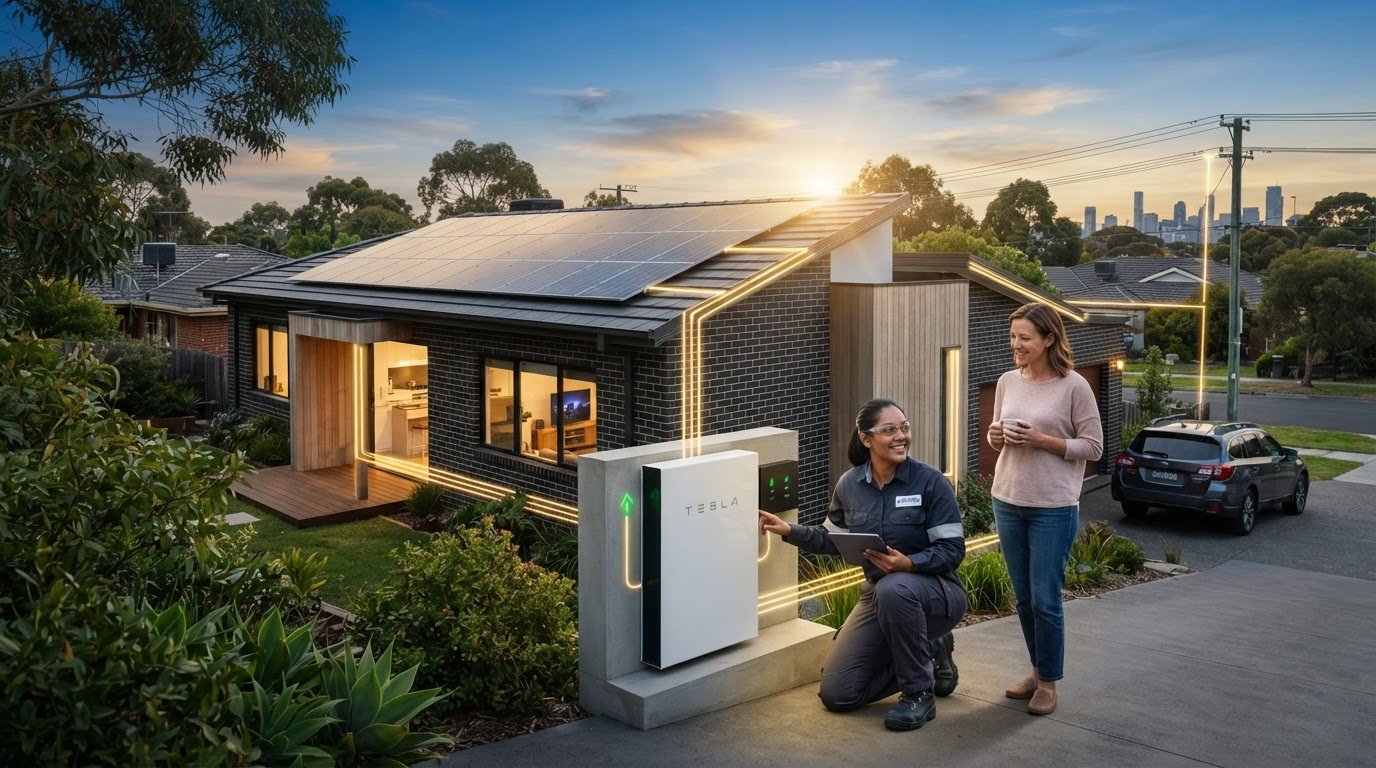
What if getting more from your solar battery isn’t about keeping it full, but about matching its settings to your day? If you’re wondering how to get the most out of your solar battery, start by comparing your household’s routines with solar generation and your electricity plan.
It can be hard to know when to use battery energy and when to save it for later. Solar generation often peaks while household demand is low. In Victoria, your retailer’s feed-in tariff and electricity plan can also affect whether storing or exporting surplus energy better suits your needs.
This guide covers practical ways to align battery operation with your energy use, review charging, discharge and backup preferences, and follow your manufacturer’s guidance. You’ll also learn what to monitor, including solar generation, household consumption, battery charge and grid imports, to spot patterns over time.
Start with your household’s energy rhythm. Use what you learn to set realistic preferences, and consider whether your system design or battery capacity still suits your needs.
Key Takeaways
- Understand how solar energy moves through your home, from immediate use to battery storage or grid export.
- Learn how to get the most out of your solar battery by reviewing household use, shifting flexible loads and checking settings.
- Compare self-consumption, backup reserve and exporting energy to decide which battery priority best fits your household.
- Review solar generation, household consumption, battery charge and grid imports regularly to spot patterns over time.
- Understand why one cloudy day isn’t enough to diagnose a problem, and when a professional system assessment may help.
How a solar battery stores and supplies energy in your home
A solar battery stores surplus electricity from your panels for use later, such as after sunset. It charges and discharges through a battery inverter or an integrated hybrid inverter, depending on the system design. Inside the battery, electrochemical processes store and release energy, as explained in this overview of how rechargeable batteries work.
Capacity is the amount of energy a battery can store, measured in kilowatt-hours (kWh). Power output is the rate it can supply energy, measured in kilowatts (kW). Usable capacity and maximum output depend on the battery’s specifications and configuration. These figures describe different things and aren’t interchangeable.
What happens to solar energy before it reaches the battery?
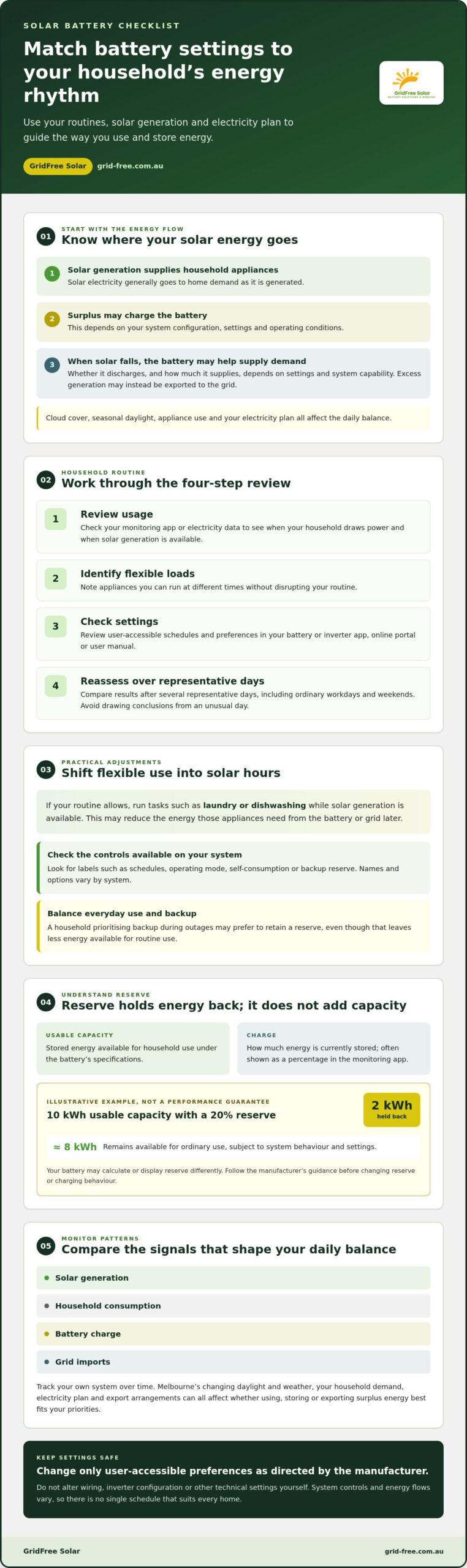
Solar electricity generally supplies household appliances as it is generated. If generation exceeds demand, surplus electricity can charge the battery, provided the system configuration, settings and operating conditions allow it. When the battery is full, or settings direct energy elsewhere, excess generation may be exported to the grid, subject to the home’s connection and export arrangements.
When solar generation drops, the battery may discharge to help supply household demand. Whether it does so, and how much energy it supplies, depends on the settings and system capability. Cloud cover, seasonal daylight, appliance use and your electricity plan all affect the daily balance. A battery can’t guarantee lower bills or energy independence; outcomes vary between households.
What do battery capacity, charge and reserve mean?
Usable capacity is the stored energy available for household use under the battery’s specifications. Charge describes how much energy is currently stored, often shown as a percentage in the monitoring app. A reserve setting holds some charge back, commonly to keep energy available for backup if the system supports backup operation. It reduces the energy available for routine use; it doesn’t increase the battery’s total capacity.
Illustrative example, not a performance guarantee: if a battery has 10 kWh of usable capacity and a user-set reserve of 20%, about 2 kWh is held back and the remaining 8 kWh is available for ordinary use, subject to system behaviour and settings. Your battery may calculate or display reserve differently. Follow the manufacturer’s guidance, particularly before changing reserve or charging behaviour.
Understanding this flow is the starting point for how to get the most out of your solar battery. The right balance depends on your household’s energy rhythm, system design, weather, settings and electricity plan, not on keeping the battery full at all times.
Match solar battery settings and routines to your household
The most useful battery schedule reflects when your home uses energy, rather than following a generic timetable. To work out how to get the most out of your solar battery, use this four-step routine:
- Review usage: Check your monitoring app or electricity data to see when your household draws power and when solar generation is available.
- Identify flexible loads: Note appliances you can run at different times without disrupting your routine.
- Check settings: Review user-accessible schedules and operating preferences in your battery or inverter app, or its online portal.
- Reassess: Compare results after several representative days, including ordinary workdays and weekends. Avoid drawing conclusions from an unusual day.
Shifting flexible energy use into solar-generation hours means more of your current solar output can go directly to appliances, leaving more potential surplus to charge the battery. The U.S. Department of Energy also outlines the principle of storing solar energy for use later. Actual energy flows depend on your system, settings and conditions.
Which household loads can you shift into solar hours?
Start with tasks such as laundry or dishwashing, if your routine allows. Running them while solar generation is available may reduce the energy those appliances need from the battery or grid later. High-demand appliances can draw from solar, battery and grid supply in different combinations, depending on timing, system limits and settings. There’s no single schedule that suits every home.
How should you review battery schedules and reserve settings?
Look in your battery or inverter app, web portal or user manual for controls labelled schedules, operating mode, self-consumption or backup reserve. Names and available options vary by system. A household that prioritises backup during outages may prefer to retain a reserve, even if that leaves less energy available for everyday use. Follow the manufacturer’s instructions for settings specific to your equipment.
Melbourne’s changing daylight and weather are worth factoring into your review. Solar generation and household demand can vary by season, but track your own system rather than assuming a fixed pattern. Your electricity plan and export arrangements can also influence whether using, storing or exporting surplus energy best fits your priorities.
Adjust only user-accessible preferences as directed by the manufacturer. Don’t alter wiring, inverter configuration or other technical settings yourself. If your system no longer suits your household, GridFree Solar can help plan a solar or battery installation, upgrade or replacement. Explore solar and battery solutions to see how system design can be matched to your needs.
Compare battery priorities: self-consumption, backup and export
There’s no single best way to operate a home battery. The right priority depends on when your household uses electricity, how much backup you want and what your retailer pays for exported energy. Your battery’s capabilities, system compatibility, electricity plan and export arrangements all matter. Use this comparison to identify the trade-off that best fits your needs.
| Priority | May suit a household that… | Main trade-off |
|---|---|---|
| Self-consumption | Uses a substantial share of its electricity after solar generation falls, and wants stored solar energy available for home use. | Keeping energy for later use means less may be available for export. Whether this is financially worthwhile depends on the plan and the value of grid imports compared with export credits. |
| Backup reserve | Values having some stored energy set aside for outages, where the battery and system support backup operation. | A reserve reduces the energy available for everyday use. Backup capability and the loads it can support depend on compatible equipment and system configuration. |
| Export | Has surplus solar energy and prefers to send some of it to the grid rather than retain it in the battery. | The value depends on the retailer’s feed-in terms and applicable export arrangements. Export credits aren’t guaranteed to outweigh the value of using or storing that energy. |
When might self-consumption be the priority?
Households that draw more power in the evening, after solar generation has tapered off, may favour using stored energy at home. This can reduce reliance on grid imports during those periods, but it doesn’t automatically deliver the best financial outcome. Compare your plan’s usage rates and feed-in terms, and consider when the battery can charge and discharge under its settings.
When should backup reserve or export matter more?
If keeping power available during an outage is a priority, a reserve may suit you better than using every available kilowatt-hour for routine consumption. That choice only helps with backup if your battery, inverter and system configuration support it. Export may be more appealing when retailer terms make it worthwhile, but Victorian export rates and arrangements vary. Review current details rather than relying on an old estimate.
A virtual power plant (VPP) is a separate participation option. It may coordinate compatible household batteries as part of a wider network, under program-specific terms that can affect battery operation. Consider those terms alongside your backup and usage preferences; don’t assume participation guarantees earnings or savings.
To decide how to get the most out of your solar battery, weigh everyday use, backup needs and export terms together. For broader context on system design and storage, see the guide to Melbourne energy storage solutions.
Monitor solar battery performance without guessing
Your monitoring app is most useful for comparing patterns, not isolated readings. Set aside time each week to review the same data over a consistent period. This helps you see how generation, household demand, battery operation and grid imports relate, without treating every change as a fault.
Each week, compare solar generation, household consumption, battery charge and discharge, and electricity imported from the grid across similar days or periods. Note the weather, unusual appliance use or changes to your routine. Cloudy weather can reduce solar generation and leave less surplus to charge the battery, but one day alone can’t prove poor performance or establish a system fault.
Which figures in your monitoring app are worth comparing?
Start with the readings your app provides. Labels and available data vary by system:
- Solar generation: Electricity produced by your panels during the period.
- Household consumption: Electricity used by appliances and other loads in your home.
- Battery charge and discharge: Energy stored in the battery and energy supplied from it.
- Grid imports: Electricity drawn from the network when solar or battery supply doesn’t meet demand.
Compare like with like, such as similar weekdays or the same period across several weeks. A weekend with more cooking or laundry may not be comparable with a typical weekday. There’s no universal performance benchmark: battery models, system settings, weather and household use differ.
When could a battery or system assessment be useful?
Melbourne’s daylight and weather change with the seasons, so some variation in generation and battery charging is normal. Look for persistent changes across comparable periods rather than reacting to a short spell of overcast weather. If a pattern continues, record dates, recurring alerts, unusual behaviour and relevant changes in household use.
Ongoing concerns may relate to settings, equipment, system configuration or another cause that monitoring data alone can’t identify. If an older battery has recurring performance concerns, consider whether its condition, configuration or replacement needs review. Don’t open equipment or attempt electrical adjustments yourself.
Your records can help clarify what has changed and what your household needs from its system. Explore a solar or battery upgrade or replacement with GridFree Solar if you’re considering a change to your setup.
Put your solar battery plan into action in Melbourne
A practical battery plan starts with your household’s energy data, not assumptions. Review how your system performs, decide what matters most, then make only manufacturer-approved changes through the user interface. Retailer plans, feed-in terms and Victorian rebate programs can change, so check current details before factoring them into your decisions.
What should you do this week to improve battery use?
Build a useful baseline over several representative days. Record solar generation, household consumption, battery charge and discharge, and grid imports. Note the weather or unusual energy use so you can interpret the figures in context.
- Choose a priority: Decide whether everyday use, retaining backup capacity or exporting surplus energy matters most to your household.
- Review your plan: Check your retailer’s current usage rates and feed-in terms, plus any export arrangements that apply to your connection.
- Check user settings: Review schedules and operating preferences in your battery or inverter app. Follow the manufacturer’s instructions and don’t attempt electrical or technical adjustments yourself.
- Reassess consistently: After using the selected settings for a representative period, compare similar days and see whether the system is better aligned with your routine.
This measured approach helps you understand how to get the most out of your solar battery without treating one cloudy day or an isolated app reading as the whole story.
When is a professional battery review the next logical step?
A review may be useful if your household’s energy needs have changed, your system has recurring alerts or monitoring shows a persistent pattern you can’t explain. An older battery with ongoing performance concerns may also warrant attention. These issues can relate to settings, equipment, system configuration or changing demand, so data alone may not reveal the cause.
GridFree Solar provides solar and battery installation, battery upgrades and replacements, with system design tailored to household energy patterns. If you’re planning a new solar system, a battery upgrade or a replacement, GridFree Solar can help design a system around your property and priorities. The company also provides guidance on claiming applicable solar and battery rebates. Check current Victorian rebate information when considering an eligible project, as program details may change.
Ready to review your setup? Discuss a solar and battery solution with GridFree Solar and take the next step towards a system designed around your property and energy needs.
Make your solar battery work around your home
The practical answer to how to get the most out of your solar battery is to align its settings with your household’s routines and priorities. Review generation, battery use and grid imports across representative days, then decide whether everyday self-consumption, backup capacity or exporting surplus matters most. Make only user-accessible changes supported by your manufacturer, and look for patterns rather than reacting to one unusual day.
If your energy needs have changed, alerts keep recurring or your battery no longer seems suited to your home, consider whether a system upgrade or battery replacement is the next step. GridFree Solar provides residential and commercial solar and battery installation, battery upgrades and replacements, plus guidance on navigating applicable solar and battery rebates.
Explore solar and battery solutions with GridFree Solar and take a considered next step towards a system designed around your property and energy needs.
Frequently Asked Questions
How do I get the most out of my solar battery?
Start by comparing when your Melbourne home uses electricity with when your solar panels generate it. Review your battery’s operating priorities, shift suitable flexible tasks into solar hours, then compare generation, battery charge and grid imports across similar days. Keep backup needs in mind, and follow the manufacturer’s instructions when reviewing settings. The best approach depends on your system, household routine and electricity plan, so use your own data to guide decisions.
Should I use all the energy stored in my solar battery each night?
Not necessarily. Using stored energy overnight may suit households focused on everyday self-consumption, while others prefer to retain a reserve for backup or another household need. The right balance depends on your settings, compatible equipment, electricity plan and priorities. Don’t assume fully discharging the battery every night is suitable for every system. Check the manufacturer’s guidance before changing operating preferences, especially those related to reserve levels or battery charging behaviour.
Can I charge my solar battery from the grid?
Some battery systems and electricity plans may allow grid charging, but whether it’s available or suitable depends on your equipment configuration, retailer terms and goals. Grid charging isn’t automatically cheaper or better than charging from solar. Review your current plan and the manufacturer’s instructions before enabling it. If you’re unsure about system compatibility or a technical change, speak with a qualified solar and battery professional rather than altering electrical settings yourself.
What is the best battery setting for a Melbourne home?
There’s no single best setting for every Melbourne household. Solar generation varies with weather and seasons, while household demand, backup preferences and retailer arrangements differ. Decide whether everyday solar use, retaining backup capacity or another compatible operating priority matters most to you. Then review your system data and manufacturer guidance before adjusting user-accessible settings. Check current retailer terms and export arrangements too, as these can affect which approach suits your household.
Why is my solar battery not full by the evening?
A battery may not fill if solar generation is limited, household use is high or system settings direct energy elsewhere. Weather, shading, system configuration and battery operation can also affect charging. Compare several representative days rather than judging performance from one reading, particularly through Melbourne’s changing conditions. If the pattern continues or appears alongside recurring alerts, note the dates and details, then arrange a qualified system assessment to help identify the cause.
Does a virtual power plant help me get more out of my solar battery?
A virtual power plant (VPP) may let compatible batteries participate in a coordinated energy programme, but suitability and outcomes depend on program rules, retailer arrangements and current terms. Participation can affect how a battery operates, so weigh this against your household’s backup and energy priorities. Check current Victorian program information before deciding. Don’t assume every battery qualifies or that joining will guarantee earnings or savings.
How often should I check my solar battery app?
A regular check can help you understand generation, battery charge and grid imports, but constant monitoring usually isn’t needed. Review data over a consistent period and compare similar days to spot patterns rather than reacting to an isolated reading. Note alerts or persistent changes, and follow the manufacturer’s instructions. App figures alone don’t prove a fault. If unusual behaviour continues, a professional assessment can help clarify what’s happening.