
Sizing your solar storage based on summer production is a mistake. Most Victorian homeowners focus on the wrong metrics. They ask, what size solar battery do I need Melbourne? while looking at peak January sunshine. The real answer lies in bridging the gap between your 4pm and 9pm peak usage and the reality of a grey July afternoon. You shouldn’t pay for capacity you’ll never fill. You can’t afford to remain tethered to the grid when prices spike.
It’s frustrating to decipher technical jargon while worrying if your investment will ever pay for itself. We understand the confusion surrounding Melbourne’s winter solar harvest and the shifting federal Cheaper Home Batteries Program. This guide simplifies the maths to help you achieve total grid independence during peak windows. You’ll learn how to secure the latest 2026 rebates and calculate your ideal capacity based on actual daily usage. It’s time to master your home’s energy ROI and secure your long-term savings.
Key Takeaways
- Maximise your ROI by shifting focus from solar exports to self-consumption. Low feed-in tariffs in 2026 make on-site storage the only way to bypass the expensive 4pm to 9pm peak price window.
- Determine exactly what size solar battery do I need Melbourne by calculating your winter energy floor. Use our specific maths to ensure you have enough storage for the greyest July days without wasting money on excess capacity.
- Distinguish between your energy bucket (kWh) and your appliance limit (kW). Selecting the right power output is vital for maintaining your lifestyle during peak demand or grid outages.
- Secure the latest Victorian incentives through the federal Cheaper Home Batteries Program. We outline the 2026 eligibility criteria for both brand-new systems and professional battery replacements.
The 2026 Energy Landscape: Why Battery Sizing Is Your Biggest ROI Lever
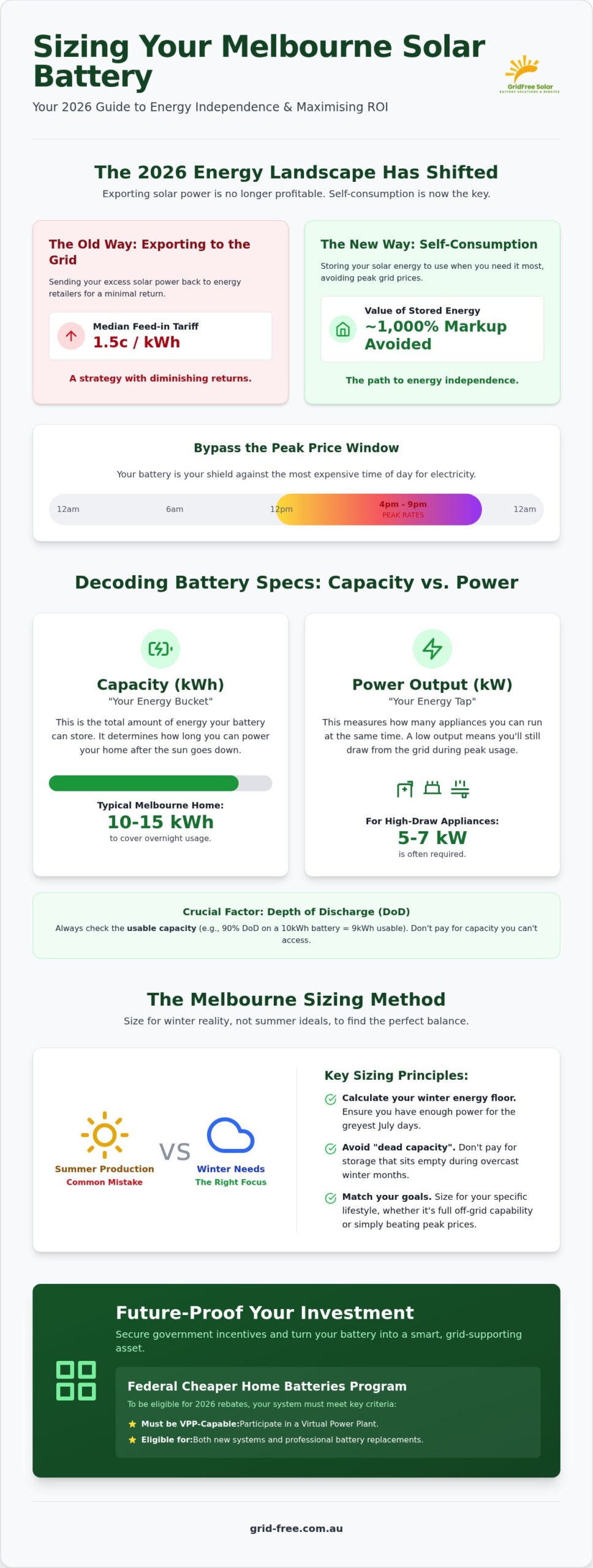
The Victorian energy market reached a tipping point in 2025. Exporting power is no longer a viable financial strategy. With median feed-in tariffs now sitting at a negligible 1.5 cents per kilowatt-hour, your roof is effectively donating electricity to multi-billion dollar retailers. To reclaim control, you must shift your perspective. Determining what size solar battery do I need Melbourne starts with acknowledging that your panels are now energy generators for your home, not a revenue stream for the grid.
Precision sizing is your primary tool for financial recovery. If you undersize your system, you’ll remain vulnerable to the brutal 4pm to 9pm peak price window. This is when Melbourne electricity rates are at their highest. Conversely, if you oversize, you’ve invested in “dead capacity” that sits empty during our grey, overcast winter months. You need a system that balances summer abundance with the reality of a Victorian July.
The Shift from Exporting to Self-Consumption
Victorian retailers have aggressively restructured their tariffs in 2026. The financial reward for sending power back to the grid has vanished. Storing your own solar electrons is the only way to protect your household budget. Without adequate storage, you’ll suffer from “solar clipping.” This occurs when your panels produce massive amounts of energy that your home can’t use and your battery can’t hold. Every clipped kilowatt is a lost saving that you’ll eventually have to buy back from the grid at a 1,000% markup.
Melbourne’s Grid Dynamics in 2026
Our local grid is evolving rapidly. Suburbs from Glen Waverley to Werribee are becoming hubs for distributed energy. Understanding how battery storage systems work is essential for any modern homeowner. These units don’t just sit idle. They are active participants in our energy infrastructure. What size solar battery do I need Melbourne depends heavily on your desire to participate in these new markets.
Virtual Power Plants (VPPs) are now a standard requirement for federal rebate eligibility. To claim the Cheaper Home Batteries Program, your system must be VPP-capable. This allows your battery to support grid stability during peak demand while earning you additional credits. A correctly sized battery ensures you have enough energy to power your own evening routine while maintaining the necessary buffer for VPP participation. It’s about turning a simple storage box into an intelligent, income-generating asset for your Victorian home.
Capacity vs. Power Output: Decoding the Technical Specs for Victorian Homes
Understanding technical specifications is the difference between a high-performing asset and an expensive paperweight. When homeowners ask, what size solar battery do I need Melbourne, they often conflate two distinct metrics: capacity and power output. Think of capacity (kWh) as the size of your energy bucket. Power output (kW) is the width of the tap. You need both to be perfectly calibrated to your household’s peak demand to avoid grid reliance.
Depth of Discharge (DoD) is a technicality that many budget installers gloss over. Modern lithium-ion units typically allow for 90% to 100% usage, but older technologies are far more restrictive. When comparing quotes, always calculate the usable capacity rather than the nominal capacity. This ensures your 10kWh investment actually delivers 10kWh of electricity when the sun goes down over Port Phillip Bay.
Understanding Kilowatt-Hours (kWh)
Kilowatt-hours (kWh) represent the total volume of energy stored for later use. For most Victorian families, the overnight baseload includes running the fridge, standby electronics, and evening lighting. This usually requires between 10kWh and 15kWh of storage to see you through until sunrise. If you plan to run heavy heating or cooling overnight, your capacity needs will climb quickly. Ensure your “energy bucket” is large enough to handle your worst-case winter scenario without running dry by midnight.
The Importance of Continuous Power Output
Power output, measured in kilowatts (kW), dictates how many appliances you can run simultaneously. This is your “Melbourne Summer” test. A high-draw split system air conditioner or an induction cooktop can easily pull 5kW to 7kW of power. If your battery’s continuous output is capped at 3kW, the grid will automatically kick in to bridge the gap. This costs you money during the most expensive peak windows of the day.
Continuous power output is also critical during Melbourne’s volatile storm seasons. When the grid fails, your battery must have the grunt to keep your essential circuits alive. You must distinguish between peak output, which covers short bursts for starting motors, and continuous output, which handles sustained performance. If you’re unsure about your specific appliance draw, it’s worth getting a professional energy audit to ensure your hardware matches your lifestyle. A premium system should offer at least 5kW of continuous output to handle a modern Victorian kitchen and cooling system without compromise. Don’t settle for a system that leaves you shivering or sweating because the “tap” is too narrow for your needs.
The Melbourne Calculation: Factoring in Winter Gloom and Peak Usage
Generic averages fail in Victoria. If you base your sizing on a sunny February afternoon, your system will leave you stranded by sunset in July. To answer what size solar battery do I need Melbourne, you must calculate your “Winter Floor.” This is the minimum amount of energy your panels produce during the shortest, cloudiest days of the year. It’s the only metric that ensures true grid independence when Victorian weather turns volatile.
Follow this four-step audit to find your ideal capacity:
- Step 1: Audit your winter energy bills. Locate your highest daily usage between June and August. This represents your “worst-case” scenario.
- Step 2: Calculate your evening peak draw. Focus specifically on the 4pm to bedtime window. This is when solar production hits zero, but your household demand for lighting, cooking, and heating spikes.
- Step 3: Identify your solar harvest floor. On a rainy winter day, a standard 6.6kW solar array might only generate 5kWh to 8kWh of total energy.
- Step 4: Future-proof your investment. Consider if you’ll be adding an electric vehicle or an extra bedroom in the next two years. It’s cheaper to size correctly now than to retrofit later.
The Melbourne Winter Factor
Summer performance is a trap. independence requires surviving 24 hours of low solar generation without relying on the grid. On a grey July day in Melbourne, your panels might only produce a fraction of their summer peak. If your battery is too large, you’ll never fill it during winter, leaving expensive hardware idle. If it’s too small, you’ll be buying peak-rate power from the grid by 6pm. Aim for a battery size that covers your total evening usage while leaving a small buffer for consecutive days of Victorian gloom.
Auditing Your Household Load Profile
Identifying “energy vampires” is essential for accurate sizing. In Victorian winters, heating is the primary drain on your stored power. Families switching from legacy gas ducted heating to modern electric split systems or heat pumps will see a massive surge in battery demand. Don’t guess your usage. Access your smart meter data through your retailer’s portal to get precise, hour-by-hour usage stats. This data eliminates the “fear of the unknown” and ensures you don’t over-invest in capacity you can’t realistically charge during the winter months. Precision in your load profile is the fastest route to a system that pays for itself through sheer efficiency.
Matching Your Battery Size to Your Solar Array and Household Goals
Your storage capacity must align with your generation potential. Installing a massive battery on a small solar array is a recipe for poor ROI. Conversely, a large 10kW system paired with a tiny battery leads to wasted energy and missed savings. When answering what size solar battery do I need Melbourne, you must first audit your roof’s output. Your goals, whether they be financial profit or emergency backup, will dictate the final specification.
A 5kW solar system remains a common entry point for Victorian homes. For these arrays, a 5kWh to 10kWh battery represents the economic sweet spot. It provides enough storage to cover basic evening loads without leaving the battery half-empty during winter. If you’ve upgraded to the 6.6kW standard, you’ll produce enough surplus to justify the 10kWh to 13.5kWh range. For large residential or commercial systems exceeding 10kW, you’re entering 20kWh+ territory. This scale is necessary to manage high-draw machinery or large-scale climate control.
Sizing for Maximum ROI
Efficiency beats ego every time. The “Law of Diminishing Returns” applies heavily to solar storage. While 100% grid independence sounds appealing, 80% is often the most profitable target. The capital required to bridge that final 20% gap rarely pays for itself within the battery’s lifespan. Focus on eliminating the expensive 4pm to 9pm peak window first. You can find more detail on these financial trade-offs in our guide to solar battery cost Australia. Investing in a system that cycles fully most days will always outperform an oversized unit that sits idle.
Sizing for Blackout Protection
Outage protection requires a distinct strategy. If your priority is keeping the lights on during a Melbourne storm, you must identify your “essential circuits.” Running medical equipment, water pumps, or a fridge requires a dedicated reserve capacity that isn’t used for daily cycling. This “backup buffer” effectively reduces your usable daily capacity. You must size up to ensure you have enough energy for both daily savings and emergency security. Don’t compromise on your family’s safety by cutting capacity too fine. Take control of your energy future and request a custom sizing plan tailored to your specific Melbourne household requirements.
Navigating Victorian Rebates and Professional Upgrades for Maximum Savings
The final hurdle isn’t the maths. It’s the paperwork. You’ve identified your winter floor and peak draw. Now, you must secure the funding. In 2026, the rebate landscape has shifted away from state loans toward federal incentives. Understanding what size solar battery do I need Melbourne is the first step toward unlocking these discounts. The federal Cheaper Home Batteries Program offers a substantial 30% discount on eligible systems, provided they are VPP-capable. This incentive is designed to turn your private storage into a grid-stabilising asset.
Professional installation is non-negotiable for Victorian compliance. GridFree Solar acts as your local authority on Victorian grid dynamics. We handle the technical sizing and the administrative burden. Our focus is rebate optimisation. We ensure every kilowatt-hour of capacity you install meets the strict 2026 safety and performance standards. Don’t risk your investment with an unauthorised installer who doesn’t understand the specific requirements of the Victorian Energy Upgrades program or the latest federal guidelines.
Claiming the Victorian Battery Rebate
Eligibility in 2026 is strict but rewarding. To qualify for the federal discount, your battery must range between 5kWh and 100kWh. It must be on the Clean Energy Council’s approved product list. While the Victorian interest-free battery loan is now closed, the federal rebate significantly reduces your total solar system price Victoria. Keep in mind that as of July 1, 2026, the income cap for the Solar Homes PV rebate was reduced to $150,000. Choosing an authorised retailer is the only way to ensure these discounts are applied correctly at the point of sale.
Battery Replacement and System Upgrades
Many Melbourne homes are now entering their second decade of solar ownership. If your early-generation unit is struggling to hold a charge or lacks smart grid integration, it’s time for a professional change. Modern LiFePO4 technology offers superior safety and cycle life compared to legacy lithium-ion variants. Integrating these advanced units into an existing array requires specialist knowledge of inverter compatibility and DC coupling. We specialise in solar battery replacement Melbourne, ensuring your aging system is brought up to modern standards. Upgrading doesn’t just restore your storage; it unlocks 2026-level efficiency and grid independence that older hardware simply cannot match.
Secure Your Energy Future: Take Control of the 2026 Grid
Your path to total grid independence is now clear. Precision sizing is your strongest defence against rising 2026 tariffs and plummeting feed-in rates. You’ve learned that bridging the winter solar floor and matching your peak evening draw are the keys to a system that truly pays for itself. Determining what size solar battery do I need Melbourne is no longer a guessing game. It’s a strategic calculation designed to deliver long-term financial security for your Victorian household.
GridFree Solar provides the local Melbourne expertise required to navigate complex Victorian rebate claims and high-efficiency battery upgrades. We deliver data-backed ROI assessments tailored specifically to current 2026 energy dynamics. Don’t leave your potential savings to chance with generic estimates or outdated hardware. It’s time to lock in your home’s reliability and join the ranks of energy-independent Victorians who are ahead of the curve.
Get a Custom Melbourne Battery Sizing Quote from GridFree Solar and start your journey toward a smarter, more resilient home today. You’ve got the knowledge; now take the action that secures your budget for the decade to come.
Frequently Asked Questions
Is a 10kWh battery enough for a 4-bedroom house in Melbourne?
A 10kWh battery is typically the sweet spot for a standard 4-bedroom Melbourne home. It provides enough capacity to cover essential evening loads like lighting, refrigeration, and entertainment. However, if your household relies on electric split-system heating during winter or features high-draw appliances like induction cooktops, you might require 13.5kWh or more. Determining what size solar battery do I need Melbourne requires a precise audit of your specific peak usage windows.
Can I add a battery to my existing solar system in Victoria?
You can certainly add battery storage to an existing solar array in Victoria. This process, often called AC coupling, involves installing a battery-compatible inverter alongside your current setup. It’s a highly effective way to modernise an older system and eliminate grid reliance. We specialise in battery upgrades and replacements, ensuring your new storage integrates seamlessly with your existing panels to maximise your daily self-consumption and protect against rising electricity tariffs.
What is the best solar battery chemistry for Melbourne’s climate?
Lithium Iron Phosphate (LiFePO4) is the gold standard for Melbourne’s variable climate. Unlike older lithium-ion chemistries, LiFePO4 offers superior thermal stability and a longer cycle life. It handles the shift from scorching summer days to frosty winter nights without significant degradation. This technology ensures your investment remains reliable for over a decade, providing the safety and efficiency required for modern Victorian residential installations. It’s the most pragmatic choice for long-term reliability.
How much does a 13.5kWh solar battery cost in 2026?
The cost of a 13.5kWh system in 2026 depends heavily on your choice of inverter and the complexity of your switchboard. While the federal Cheaper Home Batteries Program provides a 30% discount for eligible VPP-capable units, the total investment varies across different brands and installation requirements. We focus on rebate optimisation to ensure you pay the lowest possible net price. A professional site audit is the only way to get a precise, data-backed quote.
Do I need a bigger battery if I have an Electric Vehicle (EV)?
Charging an Electric Vehicle (EV) overnight significantly increases your storage requirements. A standard EV battery holds between 60kWh and 100kWh, which is far larger than most home storage units. If you intend to charge exclusively from your solar reserves at night, you’ll need a much larger residential battery array. Most homeowners find it more efficient to use a standard battery for household loads and charge their EV during peak solar generation hours instead.
What happens to my solar battery during a Melbourne power outage?
Your battery will only provide power during an outage if it has been configured with blackout protection or islanding capabilities. Standard systems without this feature will shut down for safety reasons when the grid fails. To maintain power in suburbs like Frankston or Ringwood during storms, you must specify essential circuits for backup. This ensures your fridge and lights stay on while the rest of the grid remains dark. It’s a vital feature for local reliability.
Are there still solar battery rebates available in Victoria for 2026?
Yes, significant incentives remain active for Melbourne homeowners in 2026. The primary driver is the federal Cheaper Home Batteries Program, which offers a 30% discount on eligible VPP-capable systems. Additionally, the Victorian Solar Homes Program continues to provide a $1,400 rebate for solar panel installations. While the Victorian interest-free battery loan has closed, these federal incentives offer substantial upfront savings. We provide expert guidance to ensure you meet all current eligibility criteria.
How long will a 5kWh battery power my home during the night?
A 5kWh battery generally powers a low-demand Melbourne home for four to six hours. This capacity easily covers basic baseloads like a fridge, LED lighting, and phone charging. However, it will deplete rapidly if you run high-draw appliances like a dishwasher or clothes dryer. When asking what size solar battery do I need Melbourne, consider that 5kWh is often better suited as a supplementary unit for smaller households rather than a total grid-independence solution.