
Stop letting unpredictable peak demand charges from United Energy or Jemena dictate your quarterly margins. In 2026, the goal isn’t just to install panels; it’s to master your energy profile. With the Small-scale Renewable Energy Scheme expanding to 1MW systems this October, the commercial solar installation cost Melbourne enterprises prepare for has shifted from a sunk cost to a high-velocity ROI engine.
It’s frustrating to navigate the technical gap between STCs and LGCs while worrying about installer reliability. You need a solution that works as hard as your business does. We’ll show you how to leverage the 30% federal battery discount and the VEU program to maximise your energy independence. This guide breaks down the 2026 strategy for industrial-scale storage and explains why waiting any longer means missing the most aggressive incentives in Victorian history. We’ll explore how to navigate the administrative landscape with confidence and ensure your next capital project delivers immediate operational relief.
Key Takeaways
- Neutralise peak demand. Learn how integrated storage transforms solar from a daytime-only benefit into a 24/7 energy management tool.
- Optimise your capital expenditure. Utilise the 2026 SRES expansion to 1MW to significantly lower the commercial solar installation cost Melbourne businesses encounter.
- Master regulatory transitions. Navigate the technical gap between STCs and LGCs to secure the most lucrative incentives for your project.
- Ensure technical precision. Follow a rigorous installation roadmap, from load profile mapping to structural engineering, for a high-performance asset.
- Achieve grid independence. Implement the “Total Grid Independence” philosophy to insulate your business from Melbourne’s volatile energy market.
The Business Case for Commercial Solar in Melbourne (2026)
Melbourne’s commercial energy landscape has reached a critical tipping point in 2026. Network distributors like United Energy and Jemena have intensified peak demand charges, transforming traditional electricity bills into a primary threat to operational margins. Relying on the grid during peak windows is no longer just expensive; it’s a strategic liability. Businesses across Melbourne’s industrial and commercial sectors are feeling the squeeze as network charges now comprise a significant portion of the total utility bill. The volatility of the wholesale market means that price spikes are no longer occasional events but frequent disruptions.
Solar-only installations are rapidly becoming obsolete for modern Victorian enterprises. If your facility operates between 4pm and 9pm, panels alone won’t protect your bottom line. Advanced photovoltaic (PV) systems must now be paired with intelligent storage to capture daytime generation for evening use. This shift is driven by the urgent need to bypass the most expensive tariff brackets. Beyond the immediate savings, achieving Net Zero is now a commercial necessity rather than a corporate social responsibility goal. Many Melbourne commercial leases now require transparent carbon reporting, making solar an essential asset for tenant retention and asset valuation.
Hedging Against Melbourne’s Rising Network Charges
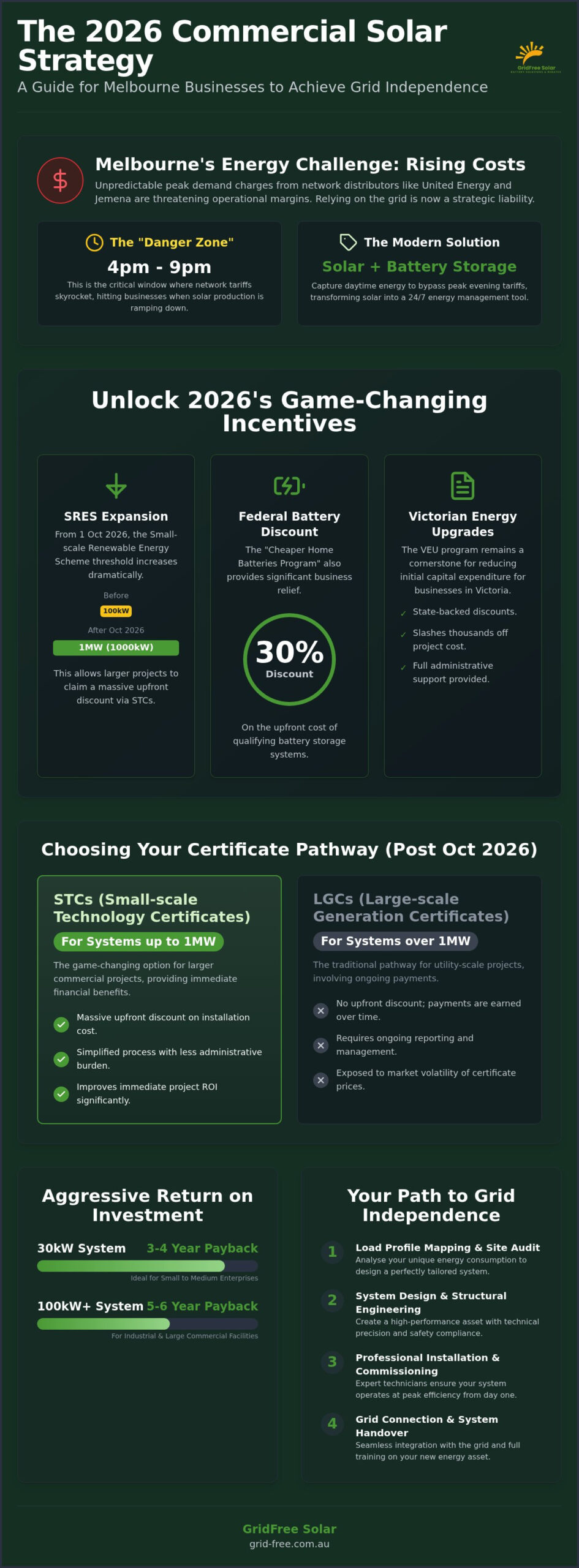
Peak demand windows typically strike when solar production is ramping down. For Melbourne businesses, the 4pm to 9pm window is the danger zone where tariffs skyrocket. By integrating high-capacity batteries, you can shift your load away from these premium periods. This isn’t just about saving cents. It’s about capping your exposure to a volatile grid and ensuring your 2026 operational budget remains predictable.
The ROI of Energy Independence in Victoria
The cost of inaction is the hidden line item on your balance sheet. Every month you delay, you’re effectively subsidising the grid’s inefficiency with your profits. While the commercial solar installation cost Melbourne businesses face varies by scale, the 2026 payback periods remain aggressive due to rising wholesale rates. Industry averages suggest a 30kW system can achieve ROI in 3 to 4 years, while 100kW+ systems typically see full payback within 5 to 6 years. Energy independence is the strategic ability to shield your operations from the wholesale market’s volatility through onsite generation and storage. Protecting your business from grid instability in Melbourne’s industrial zones ensures you stay operational when competitors are left in the dark.
Navigating Melbournes Commercial Solar Incentives and Rebates
Efficiency is the new currency for Victorian enterprises. While the previous Victorian Solar for Business Program has reached its conclusion, the 2026 incentive landscape is actually more robust for larger operations. The Victorian Energy Upgrades (VEU) program remains a cornerstone for reducing initial capital expenditure. By leveraging these state-backed discounts, the commercial solar installation cost Melbourne businesses encounter can be slashed by thousands of dollars before the first panel is even mounted. Our team manages the entire administrative lifecycle of certificate creation. We ensure your internal teams don’t get bogged down in bureaucratic red tape.
Tax incentives provide another layer of financial relief. The instant asset write-off provisions for 2026 allow many businesses to fully depreciate renewable energy equipment in the first year. This creates an immediate cash flow benefit that significantly accelerates your project’s break-even point. When combined with federal certificates, the net investment becomes far more manageable for SMEs and industrial giants alike.
STCs vs LGCs: Which One Fits Your Project?
The 100kW threshold used to be the hard line for incentive pathways. However, a major expansion to the Small-scale Renewable Energy Scheme (SRES) takes effect on 1 October 2026. Solar PV systems up to 1MW will now be eligible for Small-scale Technology Certificates (STCs). This is a game-changer. It allows larger projects to claim a massive upfront discount rather than dealing with the ongoing reporting and price volatility of Large-scale Generation Certificates (LGCs). For a 150kW warehouse installation, this shift can improve the immediate ROI by tens of thousands of dollars compared to the old LGC model. Speak to our experts to optimise your commercial energy strategy and secure the best certificate pathway.
Maximising the Victorian Battery Rebate for Business
Storage is no longer an optional luxury. The federal “Cheaper Home Batteries Program”, active as of July 2025, provides approximately 30% off the upfront cost for eligible batteries between 5kWh and 100kWh. This applies to small businesses as well as households. In Melbourne’s metropolitan areas, combining this federal discount with VEU incentives creates a formidable energy management asset. You can find the full eligibility criteria in our Victorian Battery Rebate Guide. Integrated solar and battery solutions are now the definitive standard for achieving total grid independence.
Commercial Battery Storage: Scaling for 2026 Demand
Storage is the definitive missing link in the Melbourne commercial energy puzzle. In 2026, a solar-only system is a half-measure that leaves your business exposed to the grid’s most aggressive pricing structures. High-capacity battery storage allows you to capture surplus generation and deploy it when the market is most expensive. While the initial commercial solar installation cost Melbourne businesses evaluate might seem higher with storage, the compressed payback period tells a different story. Lithium Iron Phosphate (LiFePO4) has become the undisputed industrial standard for these systems. Its superior thermal stability and 10,000-cycle lifespan ensure your investment remains a high-performance asset for over a decade.
The Clean Energy Council has highlighted that the integration of storage is what truly unlocks the potential of large-scale commercial solar. By moving beyond simple generation, Victorian enterprises are transforming from passive consumers into active market participants. This transition is essential for any business looking to insulate itself from the volatility of the National Electricity Market.
Peak Shaving: The CFO’s Secret Weapon
Demand charges are the silent killers of commercial profitability. These fees are based on the highest point of energy usage during a billing period, often occurring when heavy machinery starts up or climate control systems ramp up in the late afternoon. Batteries provide a technical solution through peak shaving. By discharging stored energy during these spikes, the battery ‘shaves’ the top off your usage profile. Data indicates that a properly sized 50kWh battery can reduce demand charges by up to 40%. This isn’t just about saving energy; it’s about strategic cost suppression. For a deeper breakdown of the financial landscape, see our guide on Solar Battery Cost Australia 2026.
Participating in Melbourne VPPs
Virtual Power Plants (VPPs) have matured into a legitimate revenue stream for Melbourne businesses. By joining a VPP, your battery becomes part of a distributed network that supports the Victorian grid during periods of high stress. In exchange, you receive credits or direct payments, effectively subsidising the commercial solar installation cost Melbourne projects require. This participation doesn’t compromise your onsite needs. Modern software ensures your business continuity is prioritised, providing critical backup during grid outages. For Melbourne offices, this means the lights stay on and servers remain active when the local network falters. You’re no longer just buying a battery; you’re investing in an intelligent, revenue-generating insurance policy.
The Installation Roadmap: From Site Audit to Grid Connection
A high-performance commercial project is a precision engineering exercise. It isn’t merely about mounting panels; it’s about integrating a sophisticated power plant into your existing infrastructure. We start with a comprehensive energy audit and load profile mapping. We analyse your 15-minute interval data to understand exactly when your business draws power. This ensures your system is optimised for self-consumption. Step 2 requires structural engineering certification. For many Melbourne commercial rooftops, especially older industrial sites, verifying load-bearing capacity is a legal and safety mandate. This level of due diligence ensures that the commercial solar installation cost Melbourne businesses invest is protected by structural integrity and compliance.
Once the engineering is verified, we move to Step 3: navigating the DNSP grid-connection approvals. This is the most complex administrative phase. Finally, Step 4 is the professional installation and commissioning. We focus on technical precision, ensuring every string, inverter, and battery rack is calibrated for maximum yield. Our commissioning process includes rigorous testing to verify that your system performs exactly as modelled during the audit phase.
Melbourne DNSP Approvals: Managing the Red Tape
Grid connection in Victoria is a fragmented landscape. Citipower, Powercor, United Energy, and Jemena each maintain their own technical rulebooks. Citipower’s inner-city requirements for secondary protection often vary from the standards set by Powercor in the western suburbs. Securing pre-approval is non-negotiable. You shouldn’t purchase hardware until the network provider confirms your export capacity. We fast-track these applications through established local channels. We act as your authoritative guide, ensuring your project meets all Victorian Service and Installation Rules without unnecessary back-and-forth. This expert handling is why we are considered the benchmark for professional solar installation Melbourne businesses trust.
Minimising Business Disruption During Install
Your business doesn’t stop, and neither should your production. We specialise in staged installations within active retail and industrial hubs. By segmenting the project, we ensure that electrical isolation only affects specific zones at scheduled times. Safety protocols are the foundation of our work. Our teams are fully certified for working at heights and adhere to strict OHS standards for commercial sites. We coordinate directly with your facility managers to align our schedule with your operational lulls. This ensures a seamless transition to onsite generation with zero impact on your bottom line. Consult with our engineering team to design a low-impact installation strategy for your facility.
Why GridFree Solar is Melbournes Trusted Commercial Partner
GridFree Solar operates on a single, uncompromising principle: Total Grid Independence. We don’t just bolt hardware to your roof; we architect high-performance energy ecosystems. Our team provides direct access to CEC-accredited commercial solar designers and engineers who specialise in complex industrial systems. This technical depth is essential when evaluating the commercial solar installation cost Melbourne enterprises must justify. We ensure every dollar of your capital expenditure is mapped to a specific ROI milestone. Whether you require high-capacity battery upgrades or the replacement of ageing industrial infrastructure, we deliver the precision required for high-stakes commercial environments. We act as your proactive partner, taking the complexity out of technical transitions.
Our relationship begins at commissioning, not ends there. We provide ongoing performance monitoring and comprehensive operations and maintenance (O&M) support. This ensures your system continues to suppress overheads and maximise yield long after the initial install. We monitor your system’s health in real-time, identifying potential inefficiencies before they impact your bottom line. This commitment to long-term reliability is what differentiates a specialist from a generic installer. We understand that for a Melbourne business, energy is a critical input that requires constant, professional oversight.
The GridFree Solar Advantage: Integrated Solutions
Every project we design is battery-ready by default. We’ve seen too many Melbourne businesses stranded with legacy systems that cannot scale or integrate with modern storage. Our integrated approach focuses on Energy Storage Solutions Melbourne industrial leaders rely on for grid stability. We’ve built a proven track record across Melbourne’s SMEs and manufacturing facilities by understanding the specific load profiles of local commerce. This localised expertise allows us to predict performance with a degree of accuracy that national providers simply cannot match. We don’t offer one-size-fits-all packages; we deliver bespoke engineering tailored to your facility’s unique footprint.
Future-Proofing Your Melbourne Business
Energy regulations in Victoria shift rapidly, and we stay ahead of these changes so you don’t have to. Our scalable designs ensure that as your business grows, your energy capacity can expand without a full system overhaul. We navigate the evolving rebate landscape and the technical requirements of the Melbourne grid daily, protecting your investment from technical obsolescence. Don’t leave your energy strategy to chance while your competitors are already locking in their 2026 margins. Request a 2026 Commercial Solar ROI Audit for your Melbourne business today. Secure your operational future. Achieve total independence. Partner with the specialists who understand the true commercial solar installation cost Melbourne projects demand for long-term success.
Secure Your Operational Edge in 2026
Melbourne’s energy market doesn’t reward hesitation. The shift toward integrated solar and storage is no longer a luxury; it’s a fundamental requirement for protecting your margins against volatile peak demand charges. By leveraging the 1MW SRES expansion and federal battery incentives, the commercial solar installation cost Melbourne businesses face has never been more effectively offset by immediate ROI. You’ve seen how precise engineering and expert DNSP navigation turn a technical challenge into a high-performance asset. It’s time to stop paying for grid inefficiency and start investing in your own resilience.
GridFree Solar brings CEC Accredited Commercial Solar Designers and specialised expertise in Melbourne DNSP grid-connections to every project. We manage the complexity of 100kW+ LGC management so you can focus on scaling your operations without energy-related stress. Future-Proof Your Business: Get a Custom Commercial Solar Quote. Take control of your energy future today and build the sustainable foundation your business deserves.
Frequently Asked Questions
What is the typical ROI for commercial solar in Melbourne in 2026?
Typical ROI for a 30kW system ranges from 3 to 4 years, while larger 100kW+ installations usually see full payback within 5 to 6 years. This timeline is accelerated by rising wholesale energy rates and the 2026 expansion of the Small-scale Technology Certificate (STC) scheme. Your specific payback period depends on your load profile and how effectively you shift usage to daylight hours or utilise high-capacity battery storage to avoid peak demand windows.
How much roof space is required for a 100kW commercial solar system?
A 100kW commercial solar system generally requires between 500 and 600 square metres of clear, unshaded roof space. This estimate accounts for modern high-efficiency panels and the necessary spacing for maintenance access and structural attachments. We conduct a detailed structural engineering audit to ensure your roof can support the static and wind loads associated with an installation of this magnitude, prioritising safety and long-term asset reliability for your facility.
Can I install commercial solar on a leased building in Melbourne?
Yes, you can install solar on a leased commercial property through various arrangements like Power Purchase Agreements (PPAs) or environmental upgrade finance. Many Melbourne landlords now view solar as a critical asset for tenant retention and property valuation. We recommend reviewing your lease terms and discussing capital improvement clauses with your legal advisor to determine the best financial structure for your business and ensure a mutually beneficial outcome for both parties.
What is the difference between STCs and LGCs for my business?
STCs provide an upfront discount on your system cost, while LGCs offer ongoing revenue based on generation. From 1 October 2026, the SRES expansion allows systems up to 1MW to claim STCs. This change significantly lowers the commercial solar installation cost Melbourne businesses face by providing immediate financial relief. LGCs remain an option for larger industrial projects seeking long-term environmental credits or recurring income through the Large-scale Renewable Energy Target framework.
How long does the DNSP approval process take in Victoria?
The DNSP approval process in Victoria typically takes between 4 and 8 weeks, depending on the complexity of your grid connection. Network providers like United Energy or Citipower require technical assessments to ensure local grid stability isn’t compromised. We manage the entire application lifecycle, leveraging our established local channels to fast-track approvals and avoid common administrative bottlenecks that can delay your commissioning date. This proactive approach ensures your project stays on schedule and budget.
Do commercial solar panels require regular maintenance in Melbourne?
Commercial solar panels are low-maintenance but require periodic professional inspections to ensure peak performance. While we don’t sell cleaning services, we advise monitoring your system’s output through integrated software to identify any significant drops in yield. Regular electrical testing of inverters and battery racks is essential for safety compliance and maintaining your manufacturer warranties over the system’s 25-year lifespan. This ensures your investment continues to deliver the expected energy savings and operational reliability.
Can a commercial battery storage system completely eliminate my demand charges?
A commercial battery storage system can significantly reduce demand charges through peak shaving, but total elimination depends on your specific load spikes. By discharging stored energy during high-usage periods, batteries cap the peak demand recorded by your meter. When combined with a properly sized solar array, this strategy suppresses the most expensive components of your utility bill. It provides essential backup during grid outages, ensuring your Melbourne office or facility maintains critical business continuity.
Is there an instant asset write-off for solar in 2026?
Yes, the 2026 tax provisions allow eligible businesses to utilise instant asset write-off schemes for renewable energy equipment. This allows you to fully depreciate the cost of your solar and battery hardware in the first year, providing a massive cash flow benefit. It effectively reduces the net commercial solar installation cost Melbourne enterprises encounter, making high-capacity systems more accessible for SMEs. We recommend consulting with your tax professional to maximise these benefits for your specific financial situation.