
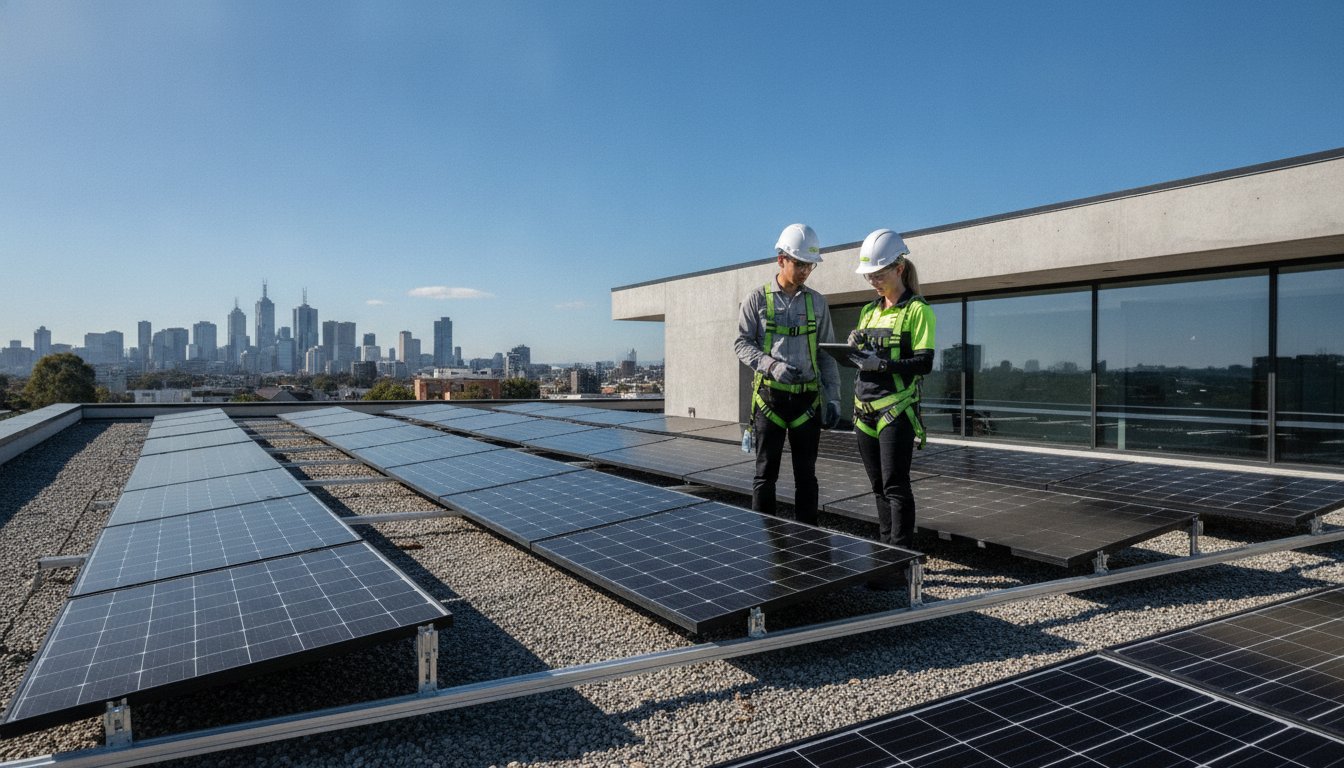
What if your Melbourne flat roof isn’t a structural liability, but your home’s most powerful untapped energy asset? Many homeowners hesitate. They fear roof penetrations lead to leaks. They worry flat panels collect Victorian dust and grime. These are valid concerns. However, with precision engineering, a solar panel installation on flat roof Melbourne homes becomes a high-performance hub that outpaces standard pitched roofs.
You deserve an installation that delivers maximum output without the maintenance headache. We’ll show you how to transform your roof using precision tilt-frames that enable self-cleaning and peak solar harvest. This guide details exactly how to claim your A$1,400 Solar Victoria rebate and the federal STC discounts available in 2026. You’ll discover the technical secrets to a 100% leak-proof finish and why a 25 degree tilt is the “goldilocks” zone for Melbourne’s unique climate. We are moving beyond basic setups to intelligent, high-yield energy solutions that pay for themselves in record time.
Key Takeaways
- Understand why the 10-degree minimum tilt is non-negotiable for preventing dirt buildup and ensuring your panels remain self-cleaning.
- Discover how a precision solar panel installation on flat roof Melbourne projects can maximise energy harvest through Victorian-specific tilt engineering.
- Compare penetrating and ballasted mounting systems to find the most secure, leak-proof solution for your home’s unique structural requirements.
- Learn to navigate the 2026 Solar Victoria rebate process to claim up to A$1,400 while simultaneously maximising your federal STC financial incentives.
- Gain insight into the specific wind load standards required to protect your flat-roof array from Melbourne’s unpredictable coastal weather patterns.
The Reality of Flat Roof Solar in Melbourne
Melbourne’s skyline is evolving. From the minimalist residential designs in South Yarra to the sprawling industrial hubs of Port Melbourne, flat-roof architecture is now the standard for modern Victorian living. This architectural shift makes a solar panel installation on flat roof Melbourne systems more relevant than ever. While some installers avoid these “complex” geometries, we view them as a strategic advantage for the savvy homeowner.
Don’t be fooled by the terminology. Most Victorian flat roofs aren’t strictly horizontal; they feature a subtle pitch of 1 to 5 degrees to manage runoff. This slight incline serves as the foundation for high-performance engineering. Unlike pitched roofs that lock you into a fixed orientation, a flat roof offers a blank canvas. You aren’t at the mercy of your home’s original alignment. You can orient your panels toward true north, regardless of where your property line sits. This flexibility is vital for maximising ROI in a city famous for its “Four Seasons in One Day” volatility.
Melbourne Weather and Flat Roof Durability
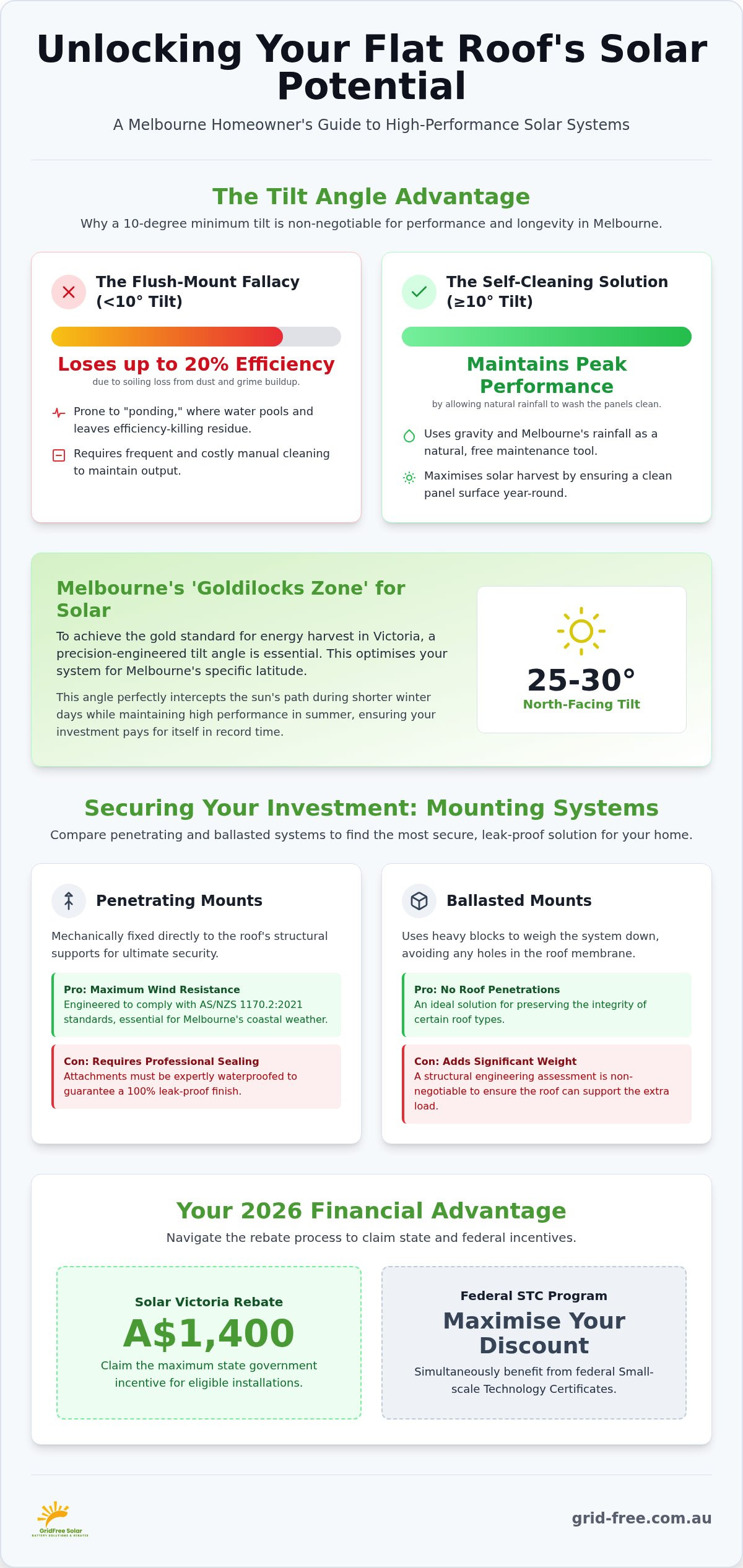
Melbourne weather demands respect. Coastal suburbs like Brighton and St Kilda face intense wind loads that can lift poorly secured arrays. According to AS/NZS 1170.2:2021, installations must comply with site-specific wind actions, particularly near Port Phillip Bay. Drainage is the ultimate priority. Without a 10 to 15 degree minimum tilt, water pooling leads to dirt buildup and potential membrane damage. Modern 2026 panel technology is engineered to survive. Toughened glass and advanced photovoltaic mounting systems ensure your investment resists the occasional Victorian hail storm while maintaining peak efficiency.
Commercial vs. Residential Flat Roofs
Scaling solar requires a nuanced approach. Inner-city terraces with limited roof space need high-density, high-efficiency layouts. Conversely, large-scale commercial solar installation Melbourne projects, such as those on Port Melbourne warehouses, often utilise specialised racking to distribute weight across broader structural spans. For older Melbourne buildings, a structural engineering assessment is a non-negotiable safety requirement. We ensure the roof’s integrity supports the added load of the array and mounting hardware without compromising the building’s lifespan.
Tilt Frames vs. Flush Mounting: Maximising Melbourne Sun
Flush mounting on a flat roof is a compromise you don’t need to make. While it might appear aesthetically “cleaner” to lay panels parallel to the roofline, this approach often leads to a maintenance disaster. The 10-Degree Rule is the industry benchmark for a reason. Any solar panel installation on flat roof Melbourne systems must incorporate a minimum tilt of 10 to 15 degrees to facilitate basic drainage. Without this incline, rainwater pools in the corners of the panel frames. This creates “ponding,” where water evaporates and leaves behind a thick crust of Victorian dust and grime.
A flat roof is a strategic advantage because it grants you total orientation freedom. On a standard pitched roof, you’re forced to accept whatever direction the builder chose. On a flat surface, we treat the roof as a blank canvas. We can orient your array toward true North to capture peak midday sun or design an East-West split to provide consistent power throughout the entire day. This flexibility ensures your system isn’t just generating power; it’s generating power when you actually need it. When planning your system, remember that the Victorian Government’s Solar Homes Program provides significant financial support for these high-efficiency configurations, making the upgrade to precision tilt frames even more accessible.
The Self-Cleaning Advantage
Rain is your best maintenance tool, provided you give it gravity to work with. At a 10 to 15 degree angle, standard Melbourne rainfall effectively clears dust and debris from the glass surface. Flush-mounted panels that sit flat lose up to 20% of their efficiency within the first year due to persistent grime buildup. Soiling loss in Melbourne describes the reduction in photovoltaic output caused by the accumulation of atmospheric pollutants and dust, which can sap up to one-fifth of your system’s potential if panels lack sufficient tilt for rain-driven cleaning. By investing in tilt frames, you eliminate the need for monthly manual scrubbing.
Optimising for Melbourne Latitude
To achieve the “Gold Standard” for energy harvest in Victoria, a 30-degree North-facing tilt is ideal. This angle perfectly intercepts the sun’s path during our shorter winter days while maintaining high performance in summer. However, we often recommend a 15 to 20 degree tilt for residential properties to balance peak output with wind resistance and visual impact. An East-West “split” array is another powerful option for flat roofs. This layout captures the morning and afternoon sun, which is perfect for households that use most of their energy before and after work. Our specialists can design a custom tilt array that matches your home’s energy profile and structural limits.
Penetration vs. Ballasted Racking: Securing Your Investment
Securing an array on a flat surface presents a unique engineering challenge. Because we recommend tilt frames for maximum energy output, your panels essentially act as sails. They catch the wind. Without precision racking, the “uplift” forces during a Melbourne storm can be catastrophic. A professional solar panel installation on flat roof Melbourne project must choose between two primary methods: penetrating mounts or ballasted systems. Each has specific applications based on your roof’s material and structural capacity.
Penetrating mounts are the industry standard for timber-framed Victorian homes. This method involves bolting the racking directly into the rafters. It provides the highest level of security against high wind speeds. However, many homeowners fear these penetrations cause leaks. This is a myth when handled by specialists. We use industrial-grade flashing and chemically resistant sealants to ensure the roof membrane remains completely watertight. If your property features a concrete roof, a ballasted system might be the smarter choice. These systems use heavy weights to hold the array in place without a single screw entering the structure. It preserves the roof’s integrity while meeting all safety standards.
The Anatomy of a Leak-Proof Penetration
Zero leaks are our non-negotiable standard. Professional solar panel installation Melbourne teams must possess specific roof-plumbing skills that general electricians often lack. We utilise high-grade aluminium flashing that integrates seamlessly with your existing roof material. Every penetration is double-sealed with UV-stable industrial sealants designed for the harsh Victorian sun. Using inferior materials or DIY methods can void your home insurance and roof warranty. We provide a full structural guarantee because our waterproofing protocols exceed the minimum requirements for Melbourne’s intense winter downpours.
Wind Loads and Ballasted Systems
Melbourne’s wind region classifications are strict. If you live near the coast, your system faces constant pressure from Port Phillip Bay gusts. All our solar panel installation on flat roof Melbourne projects strictly follow the AS/NZS 1170.2:2021 wind load standards. This ensures your racking can withstand site-specific conditions without shifting. We refer to the latest Victorian Government installation guidance to ensure every ballasted system is weighted correctly. We calculate the exact “uplift” potential of your specific tilt angle. This data-backed approach protects your investment and ensures your system remains stationary for the next 25 years.
Victorian Rebates and ROI for Flat Roof Systems
A professional solar panel installation on flat roof Melbourne project is more than a home upgrade. It’s a high-yield financial investment. In 2026, the Victorian Government continues to incentivise transition through the Solar Homes Program. This makes the leap to premium tilt-frame technology significantly more affordable. While the upfront cost of tilt frames is higher than basic flush mounting, the long-term ROI is vastly superior. You aren’t just buying hardware; you’re buying decades of peak energy production.
The financial logic is simple. Tilted panels generate more electricity per square metre than flat ones, especially during Melbourne’s overcast winter months. This increased efficiency directly shortens your payback period. Most Melbourne homeowners now see their systems pay for themselves within 3 to 5 years. By choosing a high-performance configuration, you maximise your self-consumption and insulate your household against rising retail electricity prices. This is the smartest way to future-proof your home’s energy economy.
Claiming Your 2026 Solar Victoria Rebate
The 2026 rebate landscape is specific. Eligible owner-occupiers can claim a rebate of up to A$1,400 as a point-of-sale discount. As of July 1, 2026, the household taxable income cap for this program is A$150,000 per year. You can also access an interest-free loan of up to A$1,400, repayable over four years, to further reduce the initial capital required. If you are planning a storage upgrade, the Victorian battery rebate 2024 to 2026 provides additional federal incentives. These programs are designed to work in tandem, but the federal battery discount is scheduled to decrease on January 1, 2027. Immediacy is key to securing the highest possible savings.
ROI: The Real Cost of “Cheap” Flat Installs
Don’t fall for the “cheap” flush-mount trap. Saving a few hundred dollars on mounting hardware creates an “Efficiency Gap” that costs you thousands in lost power over the system’s lifespan. Tilted arrays capture more light and stay cleaner, ensuring you get the most out of your federal Small-scale Technology Certificates (STCs). For a standard 6.6kW system in Melbourne, these STCs provide an upfront discount of approximately A$1,400. When you factor in the solar battery cost Australia homeowners face today, every extra kilowatt-hour your tilted panels produce becomes even more valuable for charging your storage overnight.
Ready to lock in your A$1,400 rebate before the next federal reduction? Consult our rebate specialists today to secure your 2026 funding allocation.
The GridFree Advantage: Custom Flat Roof Engineering
GridFree Solar isn’t just another installer. We are specialists in Melbourne’s complex architectural landscape. A solar panel installation on flat roof Melbourne properties requires more than just standard brackets. It demands a deep understanding of Victorian structural loads and local wind patterns. We don’t guess. We engineer. Every flat-roof project we undertake is backed by our “Zero-Leak” guarantee. This isn’t a marketing slogan. It’s a commitment rooted in our use of advanced roof-plumbing techniques and premium industrial sealants. We protect your home’s integrity while maximising its energy potential.
The regulatory environment in Victoria is shifting. By 2026, compliance with AS/NZS 1170.2:2021 and Solar Victoria standards has become more rigorous. Our local Melbourne teams live and work here. We understand the specific administrative requirements and wind load zones for a solar panel installation on flat roof Melbourne homes from Port Melbourne to the outer suburbs. We handle the complexity so you don’t have to. You get a high-performance energy hub that meets every legal and safety benchmark without the stress of navigating the red tape yourself.
Precision Design and Integrated Storage
Standard designs don’t work for flat roofs. We use custom CAD modelling to map every square centimetre of your roof space. This precision allows us to account for shading, drainage paths, and optimal tilt angles simultaneously. We don’t just stop at panels. We specialise in pairing high-efficiency flat-roof arrays with modern energy storage solutions Melbourne homeowners need for true grid independence. By integrating Tier-1 hardware with intelligent battery management, we ensure your household runs on clean energy long after the sun sets.
Your Next Steps to Energy Independence
Your journey starts with a site-specific assessment. We don’t provide generic quotes over the phone. A GridFree Solar specialist visits your property to evaluate your roof’s condition and structural capacity. We then design a bespoke system that fits your energy profile and budget. During the installation process, our local teams work with surgical precision to ensure a fast, clean, and non-disruptive setup. We handle everything from the initial rebate application to the final grid connection.
The time to act is now. Rebate thresholds and federal incentives are changing. Secure your energy future with a team that understands the Melbourne market inside and out. Request your precision flat-roof solar quote from GridFree Solar today and transform your roof into a high-performance asset.
Secure Your Melbourne Energy Future Today
Your flat roof is an untapped energy asset. By choosing precision tilt frames, you ensure your array remains self-cleaning and high-performing throughout the Victorian winter. You don’t have to choose between structural safety and maximum output. A professional solar panel installation on flat roof Melbourne configuration delivers both, provided it’s backed by local engineering expertise and a zero-leak guarantee.
The financial window is open. With the A$1,400 Solar Victoria rebate and significant federal STC discounts available in 2026, the ROI on a premium system has never been better. Our Melbourne-based expert installers are specialists in navigating these rebate claims to ensure you secure every dollar you’re entitled to. We take the complexity out of the transition, offering you a seamless path to energy independence.
Don’t wait for power prices to climb further. Get a Precision Quote for Your Melbourne Flat Roof and join the thousands of Victorians already harvesting the sun. It’s time to turn your roof into a high-performance energy hub.
Frequently Asked Questions
Do solar panels on a flat roof need tilt frames in Melbourne?
Yes, tilt frames are essential for high-performance Victorian systems. A minimum tilt of 10 to 15 degrees is required to prevent water from pooling and causing “ponding” residue. Without this incline, your panels will collect thick layers of dust and grime, which can reduce your total energy harvest by up to 20%. Tilt frames also allow our engineers to orient your array toward true North for peak efficiency.
Will installing solar panels on my flat roof cause leaks?
No, a professional solar panel installation on flat roof Melbourne project will not compromise your roof’s integrity. We use industrial-grade aluminium flashing and UV-stable sealants to create a 100% watertight barrier around every penetration. Our “Zero-Leak” guarantee ensures that your roof membrane remains protected from the heaviest Melbourne downpours. By using specialist roof-plumbing techniques, we maintain your home’s structural security while upgrading its energy potential.
What is the best angle for solar panels on a flat roof in Victoria?
The “Gold Standard” for year-round energy production in Melbourne is a tilt of 25 to 30 degrees. This specific angle is calculated based on our latitude to capture maximum sunlight during shorter winter days. For many residential properties, a 15-degree tilt is a popular compromise. It provides the necessary self-cleaning benefits and high energy yields while maintaining a lower profile and reducing wind resistance during coastal storms.
Can I get the Solar Victoria rebate for a flat roof installation?
Yes, flat roof configurations are fully eligible for the A$1,400 Solar Victoria rebate. To qualify for a solar panel installation on flat roof Melbourne project in 2026, your combined household taxable income must be under A$150,000. You can also access an interest-free loan of up to A$1,400 to reduce your upfront costs. Our team handles the complex rebate navigation process to ensure you claim your full entitlement.
How do you clean solar panels that are installed flat?
If your panels are installed with a precision tilt of at least 10 degrees, rainfall handles the cleaning for you. Gravity allows water to wash away Victorian dust and atmospheric pollutants naturally. If panels are laid completely horizontal, they require manual scrubbing every few months to remove stubborn grime. We always recommend tilt frames because they eliminate this maintenance burden and ensure your system operates at peak capacity year-round.
Are tilt frames more expensive than standard pitched roof mounts?
Yes, tilt frames involve additional hardware and specialised engineering, which increases the initial capital investment compared to flush mounting. However, the financial upside is undeniable. Tilted arrays produce significantly more power, especially in winter, and avoid the efficiency losses associated with dirt buildup. This increased energy harvest leads to a faster payback period and higher STC yields, making tilt frames the smarter long-term financial choice for Melbourne homeowners.
Can a flat roof handle the weight of solar panels and a battery?
Most modern Melbourne roofs are designed with the structural capacity to handle solar arrays, but a professional assessment is non-negotiable. We use custom CAD modelling to ensure the weight is distributed safely across your roof’s load-bearing points. For battery storage, we typically recommend ground-level installation or reinforced mounting. This ensures your home remains compliant with Victorian safety standards while providing the security of a high-capacity energy storage solution.
What happens to flat roof solar panels during a Melbourne hail storm?
Modern Tier-1 panels are engineered with toughened glass designed to survive extreme Victorian weather. These panels undergo rigorous impact testing to ensure they can withstand significant hail. Interestingly, tilted panels are often safer than flat ones during a storm. Because they sit at an angle, hailstones are more likely to strike with a glancing blow rather than a direct 90-degree impact, which significantly reduces the risk of micro-cracking or glass breakage.