Is your company still at the mercy of volatile peak demand charges? Most Victorian business owners believe the best incentives disappeared when the old state-based grants ended. They are wrong. The 2026 landscape is actually more lucrative for those who know how to navigate the small business solar rebate Victoria landscape by stacking the Victorian Energy Upgrades (VEU) program with federal battery discounts. You shouldn’t have to choose between high upfront costs and rising electricity bills.
Securing these incentives requires precision, not guesswork. We understand the frustration of wading through technical jargon and complex government forms while your overheads continue to climb. This guide provides a definitive roadmap to maximise your ROI. You will learn how to claim the A$336 per kWh battery rebate and leverage VEU incentives for commercial systems up to 200kW. It is time to stop paying for the grid and start owning your energy future with an integrated, future-proofed solution.
Key Takeaways
- Understand the 2026 transition from retired state grants to the integrated VEU and federal battery schemes to avoid missing out on current funding.
- Navigate the small business solar rebate Victoria landscape by stacking federal STCs with Victorian Energy Upgrades for maximum capital cost reduction.
- Identify the correct incentive stream for your facility, comparing Solar Victoria’s small-scale options against VEU pathways for systems up to 200kW.
- Discover how to leverage the A$336 per kWh battery rebate to neutralise volatile peak demand charges and secure long-term energy independence.
- Access a streamlined roadmap from initial energy audit to final approval to eliminate administrative delays and paperwork headaches.
Understanding the 2026 Small Business Solar Rebate Landscape in Victoria
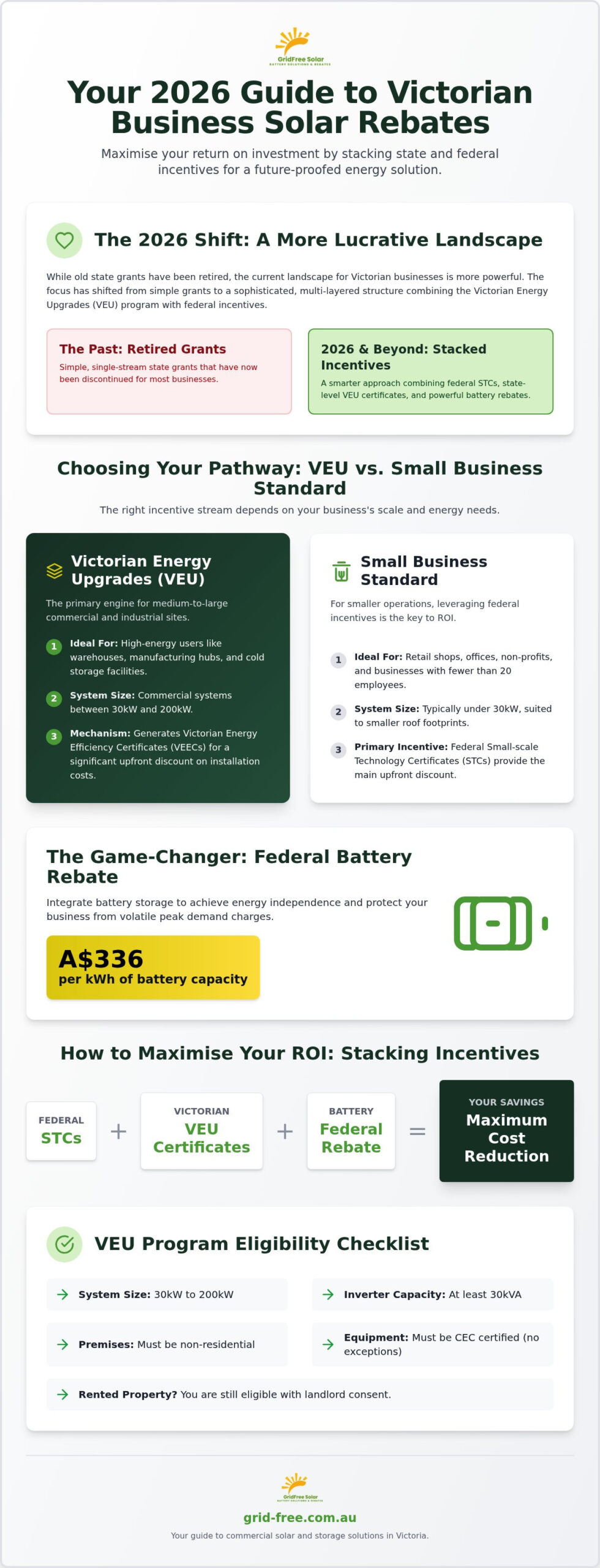
2026 is a line in the sand for Victorian industry. The small business solar rebate Victoria landscape has shifted from simple grants to a sophisticated, multi-layered incentive structure. These government-backed programs are designed to lower the capital cost of renewable energy, making high-performance hardware a viable reality for local enterprises. With the rapid expansion of Solar power in Australia, Victoria has pivoted its strategy to focus on deep energy efficiency through the Victorian Energy Upgrades (VEU) program.
The landscape is now split into two primary streams. Small offices and retail shops typically look toward federal incentives, while medium-to-large commercial sites utilise the VEU program. This year is critical. Many transition schemes that cushioned the market over the last three years have expired, leaving the VEU as the primary engine for commercial growth. To ensure safety and eligibility, every piece of equipment must be certified by the Clean Energy Council (CEC). There are no exceptions. This certification protects your investment and guarantees your system meets rigorous Australian standards.
Who is Eligible for the Victorian Business Solar Rebate?
Eligibility is no longer a guessing game for Melbourne business owners. To qualify for the VEU commercial solar incentive, your system must have an inverter capacity of at least 30kVA and fall between 30kW and 200kW. The installation must occur at a non-residential premises. This includes warehouses, manufacturing hubs, and retail centres. If you operate in a leased or rented facility, you are still eligible. You simply require landlord consent to proceed. This “missing middle” of energy users, requiring systems between 30kW and 200kW, now has the most robust support in the state’s history.
The 2026 Financial Impact: Beyond the Upfront Discount
The real magic happens when you stack incentives. Victorian businesses can combine federal Small-scale Technology Certificates (STCs) with VEU certificates to maximise their ROI. This isn’t just about a lower price tag. It’s about “behind-the-meter” savings. By consuming the energy you generate, you avoid buying power at volatile retail rates. For systems under 30kW, the primary financial incentive in 2026 is the federal STC discount, as the specific Solar Victoria business rebate has been discontinued. This makes the move toward larger, battery-integrated systems more financially attractive than ever before.
VEU vs. Solar Victoria: Choosing the Right Pathway for Your Business
Don’t get caught in the administrative crossfire. Choosing between the Victorian Energy Upgrades (VEU) and Solar Victoria programs determines your total ROI. While both aim to reduce emissions, they target different scales of operation. Understanding the small business solar rebate Victoria framework is the first step toward slashing your overheads. The distinction is simple. One is built for industrial powerhouses; the other supports the local high street.
The VEU Program: Incentives for High-Energy Users
The VEU program is the heavy lifter for industrial sites. It operates through the creation of Victorian Energy Efficiency Certificates (VEECs). These certificates are generated based on the carbon abated by your new system. They are then traded to provide an immediate upfront discount on your installation. For high-energy users like cold storage facilities or food processors, this is a game-changer. These sites often face massive bills; a 150kW system under the VEU can drastically offset those costs. You must work with an accredited provider to access these certificates. It’s the only way to ensure the paperwork is handled correctly and the discount is applied at the point of sale.
Solar Victoria PV Rebate: The Small Business Standard
For smaller retail shops and offices, the Solar for Business Program was traditionally the primary entry point. While the specific state-based grant has transitioned in 2026, the framework remains the standard for businesses with fewer than 20 employees and ABN holders. Non-profit organisations also find support through this stream. If your system is under 30kW, this pathway ensures you aren’t left behind by the move toward larger industrial arrays. It’s about securing a reliable Solar Panel Installation Melbourne that fits a smaller roof footprint while still capturing federal STC benefits.
Can you stack these incentives? Yes. You can combine federal STCs with the VEU program for systems between 30kW and 100kW. This double-layered incentive drastically reduces the payback period. It’s a strategic move that most competitors fail to mention. Don’t leave money on the table by choosing only one stream. If you’re unsure which path fits your facility, consult with a commercial specialist to map out your maximum possible discount. Securing your energy future requires the right partner to handle the complexity while you focus on your bottom line.
Maximising ROI: Why Battery Rebates are the 2026 Game-Changer
Solar panels are only half the equation. For a Melbourne business operating during early morning prep or late-night service, generation often misses the peak demand window. This mismatch leaves you vulnerable to the grid’s highest tariffs. The 2026 shift toward integrated storage has transformed the small business solar rebate Victoria landscape. By adding a battery, you don’t just save energy; you control it. You stop being a passive consumer and start becoming an active energy manager.
The federal Cheaper Home Batteries Program is the catalyst. It provides a significant discount for systems between 5kWh and 100kWh. This incentive allows Victorian enterprises to bridge the gap between daytime generation and high-cost consumption periods. It’s a strategic ROI multiplier. Instead of selling excess power back to the grid for cents, you store it to neutralise peak demand charges. This is the GridFree approach to total energy independence. We focus on systems that pay for themselves by attacking your most expensive energy minutes.
Battery Rebate Eligibility for Victorian Businesses
Not every battery qualifies for the current incentives. To claim the rebate, your system must be Virtual Power Plant (VPP) ready. This ensures your hardware can support the grid during stress events while earning you additional credits. Eligibility is capped at 100kWh of usable capacity. This is ample for most retail and light industrial sites. Understanding the Solar Battery Cost Australia 2026 is essential before committing to an upgrade. It allows you to calculate the precise payback period based on your specific load profile and seasonal usage patterns.
Case Study: Cafe vs. Warehouse ROI
Consider a Melbourne cafe. They face a massive morning peak for coffee machines and refrigeration. A 10kW solar array helps, but a battery captures the midday sun to power the late-afternoon rush. Contrast this with a Braeside warehouse. Their 50kW system generates massive surpluses. Without storage, that energy is wasted. With a battery, they can shift their entire evening security and lighting load to free solar power. The 2026 federal rebate provides up to A$336 per kWh of usable capacity, which can effectively reduce the upfront cost of a 30kWh battery system by approximately 30 per cent. This shift moves the payback period for the entire installation from several years into a much more aggressive timeframe.
How to Claim Your Small Business Solar Rebate: A Step-by-Step Guide
Paperwork shouldn’t stand between your business and lower energy costs. Securing the small business solar rebate Victoria is a technical sequence that demands precision. It’s about compliance, not just forms. Many businesses fail because they treat the application as an afterthought. You need a methodical approach to ensure your hardware is approved and your discount is locked in before the 2026 funding pools are exhausted.
- Step 1: Professional Audit. Conduct a comprehensive energy audit and structural roof assessment. You must understand your load profile and roof integrity before selecting hardware.
- Step 2: Accredited Quote. Obtain a detailed proposal from a CEC-accredited commercial solar retailer like GridFree. We ensure your system design meets the specific 2026 eligibility criteria for both state and federal incentives.
- Step 3: Distributor Pre-approval. Secure permission from your Network Service Provider, such as Citipower, Powercor, or United Energy. This is the most common bottleneck in the process.
- Step 4: Portal Submission. Apply through the Solar Victoria portal or your VEU-accredited provider. This step triggers the reservation of your incentive and confirms your eligibility for the VEU pathway.
- Step 5: Inspection and Generation. Complete the post-installation inspection. This allows for the generation of Victorian Energy Efficiency Certificates (VEECs) and the final application of your discount.
The Importance of Structural Engineering Certificates
Commercial roofs in Victoria are subject to rigorous safety standards. You cannot simply bolt panels to an aging warehouse and hope for the best. Melbourne’s industrial fringes, from Braeside to Dandenong, are home to many older structures that require a formal engineer’s sign-off. This assessment checks the dead load of the panels and the potential wind load on the mounting system. We manage this entire structural audit process for you. It eliminates the risk of roof failure and ensures your installation is fully insured and compliant with Victorian building codes.
Navigating the Grid Connection Process
The Melbourne grid is increasingly congested. Your distributor will decide if you receive a “full-export” or “export-limited” agreement. An export-limited system prevents you from sending excess power back to the grid, which can severely impact your ROI if you don’t have storage. This is where the Victorian Battery Rebate 2024 to 2026 becomes a strategic necessity. It allows you to store the power you aren’t permitted to export. Don’t wait for a distributor’s rejection to plan your storage needs. Contact GridFree for a professional energy audit to map out your grid connection strategy before committing to a system design.
Why GridFree is Victoria’s Leader in Commercial Solar & Storage
Expertise isn’t optional; it’s the foundation of your ROI. At GridFree Solar, we specialise in the technical precision required to dominate the Victorian energy market. We don’t just install panels. We engineer high-performance assets. Our team possesses an intimate understanding of the Melbourne grid and the specific regulatory hurdles of the small business solar rebate Victoria framework. We handle the “paperwork headache” from start to finish, ensuring your application is compliant, accurate, and fast-tracked for approval.
Generic solutions fail commercial enterprises. Every warehouse, factory, and retail centre has a unique load profile that requires a bespoke approach. We provide an end-to-end service that covers everything from initial structural audits to long-term post-installation support. Our focus is on total energy independence. By integrating advanced solar arrays with high-efficiency battery storage, we turn your roof into a revenue-generating powerhouse. You get a system built for the specific demands of the Victorian climate and the 2026 energy landscape.
The GridFree Solar Advantage: Personalised Energy Strategies
We lead with data. Our specialists calculate your exact ROI using 2026 Victorian energy price forecasts, ensuring your investment is backed by hard numbers. We refuse to compromise on quality. This means using only CEC-approved modules and Tier 1 storage solutions. By prioritising high-efficiency LiFePO4 battery upgrades, we provide a safer, longer-lasting alternative to standard lithium-ion units. This commitment to premium hardware is why our Commercial Solar Installation Melbourne services remain the gold standard for businesses seeking long-term reliability. We future-proof your operation against rising grid costs while others are still catching up.
Ready to Slash Your Overheads?
The 2026 landscape is moving fast. Delaying your transition doesn’t just cost you the rebate; it costs you every month of lost savings. The VEU program and federal battery incentives are active now, but funding pools are subject to change as targets are met. It’s time to take control of your overheads. Mastering the small business solar rebate Victoria requires a partner who understands the urgency of your bottom line. Stop being a victim of volatile energy prices and start building a resilient, self-sufficient business. Organise your free commercial solar audit with GridFree Solar today and secure your definitive energy roadmap.
Secure Your Competitive Edge with Strategic Energy Upgrades
Transitioning to high-efficiency energy is no longer a luxury for Victorian industry. It’s a strategic necessity. By mastering the small business solar rebate Victoria landscape, you lock in immediate capital savings while insulating your bottom line from future price shocks. Whether you’re leveraging VEU certificates for a massive warehouse array or stacking federal battery incentives to neutralise peak demand, the 2026 window provides a definitive financial advantage. You shouldn’t let administrative hurdles or grid connection delays stall your momentum.
As CEC-Accredited Commercial Installers, GridFree Solar provides the Melbourne-based local support and specialist expertise in Victorian rebate compliance you need to secure your ROI. We manage the technical heavy lifting and paperwork so you can focus on scaling your operation with intelligent, low-cost power. Our team is ready to help you navigate the complexities of the current incentive landscape and future-proof your facility. Take the first step toward total energy independence today.
Book Your 2026 Commercial Energy Audit with GridFree Solar
Your path to a more profitable, resilient energy future starts now.
Frequently Asked Questions
What is the maximum small business solar rebate available in Victoria for 2026?
Total incentives can exceed A$30,000 for a 100kW system through the federal Small-scale Renewable Energy Scheme (SRES). In 2026, the small business solar rebate Victoria landscape is driven by federal Small-scale Technology Certificates (STCs) and the Victorian Energy Upgrades (VEU) program. These values fluctuate based on market demand and your specific system capacity.
Can my business get a rebate for both solar panels and battery storage?
Yes, you can stack multiple incentives to maximise your ROI. You are eligible to claim federal STCs for your panel installation while simultaneously accessing the federal battery rebate of approximately A$336 per kWh of usable capacity. This dual-stream approach is the most effective way to offset the upfront costs of a complete energy independence solution.
How long does the application process take for Victorian commercial solar rebates?
Approval cycles typically take four to eight weeks from the initial audit. This timeframe includes securing pre-approval from your network distributor, such as Citipower or Powercor, and processing your eligibility through the relevant government portals. Working with an accredited provider ensures your documentation is handled with precision to avoid administrative delays.
Is my business eligible for the rebate if I lease my building in Melbourne?
Tenants operating in Melbourne’s industrial and retail sectors are fully eligible for commercial incentives. You must obtain written consent from your landlord before the installation begins. We frequently assist our clients by providing landlords with the technical data needed to understand how solar upgrades increase the long-term capital value of their commercial property.
What is the difference between the Solar Victoria rebate and the VEU program?
The VEU program is the primary pathway for commercial systems between 30kW and 200kW. Solar Victoria’s programs have historically focused on smaller, sub-30kW installations. For the majority of industrial sites in Victoria, the VEU program offers a more robust financial return through the creation and sale of Victorian Energy Efficiency Certificates (VEECs).
Do I need to upgrade my switchboard to qualify for the Victorian solar rebate?
A switchboard upgrade is often a technical necessity for commercial-grade installations. While the rebate itself applies to the solar hardware, your switchboard must meet current Australian safety standards to handle bidirectional power flow. An upgrade ensures your system operates at peak efficiency and remains compliant with your distributor’s grid connection requirements.
Are non-profit organisations in Victoria eligible for small business solar incentives?
Non-profit organisations and community centres can access the small business solar rebate Victoria framework. As long as you possess a valid ABN and operate from a non-residential premises, you are eligible for the same federal and state incentives as a for-profit enterprise. This allows non-profits to redirect energy savings back into their core community missions.
What happens to the rebate if I want to expand my solar system later?
You can claim incentives for any new capacity you add to your system in the future. However, you won’t receive a second rebate for the original hardware already installed. It’s almost always more cost-effective to install the maximum possible capacity during the initial phase to avoid redundant engineering, scaffolding, and administrative costs associated with multiple installations.