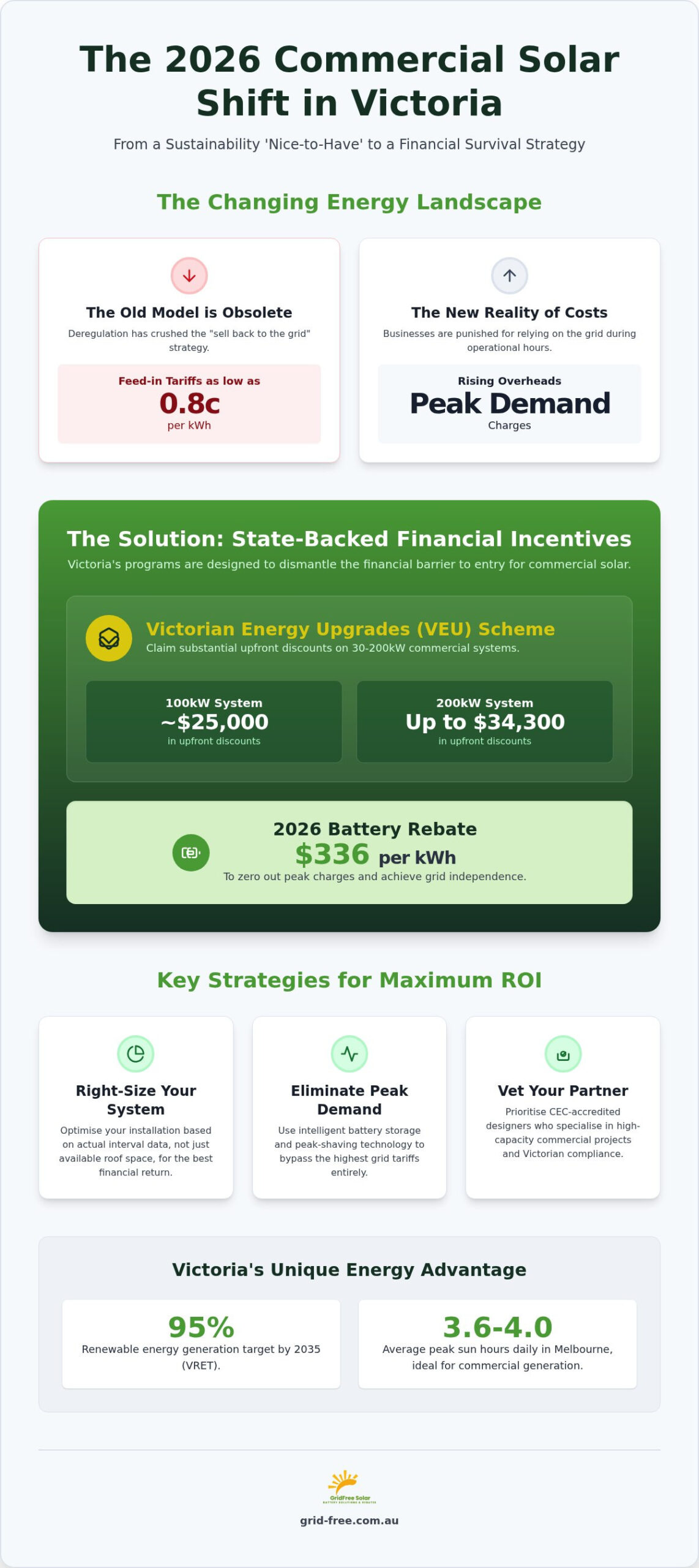
In 2026, Victorian commercial solar is no longer a sustainability “nice-to-have”; it’s a high-yield financial instrument designed to dismantle peak demand charges. Integrating solar energy for business Victoria has shifted from a moral choice to a critical survival strategy. You’ve likely watched energy retailers deregulate feed-in tariffs to as low as 0.8c per kWh while your own operational costs continue to spike. It’s a volatile landscape that demands a smarter, more aggressive approach to power.
You want to slash overheads without the fear of a cut-price installation damaging your asset or failing to deliver. We understand the frustration of navigating the gap between defunct grant schemes and the current VEU incentives. This guide clarifies the path forward. Discover how to claim up to $35,000 in government incentives and use the 2026 battery rebate of $336 per kWh to zero out peak charges. We will show you how to secure your facility’s future, maximise “free money” from the state, and turn your roof into a high-performance power station.
Key Takeaways
- Secure up to $35,000 in VEU incentives by understanding the specific eligibility requirements for 30-200kW commercial systems in 2026.
- Transition from basic solar exports to advanced demand management to effectively combat the deregulation of Victorian feed-in tariffs.
- Optimise your ROI for solar energy for business Victoria by right-sizing your installation based on actual interval data rather than roof space alone.
- Eliminate peak demand charges and achieve grid independence through intelligent battery storage upgrades and peak-shaving technology.
- Vet your installation partner by prioritising CEC-accredited designers who specialise in high-capacity commercial infrastructure and Victorian compliance.
Why Solar Energy for Business in Victoria is a 2026 Priority
Victorian energy prices are a direct threat to your 2026 margins. Stop thinking about solar as an environmental gesture. In 2026, solar energy for business Victoria is a surgical strike against utility overheads. The market has shifted. We’ve moved beyond the era of simple feed-in tariffs where businesses expected a cheque from their retailer. Today, the Essential Services Commission has deregulated minimum rates. With some retailers offering as little as 0.8c per kWh for exports, the old “sell back to the grid” model is dead. The new priority is sophisticated demand management. You must capture, store, and consume every watt you generate to bypass the grid entirely.
Corporate ESG (Environmental, Social, and Governance) mandates have also evolved. It’s no longer just about the top end of town. Victorian supply chains now demand carbon transparency from every partner. If you’re tendering for state government contracts or Tier 1 commercial projects, your energy profile is under the microscope. Transitioning to a high-capacity solar and battery system isn’t just about the bill; it’s about your licence to operate in a decarbonising economy.
The Financial Logic of Commercial Solar
The 2026 tariff structure punishes businesses that rely on the grid during daylight hours. Most Victorian SMEs operate during the exact window when solar production peaks. This creates a perfect hedge. By generating your own power, you avoid the high retail rates and the associated network charges that make up nearly half of your bill. The savings are twofold. You get the direct reduction in kilowatt-hour usage and the indirect benefit of lowering your peak demand threshold. For many businesses, the available tax incentives and depreciation schedules for 2026 make the transition cash-flow positive almost immediately. It’s an asset that pays for itself while protecting you from future market volatility.
Victoria’s Unique Energy Landscape
The growth of Solar power in Australia has reached a tipping point where state-specific targets like the Victorian Renewable Energy Target (VRET) are driving down the cost of entry for local businesses. Victoria is aiming for 95% renewable generation by 2035. This aggressive stance has flooded the market with incentives like the Victorian Energy Upgrades (VEU) scheme. In Melbourne, businesses can expect an average of 3.6 to 4 peak sun hours daily. This yield is more than enough to power heavy machinery, cool large-scale warehouses, or run intensive office hubs. We understand the local regulatory landscape. We know how to navigate the DNSP requirements that often stall projects. This local expertise ensures your system is compliant and connected without the administrative headaches.
- Maximise Self-Consumption: Use your energy where it’s made to avoid 2026 retail spikes.
- ESG Compliance: Meet the rising demands of Victorian supply chains.
- VEU Incentives: Leverage state-backed discounts to lower your upfront capital expenditure.
Navigating Victorian Business Solar Rebates and Incentives
Stop leaving money on the table. In 2026, the financial barrier to entry for solar energy for business Victoria has reached an all-time low thanks to aggressive state and federal backing. The Victorian Energy Upgrades (VEU) program is the current heavyweight. It offers substantial upfront discounts that can reach $34,300 for systems up to 200kW. This isn’t a future promise; it’s a realised discount applied at the point of sale. It’s designed to stimulate the commercial sector which has historically lagged behind residential uptake.
While smaller enterprises still look toward Solar Victoria rebates, larger industrial sites are pivoting toward the VEU. Combining these state-level Victorian Government business solar discounts with federal Small-scale Technology Certificates (STCs) allows for a massive reduction in capital expenditure. For systems exceeding 100kW, you move into Large-scale Generation Certificates (LGCs). These provide ongoing revenue based on your generation. Knowing which threshold your business sits on is the difference between a good ROI and a great one.
The VEU Scheme Explained for Industrial Sites
High-energy sites like food processors and warehouses are the primary beneficiaries of the VEU scheme. The discount is calculated based on the carbon abatement of your system. A 100kW system typically attracts a $25,000 discount, while a 200kW system can secure up to $34,300. To qualify, your system must use components from the Clean Energy Council’s approved list. It’s a safety measure that ensures 2026 installations meet rigorous Victorian standards. We help you select VEU-compliant modules that balance high yield with maximum rebate value, ensuring your roof integrity remains uncompromised.
Claiming the Victorian Battery Rebate
Storage is the final piece of the independence puzzle. The federal Cheaper Home Batteries Program remains available to Victorian businesses in 2026. It provides a discount of approximately $336 per kWh of usable capacity. This is essential for businesses looking to escape peak demand charges. For a detailed breakdown of the application process, view our guide on the Victorian Battery Rebate 2024 to 2026. Fast-tracking your application requires a Virtual Power Plant (VPP) capable battery and an SAA-accredited installer. If you aren’t sure where your site stands, it’s worth having a specialist assess your eligibility for commercial solar solutions before the 2026 quotas fill up.
- VEU Eligibility: Systems between 30kW and 200kW with a minimum 30kVA inverter.
- STC Advantage: Immediate upfront subsidy for systems under 100kW.
- Battery Incentives: Direct discounts for systems between 5kWh and 100kWh capacity.
Sizing and ROI: Optimising Your Commercial System
Efficiency beats scale every time. In 2026, the biggest mistake a facility manager can make is attempting to “fill the roof” without a data-backed strategy. Oversizing a system leads to wasted capital, especially with Victorian feed-in tariffs currently sitting as low as 0.8c per kWh. When planning solar energy for business Victoria, the focus must remain on your interval data. This granular look at your energy consumption patterns allows us to match your kW capacity to your actual daytime load. You don’t want to export power; you want to use it.
The “Missing Middle” represents the most lucrative opportunity for Victorian enterprises. Systems ranging from 30kW to 200kW currently offer the most aggressive return on investment. This range perfectly aligns with the Victorian Energy Upgrades (VEU) threshold, ensuring you capture maximum certificate value. According to a Clean Energy Council analysis, these state-backed incentives have fundamentally changed the payback equation for industrial sites. By targeting this sweet spot, businesses can achieve a sophisticated energy profile that balances upfront cost with long-term grid independence.
Commercial ROI Calculations
Payback periods for Victorian businesses have tightened significantly. In 2026, most well-designed systems achieve full ROI within 3 to 5 years. This speed is driven by the rising value of Victorian Energy Efficiency Certificates (VEECs) and the immediate reduction in peak demand charges. The larger your system, the more certificates you generate, but only if the installation is managed by a specialist who understands the 2026 certificate market. For a deeper look at site-specific benefits, explore our breakdown of Commercial Solar Installation Melbourne to see how local businesses are future-proofing their operations.
Roof Space and Structural Integrity
Your roof is more than just a mounting surface; it’s a structural asset. Commercial solar arrays add significant static and wind loads to a building. You must secure an engineering certificate before a single panel is laid. This is non-negotiable for Victorian compliance. We frequently encounter aged roofing or asbestos in older industrial zones like Campbellfield or Dandenong. These factors must be addressed early to prevent costly delays. Furthermore, navigating Victorian distributors like Powercor, AusNet, or United Energy requires precise technical applications. Grid connection approvals are often the bottleneck of a project, so starting with a compliant, engineered design is the only way to ensure a seamless commissioning process.
- Interval Data: The foundation of every high-performance 2026 system.
- Engineering Certificates: Essential for protecting your asset and meeting insurance requirements.
- DNSP Navigation: Expert management of Powercor and AusNet connection hurdles.
Beating Peak Demand with Commercial Battery Storage
Peak demand charges are the silent killers of Victorian industrial margins. For many facilities, these fees account for up to 50% of the total electricity bill. A single 15-minute spike in usage, perhaps from starting a heavy production line or a commercial cooling system, can lock in a high demand rate for the entire billing period. This is where solar energy for business Victoria reaches its full potential. By integrating high-capacity storage, you stop being a victim of the grid’s pricing volatility. You gain the power to decide when and how you use your energy.
Peak shaving is the strategic core of modern storage. When your site’s energy consumption threatens to cross a specific threshold, the battery system automatically discharges. It “shaves” the top off your demand curve, ensuring your grid draw stays within a lower, cheaper bracket. This isn’t just about saving cents; it’s about fundamentally restructuring your operational costs. In 2026, Virtual Power Plants (VPPs) offer an additional revenue stream. By allowing your battery to support the grid during extreme stress events, your business can earn credits or direct payments, turning a storage asset into a proactive profit centre.
Selecting Commercial Storage
Industrial environments demand more than standard residential batteries. We prioritise LiFePO4 (Lithium Iron Phosphate) technology because it offers superior thermal stability and a longer cycle life under heavy daily use. Safety is paramount when installing storage near critical business infrastructure. Scalability is also a vital consideration. Your 2026 system should be designed with the capacity to expand as your energy needs grow. For a detailed breakdown of current market rates and financial performance, see our guide on Solar Battery Cost Australia 2026.
The GridFree Storage Advantage
We don’t just “bolt on” batteries. Our approach involves customised battery management systems (BMS) calibrated specifically for Victorian time-of-use tariffs. We specialise in integrating storage with existing solar arrays, providing a clear upgrade path for businesses with aging systems that are no longer performing. This ensures your transition to energy independence is seamless and optimised for the local market. Learn more about our regional expertise in our Energy Storage Solutions Melbourne resource. To see how storage can transform your facility’s bottom line, request a commercial storage feasibility study from our local team today.
- Peak Shaving: Cap your grid consumption to avoid month-long demand penalties.
- VPP Revenue: Earn credits by supporting the Victorian grid during peak stress.
- Critical Reliability: Protect essential operations from grid instability and outages.
Implementation: Choosing a Victorian Commercial Solar Partner
Residential experience doesn’t translate to commercial success. A 5kW home system is a world away from a 100kW industrial array. Commercial projects involve complex structural engineering, DNSP negotiations, and high-voltage safety protocols. When investing in solar energy for business Victoria, you need a partner who understands industrial-scale infrastructure. Look for designers accredited by the Clean Energy Council (CEC) specifically for commercial systems. These specialists ensure your array doesn’t just produce power but also maintains the structural integrity of your facility and complies with 2026 Victorian safety standards.
Post-installation support is where most budget installers fail. Solar is a 25-year asset. It requires ongoing operations and maintenance (O&M) to ensure the ROI we discussed earlier stays on track. GridFree Solar is the preferred choice for Melbourne businesses because we remain on-site long after the final panel is bolted down. We monitor performance, manage warranty claims, and ensure your system continues to bypass peak demand charges. Our local presence means we’re in your timezone and on your doorstep when you need us.
The GridFree Professional Process
Our end-to-end approach takes the complexity out of high-capacity installations. We start with a comprehensive energy audit to match your interval data to the right kW capacity. From there, we handle the structural certification and the mountain of paperwork required for the VEU scheme. We ensure you receive every cent of the $34,300 incentive without the administrative headache. For more on our specific methodology, read our guide to Solar Panel Installation Melbourne. We manage the distributors, the regulators, and the installers, so you can focus on running your business.
Next Steps for Your Business
The 2026 VEU certificate allocations are filling fast. To secure your discount, you need to act before the state’s quarterly quotas are reached. The first step is booking a site-specific energy audit. Have your previous 12 months of electricity bills ready; this interval data is the key to our sizing strategy. We’ll use this to build a financial model that shows your exact payback period and projected savings. Don’t wait for another price spike to force your hand. Secure your energy independence now and lock in the 2026 incentives while they’re at their peak.
- Energy Audit: We analyse your bills to find the “Missing Middle” sweet spot.
- Paperwork Management: We handle all VEU and STC applications on your behalf.
- Structural Integrity: Every system includes an engineering certificate for peace of mind.
Secure Your Victorian Energy Future in 2026
The window of opportunity for 2026 is narrow. Victorian businesses that act now lock in the most aggressive state incentives while insulating themselves from retailer price hikes. By right-sizing your system and integrating intelligent storage, you move from being a passive consumer to an active energy manager. You’ve seen the data. The ROI for solar energy for business Victoria is now too compelling to ignore. It’s about protecting your margins and ensuring your facility is ready for the next decade of decarbonisation. Don’t let your competitors be the ones to claim the limited VEU certificate allocations first.
GridFree Solar provides the local Melbourne engineering expertise and VEU rebate navigation required for high-capacity 30kW to 200kW installs. We take the administrative burden off your desk and deliver a high-performance asset designed for the long haul. It’s time to stop paying for peak demand and start generating your own independence. Take the first step toward a more resilient, profitable operation today. Request Your Custom Commercial Solar ROI Audit from GridFree Solar. Your path to energy sovereignty starts with a single site assessment. Let’s build a smarter, more efficient future for your business together.
Frequently Asked Questions
What is the Victorian Energy Upgrades (VEU) program for business?
The Victorian Energy Upgrades (VEU) program is a state-backed initiative that provides significant upfront discounts on energy-efficient technology. In 2026, it serves as the primary financial driver for commercial solar installations between 30kW and 200kW. By generating Victorian Energy Efficiency Certificates (VEECs), the program allows businesses to reduce their capital expenditure immediately at the point of sale. It’s a performance-based scheme designed to reward carbon abatement in the industrial sector.
How much can a Victorian business save with solar in 2026?
Savings are delivered through a combination of upfront incentives and the total elimination of peak demand charges. For a high-capacity 200kW system, the VEU discount can reach $34,300. Beyond this initial saving, most Victorian businesses see an ongoing bill reduction of 50% to 70%. The exact return depends on your interval data and how effectively you shift your heavy energy usage to coincide with peak daylight generation hours.
Does my business qualify for the $34,300 solar discount?
You qualify for the maximum VEU discount if you’re installing a 200kW system on a non-residential site. Eligibility requires a system size between 30kW and 200kW and a minimum inverter capacity of 30kVA. You must also use components from the Clean Energy Council’s approved list and employ an SAA-accredited installer. Only one solar PV system is permitted per National Meter Identifier (NMI) under this specific 2026 incentive structure.
What size solar system does a typical Victorian warehouse need?
Most Victorian warehouses require a system between 30kW and 100kW to offset their standard operational load. However, if your facility includes large-scale refrigeration or intensive machinery, a 200kW system is often the more strategic choice to maximise the VEU incentive. We always determine the final capacity by analysing your previous 12 months of electricity bills to ensure the system is right-sized for your actual consumption patterns.
Can I install a battery without solar for my business?
You can install a standalone battery system to manage load shifting and peak shaving. Even without solar panels, a battery allows you to draw power from the grid during cheaper off-peak windows and discharge it when prices spike. In 2026, these systems remain eligible for federal incentives of approximately $336 per kWh of usable capacity. It’s an effective way to cap demand charges and protect critical business operations from grid instability.
What is the difference between Solar Victoria and the VEU scheme?
Solar Victoria typically manages rebates for small businesses installing systems under 30kW, while the VEU scheme targets the 30kW to 200kW industrial bracket. The VEU discount is scaled based on the carbon reduction of the system, often resulting in much larger financial benefits for high-capacity users. Choosing solar energy for business Victoria through the VEU scheme is the standard path for factories, large retail hubs, and warehouses in 2026.
Do I need a structural engineering certificate for commercial solar?
A structural engineering certificate is a mandatory requirement for every commercial solar installation in Victoria. This certification confirms that your roof can safely support the static weight and wind loads of the solar array. It’s a critical document for maintaining your building insurance and ensuring compliance with local council regulations. We include this engineering assessment as a standard part of our professional implementation process to protect your asset.
How long is the payback period for commercial solar in Melbourne?
Payback periods for Melbourne businesses currently range from 3 to 5 years. This rapid ROI is driven by the deregulation of feed-in tariffs and the availability of the $34,300 VEU discount. Businesses that operate primarily during daylight hours see the fastest returns, as they replace expensive retail electricity with self-generated power. When you factor in the 2026 tax benefits and depreciation, the system often becomes cash-flow positive within the first 36 months.