
On 1 July 2026, thousands of Victorian families will be locked out of solar incentives overnight as income eligibility thresholds plummet from $210,000 to $150,000. Finding a precise solar rebate calculator Victoria homeowners can trust is no longer just about curiosity; it’s about securing your financial future before the window slams shut. You’ve likely felt the frustration of trying to decode the STC phase-out while simultaneously hearing about new federal battery discounts. It’s a complex landscape. The fear of missing out on thousands in savings is a valid concern for any savvy homeowner.
We’ll show you exactly how to stack these incentives for the highest possible return. This guide clarifies the $1,400 Solar Victoria rebate, explains the federal Cheaper Home Batteries program, and highlights the property value caps you must navigate. You’ll discover a simple path to claiming the maximum amount available. This ensures your transition to clean energy is as profitable as it is sustainable. We’ve mapped out the 2026 landscape so you can act with total confidence and precision.
Key Takeaways
- Master the precise 2026 formula behind the solar rebate calculator Victoria homeowners use to determine system size and STC values.
- Confirm your eligibility under the new income thresholds and property value caps to secure your $1,400 state rebate before the July deadline.
- Learn the strategic “stacking” method to combine federal incentives with battery discounts for the highest possible financial return.
- Maximise your long-term ROI by integrating Virtual Power Plant (VPP) credits into your home energy management strategy.
- Ensure technical compliance and secure your funding by leveraging professional installers who manage the entire rebate application process for you.
Understanding the 2026 Solar Rebate Landscape in Victoria
2026 marks a defining moment for Victorian energy independence. The “solar rebate” isn’t a single government payment. It is a strategic combination of federal incentives and state-level support. To get the math right, you need a precise solar rebate calculator Victoria residents can rely on to account for shifting regulations. Understanding how these layers interact is the only way to ensure you aren’t leaving money on the table.
At the federal level, the Small-scale Renewable Energy Scheme (SRES) remains the foundation. Managed by the Clean Energy Regulator, this scheme creates Small-scale Technology Certificates (STCs). These certificates function as a direct, upfront discount on your system’s price. The history and growth of Solar power in Australia show that these incentives have been vital for adoption; however, they are now on a strict countdown. The federal government is phasing this program out entirely by 2030.
In 2026, the “deeming period” for STCs is only five years. This means the total number of certificates your system generates is significantly lower than it was just a few years ago. Every year you wait, the federal discount shrinks. This makes 2026 a critical window for action before the next scheduled reduction in certificate value occurs. It’s a race against a diminishing clock.
Federal STCs: The “Point of Sale” Discount
STCs act as a tradeable commodity. Most homeowners assign the right to these certificates to their installer in exchange for a lower purchase price. This is an upfront discount; it is not a refund you wait months to receive. Because the value of these certificates fluctuates based on market demand, a professional solar rebate calculator Victoria homeowners use must reflect current market pricing. We handle this entire trading process for you, ensuring the value is applied directly to your invoice without any administrative burden on your end.
Victorian State Incentives: The Solar Homes Program
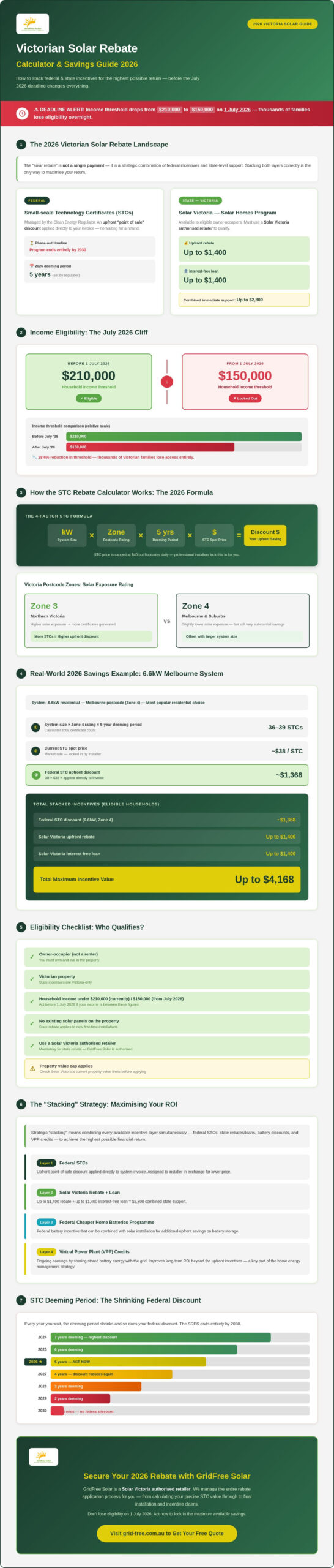
The Solar Victoria program adds another layer of financial relief. Currently, eligible owner-occupiers can access a rebate of up to $1,400 for solar panel installations. Unlike the federal discount, this is a state-managed incentive with strict eligibility criteria. You must use a Solar Victoria authorised retailer to qualify for these funds. Beyond the upfront rebate, the state offers an interest-free loan of up to $1,400. This effectively doubles your immediate financial support. Speed is essential here. The income threshold for these state benefits is set to drop from $210,000 to $150,000 on 1 July 2026, meaning many households will lose eligibility entirely if they don’t act now.
How the Solar Rebate Calculator Victoria Works: The 2026 Math
Precision matters. To understand your potential savings, you must look under the hood of the solar rebate calculator Victoria uses for official assessments. The calculation isn’t a guess. It’s a rigid four-factor formula: System Size (kW) multiplied by Postcode Zone, the Deeming Period, and the current STC Price. If one variable changes, your ROI shifts. Understanding these components allows you to lock in the highest possible discount before the 2027 reduction takes effect.
Postcode zones determine your system’s expected solar yield. Melbourne and its surrounding suburbs are classified as Zone 4. This classification is slightly lower than Northern Victoria’s Zone 3. While Zone 3 regions receive a higher certificate count due to increased solar exposure, Zone 4 residents still access substantial savings. The key is to maximise your system size to offset the lower zone multiplier. Market volatility also plays a role. While STCs are capped at $40, the spot price fluctuates daily. A professional installer locks this in for you, protecting you from sudden market dips.
Step-by-Step Calculation Guide
Start with your system size. A 6.6kW system is currently the most popular residential choice. It offers the best balance between cost and certificate generation. Next, identify your multiplier. For 2026, the deeming period is exactly 5 years. This is a non-negotiable figure set by the federal regulator. Multiply your system size by the Zone 4 rating and then by the 5-year multiplier. This total represents the number of certificates you can trade for an upfront discount.
Real-World 2026 Savings Example
Consider a standard 6.6kW system in a Melbourne postcode. In 2026, this system produces approximately 36 to 39 certificates. At a spot price of $38 per certificate, you receive an immediate discount of roughly $1,368. This is significantly less than the 2025 values. The “deeming drop” is real. It’s a scheduled reduction that happens every January 1st. To secure these 2026 rates, your solar panel installation Melbourne project must be fully installed and registered before the end of the year. If you push the project into 2027, the multiplier drops to 4. You lose hundreds of dollars instantly.
You can further amplify these federal savings by applying for the Victorian Solar Homes Program. Combining these two incentives is the “stacking” strategy that leads to the fastest payback period. If you want to see your specific numbers, our team can provide a tailored site assessment and rebate breakdown today.
Eligibility Check: Who Qualifies for Victorian Solar Incentives?
Before you run the numbers through a solar rebate calculator Victoria homeowners rely on, you must confirm you meet the strict gateway criteria. Eligibility isn’t a permanent fixture of the Victorian landscape. It’s tied to specific financial and property benchmarks that are shifting as we move through 2026. If you don’t tick every box, the most sophisticated system in the world won’t trigger a single dollar in state support.
The most urgent factor for 2026 is the income threshold. Currently, households with a combined taxable income of less than $210,000 qualify for the Solar Homes Program. This is set to drop sharply to $150,000 on 1 July 2026. If your household income sits between these two figures, your window for state level support is closing. You must have your application submitted in full by 5 pm on 30 June 2026 to be assessed under the more generous $210,000 limit. Waiting even a day longer could cost you thousands. To avoid the pitfalls that derail applications at the final hurdle, review the common mistakes applying for solar rebate Victoria that cause instant rejections and lost savings.
Beyond income, several non-negotiable property requirements apply:
- The property must be an existing home, not a new build currently under construction.
- The property’s value must be under $3 million based on the most recent council rates notice.
- You must not have previously received a solar panel rebate or a battery rebate under the Solar Homes Program.
- The installation must be performed by a Solar Victoria authorised retailer and use approved products.
Rebates for Rental Properties
Landlords can also access the $1,400 rebate for rental properties to boost asset value and improve tenant retention. It’s a strategic move for any Victorian property investor. Landlords and tenants often enter a cost sharing model where the tenant pays a portion of the interest free loan repayments using the savings generated on their electricity bills. You’ll need a signed Solar Victoria Landlord-Tenant Agreement and proof of income for either the landlord or the tenant to proceed with the application.
Commercial Solar Incentives
Businesses operate under a different set of rules. While they don’t qualify for the residential Solar Victoria rebate, commercial entities can claim Small-scale Technology Certificates (STCs) for systems up to 100kW. This provides a massive upfront reduction in capital expenditure. For Victorian business owners, the instant asset write-off remains a powerful tool to accelerate ROI. If you’re looking to scale your operations, check our guide on commercial solar installation Melbourne to see how these incentives apply to larger arrays and complex energy profiles.
Maximising Your ROI: Stacking Rebates with VPPs and Batteries
Generating power is only half the battle in 2026. With Victorian minimum feed-in tariffs now deregulated and potentially hitting 0.00 c/kWh, exporting energy to the grid is a losing game. To achieve true energy independence, you must transition from a simple generator to a smart storage manager. This is where “stacking” becomes your most powerful financial tool. By combining federal panel incentives with the latest battery subsidies, you transform your home into a high-efficiency power plant. A standard solar rebate calculator Victoria homeowners use often misses these layered benefits, but the difference in your bottom line is massive.
The math has shifted. A rebate-only panel system might save you money during the day, but a rebate plus battery plus Virtual Power Plant (VPP) system secures your ROI around the clock. Statistics show Victorian households with solar can save between $500 and $1,200 annually. Adding a battery and joining a VPP pushes those savings toward the higher end of that spectrum. You aren’t just offsetting your usage; you’re actively trading energy when the grid needs it most. It’s a proactive approach to a volatile energy market.
Victorian Battery Incentive Updates
The incentive landscape for storage has evolved rapidly. While the state-level battery loan program is currently closed to new applications, the Federal Cheaper Home Batteries Program has stepped in to fill the gap. In 2026, this program provides an upfront discount of approximately $258 per kWh of usable battery capacity. For a standard 10kWh battery, that is over $2,500 in immediate savings. Before you commit, a detailed solar battery cost Australia analysis is essential. It ensures the hardware you choose meets the technical requirements for these federal credits, including being on the approved product list. To understand exactly which eligible batteries for Victorian rebate savings qualify under the current 2026 framework, our complete storage guide breaks down every approved product and the federal discount you can claim.
VPP Bonuses in Melbourne
Joining a Virtual Power Plant is the final piece of the 2026 ROI puzzle. A VPP is a network of home batteries that work together to support the grid during peak demand. In exchange for this access, Victorian retailers like AGL, Origin, and Powershop offer significant incentives. These typically include higher feed-in tariffs or direct bill credits. We ensure your hardware is VPP-ready from day one. This allows you to turn your battery into an active financial asset that pays you back every time the grid feels the heat. Don’t settle for a passive system when you can own an intelligent one. Contact GridFree Solar today to stack your 2026 incentives and start your journey toward total energy mastery.
Secure Your 2026 Rebate with GridFree Solar Melbourne
You’ve seen the numbers. You’ve used the solar rebate calculator Victoria provides to estimate your 2026 savings. Now it’s time for precision. Estimates are a vital starting point, but a formal, rebate-optimised quote is the ultimate destination. Government incentives are not self-executing. They require a professional gateway to ensure every dollar is accounted for and every regulation is met. Moving from a calculator to a confirmed installation is the most important step in your energy journey.
Professional installation is a non-negotiable prerequisite. Both the Clean Energy Regulator and Solar Victoria mandate that systems must be installed by accredited specialists. Without this, your STCs and state rebates are void. We provide the expertise required to turn your estimate into actual bankable savings. Using a CEC Accredited installer is about more than just compliance. It’s about system longevity. It ensures your hardware is mounted to withstand Melbourne’s volatile weather patterns while maintaining peak efficiency. We don’t cut corners on your ROI.
Paperwork is often the biggest barrier to entry. The Victorian rebate application process involves multiple digital portals and strict documentation requirements. GridFree Solar handles this entire administrative burden for you. We ensure your certificates are traded at the best possible spot price. We apply your state rebate directly to your invoice. You get the savings; we handle the bureaucracy. This includes verifying your income documents and property title before the July 1st threshold drop. We act as your liaison with Solar Victoria to ensure no funds are lost due to technical errors or missed deadlines.
The GridFree Fast-Track Process
Our fast-track process removes the guesswork. We verify your eligibility before you spend a cent. Our team audits your property value and income status against the latest 2026 guidelines. We ensure your system design exceeds Solar Victoria safety standards. A Solar Victoria Authorised Retailer is the gold standard for consumer protection, ensuring your installation is backed by government-vetted quality and accountability. We take this responsibility seriously. We don’t just install panels; we build high-performance energy assets that deliver year-on-year returns.
Contact Our Melbourne Experts
Don’t leave your ROI to chance. Lock in your 2026 rates before the next deeming period reduction on January 1st. The federal multiplier will drop, and your upfront discount will shrink instantly. Contact our Melbourne experts for a site-specific assessment today. We’ll map out your total savings and provide a clear, professional path to energy independence. If you want to see the administrative roadmap, check our guide on how to claim solar rebate Victoria for a detailed breakdown. Act now to secure your financial future before the window closes.
Secure Your Maximum 2026 Savings Today
The window for Victoria’s most aggressive solar incentives is rapidly closing. You now have the knowledge to move beyond a simple estimate. A reliable solar rebate calculator Victoria homeowners trust confirms that 2026 is a pivotal year for energy ROI. Between the 1 July income threshold drop and the shrinking federal deeming period, delay is your most expensive mistake. Stacking state rebates with federal battery discounts and VPP credits is the only way to ensure your system pays for itself in record time.
We are a Solar Victoria Authorised Retailer and specialists in 2026 rebate stacking. Our CEC Accredited Installers handle the technical precision while our administrative team manages every line of your paperwork. We’ve designed our process to be fast, efficient, and entirely focused on your financial return. Don’t wait for the next scheduled reduction to slash your savings. Get Your Rebate-Optimised Solar Quote Today and take command of your electricity bills. Your journey toward total energy independence is one click away.
Frequently Asked Questions
Is the solar rebate still available in Victoria for 2026?
Yes, the Victorian solar rebate remains active in 2026, though eligibility criteria are tightening significantly. Eligible owner-occupiers can still access a rebate of up to $1,400 along with an interest-free loan of the same amount. You must act before 1 July 2026 to be assessed under the $210,000 household income threshold. After this date, the limit drops to $150,000, which will exclude many Victorian families from the program entirely.
How much is the Victorian solar rebate worth for a 6.6kW system?
For a 6.6kW system, you can typically shave thousands off the upfront cost by stacking state and federal incentives. A reliable solar rebate calculator Victoria homeowners use will show the $1,400 state rebate plus the federal STC discount. In 2026, the STC component for a 6.6kW system in Melbourne is valued at approximately $1,400 to $1,600. This brings your total initial reduction to roughly $2,800 or more.
Can I claim the solar panel rebate if I already have solar?
You generally cannot claim the solar panel rebate if you have already received one under the Solar Homes Program. This incentive is a one-time benefit per person for a single property. However, if you are looking to expand your current setup or replace an ageing system, you may still be eligible for the federal battery rebate or hot water incentives. These are separate categories designed to help you further optimise your home’s energy efficiency.
What is the difference between STCs and the Victorian Solar Homes rebate?
STCs are a federal incentive available nationwide, while the Solar Homes rebate is a state-specific Victorian program. STCs provide an upfront discount based on your system’s renewable energy generation over the next five years. The Victorian rebate is a specific $1,400 payment managed by Solar Victoria. Most homeowners use a solar rebate calculator Victoria to see how these two distinct layers of funding combine to reduce their out-of-pocket expenses and accelerate their ROI.
Do I have to pay back the Victorian solar loan?
Yes, the Victorian solar loan must be repaid, but it is entirely interest-free. This loan of up to $1,400 is typically repaid over a four-year period. Many households find that the monthly electricity bill savings generated by their new solar panels actually exceed the loan repayment amount. This makes the transition to renewable energy cash-flow positive from the very first month of installation. It is a highly efficient way to manage your household budget.
How do I find out if my postcode is in Zone 3 or Zone 4?
Most of Melbourne and its surrounding suburbs fall into Zone 4, while Northern Victoria typically sits in Zone 3. Zone 3 regions receive slightly more STCs because they have higher average solar radiation. You can verify your specific postcode’s classification through the Clean Energy Regulator’s official database. Knowing your zone is a critical step in calculating the exact number of certificates your system will generate in 2026. This data ensures your financial projections are accurate.
Can businesses in Melbourne claim a solar rebate?
Businesses do not qualify for the $1,400 Solar Victoria residential rebate, but they can access significant federal incentives. Commercial installations up to 100kW are eligible for STCs, which provide a substantial upfront discount. Additionally, Victorian business owners can often leverage the instant asset write-off to accelerate their return on investment. These commercial incentives remain a powerful tool for reducing operational overheads and future-proofing your organisation against rising energy costs in a volatile market; for those looking to further optimise their business expenses, goodbudgetwebsite.com.au provides affordable digital solutions for Australian small businesses.
What happens to the rebate if I install a battery later?
Installing a battery later does not affect your initial solar panel rebate, but you may miss out on current battery-specific incentives. The federal Cheaper Home Batteries Program provides an upfront discount of approximately $258 per kWh of usable capacity in 2026. If you wait, these federal certificate values will continue to decrease as the program phases out towards 2030. Integrating storage now ensures you lock in the highest possible subsidies for both panels and batteries.