
Your solar panels are likely wasting money right now, and it isn’t because of the Melbourne clouds. With Victorian feed-in tariffs hitting record lows of 0.8c/kWh this year, the old “set and forget” strategy is officially dead. It’s frustrating to see quarterly bills stay high while you’re exporting power for next to nothing. You’ve done the right thing by going green, but the rules of the game have changed.
We understand the frustration of falling returns and the urgency of the 1 July 2026 income threshold drop to $150,000. This guide reveals exactly how to maximize solar savings by pivoting from a passive exporter to a master of self-consumption. You’ll discover how to align your household habits with Victoria’s specific energy environment and secure the $1,400 rebate while you’re still eligible. We’re breaking down the precise strategies for load shifting, battery integration, and joining Virtual Power Plants to reclaim your energy independence. Let’s turn your system from a roof ornament into a high-performance financial asset.
Key Takeaways
- Shift your energy-intensive tasks to the 10 am – 2 pm window to bypass the “feed-in tariff trap” and use your own power instead of buying it back.
- Discover how to maximize solar savings by integrating smart storage to capture the 60% of generated energy that export-only systems typically waste.
- Act before 1 July 2026 to secure the $1,400 Solar Victoria rebate before the household income eligibility threshold drops to $150,000.
- Turn your battery into a passive income stream by joining a Virtual Power Plant (VPP) and getting paid a premium to support the grid during peak events.
- Implement professional monitoring to spot efficiency-killing faults like “dead strings” before they impact your quarterly electricity bill.
The “Daylight Savings” Strategy: Shifting Your Energy Load to the Sun
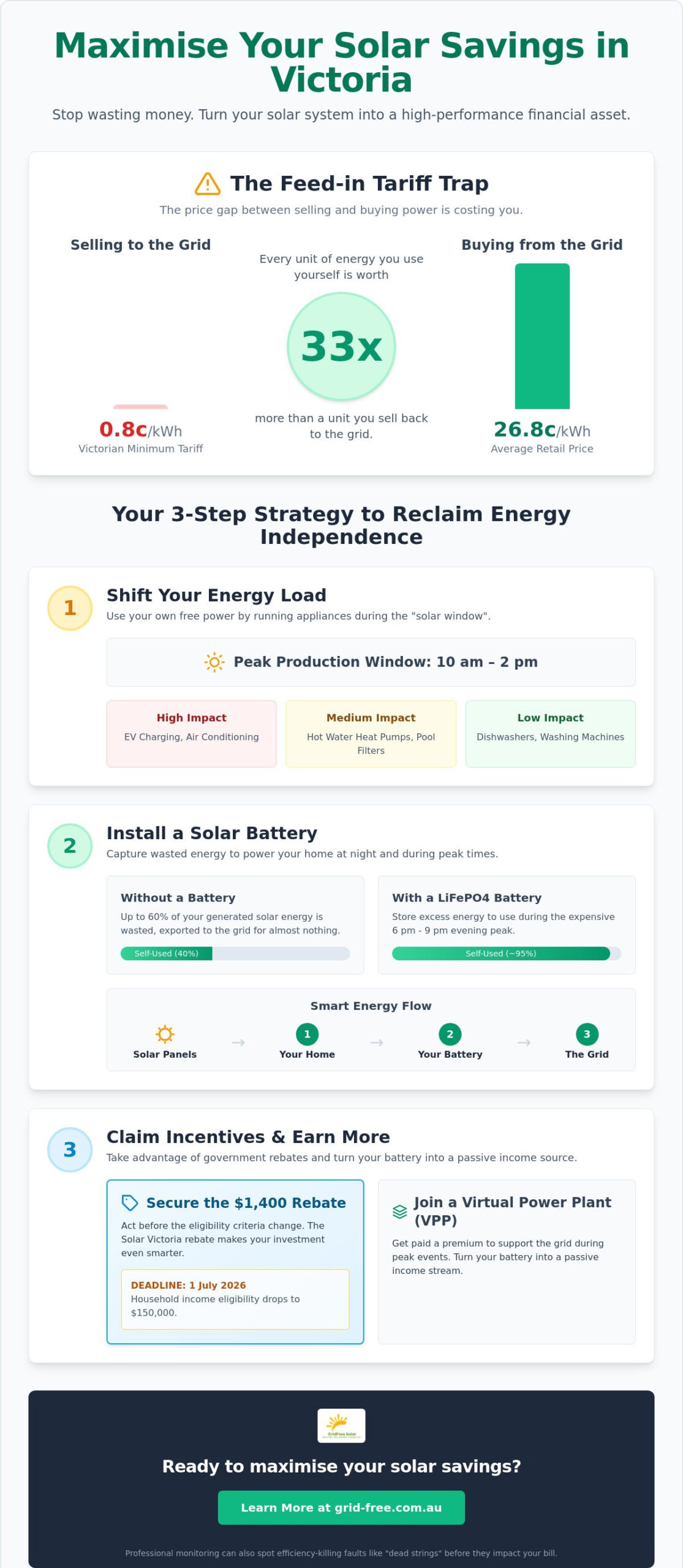
Stop sending your hard-earned energy back to the grid for pennies. In Victoria, the average minimum feed-in tariff has plummeted to a negligible 0.8c/kWh. Meanwhile, the average household pays roughly 26.8c/kWh to buy power back at night. This massive price gap is the “Feed-in Tariff Trap.” If you export your power, you lose. To understand how to maximize solar savings, you must stop being a passive exporter and start being an active consumer.
Load shifting is the most effective way to fix this imbalance. It involves moving your most energy-intensive tasks into the “solar window” between 10 am and 2 pm. During these four hours, your rooftop solar power system is hitting peak production. By using that power live, you avoid the 26c retail cost entirely. Don’t wait for the arvo when the sun dips; run your heavy hitters while the sky is brightest.
Every appliance has a different impact on your bottom line. Prioritise your energy usage according to this hierarchy of loads:
- High Impact: Electric vehicle charging and ducted air conditioning or split systems.
- Medium Impact: Electric hot water heat pumps and pool filtration systems.
- Low Impact: Dishwashers, washing machines, and dryers.
For Melburnians who aren’t home during the day, smart technology is your best ally. Modern Wi-Fi-enabled appliances and simple plug-in timers allow you to organise your energy consumption from your smartphone. Set your dishwasher to start at 11 am or program your split system to pre-cool the house at 1 pm. These small adjustments ensure you aren’t wasting free energy while the house is empty.
The Math of Self-Consumption vs Feed-in Tariffs
Your “Self-Consumption Rate” is the percentage of solar energy used directly by your home rather than exported. With Victorian retail rates sitting around 26.8c/kWh and feed-in tariffs as low as 0.8c/kWh, every unit of energy you consume yourself is worth 33 times more than a unit you sell. Increasing your self-consumption by just 20% can shave hundreds of dollars off your annual bill by avoiding high peak-hour retail charges. This is the most direct path for anyone looking at how to maximize solar savings in 2026.
Top 5 Appliances to Run During the Day
Focus on these three heavy hitters to see immediate results. First, set dishwashers and washing machines to run via timers; they are easy wins for mid-morning operation. Second, configure your electric hot water system to heat during peak sun rather than overnight. Finally, ensure pool pumps run exclusively during the day. Running a pool pump at night is a financial disaster for solar owners; move it to the noon slot to run it for free.
Smart Storage: Why a Battery Upgrade is the Ultimate Savings Multiplier
Older solar systems in Melbourne are often financial leaks. Without storage, these systems typically waste up to 60% of their generated energy by exporting it back to the grid. Because feed-in tariffs have dropped to negligible levels, this is essentially giving away your profit to retailers. An integrated solar battery solution stops this bleed. It allows you to capture every excess kilowatt produced during the day for use when the sun goes down.
Modern lithium storage has revolutionised how to maximize solar savings. Early adopters were often stuck with bulky lead-acid batteries or temperamental first-gen lithium models. In 2026, Lithium Iron Phosphate (LiFePO4) technology is the gold standard for reliability and safety. These units allow you to “time-shift” your midday production to cover the “Duck Curve.” This term describes the sharp spike in grid demand and prices that occurs between 6 pm and 9 pm. By powering your home with stored sunshine during these peak hours, you effectively opt out of the most expensive electricity rates in Victoria.
Capturing the Midday Surplus
The technical process is seamless. Your inverter prioritises your home’s immediate needs first. Any surplus energy then flows into the battery rather than the grid. Once the battery hits 100% capacity, only then does energy export. This prevents “Bill Shock” during the evening peak usage period. If you already have panels but your bills are still high, a battery upgrade is the most logical next step to reclaim your energy independence. It transforms an aging, export-heavy system into a modern, self-sufficient powerhouse.
Choosing the Right Storage Capacity
Matching your battery size (kWh) to your household’s evening consumption is critical for a high ROI. A system that is too small leaves you relying on the grid by 8 pm. A system that is too large results in wasted upfront capital. Modular systems are now the preferred choice for Melbourne homeowners because they can grow with your family’s needs. You can start with a 5kWh unit and add modules as your demand increases. For a full breakdown of the math behind these investments, consult our solar battery cost Australia 2026 guide. Remember that while some state-level incentives have shifted, the Victorian government’s solar panel rebate framework still provides a vital baseline for system eligibility and standards.
Navigating Victoria’s Rebate Landscape for Maximum Return
The window for the most generous Victorian solar incentives is closing fast. As of June 2026, the Solar Homes Program still offers a rebate of up to $1,400 for eligible homeowners, alongside an interest-free loan of the same amount. However, a major policy shift occurs on 1 July 2026. The combined household income threshold for these rebates will drop from $210,000 to $150,000 per year. If your household earns between these two figures, you must submit your application by 5 pm on 30 June 2026. Missing this deadline could cost you thousands in lost subsidies. Understanding these regulatory “cliffs” is the first step in learning how to maximize solar savings before the rules tighten.
While the state-level interest-free battery loan program has closed to new applicants, the federal “Cheaper Home Batteries Program” has stepped in to fill the gap. This initiative provides an upfront discount of approximately 30% on the cost of a battery system. For Melbourne residents, this federal support is the primary engine for achieving grid independence. Exploring the full range of energy storage solutions Melbourne homeowners can access in 2026 is essential to understanding how these federal and state incentives can be combined for maximum financial benefit. Beyond panels and batteries, Victoria is aggressively incentivising the move away from gas. Transitioning to an electric heat pump for hot water can attract additional rebates, further reducing your reliance on expensive fossil fuels and lowering your daily standing charges.
To secure these funds, you must use an authorised retailer. This isn’t just a recommendation; it’s a strict eligibility requirement. Your retailer must ensure all components meet Australian Standards and that the installation is performed by a Clean Energy Council (CEC) accredited professional. Don’t risk your rebate by cutting corners with unverified “solar cowboys” who offer rock-bottom prices but lack the credentials to trigger your government payments.
Stacking Incentives for a Full Home Upgrade
Smart homeowners don’t just take one rebate; they stack them. You can combine the Victorian $1,400 PV rebate with federal Small-scale Technology Certificates (STCs) to drastically lower the upfront solar panel installation Melbourne costs. These STCs act as a point-of-sale discount, often worth several thousand dollars depending on the system size. Additionally, the Victorian Energy Upgrades (VEU) scheme provides further incentives for energy-efficient lighting and heating upgrades. By layering these programs, you can overhaul your home’s energy profile with minimal capital outlay.
Eligibility and Application Tips
Application errors are the leading cause of rebate delays. Ensure you have your latest council rates notice and verified income documentation ready before you start the process. A common pitfall is providing outdated pay slips or incorrect property titles, which can push your application past the 30 June deadline. Verification through an accredited installer is mandatory. They will provide the necessary technical declarations to prove your system meets the efficiency benchmarks required for how to maximize solar savings through official channels.
The VPP Advantage: Getting Paid for Your Excess Energy
Your home battery is more than a backup. In 2026, it is a dynamic financial instrument. A Virtual Power Plant (VPP) is a sophisticated network of residential batteries coordinated to support the Victorian grid during peak demand. Instead of merely storing power for your evening shower, your system becomes a micro-utility. This is the next frontier for anyone learning how to maximize solar savings beyond simple self-consumption. You aren’t just saving money; you’re generating it.
VPP providers like AGL, Origin Energy, and Powershop now offer aggressive incentives for participation. During high-demand periods when the grid is under pressure, these providers “tap into” your stored energy to prevent blackouts. In return, you receive premium credits that far exceed the standard 0.8c feed-in tariff. Research shows that Victorian homeowners can earn between $200 and $1,500 annually through these programs. You maintain total control. Most VPP agreements allow you to set a “reserve” limit, ensuring you always have enough power for your own household needs during an outage.
Support the grid. Earn credits. Slash your payback period. It is a logical progression for any modern Melbourne home. To ensure your hardware is up to the task, consult our VPP compatible solar batteries Victoria guide for recommended brands and technical specifications.
How VPP Participation Speeds Up Your ROI
Participation turns a passive storage unit into an active income generator. These “Grid Support Credits” appear directly on your electricity bill, offsetting your daily standing charges and any residual grid usage. A well-managed VPP can reduce a battery’s payback period by 2-3 years, making the initial investment significantly more attractive. By participating in just a few “demand response events” per month, you transform your battery from a luxury into a high-yield asset.
Is Your System VPP Ready?
Not every system can join the party. VPP readiness requires a smart inverter with stable internet connectivity and a compatible battery management system. Choosing the right brand at the start is critical. If you install a closed-protocol system today, you might be locked out of the most lucrative VPP contracts tomorrow. Real-time software monitoring is also essential; it allows you to track exactly when your battery is supporting the grid and how much credit you’ve earned in real-time. Don’t leave your potential earnings to chance. For a comprehensive overview of how storage integrates with the grid in Victoria, our grid connected solar battery Melbourne reference guide covers the technical requirements and financial benefits in full detail.
Ready to turn your storage into a revenue stream? Request a VPP readiness audit for your solar and battery installation today.
Future-Proofing Your Investment with Professional Maintenance
“Set and forget” is a financial trap. While solar panels are remarkably durable, they aren’t maintenance-free. A minor 5% drop in efficiency, often caused by simple dust accumulation or poor wiring from “solar cowboys,” can strip hundreds of dollars from your annual returns. If you want to know how to maximize solar savings, you must protect the integrity of the hardware. Degraded components don’t just reduce your output; they can lead to system failures that leave you reliant on the expensive grid for weeks while you wait for repairs.
Modern monitoring apps are your first line of defence against invisible losses. These platforms allow you to spot “dead strings” or inverter faults before they manifest as a massive quarterly bill. If one string of panels goes down due to a blown fuse or bird damage, you could lose half your production without even realising it. A professional health check is particularly vital for systems over five years old. It serves as the essential first step in any solar battery replacement Melbourne strategy. You must ensure your existing array is performing at its peak before investing in new storage.
Electricity is dangerous and complex. Never attempt DIY electrical work on your system. Always engage Clean Energy Council (CEC) accredited Melbourne installers for any maintenance or component upgrades. This keeps your warranty intact and ensures your system remains compliant with evolving Victorian safety standards. Professional care is the difference between a system that limps along and one that delivers maximum ROI for decades.
The Hidden Cost of Dirty Panels
Melbourne’s heavy pollen seasons and construction dust can create a persistent film on your panels. This layer blocks sunlight and significantly reduces your current. While a gentle hose-down can remove loose debris, professional cleaning is often required to remove baked-on grime without causing micro-cracks in the glass. You should also monitor shading from new trees or neighbouring developments. Even partial shading on a single panel can bottleneck the performance of the entire string.
Annual System Audits
A professional audit goes far beyond a visual inspection. An electrician will test DC isolators for water ingress, verify wiring integrity, and ensure your inverter has adequate ventilation to prevent thermal throttling. Use your inverter’s software to compare your actual daily yield against your original “Savings Forecast.” If your production is consistently dipping below expectations, a technical audit is mandatory to find the leak. Ready to see how much you could be saving? Get a professional solar health check from GridFree Solar today.
Take Control of Your Energy Independence
The era of “set and forget” solar is over. To thrive in Victoria’s current energy market, you must pivot toward self-consumption and intelligent storage. Shifting your appliance usage to peak production hours and integrating a modern battery system are the most effective ways to bypass falling feed-in tariffs. Don’t let the 1 July 2026 rebate deadline pass you by. Secure your financial future while the incentives remain at their peak.
Success involves more than just panels on a roof. It requires a strategy for how to maximize solar savings through VPP participation and rigorous system maintenance. As Victorian rebate specialists with local Melbourne support, we ensure your transition is seamless and high-performing. Our CEC accredited installers are ready to audit your current setup and deploy the latest in smart energy tech.
Maximise your ROI with a custom Solar & Battery solution from GridFree Solar. Your path to energy freedom starts with a single, smart decision. Let’s get to work.
Frequently Asked Questions
How much can I realistically save on my electricity bill with solar in Victoria?
You can realistically save between $1,200 and $1,800 annually with a standard 6.6kW system in Melbourne. Larger 10kW systems often yield savings between $2,000 and $3,000 per year. These figures depend heavily on your self-consumption rate. By using more power during daylight hours, you offset retail rates of approximately 26.8c/kWh, which is the most effective way how to maximize solar savings in 2026.
Is it better to use solar power during the day or store it in a battery?
Using solar power directly during the day is always your most efficient choice because it avoids all conversion and storage losses. However, most Melbourne households generate a significant surplus that a battery can capture for evening use. Storing this energy allows you to avoid expensive peak grid prices between 6 pm and 9 pm. A balanced approach uses the “Daylight Savings” strategy for heavy appliances while relying on storage for night-time essentials.
Are solar batteries worth the investment in 2026?
Solar batteries are highly viable in 2026 due to record-low feed-in tariffs and the expansion of Virtual Power Plants (VPPs). With average minimum feed-in tariffs at just 0.8c/kWh, exporting power is no longer a winning strategy. A battery allows you to keep that energy, potentially earning an additional $200 to $1,500 annually through VPP participation. This active income significantly accelerates your return on investment compared to older, passive systems.
What is the best way to monitor my solar system performance?
The best way to monitor performance is through a dedicated smart inverter application that provides real-time data on both production and household consumption. These apps allow you to spot “dead strings” or efficiency drops immediately. Consistent monitoring ensures you’re hitting your savings forecasts. It also helps you identify the best times to run high-load appliances to ensure you’re using every kilowatt your roof produces before it hits the grid.
How do I claim the Victorian solar battery rebate?
The previous Victorian interest-free battery loan program is currently closed to new applicants. However, Melbourne residents can still access the federal “Cheaper Home Batteries Program,” which offers an upfront discount of roughly 30% on battery costs. To claim this, you must use an authorised retailer and ensure your system meets specific technical standards. Check your eligibility early to secure these incentives before federal funding caps are reached or policy thresholds change.
Does cleaning my solar panels actually increase my savings?
Regular cleaning can prevent a 5% to 10% drop in efficiency caused by Melbourne’s dust, salt spray, and pollen. While rain clears some light debris, a persistent layer of grime can build up and bottleneck your system’s output. Keeping panels clear ensures you’re capturing maximum sunlight during that critical 10 am – 2 pm window. This simple maintenance task is a low-cost way to protect your ROI and ensure your system performs at its rated capacity.
What happens to my solar savings if the feed-in tariff drops further?
If feed-in tariffs drop further, your focus must shift entirely to 100% self-consumption or storage to maintain your savings. Your solar returns are protected as long as you use the energy you produce rather than exporting it. Every unit of energy you use yourself offsets a retail cost of about 26.8c/kWh. This makes your system more valuable as grid prices rise, regardless of what retailers pay for your excess power.
Can I add a battery to my existing solar system to increase savings?
You can certainly add a battery to an existing solar system to increase your independence from the grid. This is often called an AC-coupled upgrade. It’s the most effective way to modernise an older system that currently wastes energy by exporting it for negligible returns. Adding storage is a proven method for how to maximize solar savings for homes that already have functional panels but still face high quarterly electricity bills.