
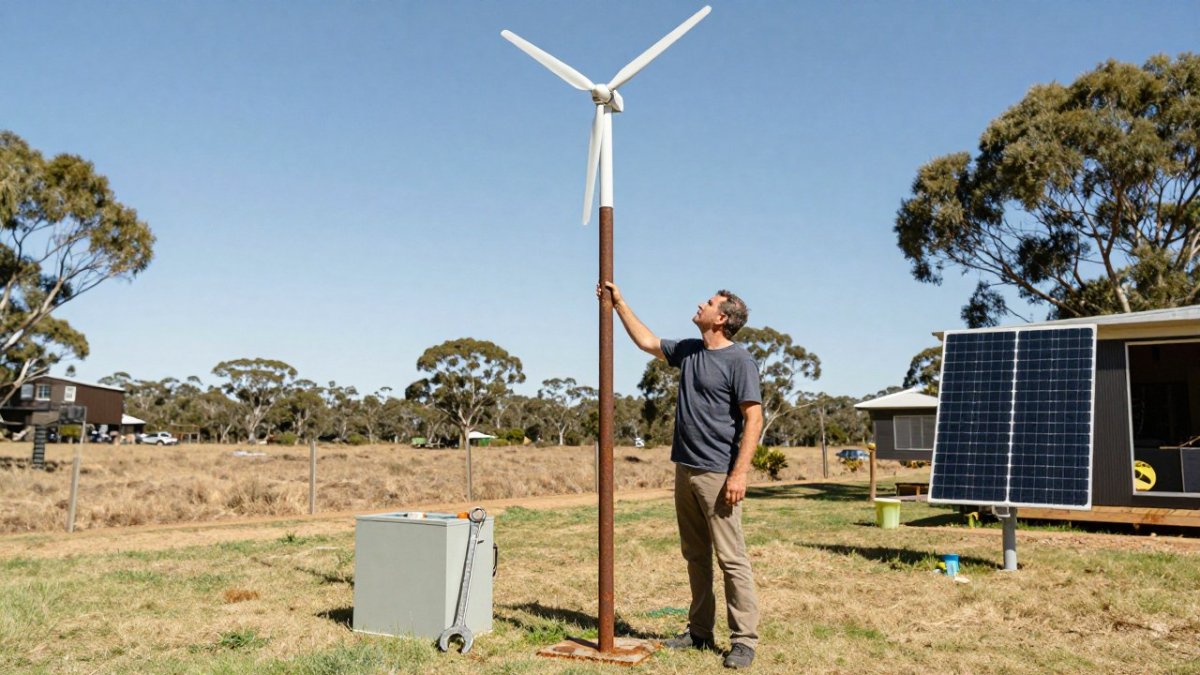
Last Updated: November 23, 2026
Quick Summary
Property zoning rules for home wind turbines are local planning controls that decide whether you can install a turbine, how tall it can be, how far it must sit from boundaries, and what noise it may emit. In Victoria, your local council assesses a small wind turbine planning permit application against its planning scheme, so check that scheme before you buy anything.
- The federal government sets no zoning rules for residential turbines; state frameworks and local council permits decide approval.
- Residential zones are the strictest, while farming zones are more permissive because small-scale wind often supports on-farm power.
- Applications are refused most often for missing acoustic or structural documentation, not for the turbine itself.
- Setbacks are measured from the property line and in most schemes scale with total tower height to blade tip.
- A grid-connected system needs distributor approval before it can export, and that runs on a separate track to council assessment.
Table of Contents
- What Are the Property Zoning Rules for Home Wind Turbines?
- Small Wind Turbine Planning Permit Requirements
- Council Height Restrictions for Wind Turbines
- Residential Wind Turbine Noise Regulations
- Setbacks, Lot Size and Shadow Flicker: The Site Rules That Decide Approval
- Grid-Tie, Interconnection and the Permits Nobody Mentions
- Variance Applications and Common Zoning Hurdles
- Checking Your Council’s Wind Energy Policy Before You Apply
- Frequently Asked Questions
What Are the Property Zoning Rules for Home Wind Turbines?
Property zoning rules for home wind turbines are the local planning controls that determine whether you can install a turbine, how tall it can be, how far it must sit from boundaries, and what noise it may emit. In Victoria, these rules sit mostly with your local council, which assesses a small wind turbine planning permit requirements application against its planning scheme. This guide from GridFree Solar walks through the seven rule sets that decide approval, from height caps and setbacks to grid connection and variance strategies.
Here’s what most guides get wrong: they treat zoning as a single national standard. It isn’t. Two neighbouring councils can apply different setback distances and height limits to the same turbine model, and a permit that sails through one shire can stall in the next.
Federal, State and Local: Who Actually Decides
The federal government sets no zoning rules for residential turbines. State governments set the framework through planning schemes and renewable energy policy, and local councils apply it property by property through permits. That means your council’s planning scheme, not a national code, is the document that decides your application. Check it before you buy anything.
Residential vs Farming Zone Rules
Residential zones are the strictest. Turbines are usually a permit-required use, judged on visual impact and amenity for neighbours. Farming zones are more permissive because small-scale wind often supports on-farm power, but they still trigger assessment on setbacks and land use. The zone code on your title, not the size of your block, is what determines which rule set applies.
Small Wind Turbine Planning Permit Requirements
Small wind turbine planning permit requirements vary by council, but the core application package and the assessment pathway are consistent enough to plan around. Before you assemble documents, confirm which pathway your proposal falls into: in most Victorian planning schemes a small turbine is either a permit-not-required use (subject to meeting all specified conditions), a permit-required use (assessed on its merits), or a prohibited use in the zone. The pathway determines whether you lodge a full development application or simply satisfy a code.
A typical lodgement checklist for a permit-required application:
- Site plan showing the turbine position, all boundaries, and distances to the nearest dwellings
- Elevation drawings with total tower height, hub height, and blade clearance to ground and structures
- Acoustic report addressing noise at the nearest dwelling under worst-case wind conditions
- Structural integrity certification from a qualified engineer, including foundation design
- Visual impact statement, including photomontages from key public viewpoints and neighbouring properties
- Shadow flicker assessment where the turbine is within the distance at which flicker can affect a dwelling
- Decommissioning and rehabilitation plan for end of life
- Grid-tie or stand-alone connection details, including distributor approval status
- Planning report addressing the relevant zone provisions, overlays (such as bushfire, heritage, or environmental significance), and any local policy
Watch out: applications are refused most often for missing acoustic or structural documentation, or for a planning report that fails to address an overlay that applies to the land, not for the turbine itself. Lodge a complete package and you avoid a months-long resubmission.
If your proposal does not meet a standard, the permit process is also where you can seek a variation. A variance application is assessed on evidence, not persuasion: acoustic modelling, shadow flicker data, and neighbour consultation carry more weight than a written argument. A pre-application meeting with a council planner is a practical way to learn whether a variance is worth pursuing before you commission reports. A variance can take months and there is no guarantee of approval, so confirm the pathway and the likely conditions before committing to a long process.
Council Height Restrictions for Wind Turbines
Council height restrictions for wind turbines are the first hard limit most homeowners hit. Many Victorian councils cap the total height of a residential structure, measured to the tip of the blade at its highest point, at a level that keeps small-scale wind feasible only on larger lots. Exceeding the cap usually pushes your turbine into a permit-required or prohibited category.
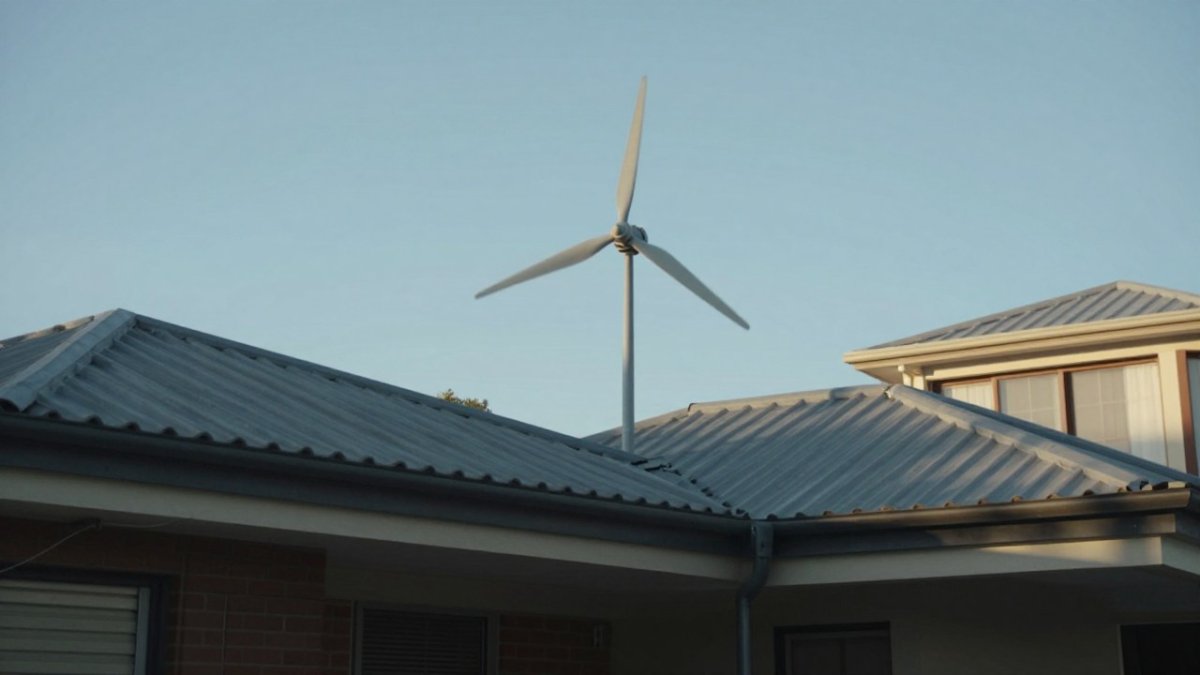
Measure the height the way the council measures it. Some schemes measure to the hub, others to blade tip. Getting this wrong is a common reason for refusal. Confirm the definition in your planning scheme before you finalise a model choice.
Residential Wind Turbine Noise Regulations
Noise from a residential turbine is assessed against the relevant noise framework, which councils apply when deciding whether a turbine causes unreasonable amenity impact. Check your council’s planning scheme for the current requirements. Low-frequency hum and tonal noise can carry further at night, which is where complaints and refusals often originate.
An acoustic report should model noise at the nearest dwelling under worst-case wind conditions, not average ones. If the predicted level sits close to the limit, plan the turbine further from the boundary or choose a model with a lower sound power rating.
Setbacks, Lot Size and Shadow Flicker: The Site Rules That Decide Approval
Setback distance, lot size and shadow flicker are the site-specific rules that decide approval even when height and noise pass. Setbacks are measured from the property line, and they exist to protect neighbours from blade clearance risk, ice throw and visual impact. Because setbacks and lot coverage both depend on how a structure occupies its site, the same careful attention to design rules for Australian structures can help keep other outdoor additions within their boundaries.
Shadow flicker is the strobing effect when rotating blades pass between the sun and a neighbouring window. Some councils ask for a shadow flicker assessment showing predicted hours per year at nearby dwellings, and some schemes set a threshold above which mitigation is required. A turbine placed to the south of neighbouring homes reduces this risk significantly in the southern hemisphere, because the sun’s arc keeps the shadow away from northern-facing windows for most of the day.
| Rule | What It Controls | Typical Application |
|---|---|---|
| Setback distance | Distance from property line | Scaled to tower height |
| Lot size | Minimum land area for a turbine | Larger lots get more scope |
| Shadow flicker | Strobing at neighbouring windows | Modelled hours per year |
| Blade clearance | Ground and structure clearance | Set by structural standards |
| Visual impact | Amenity for neighbours | Photomontage assessment |
Because these rules are set council by council, the practical step is to find your council’s planning scheme map and the zone and overlay controls that apply to your title. Many councils publish an online planning map where you enter your address and see the zone, overlays, and any local policy that applies.
Grid-Tie, Interconnection and the Permits Nobody Mentions
Grid-tie and interconnection approvals are the permits most zoning guides ignore, yet they can delay a project longer than the planning permit itself. A grid-connected small wind system needs distributor approval before it can export, and the connection application runs on a separate track to council assessment. If your turbine will be stand-alone with battery storage, you skip the export approval but still need electrical compliance.
If a grid connection looks uncertain, it is worth exploring how to achieve energy self-sufficiency at home so the system still delivers value. Battery systems must comply with AS/NZS 5139:2019 and AS/NZS 3000. GridFree Solar installs and supports battery storage systems, and the compliance requirements apply to those installations.
Variance Applications and Common Zoning Hurdles
Variance applications are how you ask a council to relax a standard, such as a setback or height limit, when strict compliance is impractical. Success depends on evidence, not persuasion. A strong variance application shows the amenity impact is acceptable despite the non-compliance, backed by acoustic modelling, shadow flicker data and neighbour consultation.
The hurdles we see most often:
- A height cap that the chosen model exceeds by a small margin
- A setback that fails because of an oddly shaped lot
- An acoustic report that models average rather than worst-case wind
- Missing structural certification at lodgement
If a turbine approval looks unlikely on your block, it may be worth reviewing the best alternatives to grid power for small homes before committing to a long variance process. A variance can take months, and there is no guarantee of approval.
Checking Your Council’s Wind Energy Policy Before You Apply
Before you lodge anything, read your council’s wind energy policy and planning scheme in full. Most publish their requirements online, and many offer a pre-application meeting where a planner tells you informally whether your proposal is viable. Use it. A short conversation saves months of wasted documentation.
The Clean Energy Council’s consumer resources and Sustainability Victoria’s household renewable energy guidance both explain how small-scale wind fits alongside solar. For the broader legal picture beyond zoning, see our guide to residential wind turbine legal requirements, which covers the rules that sit outside the planning scheme.
Zoning is where most home wind projects stall, and the rules are local, technical and unforgiving of incomplete applications. GridFree Solar helps homeowners plan renewable systems that clear compliance from the start, with CEC Accredited Installers, CEC Approved Battery storage built to AS/NZS 5139:2019 and AS/NZS 3000, and rebate guidance that keeps the whole project on track. Get started with GridFree Solar and build an energy system that passes assessment and pays you back.
Frequently Asked Questions
Do I need a planning permit for a small wind turbine on my property?
It depends on your zone and council. In most residential zones, a small turbine needs a planning permit, and often a building permit as well. Some councils allow micro turbines below a set height and capacity without a planning permit, but you must confirm this with your local council’s planning scheme before ordering equipment. Check the zone schedule, the turbine’s hub height and blade diameter, and whether the property is heritage-listed or in a bushfire overlay, because any of these can trigger extra requirements.
Are there height restrictions for home wind turbines in residential zones?
Yes. Council height restrictions for wind turbines typically cap total height, including the tower and blade tip, at a figure measured from natural ground level. Residential zones usually allow less height than rural or farming zones, and the limit often drops further near boundaries or in heritage areas. Measure the turbine’s maximum tip height, not just the tower, and compare it to your council’s schedule. If your proposed height exceeds the limit, you will need a variance or a different model.
What are the noise level requirements for small-scale wind energy systems?
Residential wind turbine noise regulations generally set a limit measured at the nearest dwelling boundary, often expressed in decibels and adjusted for background noise. Councils may also apply a low-frequency noise check and require an acoustic report from a qualified consultant. Site the turbine away from bedrooms and neighbouring boundaries, and keep in mind that smaller, faster-spinning turbines can produce more tonal noise than larger slow-rotating models. Confirm the exact limit in your council’s planning scheme before you lodge an application.
Do residential wind turbines require a building permit in addition to planning approval?
Often yes. A building permit covers structural integrity, footings, wind loading and electrical safety, and is separate from the planning permit. Your installer or engineer usually prepares the structural documentation, and the work must comply with relevant Australian standards. Ask your council whether the turbine is classified as a structure under the building regulations, and budget time for both approvals. Skipping the building permit can void insurance and force removal of the turbine later.
