

Last Updated: October 23, 2026
Quick Summary
Residential wind turbine legal requirements in Australia require council planning approval, compliance with the National Construction Code and AS/NZS 3000 electrical standards, noise regulation adherence, grid connection approval from your network operator, and installation by a CEC accredited installer. These requirements protect your property, neighbours, and electrical infrastructure.
- You must obtain council approval before installing a turbine; processing takes 4-12 weeks and requires setback distance and height compliance.
- Your turbine must meet National Construction Code structural standards and AS/NZS 3000 electrical safety standards verified by a licensed electrician.
- Noise limits typically range from 35-45 decibels at neighbour boundaries during daytime; setback distances are designed to ensure compliance.
- Your network operator must approve grid connection; your inverter must comply with AS/NZS 4777 standard before connection is permitted.
- Choose a CEC accredited installer with appropriate electrical licences and professional indemnity insurance to ensure legal compliance and safety.
Table of Contents
- Understanding Residential Wind Turbine Legal Requirements
- Council Approval for Wind Turbines
- Small Wind Turbine Building Regulations
- Wind Turbine Noise Regulations and Community Standards
- Grid Connection Requirements for Small Wind Turbines
- Safety Standards and Accreditation for Installation
- Common Mistakes and Compliance Pitfalls
- Frequently Asked Questions
Understanding Residential Wind Turbine Legal Requirements
Residential wind turbines offer genuine energy independence, but they’re heavily regulated. Before you install one, you need to understand that residential wind turbine legal requirements vary significantly depending on where you live and the size of your system. The rules aren’t optional, they protect your neighbours, your property, and your grid connection.
In Australia, residential wind turbines fall under multiple regulatory frameworks. Local councils have authority over planning and building approvals. The Clean Energy Council (CEC) sets accreditation standards for installers. Electrical safety standards like AS/NZS 3000 govern how your turbine connects to your home’s wiring. Grid operators have specific requirements for how your system feeds power back into the network.
Most homeowners discover these requirements only after they’ve already purchased equipment or committed to an installer. That’s a costly mistake. The legal framework exists before you start, and understanding it first saves time, money, and frustration.
Council Approval for Wind Turbines
You cannot legally install a residential wind turbine without council approval. This is the foundational requirement, everything else depends on it.
Your local council operates under state planning laws and local planning schemes. They assess whether your turbine meets setback distances from property boundaries, height restrictions, and neighbourhood impact standards.
The approval process starts with a development application. You’ll submit plans showing the turbine’s height, location on your property, distance from boundaries, and specifications. Learn about solar compliance paperwork and approvals to understand the documentation process for renewable energy installations.
Councils also check whether your property is in a heritage overlay, environmental significance area, or bushfire-prone zone. These designations can restrict or prohibit wind turbine installation entirely. You need to verify this before you spend money on engineering or design work.
One common mistake is treating council approval as a formality. It’s not. Councils reject applications regularly when turbines breach setback distances or when applicants haven’t provided adequate documentation. Resubmitting takes weeks. Start with a conversation with your council’s planning department before you commit to anything.
Your local council’s planning scheme and development application requirements will specify exact setback distances and height limits for your area. These vary by council, so don’t assume your neighbour’s approval applies to you.
Small Wind Turbine Building Regulations
Once council approves your project, building regulations take over. Small wind turbine building regulations in Australia are governed by the National Construction Code (NCC) and state-specific building codes. Your turbine must meet structural, electrical, and safety standards before it can be commissioned.
The NCC treats wind turbines as structures. Your installation must comply with load-bearing requirements, foundation design, and structural integrity standards.
Electrical safety is equally important. Your turbine connects to your home’s electrical system, which means it must comply with AS/NZS 3000 (the Australian electrical safety standard). This covers wiring, grounding, switchgear, and protection systems.
Building inspectors will check that your installation meets these standards. They’ll verify foundation work, inspect electrical connections, and confirm that your installer holds appropriate licences. Some states require a Certificate of Electrical Safety (CES) before your system can operate.
The cost and complexity of meeting building regulations is why choosing a CEC accredited installer matters. They know these requirements inside out and design installations that pass inspection first time. Dodgy operators cut corners on foundations or electrical work, that’s how fires start.
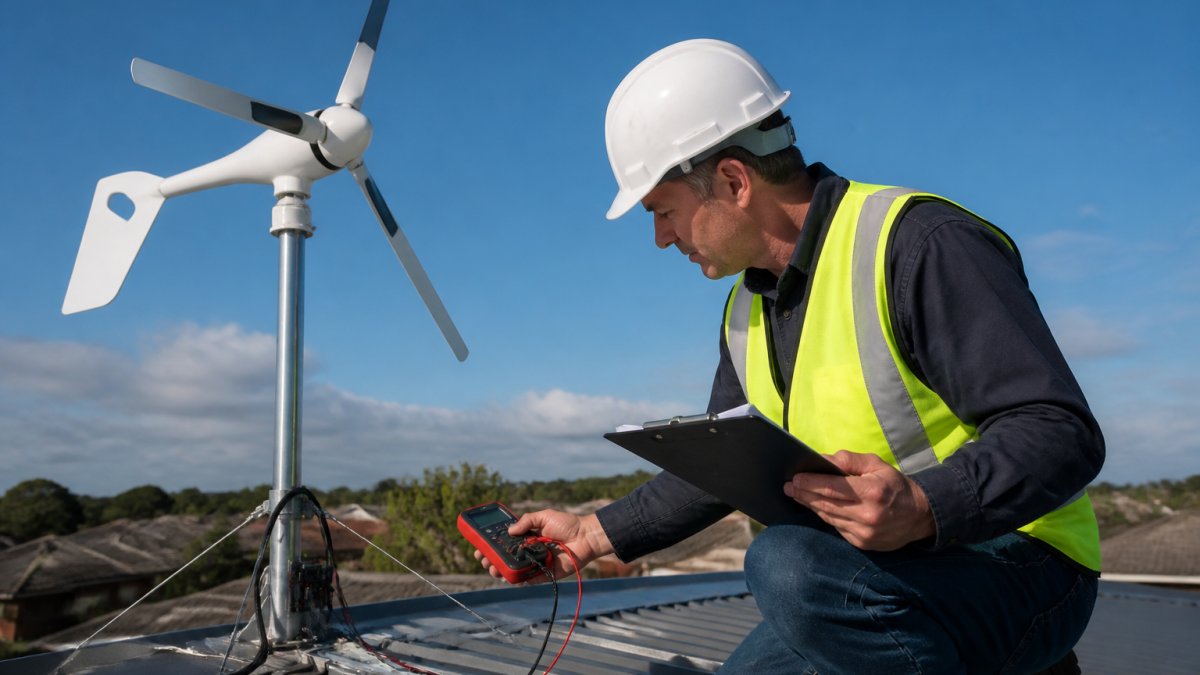
Your turbine must meet several key regulatory standards before it can be commissioned and operated.
| Requirement | Standard or Framework | Key Details |
|---|---|---|
| Structural compliance | National Construction Code (NCC) | Foundation and mounting must withstand wind loads |
| Electrical safety | AS/NZS 3000 | Covers wiring, grounding, switchgear, and protection |
| Turbine safety | AS/NZS 5139:2019 | Standard for small wind turbine safety |
| Grid-connected inverters | AS/NZS 4777 | Inverter must be certified to this standard |
| Electrical certification | Certificate of Electrical Safety (CES) | Licensed electrician must inspect and verify compliance |
Wind Turbine Noise Regulations and Community Standards
Wind turbines generate noise. The sound comes from blade rotation, mechanical components, and air movement. Noise regulations exist to protect your neighbours and maintain community harmony.
Most councils enforce noise limits under the Environment Protection Act or local planning rules. Typical limits range from 35-45 decibels at the nearest neighbour’s property boundary during daytime hours. That’s roughly the sound level of a quiet office or a refrigerator.
The actual noise your turbine produces depends on blade design, rotational speed, and wind conditions. Modern small turbines are quieter than older models, but they’re not silent. A turbine operating at full capacity typically generates 35-45 decibels at 300 metres distance.
Your setback distance from neighbours directly affects whether you’ll comply with noise regulations. If your turbine is 50 metres from a neighbour’s bedroom window, you’ll likely exceed noise limits on windy days. If it’s 200 metres away, you’ll probably stay within limits.
Some councils require a noise impact assessment before approving your application. This involves modelling your turbine’s noise output at neighbour boundaries under various wind conditions.
A common mistake is ignoring noise concerns during the planning phase. Neighbours who experience unexpected noise often lodge complaints with councils. Councils can issue noise abatement notices requiring you to reduce noise or shut down your turbine during certain hours.
Grid Connection Requirements for Small Wind Turbines
Your turbine doesn’t operate in isolation, it connects to the electricity grid. Grid connection requirements are set by your network operator and governed by the National Electricity Rules.
Before you connect, your network operator must approve your system. They’ll assess whether your turbine’s output could destabilise the grid, damage equipment, or create safety hazards.
You’ll need to submit an application with your turbine’s technical specifications: output capacity, inverter type, protection systems, and earthing arrangements.
Your turbine must also have appropriate metering. If you’re exporting power back to the grid, you need an export meter that records how much electricity you’re sending back. This is how you get paid for exported power.
Connection timelines vary. Straightforward approvals take 2-4 weeks. Complex assessments can take 8-12 weeks. During this time, your turbine cannot legally operate on grid-connected mode.
One critical requirement: your inverter must comply with AS/NZS 4777 (the Australian standard for grid-connected inverters). This standard ensures your inverter won’t damage the grid or create electrical hazards.
Your network operator’s connection application process and technical requirements will specify exact documentation and timelines for your area. Different network operators have slightly different procedures, so check with yours before you start the process.
Best alternatives to grid power for small homes explores other renewable energy options if grid connection doesn’t suit your situation.
Safety Standards and Accreditation for Installation
Installation quality determines whether your wind turbine operates safely for decades or becomes a hazard. This is where accreditation matters.
The Clean Energy Council (CEC) accredits installers who meet training, experience, and competency requirements. A CEC accredited installer has demonstrated knowledge of electrical safety, building codes, planning regulations, and grid connection procedures.
Your installer must hold appropriate electrical licences for your state. In Victoria, this means holding a relevant electrical licence issued by Energy Safe Victoria.
The installation itself must comply with AS/NZS 5139:2019 (the standard for small wind turbine safety) and AS/NZS 3000 (electrical safety). These standards cover everything from foundation design to electrical connections to shutdown procedures. They’re not suggestions, they’re legal requirements.
Your installer should provide a Certificate of Electrical Safety (CES) after installation. This confirms a licensed electrician has inspected the work and verified it meets electrical safety standards.
Learn why choosing a CEC accredited solar installer in Victoria protects your investment, ensures safety compliance, and maximises government rebate. The same principles apply to wind turbine installation, accreditation is your assurance that work meets legal standards and safety requirements.
How to choose CEC accredited installers for your solar system. Verify credentials, compare quotes, and avoid costly mistakes. Find trusted. applies equally when selecting a wind turbine installer.
Common Mistakes and Compliance Pitfalls
Most problems with residential wind turbines stem from skipping steps or underestimating regulatory requirements.
The first mistake is buying equipment before getting council approval. Homeowners see an attractive turbine, purchase it, then discover their council won’t approve installation because of setback distances or height restrictions.
The second mistake is choosing an installer based on price alone. Cheap installers often cut corners on electrical work, foundation design, or compliance documentation. They might not hold CEC accreditation or appropriate electrical licences.
The third mistake is underestimating noise impact. Homeowners install turbines without assessing noise at neighbour boundaries. When neighbours complain, councils investigate. If noise exceeds limits, you face costly mitigation measures or shutdown orders.
The fourth mistake is treating grid connection as automatic. Homeowners assume their turbine will simply plug into the grid once it’s installed.
The fifth mistake is using non-compliant electrical components. Some installers use cheaper inverters that don’t meet AS/NZS 4777 standards. These inverters will be rejected by network operators and create electrical safety risks.
Residential wind turbine legal requirements exist because wind turbines are powerful systems that affect neighbours, electrical infrastructure, and property safety.
The regulatory framework in Australia is comprehensive but navigable.
Connect Now to discuss your project and learn how we make compliance straightforward.
Frequently Asked Questions
Do I need council approval to install a residential wind turbine?
Yes, council approval is required in most jurisdictions before installing a residential wind turbine. You must submit a planning application to your local council, which will assess factors including setback distances from property boundaries, height restrictions, and potential impact on neighbours. Some councils classify small wind turbines as exempt development under specific conditions, but you should verify this with your local authority before proceeding. The approval process typically takes 4-8 weeks.
What building regulations apply to small wind turbine installations?
Small wind turbine installations must comply with the National Construction Code and relevant state-based building standards. Your turbine must meet setback requirements (typically 1.5 times the total height from property boundaries), structural safety standards, and electrical safety codes. A licensed electrician must oversee installation to ensure compliance with AS/NZS 3000 (electrical safety) and other applicable standards. Building certification and inspection are usually required before grid connection.
Are there noise limits for residential wind turbines?
Yes, noise regulations vary by council but typically limit residential wind turbine noise to 35-45 decibels during the day and 30-40 decibels at night. Your turbine’s location, height, and design affect noise output. Most councils require a noise assessment as part of the planning application. Modern small wind turbines are designed to operate quietly, but distance from neighbours’ homes and prevailing wind direction are critical factors in compliance.
What do I need to do to connect my wind turbine to the grid?
Grid connection requires approval from your electricity distributor and compliance with AS/NZS 4777 (grid-connected inverter standards). You must install an approved inverter, apply for a connection agreement, and have a licensed electrician complete all electrical work. Your distributor will conduct a technical assessment to ensure your system doesn’t compromise grid stability. Connection typically takes 4-12 weeks after approval and involves an inspection by the distributor’s engineer.
Can I install a residential wind turbine myself, or do I need a licensed electrician?
A licensed electrician must oversee electrical connections and certification, but the mechanical installation of the turbine structure may be completed by a competent person with appropriate experience. However, engaging a CEC-accredited installer is strongly recommended to ensure full compliance with safety standards, building regulations, and grid connection requirements. Professional installation also typically includes warranty coverage and ongoing system monitoring.
What happens if my property doesn’t meet council setback or height requirements?
If your property doesn’t meet standard setback or height limits, you can apply for a planning variation or exemption through your council. This requires a formal application and may involve neighbour consultation or a hearing. Alternatively, you might adjust the turbine’s location or height to meet requirements, though this may reduce energy output. Engaging a planning consultant early can help identify viable options and improve approval chances.
