
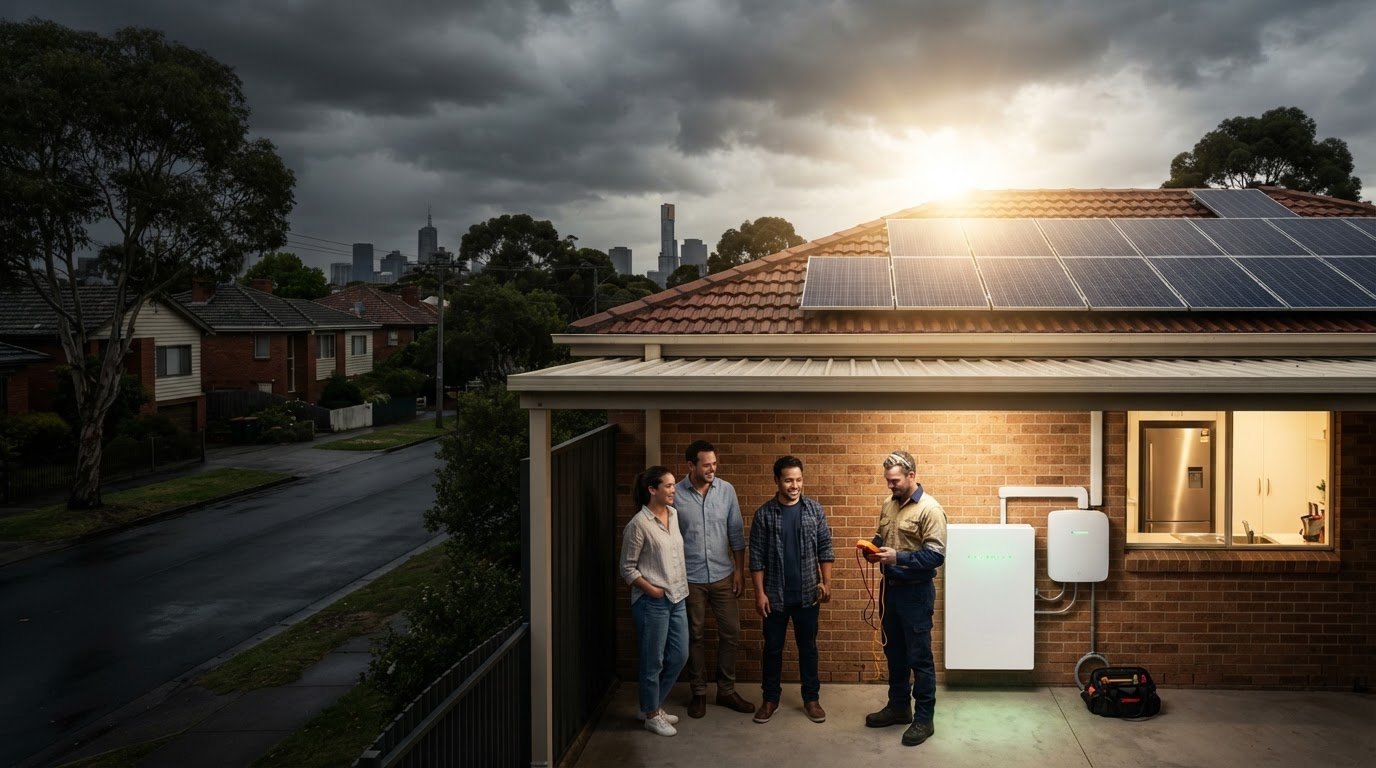
A fierce storm knocks out the local grid, yet the afternoon sun is blazing across your roof. You expect your panels to keep the lights on, only to find your entire home plunged into darkness. When network lines fail across Victoria, many residents are shocked to discover what happens to solar during a power outage Melbourne wide. Your system immediately stops producing electricity.
It feels completely counterintuitive. You invested in rooftop solar to gain energy independence, so watching bright daylight go to waste while the fridge thaws is genuinely frustrating. No homeowner wants to stress over spoiled groceries or losing power for essential medical equipment whenever severe weather buckles the suburban grid.
This 2026 guide explains the exact safety mechanisms governing Victorian rooftop systems and reveals how adding blackout-capable battery storage restores uninterrupted power to your property. We will unpack local network shutdown rules, examine reliable backup options, and show you how to leverage current rebates to protect your household from the next blackout.
Key Takeaways
- Understand exactly what happens to solar during a power outage Melbourne wide, including why standard grid-connected inverters instantly shut down the moment street power cuts.
- Learn why Australian Standard AS/NZS 4777 enforces anti-islanding mechanisms to protect Victorian network lineworkers repairing damaged power lines.
- Discover how battery systems with emergency backup gateways physically island your home within milliseconds to deliver uninterrupted power to critical appliances.
- Find out how to audit your household electrical loads so you can choose the right storage capacity for severe Melbourne storms and summer heatwaves.
- Explore how retrofitting an energy storage system allows you to capitalise on available battery rebates while securing genuine energy independence.
What Happens to Grid-Connected Solar During a Melbourne Power Outage?
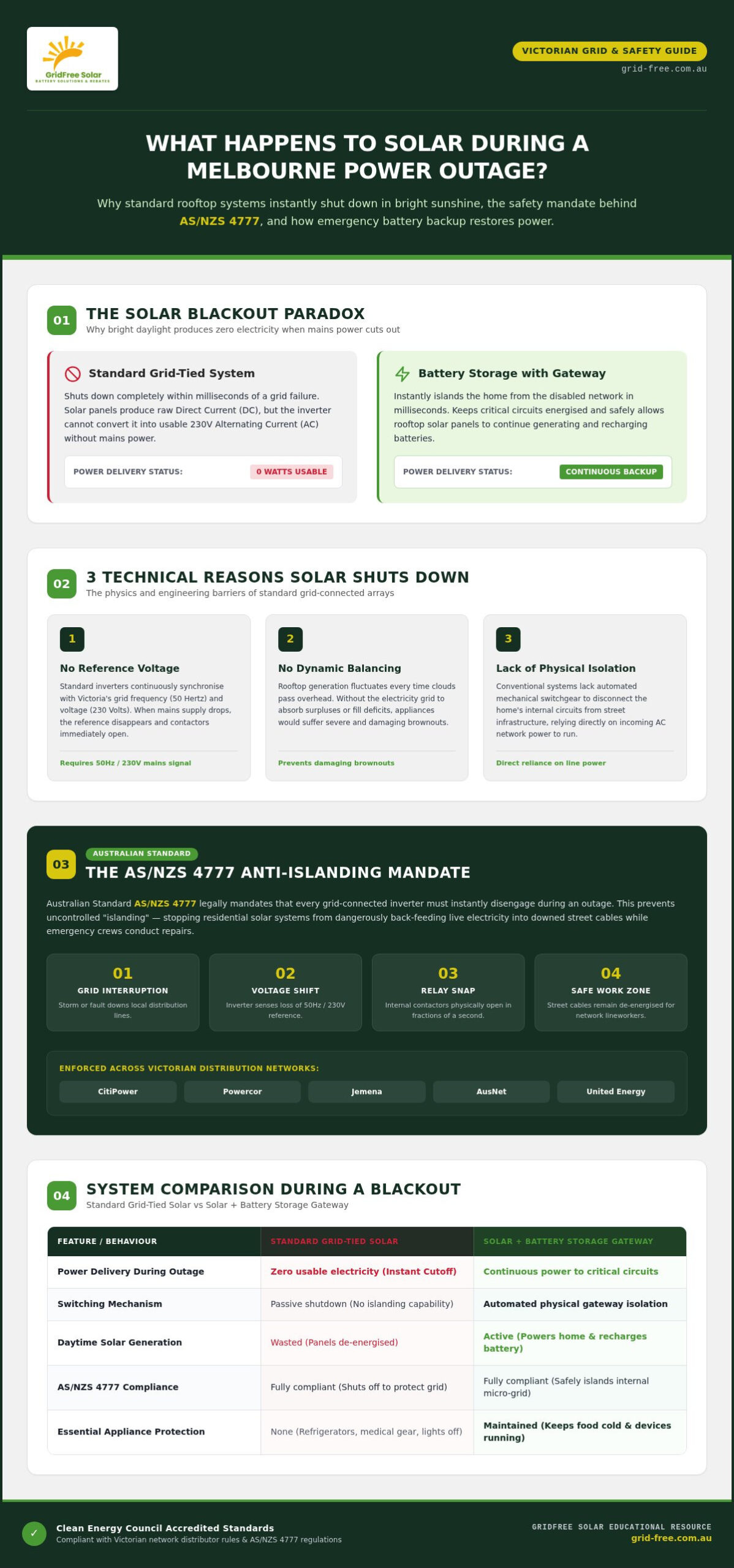
Severe storms frequently bring down distribution wires across suburbs managed by CitiPower, Powercor, Jemena, AusNet, and United Energy. When that happens, your standard grid-tied solar system shuts down instantly. It does not taper off. It cuts power in milliseconds. Melbourne homeowners are often stunned to find that their panels produce zero usable electricity during a daytime blackout, despite clear skies overhead.
Understanding what happens to solar during a power outage Melbourne wide comes down to basic electrical physics. Solar photovoltaic panels generate direct current (DC) energy whenever ambient light hits them. However, domestic appliances run strictly on alternating current (AC). Without specialized backup architecture, your system cannot supply AC power into your home circuits independently.
The Role of the Grid-Tied Inverter
Your inverter acts as the central brain of the rooftop array. Under normal conditions, it continuously monitors and synchronises its output frequency (50 Hertz) and operating voltage (230 Volts) directly with Victoria’s electricity grid. The moment mains electricity cuts out, that vital synchronisation frequency vanishes.
To put it plainly: A grid-tied inverter cannot safely generate alternating current without a reference voltage. Once the inverter detects zero incoming street voltage, safety protocols instantly force internal contactors open, halting all AC power generation.
Common Misconceptions About Rooftop Solar
Many households assume that daylight guarantees usable electricity during an unplanned network blackout. That assumption is inaccurate. Standard rooftop solar is engineered solely to reduce grid electricity consumption and export surplus energy, not to operate as an off-grid power plant. In fact, regulatory frameworks such as the anti-islanding mandate legally require systems to cut off when mains supply drops, ensuring distributed generators do not energise dead wires.
Here is why conventional grid-tied arrays fail to work in isolation during an outage:
- No dynamic load balancing: Solar output fluctuates every time a cloud passes. Without the grid to absorb excess generation or top up deficits, household appliances would suffer rapid, damaging brownouts.
- Lack of physical disconnection: Standard setups have no automated switchgear to isolate your home’s circuits from the street.
- Direct reliance on line power: Inverters draw baseline operational power directly from the incoming alternating current network.
If you rely exclusively on standard grid-connected panels, your home will remain completely dark until distribution crews repair the street infrastructure.
The Anti-Islanding Mandate: Why Victorian Regulations Enforce Solar Shutdown
When investigating what happens to solar during a power outage Melbourne households face, the shutdown is not a system failure. It is a strictly enforced legal safeguard. The primary driver behind this immediate cutoff is Australian Standard AS/NZS 4777, which governs grid connection of energy systems via inverters. This standard mandates that every residential inverter connected to the distribution network must include active and passive anti-islanding protection.
Uncontrolled islanding happens when a rooftop generator continues feeding electricity into local street cables after the substation supply has dropped out. If hundreds of homes in a neighbourhood pushed unmanaged solar voltage back into downed power lines, those street cables would stay live. Linespeople dispatched to clear fallen trees or repair damaged transformers would face lethal electric shocks from rogue solar generation.
Understanding AS/NZS 4777 and Lineworker Protection
Under AS/NZS 4777, certified inverters must disconnect from the network within a fraction of a second the moment mains power deviates from strict voltage and frequency thresholds. Internal mechanical relays physically disengage. This rapid disconnection guarantees that street infrastructure remains completely de-energised, creating a safe work environment for emergency crews.
Every Clean Energy Council accredited installation across Victoria must comply with this standard. Without compliant switchgear, your distribution company will refuse grid connection approval.
Melbourne Network Distributors and Outage Realities
Electricity delivery across Greater Melbourne is split among five distinct Distribution Network Service Providers (DNSPs):
- CitiPower: Melbourne CBD and inner suburbs.
- Powercor: Western suburbs and outer regional fringes.
- Jemena: North-western corridor and industrial zones.
- AusNet Services: Eastern suburbs, the Yarra Ranges, and outer growth corridors.
- United Energy: Southern suburbs and the Mornington Peninsula.
Violent summer windstorms and winter cold fronts regularly cause prolonged localized outages, particularly across heavily treed outer eastern suburbs and exposed western plains. When these feeder lines trip, thousands of homes immediately lose supply. Because of mandatory anti-islanding, rooftop arrays across those entire postcodes cut out in lockstep.
Overcoming this limitation requires an intelligent system capable of physically isolating your property while sustaining internal power. You can discover how modern hardware maintains resilience by reviewing energy storage solutions Melbourne homeowners use to maintain backup capacity. If you want to protect your property against future grid failures, consult the team at GridFree Solar to assess your switchboard compatibility.
Grid-Tied vs Battery Backup: How Melbourne Homes Keep Power Running
A standard grid-tied setup leaves you in the dark, but pairing your panels with energy storage changes the equation completely. Instead of wondering what happens to solar during a power outage Melbourne wide, battery owners experience a seamless transition to self-sustained energy. The key lies in specialized hardware called an Emergency Power Supply (EPS) or backup gateway. This unit isolates your household circuits while creating an independent reference voltage, allowing your panels to keep generating electricity even while the street grid sits cold.
Homeowners planning to retrofit storage can offset their upfront investment by reviewing the latest incentives outlined in our Victorian battery rebate guide.
Essential Circuit Backup vs Whole-Home Protection
When selecting a backup architecture, you must decide which household circuits receive power during an outage. Storage systems generally fall into two categories:
- Essential Circuit Backup: Connects dedicated sub-boards to run selected baseline devices. It reliably maintains power for your refrigerator, LED lighting circuits, Wi-Fi router, and critical medical appliances. This configuration maximizes your reserve hours without demanding an oversized battery bank.
- Whole-Home Protection: Keeps every single circuit energized, including energy-intensive loads like multi-head split systems, induction cooktops, and heat pump hot water units. This setup delivers complete continuity, but it requires substantial storage capacity and high peak inverter output to handle heavy motor startup currents.
For most Melbourne suburban properties, an essential circuit configuration strikes the ideal balance between installation cost and practical emergency resilience.
Automatic Transfer Switches and Islanding Gateways
Safe operation requires mechanical precision. An intelligent backup gateway constantly measures incoming supply from your local network distributor. If mains voltage drops out, the automatic transfer switch acts in less than 20 milliseconds, physically severing the connection between your home and the street.
Once isolated, the inverter switches to standalone islanding mode. It establishes a local 50-Hertz microgrid inside your switchboard. Rooftop panels continue harvesting solar energy, directing excess generation to power your living spaces and top up the battery bank concurrently. The cutover happens so fast that sensitive desktop computers stay running and digital clocks rarely reset.
If your legacy energy storage unit no longer holds sufficient charge to carry critical loads through extended weather events, explore our tailored solar battery replacement Melbourne services to bring your backup capabilities back to peak performance.
How to Design a Blackout-Proof Solar System for Melbourne Conditions
Melbourne’s volatile climate presents distinct challenges for domestic energy security. Between 40-degree January heatwaves straining local substations and Antarctic winter gales bringing down power lines, a standard setup falls short. Effectively resolving what happens to solar during a power outage Melbourne wide requires an engineered approach that aligns rooftop array generation, inverter capacity, and storage reserves directly with local seasonal patterns.
Auditing Your Household Critical Loads
Before investing in hardware, map your household electrical loads under emergency conditions. High-draw appliances such as induction cooktops, domestic ovens, and multi-kilowatt ducted air conditioners can exhaust a standard storage system within hours. Proper planning prevents you from paying for unnecessary battery capacity while guaranteeing baseline security.
Prioritise your emergency circuit allocation around non-negotiable household loads:
- Food preservation: Keep main kitchen refrigerators and deep freezers running continuously.
- Communications and home office: Maintain steady power to NBN connection boxes, Wi-Fi routers, and laptop charging stations.
- Vital infrastructure: Secure continuous supply for water booster pumps and essential medical apparatus.
- Zone lighting: Keep key hallways, kitchens, and living areas safely illuminated.
Always calculate continuous wattage alongside initial motor surge currents. Refrigerator and pump compressors frequently require three to four times their running wattage during startup. Your hybrid inverter must deliver sufficient peak surge output to absorb these instantaneous loads without tripping offline.
Winter Generation vs Summer Storm Resilience
A resilient system must handle multi-day weather events across contrasting seasons. Melbourne winters bring cloud cover, rain, and reduced solar irradiance. If you install a large battery bank alongside an undersized panel array, your system will struggle to replenish stored power during short, overcast winter daylight hours.
Summer blackouts present the opposite problem. Grid instability often strikes on blistering afternoons when suburban transformers overheat under surging neighborhood air conditioning demand. At that moment, your system must deliver substantial continuous discharge to maintain indoor climate control while the street network collapses.
Achieving this equilibrium requires precision engineering tailored to Victorian conditions. Robust planning begins with high-efficiency solar panel installation Melbourne homes need to ensure dependable daytime replenishment year-round.
Ready to secure uninterrupted backup power for your property? Contact GridFree Solar to upgrade your home with blackout protection today.
Upgrading Your Melbourne Property with GridFree Solar Energy Storage
Leaving your home exposed to suburban grid failures is unnecessary when modern technology offers total autonomy. By retrofitting battery storage to an existing array, you transform vulnerable rooftop hardware into a self-sufficient microgrid. Homeowners no longer need to accept what happens to solar during a power outage Melbourne wide as an unavoidable limitation. With the right hardware, your property stays energised while the rest of the street waits in the dark.
GridFree Solar engineers tailored battery upgrade and replacement systems built specifically around Victorian network demands. From initial load modelling to final connection approvals, our team delivers seamless, high-performance energy independence.
Professional Retrofit and Installation Assessment
Retrofitting storage requires precise technical evaluation. Our Clean Energy Council accredited designers start by auditing your existing switchboard space, wiring integrity, and inverter topology. We determine whether an AC-coupled battery retrofit or a hybrid inverter conversion best matches your daily consumption profile and emergency backup priorities.
Navigating network distributor compliance can be daunting. Our technicians manage every technical submission directly with CitiPower, Powercor, Jemena, AusNet Services, or United Energy. We guarantee that your automated changeover switchgear complies with AS/NZS 4777 and local network regulations, issuing all required Victorian electrical safety certificates upon commissioning.
We also guide you through state and federal financial incentives, ensuring you access any eligible battery rebate or solar rebate schemes to maximise your return on investment.
Next Steps to Achieve Complete Energy Security
Transitioning to reliable backup power is straightforward when you partner with local specialists. Take control of your energy security with these direct actions:
- Schedule a switchboard inspection: Verify whether your switchgear requires sub-board rewiring to isolate your essential emergency circuits safely.
- Optimise your economic returns: Use intelligent storage to eliminate expensive peak-rate grid electricity every evening, not just during network emergencies.
- Future-proof your capacity: Select modular lithium storage architecture that allows easy battery expansion as your household electrical demands grow.
Never let another storm catch your home unprepared. Knowing what happens to solar during a power outage Melbourne wide gives you the knowledge to act. Partner with GridFree Solar to convert your rooftop system into a resilient, blackout-proof energy asset today.
Secure Continuous Power for Your Melbourne Home
Unplanned suburban blackouts don’t have to leave your household in the dark. Now that you understand what happens to solar during a power outage Melbourne wide, the path forward is clear. Standard grid-connected panels shut down automatically to protect network line crews, but retrofitting intelligent battery storage provides an independent microgrid that keeps your refrigeration, lighting, and medical devices running smoothly.
True energy resilience requires local engineering precision. As Clean Energy Council accredited design and installation specialists, GridFree Solar brings deep technical expertise across all five Victorian electricity distribution network regions. We streamline the entire upgrade process, managing switchboard compliance while helping you navigate available Victorian battery rebates to maximise value. Stop letting seasonal storm damage dictate your family’s comfort. Request your tailored Melbourne solar backup assessment with GridFree Solar and take charge of your home’s energy future today.
Frequently Asked Questions
Why does my solar system turn off when the power goes out in Melbourne?
Your solar system turns off because standard grid-tied inverters require an active voltage signal from the street network to operate safely. When mains power fails across Victoria, your inverter immediately shuts down to prevent electricity backfeeding into damaged distribution lines. This automatic response explains what happens to solar during a power outage Melbourne wide on standard installations. Without dedicated backup switchgear, panels cannot safely deliver alternating current to your home circuits.
Can I use solar panels during a blackout without buying a battery?
No, standard residential systems in Victoria cannot supply usable power without an energy storage system or a specialised off-grid changeover mechanism. Direct sunlight alone cannot run household appliances because solar generation fluctuates with passing clouds. Without the street grid or a battery acting as a buffer to balance supply and demand, rapid voltage spikes and drops would instantly damage domestic electronics and trip standard inverter circuits offline.
What is anti-islanding protection and is it legally mandatory in Victoria?
Anti-islanding protection is a mandatory safety mechanism that automatically disconnects your inverter from the local distribution network during a blackout. It is strictly required under Australian Standard AS/NZS 4777 across Victoria. Without this protection, your rooftop array could send hazardous electrical current into downed street lines. That backfeed puts emergency repair crews from CitiPower, Powercor, AusNet, United Energy, or Jemena at serious risk of fatal electrocution.
How long will a solar battery run my Melbourne home during an outage?
A standard 10kWh to 13.5kWh solar battery typically powers essential household circuits for 12 to 24 hours during an outage. If you restrict consumption to baseline necessities like your refrigerator, LED lighting, internet router, and phone charging, your stored energy lasts substantially longer. When daytime weather allows rooftop panels to continuously recharge the battery bank, a well-managed setup can sustain critical household operations indefinitely over multi-day outages.
Will my solar panels recharge my battery while the grid remains down?
Yes, provided your system includes a blackout-capable hybrid inverter or an intelligent backup gateway equipped with black-start functionality. Once the gateway physically isolates your home from the disabled street grid, it establishes an independent local microgrid. This local reference voltage allows your rooftop panels to restart generation safely. The harvested daytime solar energy powers your active household circuits while sending surplus generation straight into the battery.
Can a solar battery run my air conditioner during a summer heatwave blackout?
Yes, but running an air conditioner requires substantial battery capacity and a high continuous inverter discharge rating. Starting a large compressor draws significant surge wattage that can easily overwhelm basic backup circuits. For reliable cooling during scorching Melbourne summer blackouts, systems generally require either whole-home backup switchgear with high-output storage or an energy-efficient split system isolated on a dedicated emergency sub-board.
What is the difference between an EPS port and a whole-home backup gateway?
An Emergency Power Supply (EPS) port connects to a dedicated sub-board that powers only pre-selected essential circuits, such as lighting and refrigeration. In contrast, an intelligent whole-home backup gateway sits at your main electrical meter box. It instantly islands your entire property from the mains supply during an outage, energising every domestic circuit without requiring you to split switchboard wiring into separate emergency backup zones.