2026 is the final strategic window to secure thousands in government funding before the 2027 all-electric mandates fundamentally shift the Victorian energy market. Navigating Solar Victoria rebate eligibility often feels like a maze of shifting income caps and complex technical requirements. You want the financial freedom of a premium energy system. Yet, the fear of missing a rebate cycle due to paperwork errors is a significant barrier. We understand that the upfront cost of high-end battery storage remains a hurdle for many Melbourne households.
This guide ensures you master the 2026 rules to maximise funding for your home upgrade. You’ll gain a clear financial roadmap to stack the A$1,400 state PV rebate with federal STCs and the latest non-means-tested battery discounts. We’ll break down the new A$150,000 household income threshold and the A$3 million property value cap. By the end of this article, you’ll have the confidence to claim every dollar you’re entitled to while you minimise application stress.
Key Takeaways
- Secure an immediate A$1,400 reduction on your PV system cost by tapping into the 2026 Solar Homes Program. Match this rebate with an interest-free loan to further minimise your initial investment.
- Verify your Solar Victoria rebate eligibility against the updated A$150,000 household income threshold and A$3 million property value cap. Ensure your documentation is ready before the next monthly release cycle.
- Stack state-level incentives with federal Small-scale Technology Certificates (STCs) for maximum savings. Federal certificate values drop every January 1st as the 2030 phase-out approaches, making early adoption critical.
- Transition to an all-electric home ahead of the 2027 Victorian mandates. Utilise the Federal Cheaper Home Batteries Program to secure a 30% discount on high-performance storage solutions.
- Eliminate administrative stress by using an authorised retailer to manage your Solar Victoria portal application. Professional oversight ensures your system meets all technical standards for guaranteed funding approval.
The 2026 Victorian Solar Landscape: Why Now is the Time
The Victorian energy market is undergoing its most aggressive transformation in decades. For Melbourne homeowners, 2026 represents a critical strategic window. It’s the final year to secure maximum incentives before the 2027 all-electric mandates fundamentally alter the installation landscape. Checking your Solar Victoria rebate eligibility today isn’t just a financial choice; it’s a race against regulatory deadlines that will soon dictate how every home in the state operates. The current environment favours the proactive.
As Solar power in Australia continues to evolve, the shift from basic PV setups to integrated storage is accelerating. The logic is simple: grid independence. With retail electricity tariffs climbing and feed-in tariffs no longer protected by a minimum floor since July 2025, the “wait and see” approach is effectively a quarterly tax on your household budget. 2026 allows you to stack the A$1,400 state rebate with federal STC discounts and the new non-means-tested battery incentives. This combination won’t last forever.
Understanding the 2027 All-Electric Mandate
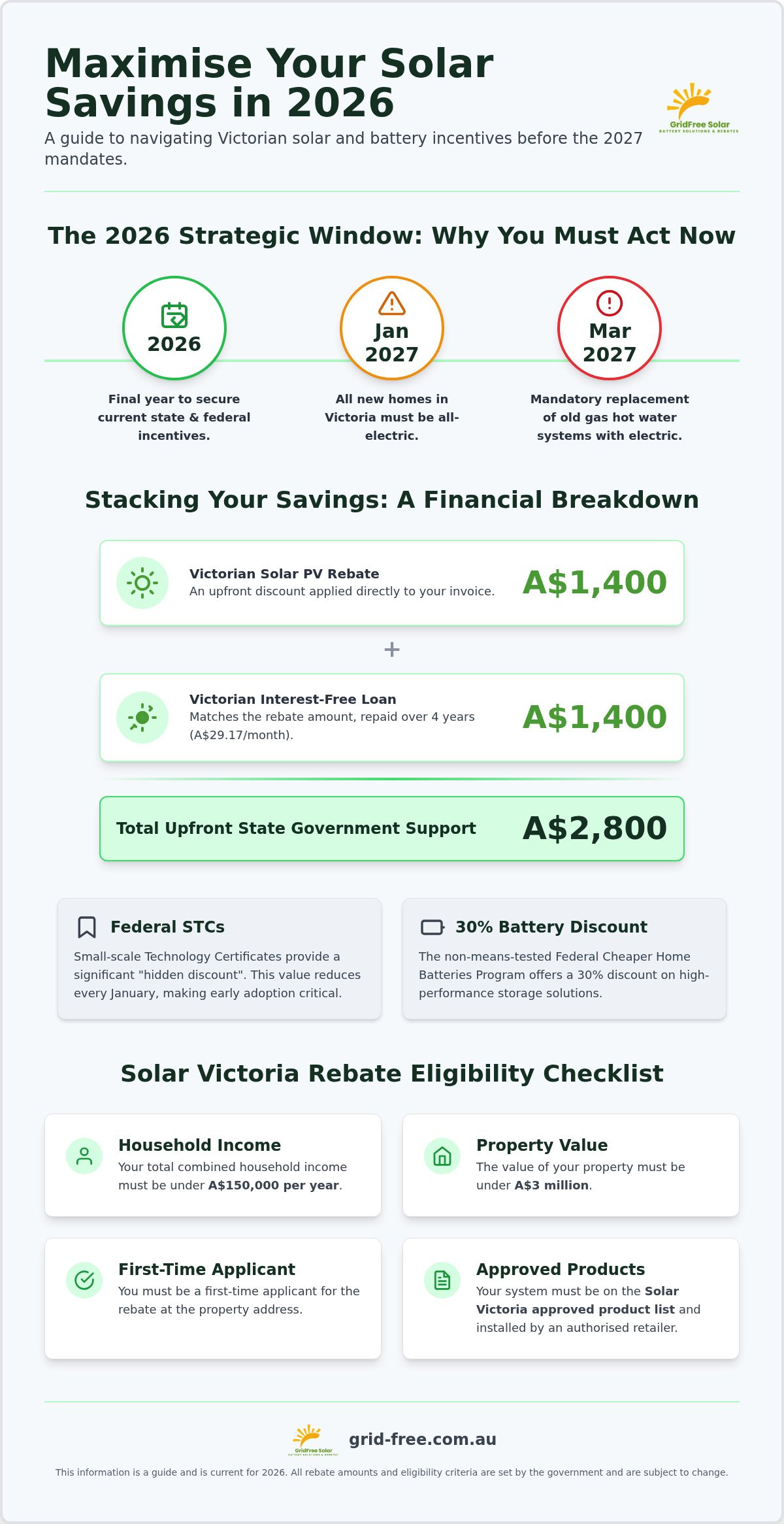
The countdown has begun. From January 1, 2027, all new homes in Victoria must be all-electric. More importantly for existing homeowners, from March 1, 2027, end-of-life gas hot water systems must be replaced with efficient electric heat pumps. These changes make solar PV the non-negotiable foundation of a modern property. By acting in 2026, you protect your property value. You ensure your home meets future standards before the inevitable rush on installers leads to price hikes and stock shortages. High-performance solar becomes the engine room that powers your heating, cooling, and hot water without the sting of gas bills.
Melbourne Energy Market Trends in 2026
Melbourne’s retail power prices remain volatile. Energy retailers now set their own feed-in rates, which has drastically reduced the ROI on solar-only systems that export to the grid. The smart money is on self-consumption. Modern “time-of-use” tariffs penalise you for using power during peak evening hours, exactly when solar production stops. This is why 2026 is the year of the battery. Stacking Solar Victoria rebate eligibility with federal storage discounts allows you to capture your own midday “free” energy and use it when the grid is most expensive. Every quarter you delay is a missed opportunity to lock in these decade-low entry costs. The transition is inevitable. The incentives, however, are temporary.
Victorian Solar Homes Program: Rebates and Interest-Free Loans
The Solar Homes Program is the primary engine driving Melbourne’s transition to renewable energy. In 2026, the financial incentives remain substantial, but the administrative requirements have tightened. Understanding the nuances of Solar Victoria rebate eligibility is the difference between a seamless installation and a rejected application. The centrepiece of this program is the Victorian solar panel rebate, which offers up to A$1,400 for eligible households. This isn’t a tax back-claim; it’s an upfront discount applied directly to your invoice by an authorised retailer.
The A$1,400 Solar PV Rebate Breakdown
To secure this funding, your system must consist of components from the Solar Victoria approved product list. This ensures every panel and inverter meets rigorous safety and performance standards. A common misconception is that you only get one rebate per lifetime. In reality, if you’ve previously received a rebate and move to a new address, you’re entitled to apply again for your new property. This flexibility is vital for Melbourne’s growing housing market. Our team at GridFree Solar manages the entire Solar Victoria portal application for you, ensuring your technical documentation is flawless from day one.
Interest-Free Loans: Reducing Upfront Costs to Zero
Cash flow shouldn’t be a barrier to energy independence. Solar Victoria offers an optional interest-free loan of up to A$1,400 to match the rebate amount. This effectively doubles your upfront government support to A$2,800. The repayment terms are designed to be “bill-neutral.” With monthly payments fixed at A$29.17 over four years, the electricity savings from your new system typically exceed the loan cost. It’s a strategic financial move that allows you to preserve your capital while immediately slashing your quarterly utility expenses.
Incentives for Construction and Rentals
The 2026 program specifically targets renters and those building new homes. Landlords can claim a rebate of up to A$1,400 for a maximum of two rental properties per financial year. This creates a win-win scenario where property value increases while tenants enjoy lower running costs. If you’re currently in the construction phase, you can apply for rebates before you move in. This allows you to coordinate with your builder to ensure all wiring and mounting systems are rebate-compliant from the start. Stacking these incentives with the A$1,000 to A$1,400 hot water rebate provides the ultimate financial foundation for an all-electric home.
The Federal “Hidden” Discount: Small-scale Technology Certificates (STCs)
The state rebate is only half the story. To achieve the lowest possible out-of-pocket cost, you must leverage the federal Small-scale Renewable Energy Scheme. While meeting the Solar Victoria rebate eligibility criteria secures your A$1,400 state funding, the federal discount happens automatically at the point of sale. These certificates, known as STCs, function as a form of renewable energy currency. They represent the amount of clean energy your system will generate over its lifetime. Most Melbourne homeowners don’t realise that this “hidden” discount often provides a larger financial benefit than the state rebate itself.
The smartest financial move in 2026 is the “Stacking Strategy.” By combining the Victorian government’s upfront rebate with the federal STC discount, you effectively slash the gross cost of a premium system by 30% to 50%. Navigating Solar Victoria rebate eligibility ensures you get the state’s contribution, but the federal layer is what makes high-performance Tier 1 hardware affordable. This dual-incentive approach is the primary reason why Melbourne has one of the fastest solar payback periods in the country. Delaying your installation doesn’t just cost you in energy bills; it costs you in lost certificate value.
Calculating Your STC Value in Victoria
Melbourne is classified as Solar Zone 4. This rating determines exactly how many certificates your installation generates based on the expected sunshine hours in our region. A standard 6.6kW residential system in Victoria typically generates dozens of certificates, while a larger 10kW commercial-grade setup yields significantly more. The total dollar value fluctuates based on the open market price for STCs, but it remains a substantial four-figure sum for most households. Your installer usually handles the STC trade-in for you by deducting the value from your final quote.
The STC Phase-Out Schedule
The federal incentive is not permanent. It is designed to reduce every year on January 1st as part of a scheduled phase-out ending in 2030. This means a system installed in December 2026 will be worth more in government incentives than the exact same system installed in January 2027. The reduction is roughly 10% annually. Waiting another year effectively increases your out-of-pocket cost without any change in hardware quality. As the “deeming period” shrinks, the window to maximise your ROI closes. Act now to lock in 2026 certificate values before the next scheduled reduction takes effect.
Are You Eligible? Victorian Incentive Requirements
Success in securing government funding starts with meeting the strict Solar Victoria rebate eligibility criteria. The government has tightened the screws for 2026. If you don’t tick every box, your application will fail before it even reaches the portal. Precision is everything. You must ensure your financial and technical details align perfectly with the latest Notice to Market requirements to avoid costly delays or outright rejection.
Financial Eligibility Deep Dive
The most significant hurdle is the combined household taxable income cap. As of July 1, 2026, this threshold is A$150,000 per year. This figure applies to the total taxable income of all owners listed on the property title. It’s based on your most recent ATO Notice of Assessment. If you’re self-employed, your taxable income is the amount remaining after all allowable business deductions. This is a critical distinction that often trips up applicants who confuse gross turnover with taxable profit.
Your property must also be valued at under A$3 million. Solar Victoria uses the Capital Improved Value (CIV) listed on your most recent rates notice to verify this. Don’t rely on bank valuations or recent real estate appraisals; they only accept the official council figure. These rules apply to both owner-occupiers and Melbourne landlords. While landlords can claim rebates for up to two rental properties per financial year, the A$150,000 income cap and A$3 million property limit remain non-negotiable benchmarks.
Documentation is the backbone of your application. You’ll need clear copies of your council rates notice and proof of income for all applicants. If you’ve recently purchased a property and haven’t received a rates notice yet, have your settlement papers and Title Search ready. Our team ensures every document is formatted correctly before submission.
Technical Eligibility: Authorised Retailers and Products
Compliance extends beyond your bank account to the hardware on your roof. You must use a Solar Victoria Authorised Retailer. Choosing a non-authorised provider means you forfeit the A$1,400 rebate and the interest-free loan entirely. There are no exceptions. The panels and inverters must also appear on the Solar Victoria Approved Product List. This database is updated frequently. A component that was eligible in 2025 might be removed in 2026 if it fails to meet new efficiency or safety benchmarks.
Cheap, generic systems often fail these standards. They end up costing you more in the long run through lost incentives and high maintenance costs. We verify every SKU against the live government database before providing your quote. Don’t risk a rejected application. Let our specialists at GridFree Solar handle your eligibility check and portal submission to secure your funding today.
Maximising Your ROI: Beyond the Initial Rebate
Securing the A$1,400 PV rebate is only your first move. In 2026, real financial savvy lies in how you manage storage and grid interaction. Self-consumption is now the gold standard for Victorian energy users. Feed-in tariffs no longer provide the reliable income they once did. Since July 1, 2025, the Essential Services Commission stopped setting a minimum tariff. Retailers now set their own rates, which are often significantly lower than peak usage costs. This makes Solar Victoria rebate eligibility for your initial system a foundational step, but your long-term ROI depends on smart battery integration.
The Solar Battery Opportunity in Melbourne
The landscape for energy storage has shifted dramatically. While the Solar Victoria interest-free battery loan is no longer available, the Federal Government’s Cheaper Home Batteries Program has filled the gap. This program provides a non-means-tested discount of roughly 30% on upfront costs. It’s a critical incentive for those preparing for 2027 all-electric readiness. You need storage capacity to power heat pumps and electric appliances overnight without relying on the expensive evening grid. For a deeper dive into current storage incentives, see our Victorian Battery Rebate 2024 to 2026 guide.
Virtual Power Plants (VPPs) and Demand Response
Virtual Power Plants are the hidden profit layer for Melbourne homeowners in 2026. By joining a VPP, you allow a provider to briefly tap into your battery during periods of high grid stress. In exchange, you receive ongoing bill credits or premium feed-in rates during those specific windows. It’s a sophisticated way to monetise your hardware. You maintain your energy independence while actively supporting the local grid. The most advanced programs now offer seamless integration with smart home systems, ensuring you always have a reserve for your own household needs.
The GridFree Professional Advantage
Complexity is the enemy of progress. The Solar Victoria portal is notoriously difficult to navigate. One minor clerical error can disqualify your application and cost you thousands in lost incentives. We provide a “Paperwork-Free” promise. Our team manages the entire Solar Victoria rebate eligibility process, from initial quote upload to final approval. Professional installation isn’t just about safety; it’s about long-term rebate compliance and system longevity. Secure your future energy needs with our expert Solar Panel Installation Melbourne services. Act now before the 2027 mandates fundamentally shift the market.
Secure Your Energy Future Before the 2027 Shift
The window for maximum government support is closing fast. By acting in 2026, you lock in the A$1,400 state rebate and higher federal STC values before the next scheduled reduction. You also prepare your home for the 2027 all-electric mandates that will soon redefine the Victorian property market. Don’t let the technicalities of Solar Victoria rebate eligibility hold you back from energy independence. Our team of Melbourne-based solar experts specialises in rebate stacking and handles every detail of the complex government portal for you. As an Authorised Solar Victoria Retailer, we guarantee that your system meets all technical standards for seamless funding approval. You deserve the long-term security of a high-performance energy upgrade without the administrative stress. Take control of your rising power bills and join the thousands of Victorian households already profiting from intelligent solar innovation. The sun is a reliable partner; it’s time you put it to work for your budget.
Check Your Eligibility and Get a Custom Solar Quote Today
Frequently Asked Questions
Can I get the Victorian solar rebate if I already have solar panels installed?
Generally, no. If your property has previously received a solar panel or battery rebate, it is ineligible for another. However, if you move to a new address, you can re-apply regardless of your previous history. If you have an existing system but never claimed a rebate, you may qualify for an upgrade or replacement. Always verify your specific Solar Victoria rebate eligibility before committing to new hardware to ensure your investment is protected.
What is the exact income limit for the Victorian solar rebate in 2026?
The combined household taxable income limit is A$150,000 per year as of July 1, 2026. This threshold includes the taxable income of all owners listed on the property title. You must provide your most recent ATO Notice of Assessment to prove compliance. This reduction from previous years aims to target support toward low and middle-income households. Ensure all owners’ documentation is prepared to avoid delays during the critical assessment phase.
How do I apply for the interest-free solar loan through Solar Victoria?
You apply for the interest-free loan through the Solar Victoria portal after receiving a formal quote from an authorised retailer. Once your retailer uploads the quote, you’ll receive an email to start your eligibility application. You can choose to match the A$1,400 rebate with an equal interest-free loan. This loan is repaid over four years in monthly instalments of A$29.17, typically deducted via an automated and seamless payment plan.
Can I stack the Victorian solar rebate with the federal STC discount?
Yes, stacking state and federal incentives is the most effective way to reduce costs. The federal STC discount is applied as an upfront reduction on your quote by your installer. The A$1,400 Victorian rebate is then applied to the remaining balance. This combination can reduce the total price of a premium residential system by up to 50%. It represents the maximum financial assistance available for Melbourne homeowners during the 2026 calendar year.
Is there a specific rebate for solar batteries in Victoria right now?
The specific Solar Victoria battery rebate and interest-free loan have been discontinued. However, Victorian residents can now access the Federal Government’s Cheaper Home Batteries Program. This provides a discount of approximately 30% on the upfront cost of a battery system. Unlike some state incentives, this federal program is not means-tested. It offers a significant opportunity for households to achieve 24/7 energy independence without the A$150,000 income restriction typically found in other programs.
Do solar rebates apply to new homes under construction in Melbourne?
Yes, you can apply for the solar panel rebate for a home currently under construction. This allows you to integrate solar into the building process, ensuring all technical requirements are met before you move in. You must still meet the standard Solar Victoria rebate eligibility criteria, including the income and property value thresholds. Coordinating with your builder and an authorised retailer early ensures the installation occurs safely and remains fully compliant with all government standards.
How long does it typically take for the Victorian solar rebate to be approved?
Approval times generally range from two to five weeks, depending on the volume of applications and the accuracy of your documentation. You must wait for your eligibility confirmation before installing your system. Installing early will result in a rejected claim and the loss of all state funding. Using an experienced retailer to manage the portal submission reduces the risk of clerical errors that lead to lengthy and frustrating administrative delays.
What happens to my solar rebate eligibility if I move house within Victoria?
Your eligibility resets when you move. Even if you received a rebate at your previous residence, you are entitled to apply again for your new property address. The program tracks eligibility by property, not just by individual. As long as your new home hasn’t previously received a rebate and you still meet the income and property value limits, you can secure fresh funding for a new solar installation at your new Melbourne home.