
Last Updated: October 29, 2026
Quick Summary
A solar tracker is rarely worth the extra cost for a typical home, but it can pay off for a commercial site with high daytime electricity use, open ground and a long investment horizon. The decision comes down to a site-specific payback calculation, not a universal rule.
- A single-axis tracker is the realistic option; dual-axis rarely justifies its extra motor, structure and maintenance.
- Payback depends on self-consumption: extra generation used on site at retail rates pays back fastest.
- Trackers need wider row spacing and backtracking, so a tight site may generate less per hectare.
- Budget for ongoing maintenance from day one, since motors, bearings and controllers are the parts most likely to fail.
- For most households, a larger fixed array or added battery storage beats tracking on cost-effectiveness.
Table of Contents
- Solar Tracker vs Fixed Panels: The Comparison at a Glance
- How a Solar Tracker Works and Where It Fits
- Solar Tracker Efficiency Gains Compared With Fixed-Tilt Systems
- Upfront Cost, Payback Period and Return on Investment
- Solar Panel Maintenance Costs and Whole-Life Reliability
- Site Conditions, Weather and Terrain Constraints
- Residential vs Commercial: Which Buyer Should Track the Sun
- Get a Site-Specific Assessment Before You Commit
- Frequently Asked Questions
Solar Tracker vs Fixed Panels: The Comparison at a Glance
A solar tracker is a mounting system that rotates panels to follow the sun, and whether a solar tracker is worth the extra cost comes down to one trade: more energy generated against more money spent, more moving parts, and more site constraints.
The short answer: tracking rarely stacks up for a typical home, but it can for a commercial site with the right load profile and space. Below, we break down efficiency gains, payback maths, maintenance costs and the site conditions that decide it.
| Factor | Fixed-Tilt System | Single-Axis Tracker | Dual-Axis Tracker |
|---|---|---|---|
| Energy yield | Baseline | Higher | Highest |
| Upfront cost | Lowest | Moderate | Highest |
| Moving parts | None | Motorised drive | Two drive axes |
| Maintenance burden | Minimal | Moderate | Highest |
| Best for | Homes, constrained sites | Commercial ground-mount | Niche, high-value sites |
How a Solar Tracker Works and Where It Fits
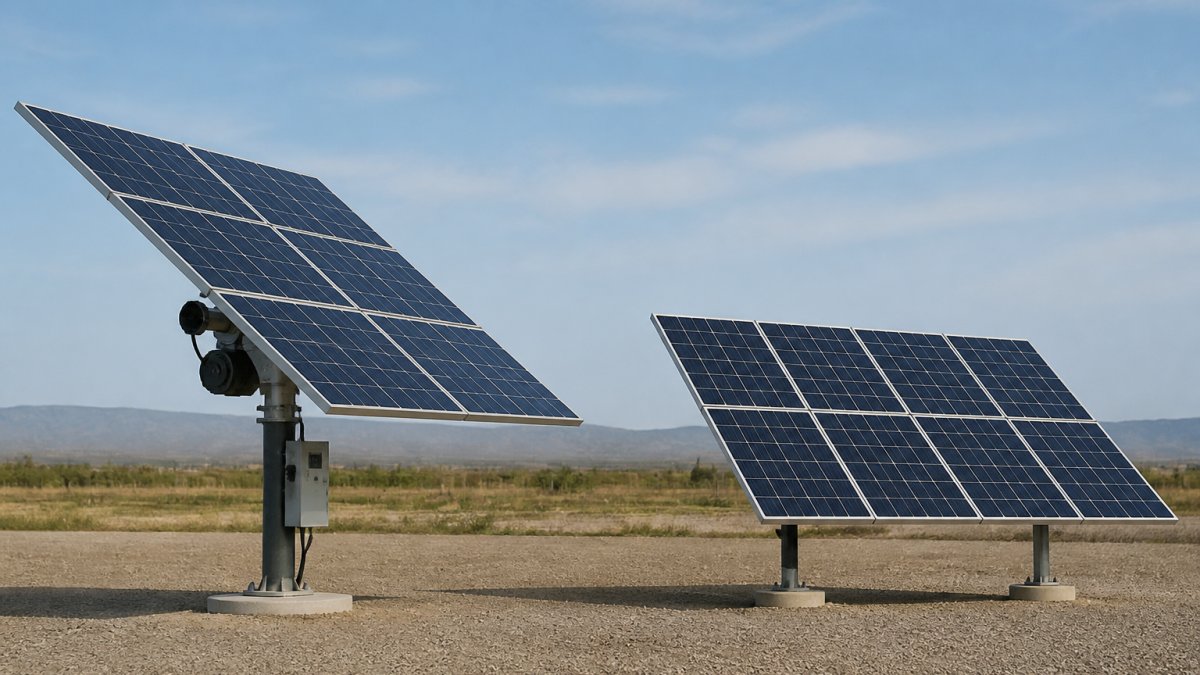
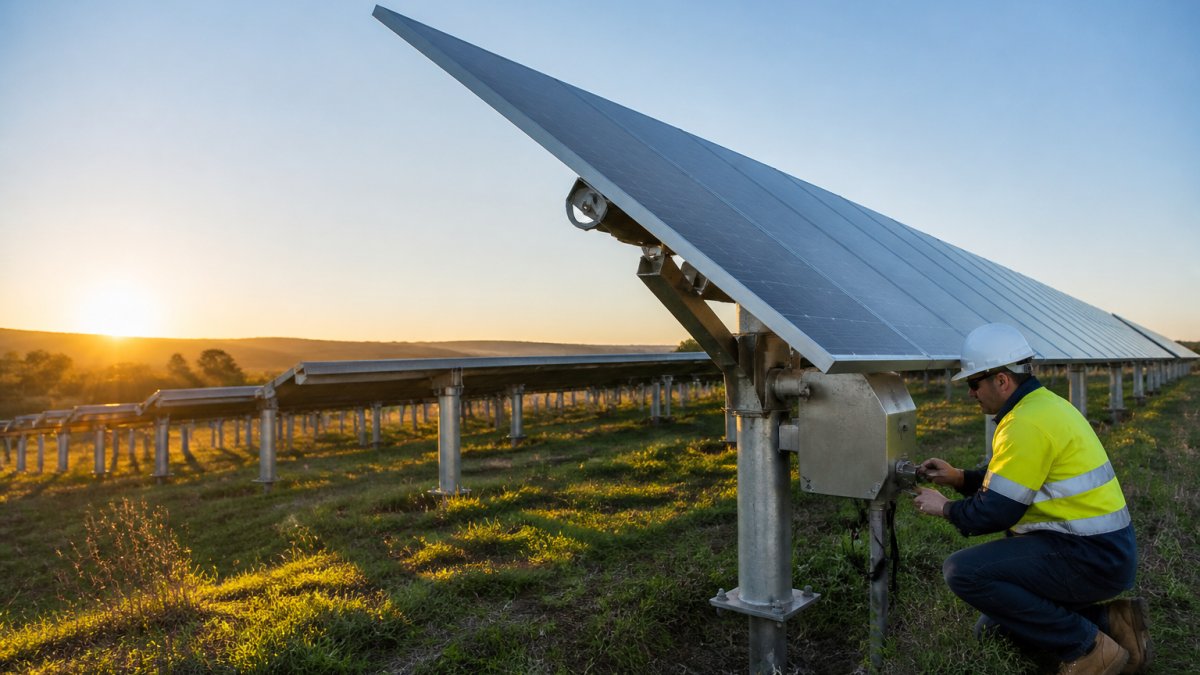
A tracking system uses a motorised drive and a controller to tilt a ground-mounted solar array toward the sun, so the panels meet sunlight more directly through the day instead of sitting at one fixed tilt angle.
That mechanical movement is the whole point, and the whole problem. Fixed panels win on simplicity: nothing moves, so nothing wears out.
Single-Axis vs Dual-Axis Tracking Systems
A single-axis tracker rotates on one axis, usually east to west, following the sun’s daily arc. It is the common choice for commercial and utility-scale solar because it captures most of the available gain for a fraction of the complexity.
A dual-axis tracker moves on two axes, tracking both the daily arc and seasonal height changes. It captures more energy again, but the extra motor, structure and maintenance rarely justify it outside niche, high-value installations. Most buyers should treat single-axis as the realistic option.
Solar Tracker Efficiency Gains Compared With Fixed-Tilt Systems
Solar tracker efficiency gains are real but often overstated. Tracking increases energy production compared with a fixed-tilt system by keeping panels closer to perpendicular to the sun, lifting yield through the morning and afternoon shoulders especially.
A tracker harvests more energy per panel, but it does not make panels magically better. If your fixed array is already well-oriented and unshaded, the tracking gain is smaller than a brochure implies.
Upfront Cost, Payback Period and Return on Investment
The upfront cost of a tracking system is meaningfully higher than a fixed ground-mount, because you pay for steel, motors, controllers and commissioning on top of the panels.
Payback period is where most tracker pitches fall apart. A tracker’s return on investment depends on self-consumption: the more of that extra generation you use on site at retail electricity costs, the faster the payback.
A Transparent Payback Framework You Can Actually Run
Most articles stop at “it depends”. Here is the framework we use, with assumptions stated so you can substitute your own numbers.
Step 3, Split the added generation by value. This is the step most payback claims skip.
Step 4, Subtract annual maintenance and downtime. Motors, bearings and controllers need servicing, and each failure is a call-out plus lost generation.
Step 5, Divide net added cost by net annual benefit. That gives years to payback.
The tracker decision is not really about generation gain, it is about the value of the added generation. A site that self-consumes most of its output at retail rates can justify tracking on a gain that would fail badly on a site exporting at a low feed-in tariff.
Worked Example Structure (Substitute Your Own Figures)
To make this concrete without inventing numbers, here is the structure of a comparison you can build in a spreadsheet:
| Line item | Fixed-tilt | Single-axis tracker | Difference |
|---|---|---|---|
| Installed cost per kW | Your quote | Your quote | Added capital |
| Annual yield per kW | Modelled | Modelled + gain | Added kWh |
| Self-consumed share | Your load profile | Your load profile | , |
| Retail rate applied | Your tariff | Your tariff | , |
| Feed-in tariff applied | Your rate | Your rate | , |
| Annual maintenance | Minimal | Budgeted | Added cost |
| Net annual benefit | , | , | Added value minus added cost |
| Years to payback | , | , | Added capital ÷ net annual benefit |
Run the same table for a household with low daytime load and a business with high daytime load and the conclusion flips. That is the honest answer to whether a solar tracker is worth the extra cost: a site-specific calculation, not a universal rule.
Working Out Payback for Your Own Site
We would not trust a generic payback figure, and neither should you. Build it from your own numbers:
- Estimate the tracker’s added energy yield against your fixed-tilt baseline
- Split that yield into self-consumed energy and exported energy
- Apply your retail electricity cost to the self-consumed portion
If the result sits beyond your comfort horizon, a larger fixed array or added battery storage usually beats tracking on cost-effectiveness. To model realistic figures for your own site, our guide to commercial solar system payback walks through the comparison.
Solar Panel Maintenance Costs and Whole-Life Reliability
Solar panel maintenance costs are the quiet killer of tracker economics. A fixed-tilt system has no moving parts, so servicing is largely inspection and cleaning. A tracker adds a motorised drive, bearings, controllers and sensors, all of which wear and need checking.
Whole-life reliability matters more than the sticker price. Our guide to solar energy system maintenance services explains what’s included, costs, and how often to service.
Site Conditions, Weather and Terrain Constraints
Site conditions decide whether tracking is even sensible. Readers with flat or constrained roofs can find mounting options and output guidance in our solar panel installation on flat roof Melbourne guide.
But the real-world constraints run deeper than “do I have space”. Trackers are mechanical systems exposed to weather, and the site has to be engineered for the loads the array will see over two decades.
Wind Loading and Stow Modes
A tracker presents a much larger sail area to the wind than a fixed array, and it changes orientation through the day, so wind loading is a structural design input, not an afterthought. Trackers move to a stow position, typically flat or at a defined angle, when wind speeds exceed a threshold, and the controller needs a reliable anemometer to trigger it.
Hail, Snow and Dust
Hail stress is greater on moving parts than static ones, and some trackers offer a hail-stow position that minimises panel exposure. Snow matters on high ground: a tracker at a steep angle sheds snow better than a flat fixed array, but the drive and bearings face icing and load issues. Dust and grit accelerate wear on bearings and seals, relevant in dry inland areas.
Shading and Row Spacing
Trackers need wider row spacing than fixed-tilt arrays because the panels swing and because backtracking, the controller rotating rows to avoid one shading the next, reduces yield at low sun angles. On a tight site, the land-use penalty can offset the energy gain: a tracker may generate more per panel but less per hectare than a well-spaced fixed array. If land is your binding constraint, model output per square metre, not per panel.
Terrain and Grading
Trackers are happiest on flat, graded ground. Sloped or rocky sites require grading, retaining or bespoke foundations, all of which add cost and can push a marginal project into negative territory. Uneven terrain also complicates row alignment and can increase shading between rows.
A tracker that stows for wind, sheds hail and backtracks for shading is doing its job, but every one of those behaviours is a design decision with a cost. If your installer cannot explain the stow thresholds, wind rating and row spacing for your site, the payback model is incomplete.
A Site Suitability Checklist
Before you model payback, confirm the site can actually support tracking:
- Ground area sufficient for wider row spacing and swing clearance
- Wind region rating and stow threshold confirmed for the tracker model
- Shading survey across the full swing arc, not just the fixed-tilt position
If the site passes this checklist, the payback framework in the previous section is the next step, and it is the payback maths, not the site, that usually decides the answer.
Residential vs Commercial: Which Buyer Should Track the Sun
For residential solar, a tracker is almost never worth the extra cost. A well-designed fixed rooftop system, paired with battery storage, delivers strong energy savings without motors to maintain or ground space to find.
For commercial buyers, the calculus shifts. A business with heavy daytime electricity use, open ground and a long investment horizon can justify tracking because it self-consumes the added generation at retail rates. Business readers can frame the decision with our commercial solar panels Victoria buying guide.
Get a Site-Specific Assessment Before You Commit
No article can tell you whether tracking pays on your block, because the answer lives in your roof, your terrain, your electrical capacity and your power use.
GridFree Solar is a CEC Accredited Installer and works to AS/NZS 5139:2019 and AS/NZS 3000 standards, and provides rebate guidance so you understand what you may qualify for.
To see what your own site can support, get a quote and get the numbers before you spend.
Frequently Asked Questions
How much more efficient are solar trackers compared to fixed panels?
Single-axis trackers can lift energy yield over a fixed-tilt system, with dual-axis designs adding more again in high-sunlight locations. The gain comes from keeping panels closer to perpendicular to the sun as it moves across the sky. That percentage is not a guarantee for your roof or block: shading, tilt angle, orientation and local irradiance all shift the figure, which is why a site-specific yield model matters more than a headline number.
What are the maintenance requirements for residential solar trackers?
A tracker adds mechanical components, a motorised drive and often a controller, so it needs more attention than a static array. Expect periodic inspection of moving parts, fasteners, wiring and the drive unit, plus cleaning to keep the panels producing. Solar panel maintenance costs on a tracked system run higher than on a fixed mount because there are more parts that can wear or fail. Ask any installer for a written maintenance schedule and the expected service life of the drive before you commit.
Do solar trackers qualify for the Small-scale Renewable Energy Scheme?
Small-scale technology certificates under the Small-scale Renewable Energy Scheme are calculated from the rated capacity and deeming period of a system that meets eligibility rules, not from whether the panels are fixed or tracked. A tracker does not automatically earn extra certificates. Confirm your system’s eligibility and the current certificate value with your installer or the Clean Energy Regulator before relying on any rebate figure in a quote.
Are solar trackers suitable for high-wind areas?
Trackers carry more wind exposure than a low fixed-tilt mount because they present a larger moving surface and rely on mechanical components to hold position. In exposed or gusty locations, stowing behaviour, structural rating and footing design become deciding factors, and some sites simply are not suitable. Ask for the wind rating of the specific hardware and how it stows in a storm. On many suburban blocks, fixed panels plus additional capacity are the lower-risk path.
Why do most residential installers recommend fixed mounts over trackers?
On a typical home, roof space and budget are the real constraints, and a tracker only makes sense on ground-mounted systems with clear sun and room to move. Adding a few more fixed panels often delivers similar energy production for less money and no moving parts. Trackers earn their place where land is available and the goal is to harvest more energy per panel across a long horizon, which is why they dominate utility-scale solar farms rather than residential rooftops.
The real challenge is not choosing between a tracker and fixed panels in the abstract, it is knowing which one your site and load profile actually reward. GridFree Solar takes the guesswork out of that decision with CEC Accredited Installers, systems compliant with AS/NZS 5139:2019 and AS/NZS 3000, and rebate guidance built into every quote. Get started with GridFree Solar and design a system that pays you back.
