With the median Victorian feed-in tariff crashing to just 1.5c/kWh in 2026, exporting power is no longer a viable business strategy. It’s a missed opportunity. As network charges across Melbourne continue to surge, the logic for installing commercial solar panels Victoria has shifted from simple environmentalism to aggressive capital recovery. You’re likely feeling the pressure of rising overheads while facing a confusing maze of VEU certificates, STCs, and the fear of hiring an unaccredited installer who might leave your project stranded.
We understand that you need a clear ROI roadmap, not a sales pitch. This guide cuts through the jargon to help you master the 2026 landscape. You’ll learn how to leverage the September 2026 VEU updates to access up to $35,000 in incentives and why the four-year STC deeming period makes this the critical year for action. We’ll show you how to maximise every available rebate while future-proofing your operations with battery-ready infrastructure. Let’s move your business from grid dependence to energy sovereignty with a system designed for industrial-scale performance.
Key Takeaways
- Stop the ROI leak by understanding why delaying your transition to commercial solar panels Victoria is costing your business thousands as Melbourne energy prices climb.
- Master the 100% self-consumption model to ensure your system size perfectly aligns with your specific business operating hours and load profile.
- Navigate the complex 2026 crossover between VEU incentives and federal certificates to secure maximum upfront capital recovery for your project.
- Identify the specific engineering and safety credentials needed to choose a specialist commercial installer who understands industrial-scale complexities.
- Future-proof your energy independence by integrating storage solutions to slash the peak demand charges that often dominate Victorian commercial power bills.
Scaling Up: Why Victoria’s Commercial Energy Landscape is Shifting in 2026
In the Victorian market, “commercial solar” isn’t a vague catch-all term. It describes high-output systems, typically starting at 30kW and scaling into industrial-grade megawatt arrays. For Melbourne businesses in 2026, the energy environment has reached a tipping point. Sticking with the status quo isn’t a neutral choice; it’s an expensive one. With network charges for distribution and transmission continuing to climb across the state, the ROI on commercial solar panels Victoria has transitioned from a long-term sustainability goal to an immediate balance-sheet necessity. Waiting and seeing is no longer a viable strategy when every month of delay equals thousands of dollars in lost savings.
The transition we’re seeing in 2026 involves more than just bolting hardware to a warehouse roof. It’s a shift toward integrated energy management. Modern Victorian companies are using solar as the foundation for sophisticated systems that monitor load profiles and automate consumption. This proactive approach is also critical for meeting Environmental, Social, and Governance (ESG) targets. As supply chains tighten their requirements, having a robust renewable energy strategy is often the difference between winning a Tier 1 contract or being overlooked. Since Solar power in Australia continues to break records for generation and adoption, local businesses must keep pace to remain competitive.
The 30kW to 200kW Opportunity
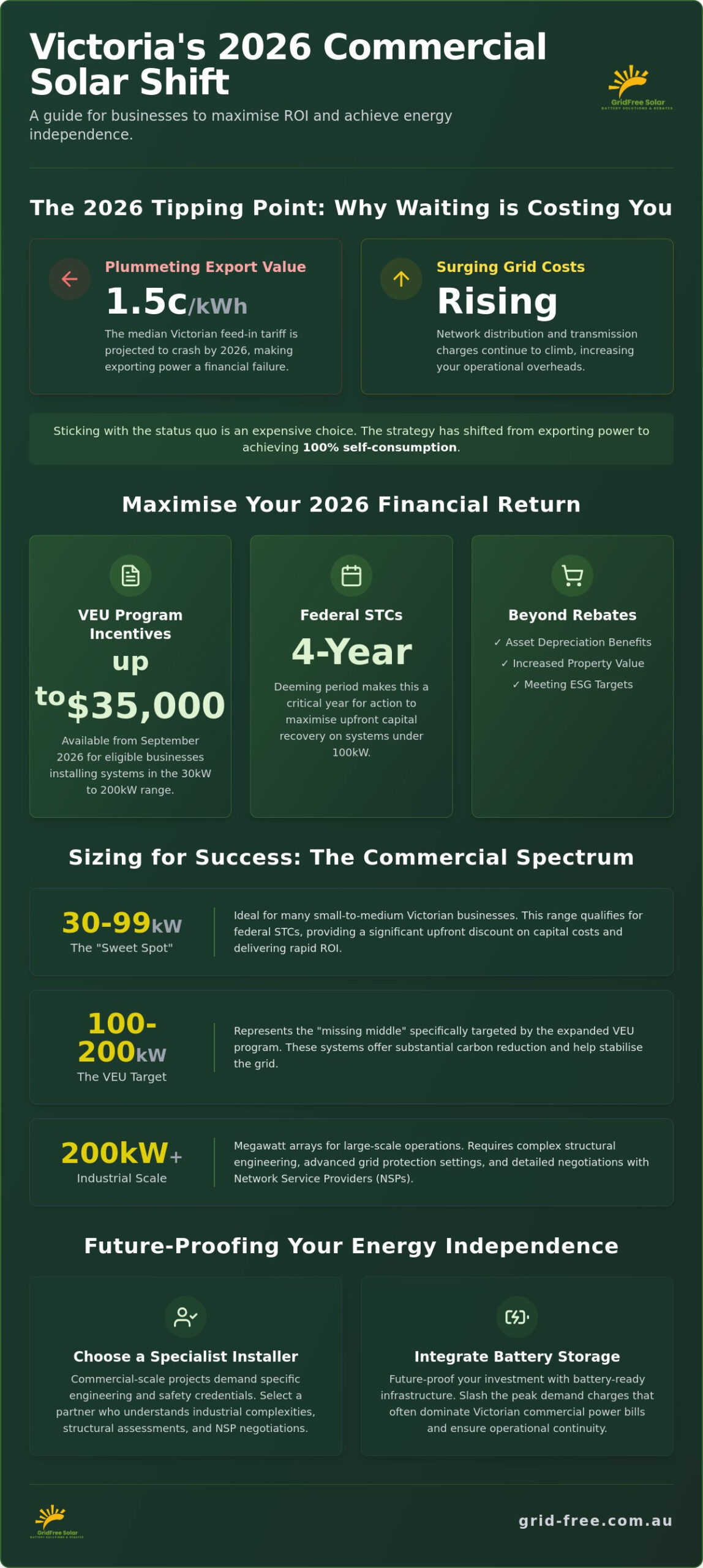
The Victorian Government has specifically expanded the Victorian Energy Upgrades (VEU) program to target the 30kW to 200kW range. This “missing middle” offers the most significant potential for rapid carbon reduction and grid stability. Engineering these systems is a world away from residential work. Large-scale setups require detailed structural assessments, complex grid protection settings, and rigorous negotiations with Network Service Providers (NSPs). From September 2026, eligible businesses can access up to $35,000 in VEU solar incentives, making this the most aggressive window for capital recovery we’ve seen in years.
Commercial ROI: Beyond the Utility Bill
Installing a commercial solar system creates a permanent, fixed-cost shield that protects your business from the volatile spikes of future network charges. Beyond the monthly savings, the financial logic is reinforced by Australian tax law. Asset depreciation benefits allow businesses to write down the value of the system, significantly offsetting the initial capital expenditure. For property owners, the value add is clear. A building equipped with a high-performing solar array commands higher lease rates and attracts long-term, high-quality tenants who prioritise energy efficiency. By investing in commercial solar panels Victoria, you aren’t just buying hardware; you’re securing a high-yield financial asset.
This investment in facility infrastructure often goes hand-in-hand with other high-end upgrades; for venues looking to enhance their corporate event capabilities, NextGen AV provides expert stage lighting design that complements a modern, energy-efficient building profile.
Determining the Right System Size: From 30kW to Industrial Scale
Sizing is an engineering discipline, not a sales tactic. In the Victorian market, the strategy has shifted. We no longer size for the highest possible generation; we size for 100% self-consumption. Why? Because the median feed-in tariff of 1.5c/kWh makes exporting power a financial failure. Every electron you send back to the grid is a missed opportunity to offset retail rates that are significantly higher. To ensure you’re capturing every benefit, including the latest Victorian commercial solar rebates, your system must be tailored to your specific interval meter data.
Interval meter data is the “black box” of your business operations. It records your energy usage in 30-minute slices over a full year. This data reveals exactly when your machines hum and when your facility goes dormant. Without this analysis, you risk over-investing in capacity you’ll never use or under-sizing a system that fails to crush your peak demand charges. For businesses in older industrial zones like Campbellfield or Dandenong, roof orientation and structural integrity also dictate your limits. While north-facing panels offer the highest total yield, west-facing arrays are often superior for businesses looking to shave down expensive late-afternoon peak loads.
Small-to-Medium Commercial (30kW – 99kW)
This range is the “sweet spot” for many Victorian businesses. Systems under 100kW qualify for Small-scale Technology Certificates (STCs), which provide a significant upfront discount. Payback periods for these systems are typically between 3 and 5 years, making them an incredible investment for retail centres and office complexes. The grid connection process is also streamlined, avoiding the heavy technical hurdles of larger industrial installations. If you want to see how these numbers stack up for your specific site, you can request a custom load-profile analysis to identify your optimal capacity.
Large-Scale & Industrial (100kW – 200kW+)
Once you cross the 100kW threshold, the financial and technical landscape changes. You move from STCs to Large-scale Generation Certificates (LGCs), which are created based on the actual power your system produces over time. These projects require custom engineering and rigorous Network Protection Studies to satisfy Victorian distributors like AusNet or United Energy. For manufacturing plants with high baseload requirements, these systems are essential. They don’t just lower bills; they provide the industrial-scale energy independence required to stay competitive in a high-cost environment. By installing commercial solar panels Victoria at this scale, you’re transforming your roof into a high-yield power plant.
Navigating Victorian Commercial Rebates and Incentives in 2026
Financial agility in 2026 depends on how well you stack Victorian and federal incentives. Many directors believe they have to choose between state and federal support. That’s a myth. In reality, combining the Victorian Energy Upgrades (VEU) program with federal certificates is the gold standard for maximising capital recovery on commercial solar panels Victoria. However, the strategy shifts dramatically once you approach the 100kW threshold. You need to understand the crossover point to avoid leaving thousands of dollars on the table.
The 2026 incentive landscape is more aggressive than previous years but requires more precision. While the federal SRES scheme provides the baseline, the Victorian state layer adds the necessary “boost” for projects between 30kW and 200kW. Smart businesses are currently pairing these solar discounts with storage incentives to achieve a total energy hedge. If you’re eyeing storage to combat the low feed-in tariffs discussed earlier, check our Victorian Battery Rebate 2024 to 2026: The Complete Guide to Storage Savings. This federal program provides a discount of roughly 30% on eligible battery systems, creating a powerful synergy with your solar investment.
The VEU Discount: Upfront Savings for Victoria
The VEU program operates through Victorian Energy Efficiency Certificates (VEECs). These aren’t just bureaucratic tokens. They represent a substantial upfront discount applied at the point of sale by an Accredited Provider (AP). From September 2026, the VEU solar incentive offers up to $35,000 for systems between 30kW and 200kW. This applies to various non-residential sites, including schools, community buildings, and hospitals. VEU discounts are strictly performance-based, meaning higher-efficiency panels yield better rebates by proving greater carbon abatement.
LGCs: The Long-Term Revenue Stream
The real complexity lies in the 100kW crossover. Systems under 100kW generate Small-scale Technology Certificates (STCs). In 2026, the STC deeming period is down to just four years. This makes the upfront value lower than in the past, though it remains a “set and forget” mechanism. If your facility requires a system of 100kW or larger, you move into the Large-scale Generation Certificate (LGC) market. LGCs aren’t a one-off discount. They provide an ongoing income stream where certificates are created based on the actual power your system produces. While this requires more administrative oversight, the 2026 market rates for LGCs make them an attractive powerhouse for Victorian heavy industry.
Key Selection Criteria for Victorian Commercial Solar Installers
Choosing the wrong partner for a multi-kilowatt project is a significant liability. Residential experience does not translate to commercial success. A residential setup is often a standardised kit; an industrial project is a complex engineering feat. When investing in commercial solar panels Victoria, you must look beyond basic electrical licences. You need a team led by CEC Accredited Designers and Installers who hold specific commercial endorsements. This verification ensures their ability to handle structural load limits, high-voltage switchgear, and the specific grid protection requirements of Victorian networks. For a deeper dive into technical benchmarks, read our guide on Commercial Solar Installation Melbourne: Future-Proof Your Business in 2026.
The stakes are high. A poorly designed system won’t just underperform. It could jeopardise your insurance or cause expensive operational downtime. High-authority installers treat your roof as a power plant, not a hobby project. They provide detailed engineering drawings and clear performance guarantees before a single panel is lifted.
CEC Accreditation and Victorian Compliance
Safety and compliance are non-negotiable. Ensure your installer is a Clean Energy Council (CEC) Approved Solar Retailer, which is now integrated into the New Energy Tech Consumer Code (NETCC). This ensures a high standard of consumer protection. In Victoria, your installer must also be a Registered Electrical Contractor (REC). This is critical for meeting WorkSafe standards on large-scale sites. Your partner should have documented experience with Victorian Distribution Network Service Providers (DNSPs) like Citipower, Powercor, and United Energy to ensure seamless grid connection and compliance.
Warranties and Post-Installation Support
A “Tier 1” panel claim is often misunderstood by buyers. It doesn’t just mean high quality; it means the manufacturer is financially stable and “bankable” for the next 25 years. Sourcing components through experienced global partners like EEHD Erneuerbare Energien Handel und Distribution GmbH provides the assurance of quality and supply chain stability that Victorian industrial projects demand. You need to distinguish between product, performance, and workmanship warranties. A 25-year performance warranty is useless if the manufacturer disappears in five. Demand 24/7 monitoring portals to track your ROI in real-time. A professional O&M contract should guarantee a technician on-site within 24 to 48 hours for critical system faults to prevent revenue leakage.
Don’t leave your energy independence to chance. Secure your project’s success by choosing a partner with proven industrial expertise; get a professional site assessment today.
Future-Proofing: Integrated Solar and Battery Solutions
2026 has officially become the year of the “Hybrid Commercial System”. Relying solely on commercial solar panels Victoria is a solid first step, but it’s no longer the complete solution for total energy independence. With the deregulation of feed-in tariffs making exports less profitable, the priority has shifted. You must capture and store every kilowatt-hour your roof produces. By integrating storage, you stop being a passive consumer and become an active energy manager. It’s about control.
Peak demand charges are the silent drain on Victorian business accounts. These charges often account for 50% of a total utility bill; they penalise you for the brief moments your facility hits maximum draw. Batteries act as a buffer. They discharge during these high-intensity windows to “shave” your peak, which drastically lowers your network costs. Beyond internal savings, Victorian businesses can now participate in Virtual Power Plants (VPPs). During Melbourne heatwaves, when the grid is under extreme stress, you can be paid to discharge power. This turns your battery into a revenue-generating asset. For detailed technical specifications, explore our Energy Storage Solutions Melbourne: Your 2026 Guide to Grid Independence.
Commercial Battery Storage ROI
The financial logic for storage is built on load shifting. You capture solar energy at midday and use it at 6 PM when retail rates and demand charges are at their highest. For businesses with critical infrastructure like cold storage or data servers, a battery also provides essential Uninterruptible Power Supply (UPS) capabilities. This prevents catastrophic stock loss or data corruption during local grid failures. While payback periods vary, a 30kWh+ commercial battery in Victoria now offers a compelling return. This is especially true when factoring in the 30% discount available through the federal Cheaper Home Batteries Program.
Starting Your Victorian Solar Journey
Transitioning to a high-performance energy system requires a methodical approach. We follow a strict three-step process to ensure your investment is sound. A generic desktop quote isn’t enough for an industrial-scale project. We start with a data audit of your 12-month interval meter files to identify your exact load profile. Next, a professional on-site visit is mandatory for any system over 30kW to assess structural integrity and switchboard capacity. Finally, we manage the complex VEU and federal certificate paperwork to ensure you receive your maximum entitlement upfront.
The window for maximum capital recovery is open, but it won’t stay that way forever. Secure your business’s financial future and end the cycle of skyrocketing energy costs. Contact GridFree Solar for a custom Victorian commercial energy audit and take control of your power today.
Secure Your Energy Sovereignty in 2026
The Victorian energy market has shifted. Relying on outdated grid models is now a direct threat to your bottom line. Success in 2026 requires a precise alignment of system sizing with your interval load data and the strategic stacking of VEU and federal incentives. By moving toward a hybrid model that prioritises self-consumption, you eliminate the risk of fluctuating network charges and low feed-in tariffs. It’s time to transform your roof into a high-yield financial asset that powers your growth for decades.
Don’t let technical complexity or administrative hurdles stall your progress. Our team of CEC Accredited Commercial Designers specialise in VEU and LGC rebate maximisation, providing local Melbourne-based engineering and support to ensure your project delivers on its ROI promise. Secure your competitive advantage by installing commercial solar panels Victoria with a partner who understands the industrial landscape. Request a Commercial Solar ROI Audit for Your Victorian Business today. Take the first step toward a future-proofed, independent energy strategy that works as hard as you do.
Frequently Asked Questions
Is my Victorian business eligible for the VEU commercial solar discount?
Yes, your business is eligible if you install a system between 30kW and 200kW at a non-residential site. This applies to warehouses, schools, hospitals, and community buildings across the state. An Accredited Provider must facilitate the upgrade to ensure all Victorian energy efficiency standards are met for the upfront discount.
What is the difference between STCs and LGCs for commercial systems?
STCs provide an immediate upfront discount for systems under 100kW. LGCs operate as an ongoing revenue stream for larger industrial installations over 100kW. In 2026, the STC deeming period has reduced to four years; this makes LGCs a more powerful long-term asset for Victorian heavy industry.
How long is the payback period for commercial solar in Melbourne?
Payback periods for commercial solar panels Victoria usually range between 3 and 5 years. This timeline depends on your self-consumption rate and how effectively you mitigate peak demand charges. Systems designed for 100% self-consumption deliver the fastest return by avoiding expensive retail rates.
Do I need a structural roof assessment before installing commercial solar panels?
A structural roof assessment is mandatory for all professional commercial installations. Industrial roofs must be certified to handle the combined weight of panels and racking, plus the uplift forces of Victorian wind loads. Skipping this step risks your building insurance and safety compliance on-site.
Can I add a battery to my existing commercial solar system in Victoria?
Yes, adding storage to an existing array is the most effective way to combat declining feed-in tariffs. The 2026 federal battery program offers a discount of roughly 30% for eligible small businesses. This allows you to store weekend generation for use during expensive Monday morning peaks.
What happens to my commercial solar production on weekends when the business is closed?
Excess power is either exported to the grid or diverted into on-site storage. With the median Victorian feed-in tariff at just 1.5c/kWh, exporting weekend power offers poor value. Integrating a battery ensures that weekend production isn’t wasted on a low-return export and is saved for your next operational shift.
How do I claim the Victorian business solar rebate in 2026?
You don’t claim the VEU rebate directly from the government. Instead, your installer works with an Accredited Provider to apply the discount at the point of sale. This reduces your capital outlay immediately rather than forcing you to wait for a tax-time reimbursement or a delayed grant.
Are there specific mounting requirements for commercial solar in high-wind Victorian regions?
High-wind regions in Victoria require mounting systems that meet AS/NZS 1170.2 standards. Installers must use specific engineering fixings and ballast configurations for coastal or exposed industrial sites. This ensures your commercial solar panels Victoria remain secure and operational during extreme weather events and high-velocity gusts.