
What if your solar payback depends less on how much your roof generates and more on how much power your business uses while the sun is up? A commercial solar system payback Melbourne estimate is only as useful as the assumptions behind it, especially when export limits and retailer tariffs affect the value of surplus electricity.
It’s reasonable to be cautious. Two proposals can show very different returns because they assume different daytime consumption, export rates, system sizes or incentives. Compare like with like, and focus on the electricity your business can use on site rather than relying on exports to deliver savings.
This guide shows you how to build a transparent payback estimate and assess whether a proposed system suits your Melbourne business. You’ll learn which figures to compare across proposals, how tariffs and export constraints can affect the result, and what information to gather about your site and energy use for a tailored design. The goal is a clearer view of the opportunity, grounded in your business’s actual load profile.
Key Takeaways
- Estimate simple payback by dividing net upfront investment by estimated annual net savings, and treat the result as a scenario rather than a promise.
- Use energy bills and interval data to test how your business’s operating hours affect the commercial solar system payback Melbourne.
- Compare proposals using consistent assumptions, including system scope, generation, self-consumption and exports.
- Assess panels, inverters, monitoring and battery storage against your site’s needs. Storage isn’t automatically the right fit.
- Build base, conservative and changed-load scenarios, then factor in roof conditions and the connection requirements for your site address.
What determines commercial solar system payback in Melbourne?
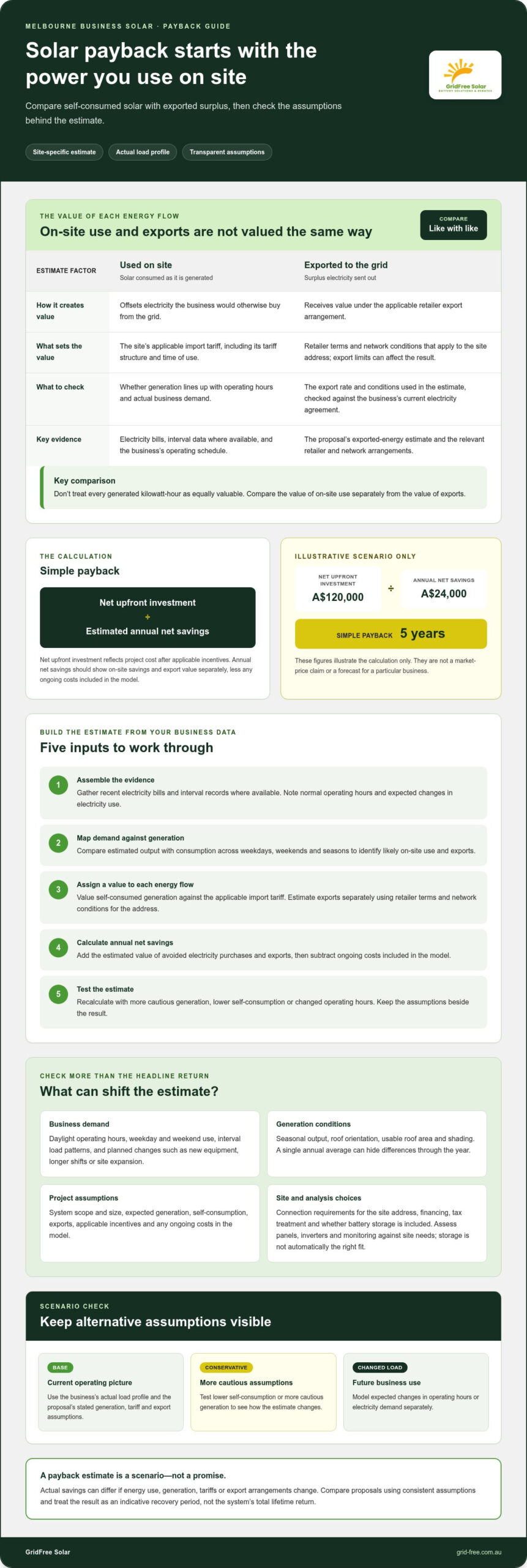
A useful estimate starts with two inputs: net upfront investment and estimated annual net savings. The result depends on how much electricity the system generates, how much your business uses as it is produced, and what value applies to any surplus sent to the grid. That makes the commercial solar system payback Melbourne a site-specific estimate, not a standard figure that applies to every business.
Simple payback is the project’s net upfront investment divided by estimated annual net savings. It shows an indicative recovery period, not the system’s total lifetime return. It’s a scenario based on assumptions, not a guaranteed result or a promised reduction in your electricity bill. Actual savings can differ if energy use, generation, tariffs or export arrangements change.
What does a commercial solar payback estimate include?
Keep the project investment, applicable incentives and annual bill savings visible as separate inputs. Net upfront investment reflects the project cost after incentives the business is eligible to receive. Annual savings should distinguish solar electricity consumed on site, which offsets grid purchases, from exported electricity, which is valued under the applicable export arrangement. Financing, tax treatment and battery inclusion can also change the analysis, so make their assumptions clear instead of folding them into one headline figure.
Why does Melbourne business demand matter?
Solar generation is most valuable when it coincides with business demand. A Melbourne business operating on weekdays and using substantial power during daylight may consume more generation on site than a business that is closed or quiet through those hours. Rooftop solar uses panels and associated equipment to generate electricity at the point of use. The overview of Rooftop solar power systems provides broader context on this distributed generation approach.
Model the site’s actual pattern, not just its annual electricity consumption. Interval data can show when loads rise and fall, helping reveal whether solar generation is likely to match operating hours. Seasonal output matters too: generation varies over the year, while roof orientation, usable area and shading influence the estimate. A single annual average can hide these differences.
Then check the Victorian tariff and export assumptions used in the calculation. The value of electricity you avoid buying may differ by tariff structure and time of use, while exported power may receive a different rate. Retail offers and site arrangements can vary, so compare the assumptions with the business’s current electricity agreement and relevant export conditions. Don’t treat every generated kilowatt-hour as equally valuable.
For a more useful comparison, record the estimate’s basis: system design, expected generation, daytime self-consumption, exported energy, applicable incentives and any ongoing costs included. If the business expects a change in operating hours or electricity demand, model that separately. This turns payback from a headline claim into a transparent planning tool for deciding whether the proposed system fits your Melbourne site.
How to calculate commercial solar payback using your business data
Build the estimate from your own electricity use, not a generic system-size assumption. The commercial solar system payback Melbourne depends on how generation lines up with weekday and weekend demand, seasonal changes and the value of exported power. Work through the inputs in order, then test how sensitive the result is to changes in those assumptions.
Which business records make the estimate more reliable?
Start with recent electricity bills, interval data where available, business operating hours and planned changes such as new equipment, longer shifts or a site expansion. Use a representative period and flag unusual closures or production peaks. Include supply charges or demand components only if the proposed analysis models how solar could affect them. Don’t assume every charge will fall.
- Assemble the evidence. Gather bills and interval records, note your normal operating schedule, and list expected changes to electricity use.
- Map demand against generation. Compare the proposed system’s estimated output with consumption across weekdays, weekends and seasons. This shows when solar can be used on site and when it may be exported.
- Assign a value to each energy flow. Value self-consumed generation against the site’s applicable import tariff. Estimate exports separately using the retailer terms and network conditions that apply to the address.
- Calculate annual net savings. Add the estimated value of avoided electricity purchases and exports, then subtract any ongoing costs included in the model.
- Test the estimate. Recalculate with more cautious generation, lower self-consumption or changed operating hours. Record the assumptions alongside the result.
Simple payback = net upfront investment ÷ estimated annual net savings. For example, in a hypothetical scenario, if net upfront investment is A$120,000 and estimated annual net savings are A$24,000, simple payback is five years. These figures illustrate the calculation only. They are not a market-price claim or a forecast for a particular business.
How should export value and incentives be modelled?
Don’t value all solar generation at the import tariff. Electricity used as it is generated can offset purchases at the applicable rate, while exported electricity is valued under the business’s retailer terms. Account for the relevant network conditions at the site. If an incentive is included, check current Clean Energy Regulator and Victorian programme criteria, eligibility and application requirements before treating it as part of the project’s net investment.
For product and installer programme context, consult the Clean Energy Council industry programs and accreditations. Keep any incentive assumption distinct in the calculation so it’s clear how the estimate changes if eligibility or programme details differ.
A tailored commercial assessment brings your usage data, site requirements and system assumptions into one project-specific estimate. Explore commercial solar solutions as a next step in assessing the fit for your business.
Compare commercial solar proposals by payback assumptions, not headline claims
A shorter forecast payback isn’t automatically the stronger proposal. Compare each system using the same bill period, tariff assumptions and incentive treatment, then inspect how the design fits your site. A commercial solar system payback Melbourne estimate is comparable only when its inputs are aligned.
Use a consistent comparison layout. Record the same details for each proposal, including what is included and which assumptions drive projected savings.
Comparison point
Proposal A
Proposal B
System scope
Panel and inverter inclusions, installation scope, monitoring and any battery.
Record the same inclusions, noting differences that could affect the total investment.
Generation estimate
Estimated output and the shading, roof layout and other site assumptions behind it.
Compare the forecast period and design assumptions, not just the annual total.
Energy value
Expected self-consumption, exported electricity and the tariff or export values used.
Check these against the same usage data, bill period and retailer terms.
Payback basis
Net investment, incentives included and estimated annual savings.
Check that each input is defined consistently and remains a forecast, not a guaranteed outcome.
Which assumptions can make forecast payback look stronger?
Look closely at daytime usage, tariff escalation and export values. A forecast may appear more attractive if it assumes the business consumes a larger share of generation than its actual trading hours support, or relies on static tariffs and unverified export rates. Check whether seasonal operating patterns, weekends and planned changes in demand are reflected. Treat projected performance as an estimate, never as a guaranteed result.
Site design matters as much as spreadsheet inputs. Usable roof area, panel layout and shading can affect estimated generation. Connection limits may also constrain how much power can be exported, while a staged expansion could change the best system size or the value of designing for future demand. Compare the assumptions behind the design, not only its headline capacity.
When should a battery be included in the comparison?
Assess a battery against evening demand, operating schedules and the business’s resilience priorities. It isn’t an automatic addition: compare a solar-only case with a solar-and-battery case, using clearly stated assumptions for battery efficiency, usable capacity and replacement timing. If those assumptions aren’t documented, the payback comparison is incomplete. This commercial solar installation guide provides further context on project scope and system design.
Before choosing a proposal, make sure each forecast uses the same business data and separates self-consumed power from exports. That reveals whether the difference comes from a better-matched system or simply more optimistic assumptions.
Melbourne project checks that can change commercial solar payback
A payback model can only be as reliable as its view of the site. In Melbourne, roof conditions, the business’s operating pattern and grid connection requirements can all affect how much solar energy is generated, used on site or exported. Check these details before treating a forecast as a sound basis for a decision.
What should a Melbourne site assessment establish?
Start with the roof. Its orientation, usable area and shading help shape the system layout and generation estimate. The roof’s structural suitability and the location of existing electrical infrastructure also matter. A design that accounts for these conditions can be compared more meaningfully with the business’s expected electricity use.
Connect the physical assessment to how the site operates. Record the hours when the premises are active, including weekend or seasonal changes, and note planned additions or reductions in daytime loads. A business adding equipment may use more solar as it is generated; a shift to evening operations could change that match.
- Roof and layout: Identify usable space, orientation, shading and any constraints that affect panel placement.
- Electrical infrastructure: Note switchboard constraints and the connection requirements relevant to the site.
- Business demand: Document operating hours and planned changes that could alter future daytime consumption.
The electricity distributor and applicable connection conditions depend on the property address. Network export limits or other connection requirements may affect the system design and the amount of surplus electricity the model assumes can be sent to the grid. Treat these as address-specific checks, not generic Melbourne-wide assumptions.
How do tariffs, exports and incentives affect the model?
Use the business’s current retailer tariff and export terms when assigning value to solar generation. Confirm the relevant details for the site and avoid carrying an old tariff assumption into a new project forecast. If export conditions limit what can be sent to the grid, the financial model should reflect that constraint rather than assume every surplus unit earns the same value.
Incentives and approvals also need project-specific verification. Eligibility can depend on current programme criteria and the system or premises details, so include an incentive as a settled reduction only after checking the relevant requirements and timing against authoritative programme information. Likewise, account for the connection process and any conditions that apply to the address before relying on a proposed design.
These checks make the commercial solar system payback Melbourne estimate more grounded: it reflects the actual roof, load profile, tariff and connection context rather than a generic site. For a wider view of project scope and system design, use the Melbourne commercial solar installation guide while considering tailored commercial solar solutions for your site.
From payback estimate to a Melbourne commercial solar decision
A payback estimate becomes useful when it leads to a decision grounded in your business’s data and site conditions. Validate the information, compare scenarios, review the design, then assess whether the proposal meets your operational needs. This sequence helps reveal which assumptions matter most, rather than letting one forecast dictate the outcome.
- Validate the inputs. Check that bills, interval data and operating hours represent normal business activity. Flag unusual shutdowns or production peaks.
- Model three scenarios. Compare a base case, a conservative case and a changed-load case that reflects planned business growth or operational changes. Keep the assumptions visible.
- Review site design. Consider whether the proposed system fits the roof, electrical infrastructure, connection conditions and expected energy use.
- Assess the proposal. Review system scope, estimated generation, self-consumption, exports, incentives and any battery option on a consistent basis.
This gives you a more robust view of commercial solar system payback Melbourne. If a changed-load scenario materially alters the estimated savings, clarify how future demand has been treated instead of relying on a single forecast.
What information should a business prepare for a tailored assessment?
Bring together recent electricity bills, interval data if available, the site address and the business’s operating schedule. Add roof plans or other site information, known electrical constraints and expected changes to demand, such as new machinery or different trading hours. Be clear about whether storage, backup capability or future expansion is part of the brief, so the design can be assessed against real priorities.
Organising these details early helps connect the financial model to the physical project. For example, a business planning to extend daytime operations may have a different load profile from one expecting to move more activity into the evening. State what’s known and identify what is still a planning assumption.
How can GridFree Solar help turn the assessment into a project?
GridFree Solar designs and installs commercial solar systems for business and industrial requirements, with project design shaped around energy use and site needs. Integrated battery options can be assessed against the business’s load profile rather than added by default. GridFree Solar also provides guidance on claiming applicable solar and battery rebates, with incentive assumptions based on current programme criteria and eligibility.
For a project-specific next step, explore tailored Melbourne commercial solar solutions. Share your available energy and site information for a tailored commercial solar assessment. A clear brief gives the design process a stronger starting point and helps keep the payback assumptions tied to your business, not a generic forecast.
Turn your solar payback estimate into a confident next step
The most useful outcome isn’t a single payback number. It’s a clearer basis for deciding whether solar fits your business now, how the project could adapt as demand changes, and which assumptions deserve closer attention. Keep the commercial solar system payback Melbourne estimate connected to your actual operating plans, not just today’s electricity use.
GridFree Solar designs and installs tailored commercial solar systems for business and industrial needs. Where it suits the load profile, integrated battery solutions can also be assessed. GridFree Solar provides guidance on applicable solar and battery rebates to help you understand incentives, with eligibility and current programme details assessed against the relevant criteria.
Bring your energy records and project priorities into the conversation. Request a tailored commercial solar assessment to explore a design for your Melbourne business and site. A well-informed next step starts with your real requirements and puts your business in a stronger position to make a practical solar decision.
Frequently Asked Questions
How long does a commercial solar system take to pay back in Melbourne?
There’s no single payback period that applies to every Melbourne business. The commercial solar system payback Melbourne depends on the project investment, the business’s electricity use, system output and the value of energy consumed on site or exported. A warehouse operating mainly in daylight may have a different result from a venue with evening demand. Use your own bills and operating profile to assess the proposal rather than relying on a broad industry estimate.
Can a commercial solar system still pay back if my business exports excess electricity?
Yes, exports can contribute to savings, but their value depends on the export terms applying to your business. For example, a site may export surplus power during a quiet period and use solar directly when equipment is running. Value these energy flows separately. Check your electricity agreement and any connection conditions that affect exports, then consider whether shifting flexible tasks into solar hours could improve on-site use.
Does a commercial solar payback calculation include financing and tax treatment?
It can, but the calculation should show clearly whether it does. A simple payback based on project investment and estimated savings may not reflect loan repayments, interest, tax deductions or depreciation. Ask your accountant or tax adviser to assess the tax treatment for your business structure and project. Keep those financial factors distinct from the solar performance estimate so you can see how each affects the overall decision.
Can my business install commercial solar if it leases its premises?
Leasing a Melbourne premises doesn’t automatically rule out a solar project, but the property owner’s agreement and lease conditions matter. Start by reviewing clauses covering alterations, building services, access and ownership of installed equipment. Discuss the proposal with the landlord early, especially if the lease term is shorter than the expected period of use. A written agreement can clarify responsibilities if the business relocates or the lease ends.
Will commercial solar keep my business operating during a power outage?
Not necessarily. A standard grid-connected solar system generally disconnects during a grid outage, so it doesn’t continue supplying the premises by default. Backup operation depends on suitable battery equipment, system configuration and the circuits selected for backup. If keeping essential equipment running matters, identify those loads and include them in the system design before installation. Don’t assume a battery automatically provides whole-site backup.
How does a change in business hours affect a commercial solar payback estimate?
A change in hours can alter how much solar electricity the business uses directly. If a Melbourne workshop adds a daytime shift, more generation may coincide with equipment demand. If operations move later, the business may rely more on grid electricity after solar output falls. Update the assessment with the proposed schedule and any new major loads, then compare it with the current operating pattern before making a decision.
Do commercial solar incentives apply to every Melbourne business?
No. Incentives aren’t universal, and eligibility can depend on current programme rules, system details, business and premises requirements, and application timing. Victorian and Australian schemes may have different criteria, which can change. Treat any proposed incentive as conditional until the relevant programme requirements have been checked for your project. GridFree Solar provides guidance on applicable solar and battery rebates and assesses eligibility against current criteria.