
A 25-year warranty is completely worthless if the company backing it doesn’t survive the next five. Many Melbourne homeowners find themselves “solar orphans” after their installer vanishes; they are left with failing hardware and no local support. It’s a high-stakes gamble you shouldn’t have to take. This 2026 solar panel warranty explained Australia guide cuts through the technical jargon to secure your energy future.
We know the anxiety of staring at fine print that differentiates between “performance” and “product” clauses. You want a system that delivers, backed by a partner who actually answers the phone. You’re right to be sceptical of “free” repairs that hidden call-out fees often negate. We promise to help you master the four critical pillars of protection so your system achieves maximum ROI for decades.
This guide provides a clear checklist for comparing quotes and explains your non-negotiable rights under Australian Consumer Law. We’ll examine the updated 2026 NETCC standards and why your workmanship guarantee is your most vital line of defence. You’ll gain the confidence to choose a local specialist who treats your investment with the same urgency and professional expertise as you do.
Key Takeaways
- Distinguish between the four essential pillars of protection in this solar panel warranty explained Australia guide to avoid misleading marketing traps.
- Separate product warranties for physical defects from performance warranties that guarantee energy output to ensure your system meets its ROI targets.
- Identify why the inverter and workmanship warranties are your most critical safeguards against the most frequent causes of system downtime.
- Use Australian Consumer Law as a secondary safety net to claim repairs even after an express manufacturer warranty has technically expired.
- Future-proof your energy security by selecting Tier-1 components and local Melbourne specialists who provide responsive, on-the-ground support.
The Four Pillars of Australian Solar Warranties
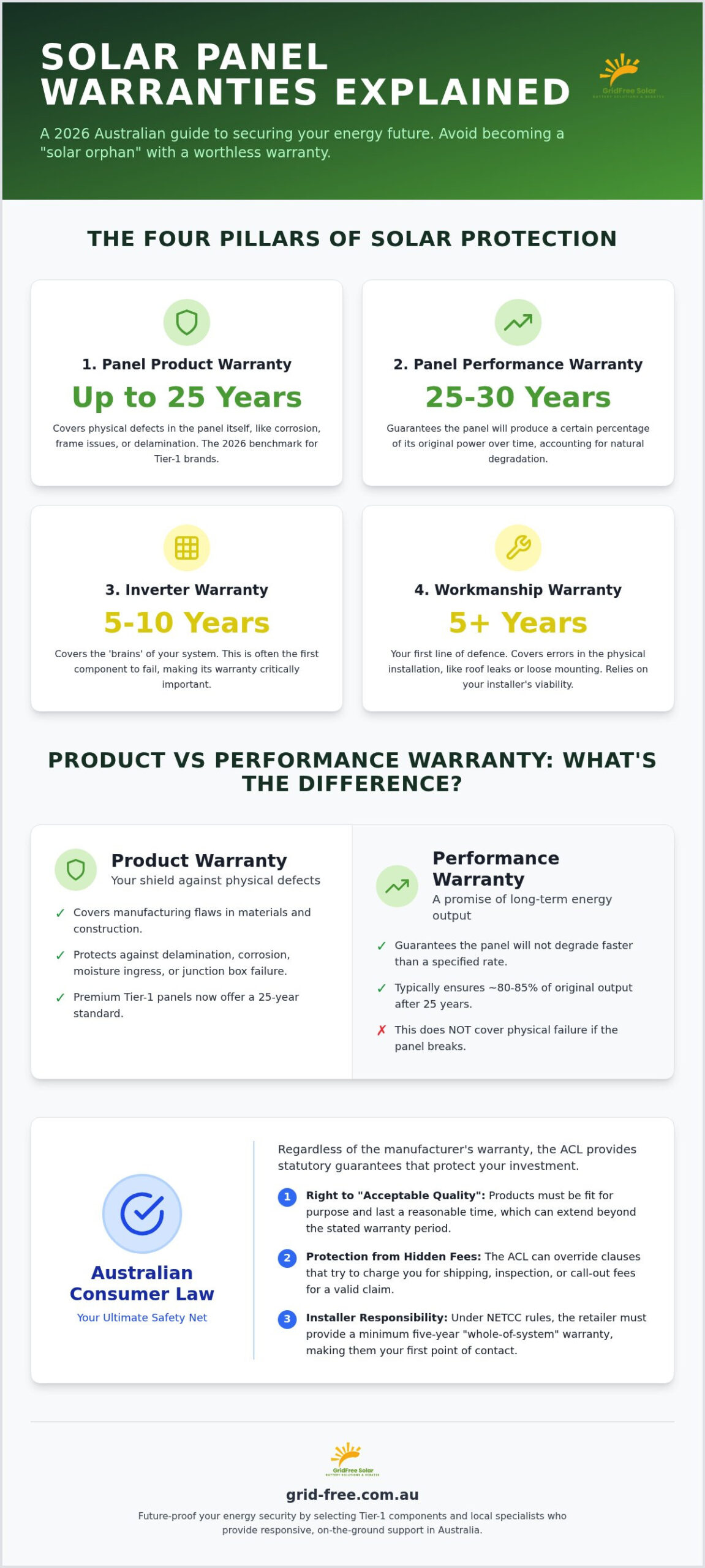
A solar installation is a complex asset. It isn’t a single purchase but a stack of contractual promises. To have your solar panel warranty explained Australia style, you must look past the glossy brochures. Four distinct pillars support your investment: the panel product warranty, the panel performance warranty, the inverter warranty, and the installer’s workmanship warranty. Each serves a different purpose. Each has a different expiry date. Each requires a different path for enforcement.
The Clean Energy Council (CEC) and the New Energy Tech Consumer Code (NETCC) set the baseline for the industry. As of late 2026, any reputable retailer participating in government rebate programs must provide a minimum five-year “whole-of-system” warranty. This ensures that the retailer, not just the manufacturer, is responsible for your system’s health. However, the Australian Consumer Law (ACL) remains the ultimate safety net. It ensures products remain of “acceptable quality” for a reasonable period, regardless of what a manufacturer’s fine print claims.
Why One Number Isn’t Enough
Don’t be seduced by a single headline figure. Sales reps love to shout about “25-year protection,” but they are usually referring to the performance warranty. This only guarantees that the panels will produce a specific amount of electricity over time. It doesn’t cover the physical components if they snap, corrode, or fail due to manufacturing flaws. While older standards settled for 10 or 15 years, the 2026 benchmark for quality panel product warranties has shifted to a full 25 years for premium brands.
Contrast this with a standard string inverter. These “brains” of the system often carry only a 5 to 10-year warranty. Because inverters work the hardest, they are statistically the most likely component to fail first. Understanding Photovoltaic system performance is essential here; degradation is natural, but a total hardware failure is a different matter. A true “whole-of-system” warranty is the gold standard because it forces the retailer to take responsibility for every bolt, cable, and microchip for at least five years.
The Hierarchy of Protection
Your workmanship warranty is the most practical tool in your kit. While manufacturers handle hardware, your installer covers the actual labour. If a roof leak appears or a mounting bracket rattles loose, you don’t call a factory in China. You call your local expert. This cover is your first line of defence against installation errors that can lead to system-wide failures.
This is where local Melbourne presence becomes non-negotiable. If your installer goes bust, your workmanship cover often vanishes. However, the ACL provides a statutory guarantee that services must be provided with due care and skill. If a product is faulty, the ACL can override manufacturer exclusions that try to charge you for shipping or “inspection fees.” In the Australian market, a warranty is only as strong as the local company standing behind it. Choosing a partner with a permanent Victorian base ensures your solar panel warranty explained Australia guide becomes a functional reality rather than a paper promise.
Product vs. Performance: Decoding the Panel Maker’s Promises
Don’t let a single “25-year” headline fool you. Most homeowners assume this figure covers everything from a broken frame to a drop in power. It doesn’t. To have your solar panel warranty explained Australia style, you must separate the physical hardware from the electrical output. These are two distinct contracts with very different levels of protection. One ensures your panels don’t fall apart; the other ensures they keep generating electricity at a profitable rate.
The Product Warranty: Your Shield Against Defects
This is your primary hardware insurance. It covers manufacturing defects such as delamination, junction box failure, or moisture ingress. In 2026, the industry benchmark for Tier-1 panels has shifted significantly. A 25-year product warranty is now the standard for premium modules, a massive leap from the 10-year standard of the past decade. This reflects increased confidence in modern manufacturing durability. However, the strength of this shield depends on local presence. Always verify that the manufacturer has a registered Australian office. If they don’t, you’ll be chasing a factory in a different time zone when things go wrong.
The Performance Warranty: Managing Expectations
The performance warranty is a promise of efficiency over time. It guarantees that your panels will still produce a specific percentage of their rated power after decades of service. Most modern panels follow a linear degradation curve of approximately 0.5% per year. By year 25, you should still see at least 80% to 85% output. While this sounds impressive, performance claims are notoriously difficult to process. Proving a dip often requires flash-testing in a controlled laboratory environment. This is expensive and can exceed the value of a single panel replacement. For a deeper dive into these technicalities, the Australian Government warranty guide provides excellent regulatory context.
The “Degradation Trap” is particularly relevant in Victoria. Our extreme temperature swings and high UV levels test panel chemistry to its limit. There are also critical exclusions to watch for. If you live near Port Phillip Bay, salt mist can corrode standard frames. Without “salt-mist certified” hardware, your warranty is dead on arrival. Similarly, damage from “acts of God” like the severe hail storms seen in Melbourne’s suburbs is rarely covered by manufacturers; these are usually insurance matters. Even improper cleaning with abrasive chemicals can void your cover instantly. If your system is ageing and performance is dipping, consider a battery upgrade or replacement to capture every bit of power your panels still produce.
The Critical Role of Inverter and Workmanship Warranties
The inverter is the system’s brain. It works harder than any other component. While your panels sit silently on the roof, the inverter constantly converts DC power to AC electricity for your home. Because it handles high voltage and heat, it is statistically the most likely part to fail first. When looking for a solar panel warranty explained Australia guide, many homeowners overlook this vital heartbeat of their installation. If your inverter dies, your entire investment goes dark.
Inverter Warranties: The 5 vs. 10 Year Debate
Standard string inverters typically come with a 5 or 10-year warranty. You’ll often face a choice at the point of sale: stick with the base cover or pay for a 10-year extension. In the Australian climate, this extension is almost always a wise investment. Heat is the natural enemy of electronics, and Melbourne’s summer spikes can push hardware to its limit. If an inverter manufacturer exits the Australian market, your “10-year promise” becomes a piece of paper. This is why we prioritise brands with established local headquarters and a history of honouring claims. For those with ageing systems, exploring GridFree Solar battery upgrade services can be an effective way to modernise your setup while replacing a failing or out-of-warranty inverter.
Battery storage warranties introduce another layer of complexity. Unlike panels, batteries are rated by “cycle life” or “years,” whichever comes first. A typical 10-year warranty might also be capped at 6,000 cycles. If you discharge your battery twice a day to navigate peak tariffs, you might hit your cycle limit before the decade is up. Adding a battery later requires careful planning; if you swap your existing solar inverter for a hybrid model, ensure the new installation doesn’t void your remaining panel workmanship cover.
Workmanship: The Installer’s Promise
The workmanship warranty is your personal guarantee from the company that stepped onto your roof. It covers the physical installation: the labour, the mounting racking, and the critical waterproofing of your roof penetrations. Manufacturing warranties cover the “box,” but workmanship covers how the box was handled. If a mounting bracket rattles loose or a cable isn’t properly UV-shielded, it’s a workmanship claim. The industry minimum under the NETCC is five years, but premium installers often extend this to 10 or 20 years to signal their confidence.
The “Orphan System” crisis is a growing problem across Victoria. Thousands of homeowners are left with useless warranties because their original installer has vanished or gone into liquidation. Without a local partner to service the claim, you’re forced to pay out-of-pocket for repairs that should have been free. GridFree Solar focuses on long-term Melbourne support to ensure our clients never become “solar orphans.” We service our own workmanship warranties directly, providing the responsive, on-the-ground support that international manufacturers simply cannot offer.
How to Make a Claim and Your Rights Under Australian Consumer Law
When your system underperforms, the clock starts ticking on your return on investment. Every day of downtime is a day of paid electricity you shouldn’t be buying. To have your solar panel warranty explained Australia style, you must understand that your first line of defence isn’t a manufacturer in another country. It’s the Australian Consumer Law (ACL). This statutory framework provides guarantees that exist regardless of what is printed on your warranty card. If a product isn’t of “acceptable quality” or fit for purpose, you have a right to a remedy.
- Step 1: Identify the fault. Use your monitoring app to check for sudden yield drops or “inverter isolated” alerts. Physical inspections should look for burnt connectors or “snails trails” on the glass.
- Step 2: Contact the original installer. Under the ACL, the retailer who sold you the system is responsible for providing a remedy. They cannot simply “pass the buck” to the manufacturer.
- Step 3: Escalate to the manufacturer. If your installer has gone out of business, you must contact the manufacturer’s Australian office. This is why we insist on Tier-1 brands with local headquarters.
The Australian Consumer Law (ACL) Advantage
The ACL differentiates between major and minor failures. A major failure occurs when a system is unsafe or would not have been acquired if you knew the extent of the problem. In these cases, you have the right to choose between a replacement or a full refund. For minor failures, the supplier can choose to repair the system. Importantly, any “warranty against defects” must be written in plain English and state that its benefits are in addition to your ACL rights. If you hit a wall, Consumer Affairs Victoria is the regulatory body that handles solar disputes in our region.
Navigating the Claim Process
Evidence is your currency. Before making a call, gather photos of the fault, serial numbers from the side of the inverter, and production logs from your app. This data prevents the “it’s just a cloudy day” excuse from lazy support desks. You should also watch out for the “Labour Cost Trap.” Many manufacturer warranties cover the replacement part but specifically exclude the electrician’s time and travel. This can result in a “free” warranty repair costing you hundreds in call-out fees.
At GridFree, we take a more proactive approach. We assist our customers with all necessary technical documentation, including navigating the Victorian battery rebate paperwork during system upgrades. We believe a warranty should be a seamless experience, not a bureaucratic hurdle. If your current system is failing and your original installer is nowhere to be found, contact our Melbourne team for a professional system assessment to get your energy production back on track.
Future-Proofing Your System with GridFree Solar
Your energy independence shouldn’t be a gamble. As this 2026 solar panel warranty explained Australia guide has demonstrated, the technical details matter; however, the partner you choose matters more. GridFree Solar eliminates the risks associated with “fly-by-night” installers. We focus exclusively on Tier-1 components that carry full Australian-backed support. This ensures that if a component fails, you aren’t stuck in a bureaucratic loop with an overseas factory. We provide the local accountability that modern Victorian homeowners demand.
Integrated systems represent the smartest path toward long-term reliability. When your solar and battery hardware come from a single, compatible ecosystem, troubleshooting becomes instantaneous. There is no finger-pointing between different manufacturers. We design every system to be rebate-compliant and ROI-optimised from day one. By choosing a local Melbourne specialist, you ensure that your workmanship warranty is serviced by the same people who performed the installation. This is the only way to truly protect your investment against the “orphan system” crisis currently affecting the industry.
The GridFree Assurance
We specialise in high-quality residential solar panel installation across Victoria. Our engineering team prioritises hardware proven to survive harsh UV levels and coastal salt mist. We don’t just “set and forget” your system. We act as a partner for life. This means we monitor performance trends and provide responsive support before a minor hardware dip becomes a major failure. Our expertise in navigating Victorian rebates ensures your system is installed to the highest regulatory standards, making future warranty claims seamless.
Next Steps for Your Energy Independence
Before you commit to an upgrade, audit your current coverage. If your panels are nearing the end of their product warranty, it’s the perfect time to “refresh” your system. You can maximise your existing infrastructure while adding a modern energy storage solution to capture every kilowatt of production. This transition allows you to move from a failing, unsupported setup to a fully warrantied, smart energy hub.
Don’t wait for a total system failure to find out your warranty is unserviceable. Proactive management is the key to decades of free energy. You deserve a system that delivers on its promises without hidden call-out fees or vanishing installers. Organise a professional system audit with GridFree Solar today. Let us secure your energy investment for the next decade and beyond.
Take Control of Your Solar Future
Understanding the four pillars of protection is the only way to ensure your investment delivers for decades. This 2026 solar panel warranty explained Australia guide has highlighted that hardware is only half the battle. Your workmanship guarantee and statutory rights under Australian Consumer Law provide the real security you need. Don’t leave your energy independence to chance or settle for an installer who might vanish when you need them most.
GridFree Solar stands as your definitive local partner in Victoria. We combine high-authority expertise with a community-focused approach. As CEC Accredited Installers and specialists in navigating Victorian rebates, we provide the responsive, on-the-ground support that national retailers often lack. We don’t just install panels; we build intelligent energy hubs designed for maximum ROI and long-term reliability.
Stop guessing and start generating. Secure your energy future with a warrantied solar solution from GridFree Solar today. Let our Melbourne-based team audit your current setup and implement a modern, fully protected energy strategy that works for you. Your decades of free energy start with a partner you can trust.
Frequently Asked Questions
Does adding a battery later void my existing solar panel warranty?
Adding a battery doesn’t automatically void your panel warranties, but the integration must be performed correctly by a qualified professional. If the new installation causes electrical faults or physical damage to the existing racking, your original workmanship cover might be compromised. We recommend using a specialist like GridFree Solar for battery upgrades to ensure your existing protections remain intact while you modernise your system. Always notify your original installer before making significant hardware changes.
What happens to my warranty if my solar installer goes out of business?
If your installer disappears, your manufacturer becomes your primary point of contact for hardware claims. However, your workmanship warranty usually vanishes with the business. This creates “orphan systems” that are difficult to service locally. To avoid this, we prioritise Tier-1 components with established Australian headquarters. If you find yourself in this position, our Melbourne team can assess your system and help you navigate manufacturer claims to restore your energy independence.
Is hail damage covered under a standard solar panel warranty in Australia?
Hail damage is almost never covered under a standard manufacturer’s warranty because it’s classified as an “act of God” rather than a manufacturing defect. While modern panels are tested to withstand 25mm hail at high speeds, severe Victorian storms can still cause micro-cracks or glass breakage. You should list your solar system on your home and contents insurance policy to ensure you are covered for weather-related incidents that fall outside typical warranty terms.
What is the difference between a 10-year and 25-year solar product warranty?
A 25-year product warranty is the 2026 benchmark for Tier-1 panels, offering 15 years more protection than the older 10-year standard. This covers physical defects, material failure, and manufacturing flaws for the majority of the system’s life. In contrast, a 10-year warranty is often found on budget components that may not survive Melbourne’s harsh UV levels. Understanding this solar panel warranty explained Australia distinction helps you avoid hardware that fails just as it reaches its ROI peak.
Does the Australian Consumer Law protect me if my warranty has expired?
Yes, the Australian Consumer Law provides statutory guarantees that exist independently of any manufacturer’s written warranty. Products must be of “acceptable quality” and last for a “reasonable period” given their price and nature. For high-end solar hardware, a reasonable period can extend beyond a five-year express warranty. If a major component fails prematurely, you may still be entitled to a repair, replacement, or refund through the retailer or manufacturer under these consumer protections.
Are solar battery warranties based on years or charging cycles?
Solar battery warranties are typically based on a “whichever comes first” policy between calendar years and charging cycles. A standard 10-year warranty might include a limit of 6,000 or 10,000 cycles. If you heavily utilise your storage to avoid peak Melbourne tariffs, you might reach the cycle limit before the decade expires. It is vital to check the “end of life” capacity guarantee, which ensures the battery still holds a specific percentage of its original charge.
Who is responsible for the labour costs when replacing a faulty solar part?
The responsibility for labour costs depends on the type of warranty being claimed. Your installer’s workmanship warranty should cover the cost of an electrician’s time for the first few years. However, many manufacturer hardware warranties only cover the replacement part itself, leaving you to pay for the shipping and on-site labour. Choosing a local partner who services their own warranties can prevent these unexpected call-out fees from eroding the savings generated by your system.
How do I check if my solar manufacturer has a physical office in Australia?
You can verify a manufacturer’s local presence by checking for an Australian Business Number (ABN) on their official website or the ASIC register. A physical office in Australia is a requirement for many government rebate programs and ensures they are bound by the Australian Consumer Law. We only recommend brands with registered Australian offices; this ensures you have a local legal entity to hold accountable if a hardware dispute arises years after the installation.