
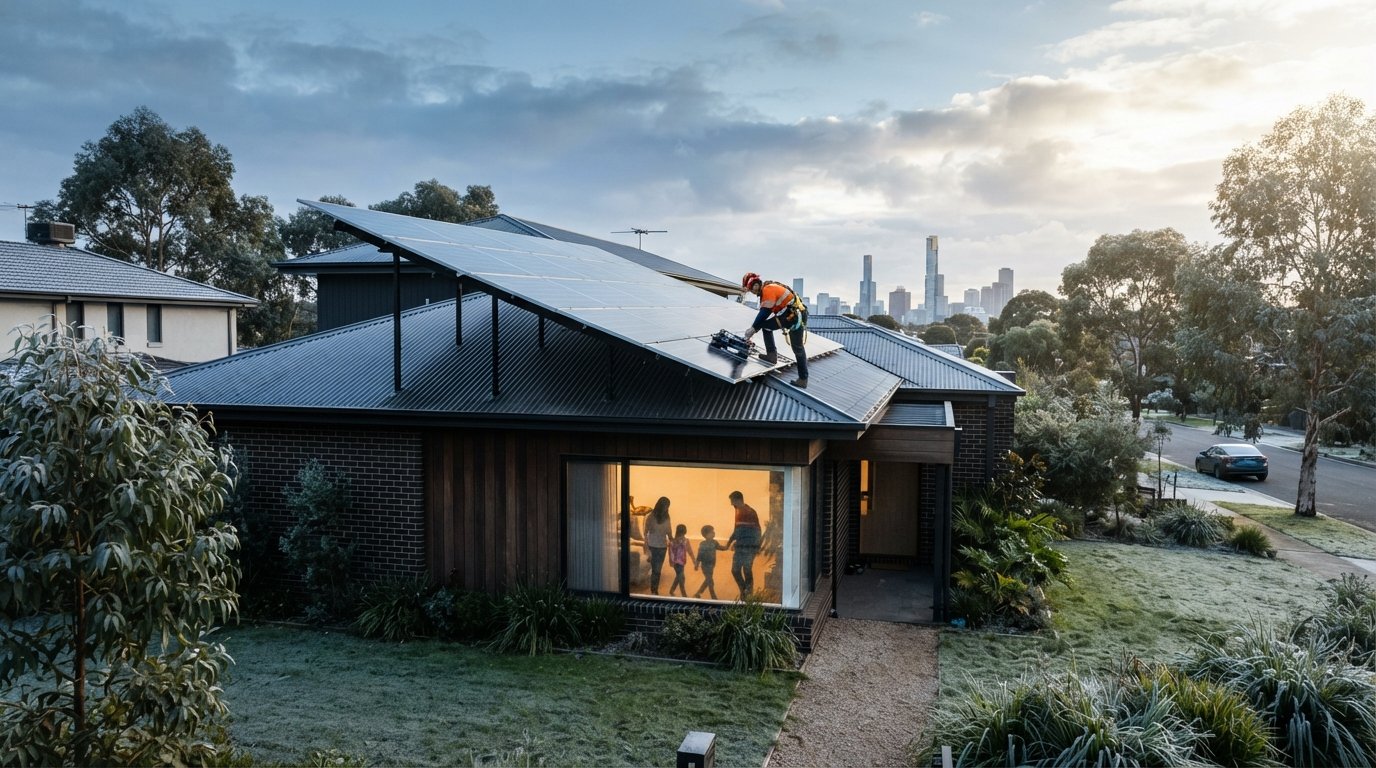
Crisp, freezing air does not hurt your solar panels; it actually makes them operate more efficiently. Most homeowners assume overcast skies shut down electricity production entirely. In reality, understanding solar panel performance in Melbourne winter comes down to available daylight hours and lower sun angles, not cold temperatures.
It is completely natural to feel uneasy when June arrives and thick grey cloud settles across Victoria. Watching your reverse-cycle heating run constantly while solar generation drops by 50% to 65% compared to mid-summer can trigger genuine bill shock. Nobody wants to invest in rooftop solar only to rely heavily on expensive peak grid electricity through the coldest months of the year.
You don’t have to guess your seasonal generation or accept punishing power bills. This 2026 guide reveals realistic daily kilowatt-hour yields across standard residential system sizes, explains how low light affects modern photovoltaic cells, and outlines proven tactics to maximise your daytime self-consumption. Here is your roadmap to taking complete command of your winter energy balance.
Key Takeaways
- Evaluate the core physics driving solar panel performance in Melbourne winter, separating cold-weather cell efficiency gains from shorter daylight hours.
- Review realistic daily kilowatt-hour generation benchmarks across standard system sizes to set accurate household expectations.
- Identify how low Victorian sun angles and residential roof pitches affect light harvesting during June and July.
- Master load-shifting strategies, like pre-heating living areas during midday generation windows, to slash retail grid reliance.
- Discover how battery storage bridges the gap between early winter sunsets and high-draw evening heating demands.
Understanding Solar Panel Performance in Melbourne Winter: Fact Versus Myth
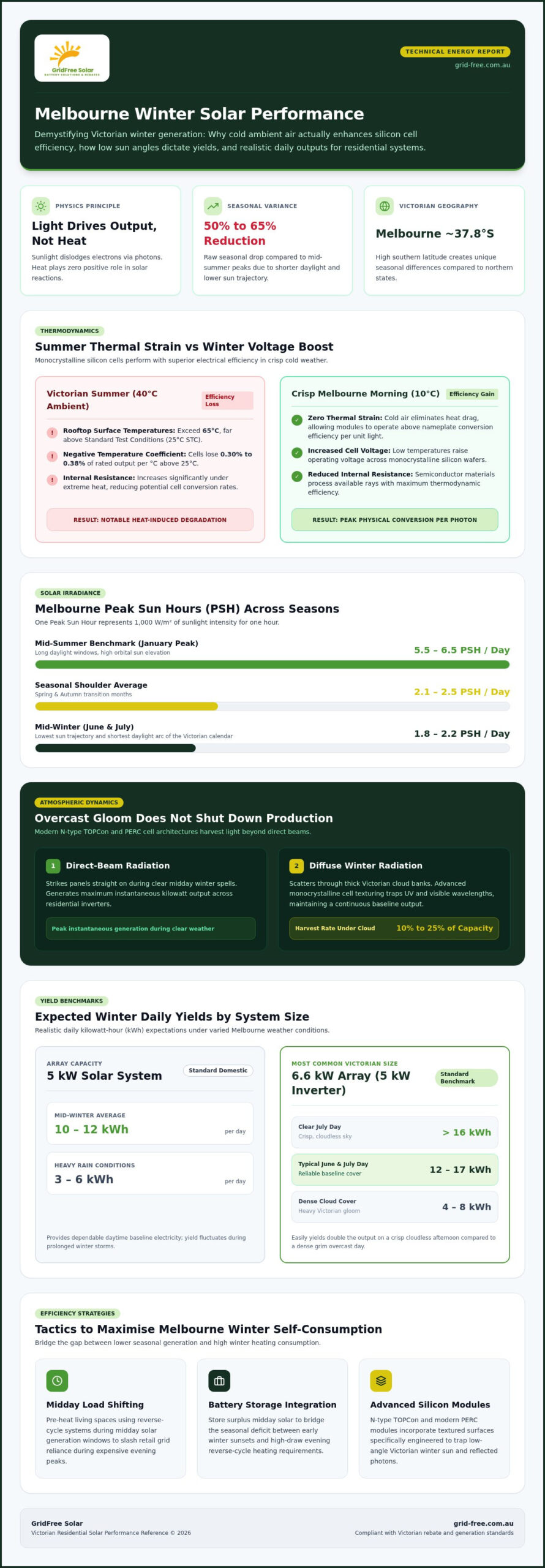
Solar panels run on light, not heat. Sunlight delivers photons that dislodge electrons within silicon cells to generate electric current. Because heat plays zero positive role in this reaction, freezing winter temperatures do not degrade power generation. Scorching 40-degree Victorian summer afternoons push rooftop surface temperatures above 65 degrees, triggering significant efficiency losses. Cold weather eliminates that thermal strain completely. Real-world solar panel performance in Melbourne winter hinges on daylight duration and orbital sun trajectory, not ambient temperature.
The Science of the Photovoltaic Effect in Cold Weather
Every photovoltaic cell has a negative temperature coefficient that governs its electrical behaviour as temperatures fluctuate. Monocrystalline silicon modules typically lose 0.30% to 0.38% of their rated output for each degree above 25°C Standard Test Conditions. On a crisp, 10-degree July morning in Melbourne, that process reverses. The photovoltaic temperature coefficient dictates that cold Melbourne air increases cell voltage, allowing silicon modules to operate above their nameplate conversion efficiency per unit of available light. Cooler semiconductor materials reduce internal resistance, meaning your array processes morning solar rays with maximum thermodynamic efficiency.
Direct Sunlight Versus Diffuse Winter Radiation
Melburnians know winter skies bring thick cloud cover. Many assume this overcast gloom shuts down solar energy production entirely. It doesn’t. While clear skies deliver direct-beam irradiance that drives peak inverter output, cloud layers simply scatter this radiation into diffuse light.
Modern residential arrays capture light across a wider spectral range than legacy hardware. The rapid rollout of solar power in Australia has driven major upgrades in module design, replacing old polycrystalline wafers with high-efficiency N-type TOPCon and PERC cells.
- Direct-beam radiation: Hits panels straight on during clear midday winter spells, generating maximum instantaneous kilowatt output.
- Diffuse radiation: Scatters through cloud banks, allowing modern cells to harvest ultraviolet and visible wavelengths at 10% to 25% of rated capacity.
- Advanced cell textures: Modern monocrystalline panels trap low-angle and reflected photons far more effectively than systems installed a decade ago.
Optimising your solar panel performance in Melbourne winter means recognising that overcast days still generate usable baseline power. System design, array orientation, and daylight availability determine seasonal yields, while Melbourne’s cold climate keeps cell efficiency running at its peak.
Melbourne Winter Solar Output: Quantifying Daily Generation Data
National averages disguise local realities. While Queensland homes enjoy generous winter sun, Melbourne sits at approximately 37.8°S latitude, creating a distinct seasonal operating environment. During June and July, the city records just 1.8 to 2.2 peak sun hours (PSH) per day, rising to an average of roughly 2.1 to 2.5 PSH across the broader seasonal shoulder. Compare that to summer, when Melbourne frequently clocks 5.5 to 6.5 PSH daily. This variance directly impacts solar panel performance in Melbourne winter, cutting raw generation by 50% to 65% relative to January peaks.
A crisp, cloudless winter afternoon will easily yield double the kilowatt-hours of a grim, overcast day. Clear July conditions can drive a standard 6.6 kW system past 16 kWh, whereas dense cloud cover might drop daily output to 4 to 8 kWh. Understanding these numbers allows you to manage daily energy expectations accurately.
System Size Breakdown: Expected Winter Daily Yields
Daily electrical output scales directly with your total photovoltaic array capacity. Installing quality hardware compliant with Solar Victoria’s solar panel rebate program guarantees that your hardware meets strict local safety and generation benchmarks. Average daily production metrics across common residential array capacities look like this:
- 5 kW Systems: Generate an average of 10 to 12 kWh per day in mid-winter, dropping to 3 to 6 kWh during heavy rain.
- 6.6 kW Systems (with 5 kW Inverter): Reliably yield 12 to 17 kWh daily across typical June and July conditions, providing solid baseline cover for daytime appliances.
- 10 kW Systems: Produce between 20 and 26 kWh daily, generating substantial daytime power to run heat pumps and heavy domestic loads.
Homes running extensive electric heating often upgrade their roof layout. Exploring an engineered solar panel installation Melbourne property owners trust ensures your array sizing offsets these intensive seasonal winter demands.
Comparing Melbourne Monthly Solar Production Across the Year
Rooftop solar operates on an annualised balance sheet. December and January deliver peak generation, yielding 28 to 35 kWh daily from a standard 6.6 kW system. In contrast, May through August produce around 25% to 30% of your annual electricity volume. Winter shortfalls are an engineered certainty, completely balanced by substantial summer generation that keeps your twelve-month operational balance sheet deeply in the black.
Planning for seasonal swings prevents unwanted bill spikes. If you want to optimise your roof space for tough Victorian winters, the team at GridFree Solar can help you design a balanced system configured specifically for local climate dynamics.
Key Factors Impacting Victorian Solar Generation Between May and August
Orbital mechanics dictate Victorian winter solar generation. On the winter solstice in late June, Melbourne experiences only 9 hours and 22 minutes of daylight. The sun’s solar noon elevation reaches barely 28 degrees above the northern horizon, compared to over 75 degrees in December. This shallow trajectory stretches shadows across suburban rooftops and forces sunlight through thicker atmospheric layers. Official Bureau of Meteorology solar exposure data for Melbourne confirms that average daily terrestrial solar exposure plummets between May and August, compressing the effective daily generation window into a tight band between 10:00 am and 3:00 pm.
Regional microclimates compound these geographical realities. Cloud density varies noticeably across Greater Melbourne. Properties in the Dandenong Ranges or outer eastern suburbs face persistent hill mist and prolonged morning overcast. Conversely, the western volcanic plains around Werribee and Melton experience fewer rain days, resulting in marginally higher baseline winter yields. Assessing local solar panel performance in Melbourne winter requires factoring in both terrain and suburban roof geometry.
Roof Orientation and Tilt Angles for Low Winter Sun
True north orientation is essential for winter yield. While east-west splits capture wider morning and afternoon sunlight during summer, they suffer sharp losses in June and July because the sun tracks low across the northern sky. Standard Victorian roofs sit between 18 and 23 degrees pitch. A 45 to 50-degree tilt would mathematically optimise winter light capture at Melbourne’s latitude, but standard pitches remain standard practice to balance year-round return on investment across high-producing summer months.
Managing Winter Shading and Environmental Obstructions
Low solar elevation angles dramatically extend physical shadows across suburban roofs. Solid obstacles that never cause summer shading issues suddenly obstruct modules during winter. Common culprits include:
- Neighbouring structures: Second-storey brick walls, parapets, and chimneys cast shadows twice their summer length.
- Bare deciduous trees: Even leafless branches disperse incoming solar radiation and lower panel output.
- Organic surface debris: Damp winter conditions cause wet leaves, fungal soot, and road grime to adhere to panels, blocking active cells.
On legacy string inverters, shading a single panel throttles current across the entire circuit. Equipping modern arrays with DC optimisers or microinverters isolates each module, letting unshaded panels produce maximum power while shaded units operate independently.
How to Optimise Solar Self-Consumption During Dreary Melbourne Winters
Victorian feed-in tariffs offer little incentive to export power. With retailers offering credits between 1c and 3c per kWh while peak retail imports exceed 26c to 34c per kWh, exporting solar electricity makes zero financial sense. Maximising your return demands consuming every watt on-site. Getting the best return on solar panel performance in Melbourne winter requires running high-draw appliances strictly between 11:00 am and 2:30 pm, capturing the sharpest window of daily generation.
Shifting consumption forward keeps grid power out of your home. Stagger heavy loads systematically. Run the dishwasher at 11:30 am, cycle laundry at 1:00 pm, and set hot water timers to fire before 2:30 pm. This sequence prevents instantaneous demand from exceeding the array’s winter production threshold.
Smart Load Shifting for High-Demand Winter Heating
Heating consumes the lion’s share of Victorian winter domestic power. Gas disconnections across the state mean homes rely heavily on electric reverse-cycle air conditioners. Turning split systems on at 6:00 pm forces you to buy expensive peak grid electricity. Instead, pre-warm your home during daylight hours.
Set split systems to 21°C from 11:30 am onward. Building thermal mass into concrete slabs, plasterboard walls, and furniture allows your home to retain heat well past sunset. In addition, program heat pump hot water systems using integrated smart timers to run exclusively within the midday solar window, effectively storing sunshine as hot water for evening showers.
System Monitoring and Inverter Maintenance Checks
Inverter telemetry reveals real-time generation issues before they manifest as billing shock. Modern Wi-Fi inverters provide granular data through dedicated mobile apps. Tracking generation curves lets you distinguish between overcast weather and technical faults.
- Daily yield tracking: Compare mid-winter production figures against local Bureau of Meteorology insolation data to verify normal hardware function.
- String voltage parity: Check twin MPPT trackers to ensure partial roof shading is not dragging down unshaded panels.
- Isolator and error codes: Monitor inverter alert logs for earth faults or DC isolation warnings triggered by persistent winter rain.
Low production should stem strictly from cloud density, never equipment failure. If your array logs output drastically below expected seasonal benchmarks, contact GridFree Solar to inspect your electrical system and realign your home energy strategy.
Bridging the Winter Deficit: Batteries and Grid Independence
Melbourne winters create a clear temporal disconnect. Photovoltaic generation tapers off by 4:30 pm, yet peak residential power consumption surges between 5:30 pm and 10:00 pm as households switch on lighting, cooking appliances, and reverse-cycle heating. Even when midday sunlight yields a solid generation burst, daytime exports earn negligible retailer credits. Coupling your array with battery storage captures that daytime surplus, ensuring solar panel performance in Melbourne winter powers your home long after dark.
Energy storage fundamentally changes your winter ledger. Instead of feeding cheap power into the grid and buying it back at expensive peak rates, you retain total control over every kilowatt-hour your roof produces.
The Role of Home Energy Storage in Cold Weather
Modern residential storage relies on Lithium Iron Phosphate (LiFePO4) cell chemistry. This architecture delivers outstanding thermal stability, ensuring safe operation and long cycle lives through cold Victorian nights. When temperatures plummet, internal battery management systems regulate cell performance without degrading operational capacity.
Storing daytime solar energy shields your household from crippling evening grid prices. Investing in tailored energy storage solutions Melbourne homes require ensures you have the reserve capacity needed to sustain continuous space heating across the coldest winter evenings.
Leveraging Off-Peak Tariffs and Victorian Government Incentives
Prolonged Victorian storm fronts can depress solar generation across multiple consecutive days. When dense cloud limits panel output, intelligent battery firmware solves the shortfall through automated tariff arbitrage. The system charges from the grid overnight during low off-peak tariff windows, storing cheap electricity to discharge during costly evening peaks.
- Automated off-peak charging: Replenish capacity during overnight off-peak windows to avoid buying peak grid power during extended rain spells.
- Federal and state incentives: Check current eligibility criteria for the Victorian battery rebate and federal programs to slash upfront capital expenditure.
- Dynamic grid protection: Insulate your household from volatile retail rates by combining daytime solar generation with strategic off-peak battery charging.
A solar array generates clean power, but a battery secures your independence. Ready to eliminate winter bill shock and take complete ownership of your household power? Book a solar and battery assessment with the team at GridFree Solar today.
Take Command of Your Winter Energy Yield
Cold weather does not cripple solar generation; shorter daylight hours and shallow sun trajectories simply demand smarter energy management. By pre-warming living spaces and shifting high-draw appliance cycles into peak midday windows, you extract maximum value from every available photon. Optimising solar panel performance in Melbourne winter proves that seasonal dips are entirely manageable when your system is engineered specifically for local Victorian conditions.
Integrating battery storage provides the definitive shield against freezing winter nights, seamlessly bridging midday generation with high-draw evening heating. Specialising in residential and commercial solar installations across Greater Melbourne, GridFree Solar delivers accredited expertise navigating Solar Victoria rebates alongside proven battery replacement engineering built for harsh southern climates. Take control of your electricity bills before the next cold snap arrives.
Upgrade your home with intelligent solar and battery storage today and secure reliable year-round power independence.
Frequently Asked Questions
Do solar panels work on completely overcast or rainy days in Melbourne?
Yes, solar panels continue to generate electricity during overcast and rainy Melbourne days by converting diffuse daylight and ultraviolet radiation. Production drops to roughly 10% to 25% of maximum rated capacity under heavy cloud cover, yielding around 4 to 8 kWh on a 6.6 kW system. While peak direct output pauses, modern monocrystalline cells ensure your home still draws free solar electricity to run baseline appliances.
How much power does a 6.6kW solar system produce in a Melbourne winter?
A standard 6.6 kW solar system produces an average of 12 to 17 kWh per day across June and July in Melbourne. Output fluctuates depending on daily cloud density. Clear winter afternoons can push generation toward 18 kWh, while gloomy, rain-soaked days may generate closer to 5 to 7 kWh. Over the entire winter season, this output reliably covers essential daytime power loads like refrigeration and background heating.
Does cold winter weather make solar panels less efficient in Victoria?
No, cold winter weather actually improves the operational efficiency of photovoltaic solar cells. Solar panels possess a negative temperature coefficient, meaning electrical voltage increases as temperatures drop. Victoria’s crisp 10°C to 14°C winter days allow panels to convert light without the severe thermal efficiency penalties caused by 35°C summer heat. Any winter generation drop stems entirely from reduced daylight hours and low sun angles, not cold air.
Will installing a solar battery help offset winter energy bills in Melbourne?
Yes, installing a home battery significantly reduces winter electricity bills by capturing daytime solar generation for evening heating. Winter solar generation wraps up hours before peak evening consumption begins. A battery stores surplus midday electricity to power reverse-cycle heating after dark. Modern storage systems also let you charge during cheap overnight off-peak windows, actively optimising solar panel performance in Melbourne winter against escalating retail peak tariffs.
Is solar power worth installing if I live in cloudy parts of Victoria?
Yes, solar remains a profitable long-term investment across cloudy Victorian regions such as the Dandenongs and the Macedon Ranges. Rooftop solar financial returns work on an annualised basis. High summer production creates substantial electricity credits that balance seasonal winter dips. With Victorian retail electricity tariffs sitting at elevated levels, generating your own power through modern high-efficiency panels yields dependable household savings across all four seasons.
Do I need to clean my solar panels during the Melbourne winter months?
Most homeowners do not need to manually clean their solar panels during Melbourne winters. Frequent Victorian winter rainfall naturally washes away ambient dust and airborne pollen on roofs with standard pitches above 10 degrees. You should only check for stubborn physical obstructions, such as fallen wet leaves or thick bird droppings, that can block active cells. Trimming back deciduous branches prevents seasonal shading and lets natural rainfall keep modules clear.