
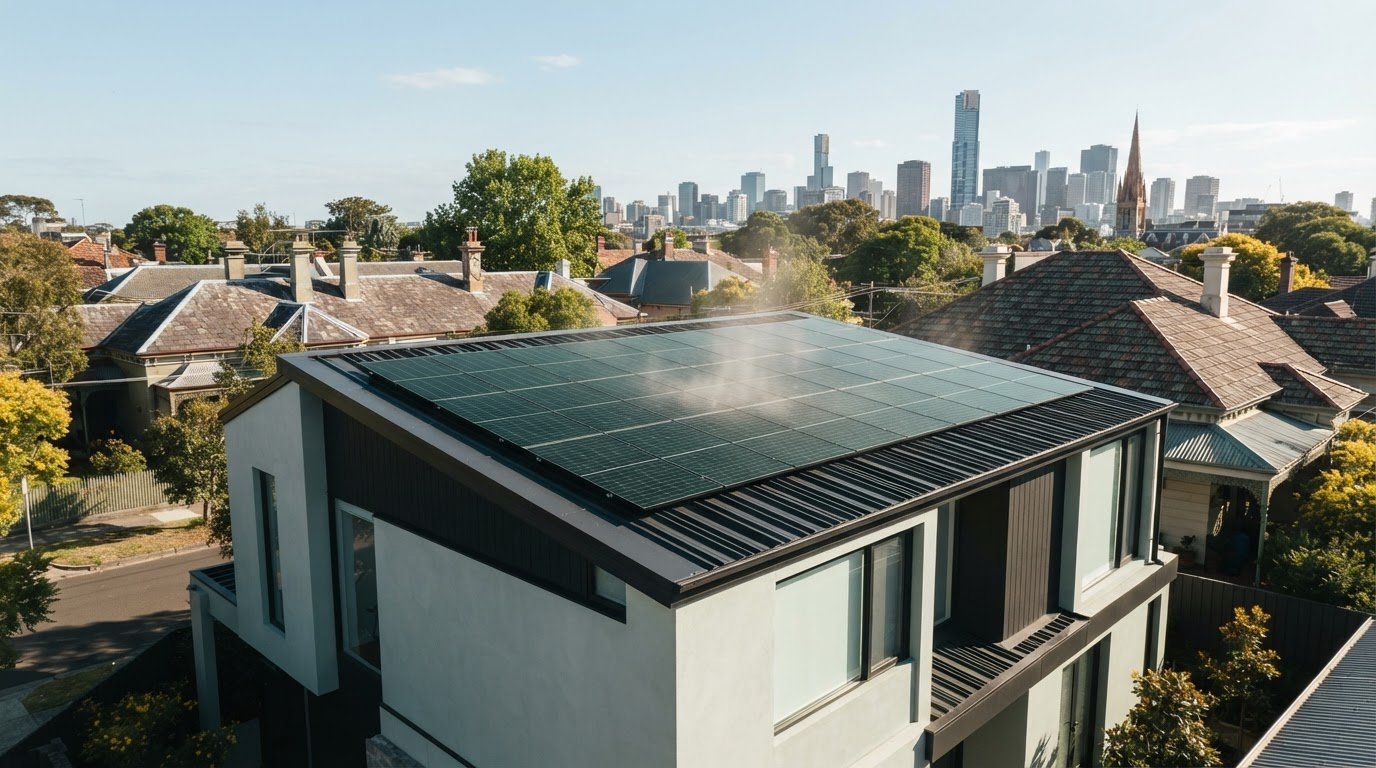
A higher wattage rating doesn’t tell the whole story. Solar cell efficiency is the share of sunlight a panel converts into electricity; in 2026, most residential panels operate at 20-23% efficiency under standard test conditions. That’s the starting point for understanding solar panel efficiency ratings explained in terms of your home’s likely output.
It’s easy to assume a higher percentage always means a better system. But efficiency matters most when roof space is limited, and it’s only one part of the picture: sunlight, heat, panel orientation and system losses also affect how much electricity you generate.
This guide explains how efficiency is measured, what Australian residential panel ratings mean, and how to weigh efficiency against roof space and return on investment. A panel’s laboratory rating is a useful comparison, not a promise of how much electricity it will produce on your roof.
Key Takeaways
- STC wattage and efficiency ratings provide a consistent way to compare panels, but they describe performance under test conditions rather than your roof’s exact output.
- Heat can reduce panel output: compare temperature coefficients as well as headline efficiency when assessing performance in Australian conditions.
- Higher-efficiency panels can deliver more generation from limited roof space, but weigh that advantage against upfront cost and your energy needs.
- Residential panel efficiency varies by technology and model; use the rating as one factor when comparing options, not the sole measure of value.
How Are Solar Panels Rated by Wattage?
A panel’s wattage shows its maximum power output under defined test conditions. Efficiency measures how much sunlight its surface converts into electricity, so the two ratings answer different questions.
Standard Test Conditions and efficiency measurement
Standard Test Conditions (STC) measure a panel at 1,000 W/m² irradiance, a cell temperature of 25°C and air mass 1.5. These controlled conditions give you a consistent basis for comparing crystalline panels, regardless of where an installation will operate.
Efficiency compares the panel’s rated power with the sunlight energy reaching its surface. For example, a 400 W panel covering 2 m² has 20% efficiency; a 1 m² panel at 15% produces 150 watts under STC. This explains why the percentage matters when roof area is constrained.
Nameplate wattage under standard conditions
Nameplate wattage is the panel’s maximum power rating measured under STC. A datasheet showing 400 W describes its rated output in the test environment, not a constant 400 W supply throughout the day.
To compare Australian product datasheets, match the STC wattage, efficiency percentage, panel area and power tolerance. A 250 W panel with a ±5% tolerance, for example, may test above or below its stated rating.
Efficiency helps distinguish standard and high-efficiency panels: one classification describes 15-20% as standard, while premium models can reach 24% or higher. Compare both the percentage and rated watts; a larger panel can have more total wattage without being more efficient per square metre.
Australian solar rebates depend on panel approval, not a particular efficiency percentage. Panels sold in Australia must have Clean Energy Council approval to qualify. The Clean Energy Council also lists modules and inverters that meet Australian Standards.
STC provides a defined measurement method, but an efficiency rating alone doesn’t show that an independent body tested each panel. In Australia, Clean Energy Council approval is a separate consideration from a panel’s efficiency percentage.
What Affects Real-World Solar Panel Output?
Rated efficiency is a controlled benchmark; sunlight, heat and location shape actual electricity output. TOPCon panels commonly reach 22-24% efficiency, while monocrystalline panels range from 20-24%. PERC’s reflective back layer is associated with an approximately 1% efficiency increase; compare heterojunction models using their listed efficiency and output specifications.
Rated efficiency and real-world output
Rated efficiency describes sunlight converted into electricity under test conditions, not the system’s total daily generation. Real output also reflects shading, orientation, temperature and electrical losses. A 22% efficient panel system may deliver an overall system efficiency of 17-19% after real-world losses. That distinction helps you estimate usable electricity rather than treating a panel percentage as a direct household energy yield.
Heat-related output losses
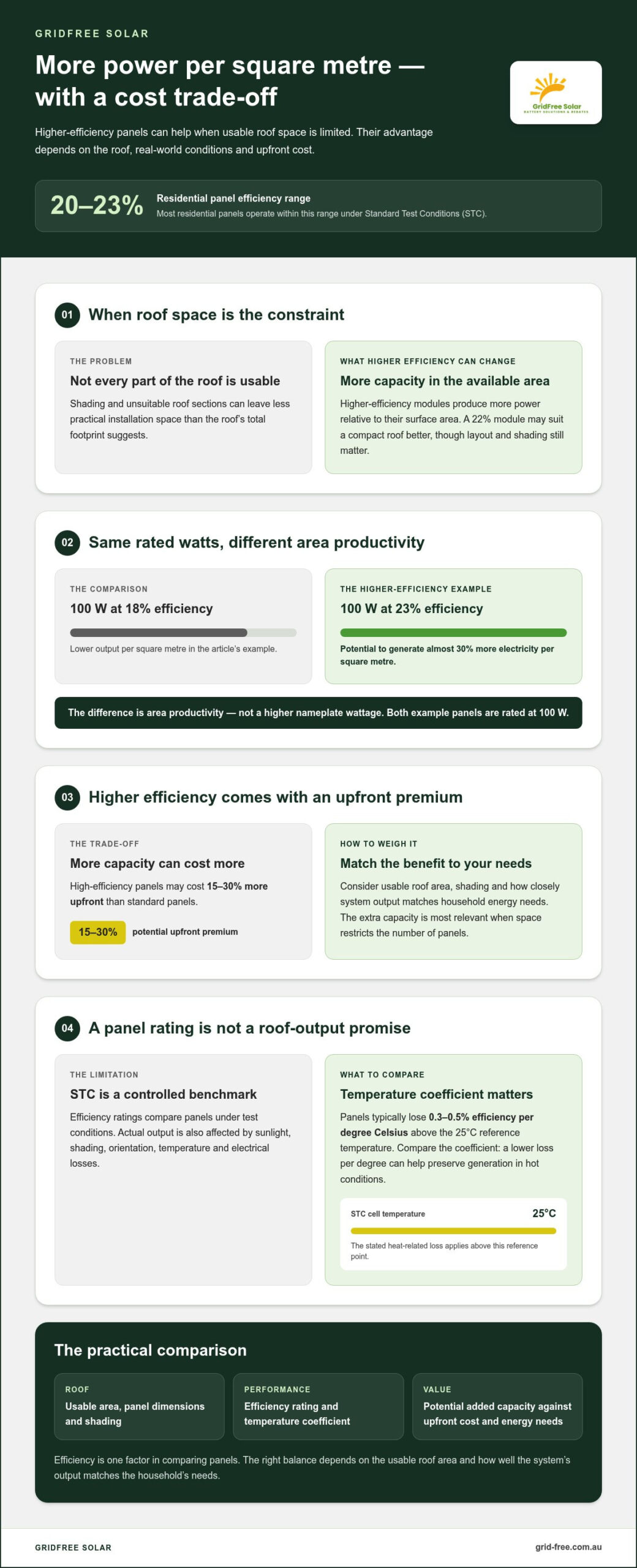
A temperature coefficient indicates how a panel’s power changes as its cells heat above the 25°C reference temperature. Solar panels typically lose 0.3-0.5% efficiency per degree Celsius above that point. On a hot Australian roof, cell temperature can therefore reduce output even under strong sunlight. Compare this coefficient across premium and standard models: a lower loss per degree can help preserve generation during hot conditions.
Wattage, system capacity and output
Panel wattage is its rated power, system capacity is the combined rating, and output is the electricity generated over time. For example, 20 panels rated at 400 W create an 8 kW system. With five peak sun hours daily and a 0.8 production adjustment factor, estimated generation is about 32 kWh daily. Location, shading and roof direction affect peak-sun exposure, so the same capacity can produce different amounts across Australia.
Degradation and long-term output
Degradation is the gradual decline in a panel’s maximum output as it ages. A typical rate is 0.5% per year, so long-term estimates should account for reduced generation rather than assume new-panel performance continues unchanged. This matters when comparing system capacity with future household use. If a 400 W system’s output and storage needs are part of your planning, explore solar and battery installation options.
Why panel efficiency matters for space and return on investment
Efficiency can help fit more generation capacity onto a limited roof. In Australia, the value of that extra capacity depends on usable roof area, shading and how closely system output matches household energy needs.
Efficiency and roof-space considerations
Panel efficiency indicates how much power a module can produce relative to its surface area under standard test conditions. On a roof with limited usable space, higher-efficiency modules can provide more capacity within the available area. This can matter when roof sections are shaded or unsuitable, leaving less practical installation space than the roof’s total footprint suggests.
Compare the roof’s usable area with each panel’s dimensions and rated capacity. A 22% module may suit a compact roof better than a lower-efficiency option, but layout and shading still affect how much of the space can generate electricity.
Making the most of limited roof space
Higher-efficiency panels prioritise power output per square metre, making them useful when roof space restricts the number of modules. For example, a 100 W rigid panel at 23% efficiency has the potential to generate almost 30% more electricity per square metre than a 100 W panel at 18%. The difference is area productivity, not a higher nameplate wattage.
That advantage has a trade-off: high-efficiency panels may cost 15-30% more upfront than standard panels. The added capacity can be valuable when space is the main constraint, but it doesn’t automatically deliver a better return for every roof.
For a useful comparison, estimate the practical roof area after accounting for orientation and shading. Then compare how many modules fit, their combined capacity and whether likely production matches household demand. A larger system may produce surplus electricity when daytime use is low, while a space-efficient array may better suit a compact roof.
Efficiency is one factor in return on investment, not a financial outcome by itself. Weigh any extra upfront cost against the generation your roof can support and the electricity you can use. Standard test conditions make ratings comparable, while local sunlight and installation layout affect how that capacity performs in practice. Consulting clean energy and electrical specialists such as Brighter Sparks Electrical Pty Ltd can help you evaluate these trade-offs and design a system suited to your property.
Residential solar panel efficiency ranges
Residential solar panels installed in Australia typically range from 15% to 23% efficiency. Efficiency ratings can provide buyers with a useful starting point for comparing module technologies and models. Having solar panel efficiency ratings explained in terms of roof area helps show what the percentage can and cannot tell you.
Monocrystalline panels commonly reach 20-24% efficiency, while polycrystalline panels are generally rated at 15-17%. TOPCon panels typically achieve 22-24%, and premium models can reach 24% or higher. These ranges overlap, so the technology label alone won’t identify the best panel for your property.
Standard panels are often classified around 17-19% efficiency, compared with 20-22% for high-efficiency panels. The percentage describes sunlight conversion, not total household electricity generation. A higher-efficiency module can produce more power from a given surface area, which may matter where roof space is restricted.
Compare each panel’s datasheet efficiency with its rated wattage and physical dimensions. Two modules can have similar wattage but different efficiency percentages if one takes up more space. Also check that the proposed panels are compatible with the inverter, which converts direct-current electricity into household-usable alternating current.
Manufacturers measure panel figures under standard test conditions, providing a consistent basis for comparison rather than a forecast for every Australian roof. Orientation, shading and heat affect actual generation. A 22% panel on a shaded roof section may contribute less useful electricity than a lower-rated module in clearer sunlight.
For a practical comparison, shortlist panels that fit the usable roof area, then consider efficiency, wattage and temperature performance. Having solar panel efficiency ratings explained alongside household demand helps you judge whether a system’s capacity suits your needs. Higher efficiency can maximise a compact roof, but it isn’t automatically the best-value choice when space is ample.
Ready to match panel ratings with your roof and energy needs? Explore residential solar panel installation options.
GridFree Solar: Battery Upgrade & Replacement
GridFree Solar can help match solar generation and storage to your energy needs. If your existing battery no longer provides the storage you need, GridFree Solar’s Battery Upgrade & Replacement service can help you plan the next step.
For a new system, GridFree Solar also provides residential solar panel installation, commercial solar solutions, and solar and battery installation in Melbourne and Victoria. The right option depends on whether you’re installing solar, adding storage or upgrading an existing battery. Panel efficiency helps you understand potential generation; battery storage helps you use electricity beyond solar production hours.
To discuss a solar or battery project for your home or business in Melbourne or Victoria, contact GridFree Solar or visit grid-free.com.au.
Turn panel ratings into a plan for your property
Use efficiency as a design input, not a decision made in isolation. Before choosing a system, consider how your household uses electricity, which roof areas are practical and whether your priorities may change. A home that uses more energy during the day has different design needs from one that uses more electricity after sunset.
Solar panel efficiency ratings explained in context can help frame the right discussion. Rather than asking only, “Which panel has the highest percentage?”, ask, “What system suits this roof and energy profile?” That keeps the focus on how the complete installation fits your property, not one datasheet specification.
GridFree Solar can help you explore options for your solar project. Contact GridFree Solar to discuss your options and take the next step towards a system shaped around your needs.
Frequently Asked Questions
What is solar cell efficiency?
Solar cell efficiency is the proportion of sunlight a cell converts into electrical energy. It describes conversion, not the total electricity a household will receive. A compact panel, for example, can have a higher efficiency percentage than a larger panel but produce less total power if its rated wattage is lower. Compare efficiency with panel dimensions and rated capacity to understand what the percentage means for your installation.
What’s the difference between panel efficiency and system efficiency?
Panel efficiency describes the performance of an individual module, while system efficiency reflects how effectively the complete solar setup converts available sunlight into usable electricity. A system includes more than panels: the inverter, wiring and operating conditions also affect the result. Two homes with panels carrying the same efficiency rating can therefore have different system performance because their equipment and site conditions differ.
Are high-efficiency panels worth the extra cost?
Higher-efficiency panels can be worth considering when usable roof area limits how many panels will fit, or when you want more capacity from a compact array. If your roof has ample suitable space, the added efficiency may matter less than how well the system matches your electricity use. Compare any extra upfront cost with the practical benefit of additional generation for your property, rather than choosing by panel percentage alone.
Does Higher Efficiency Always Mean Better?
No. A higher efficiency percentage means a panel converts more sunlight per unit of surface area, but it doesn’t automatically produce a better result for every property. If two systems have the same 6 kW capacity and other factors are equal, panels rated at 15% and 20% efficiency can produce the same energy. Roof fit and household use still shape the decision.
Is Panel Efficiency the Most Important Factor?
No. Efficiency is a useful comparison, not a complete measure of suitability. Consider the system’s total rated capacity, roof orientation, shading, heat performance and how well generation aligns with your electricity use. For instance, a high-rated panel in a shaded area may contribute less useful energy than a well-positioned alternative. Assess the complete system and property, not just one datasheet figure.
Return on Investment: Does Efficiency Pay Off?
Efficiency can support a stronger return when it enables more generation from limited roof space, but the percentage alone can’t establish the financial outcome. Compare the system’s upfront cost with the electricity it can generate and how much of that energy your household can use. Export arrangements and usage patterns also affect value, so focus on the expected performance of the complete system for your circumstances. For homeowners weighing these considerations, residential installers like Makn Energy can assist in designing solar panel and battery systems tailored to real-world household consumption.