
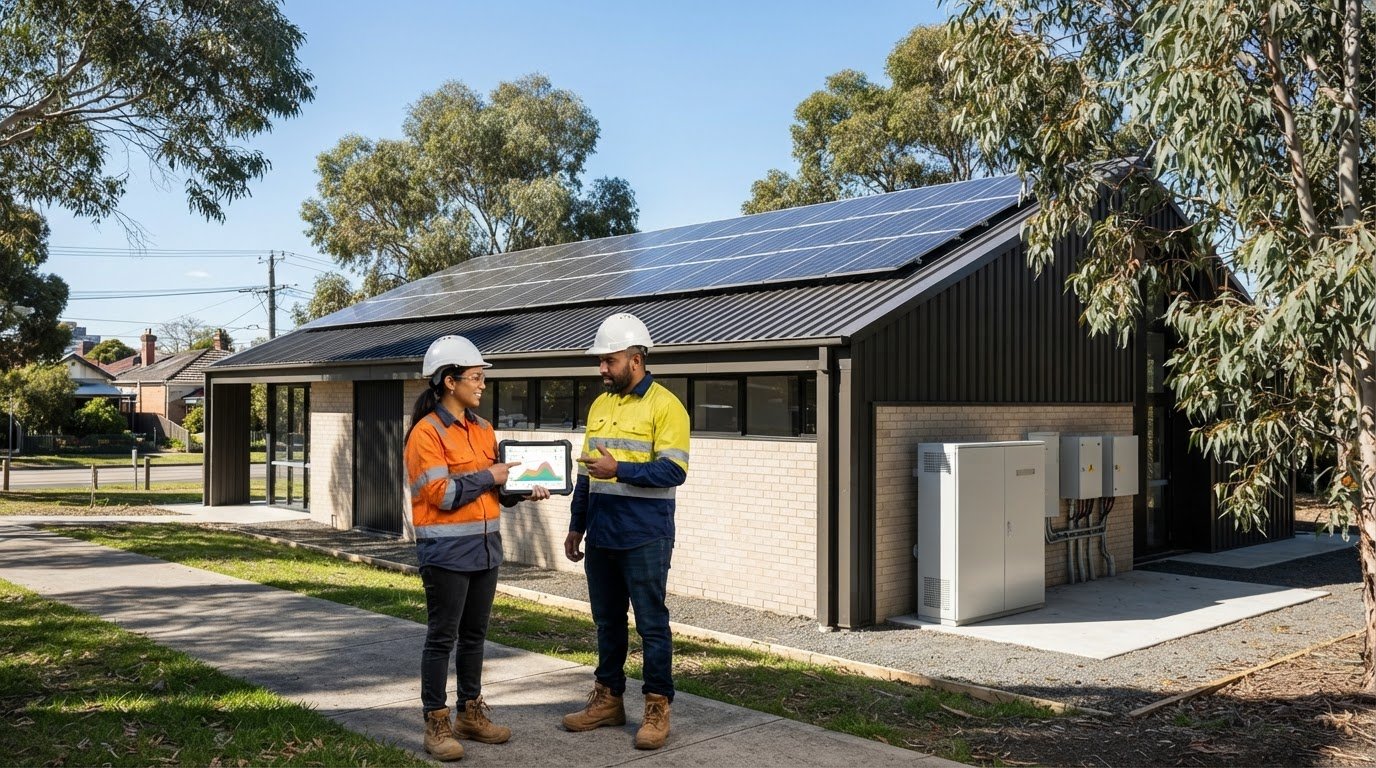
Planning solar for community buildings Victoria means looking beyond roof size. A building that uses most of its electricity after sunset may not get the most from panels alone, while a battery may only make sense if it suits the site’s needs and budget.
Start with practical questions: when does the building use power, who owns the site, and how will trustees, committees or tenants make decisions? The answers help determine whether solar-only or solar-plus-battery is a better fit.
This guide will help you assess energy use, roof conditions and governance arrangements, then compare system options using clear criteria. You’ll also find steps for progressing a project and checking Victorian support that may apply to your organisation. GridFree Solar designs and installs commercial solar and battery systems around a site’s use and energy needs, helping you make a more informed decision about what to assess next.
Key Takeaways
- Review bills, interval data and operating hours to see when electricity demand may align with solar generation.
- Compare solar-only, battery and staged-installation options against daytime use, after-hours demand and resilience priorities.
- For solar for community buildings Victoria, ownership, leases and shared decision-making can shape the project’s approval pathway.
- Use a clear sequence of objectives, site assessment, design comparison and approval to keep stakeholders aligned.
- A tailored commercial solar design can connect your building’s needs and site conditions with a practical implementation plan.
Solar for community buildings in Victoria: what the project needs to solve
Community buildings include halls, neighbourhood houses, libraries and sporting clubs. Their energy patterns vary. A neighbourhood house may be busy during the day, while a sports club may use more power for evening training, lighting and events. Seasonal closures and quieter periods can also affect annual demand.
A viable community solar project matches the building’s energy use, site conditions and decision-making arrangements. That’s the central test for solar for community buildings Victoria. First, identify the priority: managing electricity bills, reducing emissions, supporting resilience or demonstrating community leadership. A clear objective keeps system comparisons focused on what the organisation needs.
Which Victorian community buildings may benefit from assessing solar?
Regular daytime activity can make it easier to use solar generation as it occurs. Schools, community centres and council-managed facilities may have daytime demand. A hall or sporting club used mainly after dark may draw more electricity when panels aren’t generating. These are useful starting points for assessment, not guarantees of suitability.
Look beyond the building type. Compare operating schedules with electricity bills to see when and how much power the site uses. A venue with evening bookings may still have daytime demand from refrigeration, hot water or office equipment. A building that appears busy may also have long quiet periods. Actual usage gives you a firmer basis for design decisions.
Who needs to support a shared-building solar project?
Map the decision-makers early. Depending on the arrangement, they may include the committee, property owner, facility manager, tenants and the organisation responsible for the electricity account. Clarify who can approve capital works, who controls the account and who will oversee system decisions after installation. Ownership, leases or council management can affect the approval pathway, so assess the specific arrangement.
Before comparing proposals, record the project objectives and decision-making authority. Agree who will provide site and account information, who needs to review design options and how a final decision will be made. This gives stakeholders a shared reference point and reduces the risk of a suitable proposal stalling over unclear responsibilities.
Assess a Victorian community building before comparing solar systems
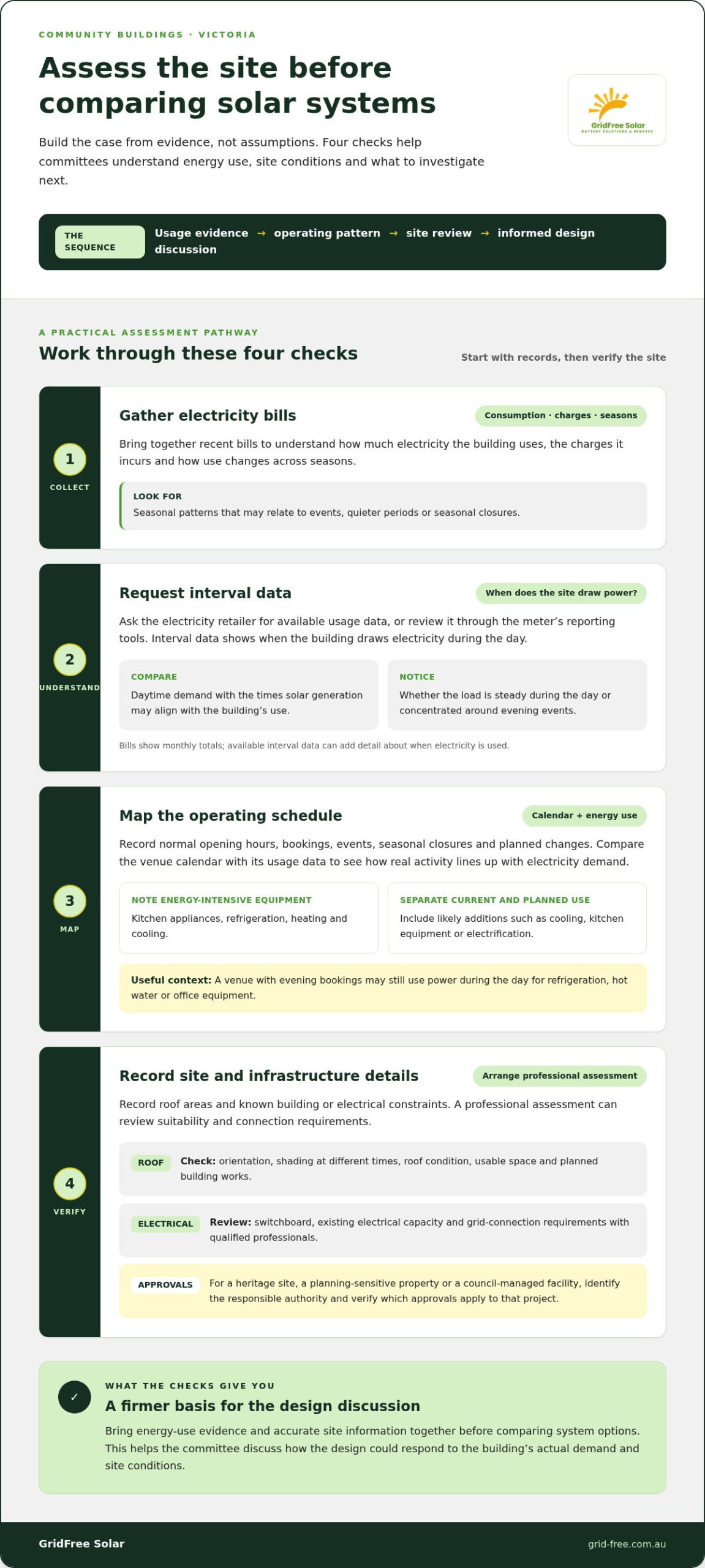
Build the case from evidence, not assumptions. A practical site assessment gives the committee a basis for comparing solar for community buildings Victoria and can reveal constraints before they shape a proposal.
Start with these four checks:
- Electricity bills: Gather recent bills to understand consumption, charges and seasonal patterns.
- Interval data: Request available usage data from the electricity retailer or review it through the meter’s reporting tools. It shows when the building draws power during the day, helping you see when solar generation may align with demand.
- Operating schedule: Map normal opening hours, bookings, events, seasonal closures and planned changes. Note energy-intensive equipment such as kitchen appliances, refrigeration or heating and cooling.
- Site and infrastructure: Record roof areas and known building or electrical constraints, then arrange a professional assessment of suitability and connection requirements.
What energy-use information should the committee gather?
Look beyond monthly totals. Where available, interval data can distinguish a steady daytime load from demand concentrated around evening events. Compare the data with the venue calendar: a hall used for daytime programmes and night bookings has a different pattern from a facility that’s quiet on weekdays. Separate existing consumption from planned additions, such as cooling, kitchen equipment or electrification, so the design can account for likely future use as well as current bills.
Matching solar generation to site demand requires both energy-use evidence and accurate site information. As clean energy specialists like Redefining Solar point out, bills alone may not show the full picture of how and when a site uses power.
What site and network factors affect the design?
Roof capacity is about more than area. A professional assessment considers orientation, shading at different times, roof condition, usable space and planned building works. These factors help determine where panels may fit and how site conditions could affect system design.
Electrical infrastructure matters too. Qualified professionals should review the switchboard, existing electrical capacity and grid-connection requirements. For a Victorian heritage site, a planning-sensitive property or a council-managed facility, identify the responsible authority and verify which approvals apply to that project. A general rule is no substitute for a site-level check.
Once the committee has gathered usage and site information, it can move to a more informed design discussion. A tailored commercial solar system design can bring those building-specific factors together as the project progresses.
Compare solar-only and solar-plus-battery options for community buildings
The right configuration depends on when the building uses electricity and what the organisation wants the system to do. For solar for community buildings Victoria, compare options against the site’s usage profile, after-hours demand, resilience priorities and capacity to manage a more involved system.
| Option | Daytime use | After-hours demand and resilience | Operational considerations |
|---|---|---|---|
| Solar-only | Can suit buildings with demand that aligns with solar generation. | Doesn’t store surplus generation for later use. Grid supply remains relevant outside generation hours. | A simpler configuration to assess. Export arrangements and grid connection are project-specific. |
| Solar with battery storage | Solar can supply current demand, with suitable surplus stored for later use. | May help meet evening loads. Backup during an outage depends on system configuration and which loads are supported. | Adds storage and system-design considerations. Assess against load timing and resilience goals. |
| Staged installation | Can begin with solar matched to current usage. | Storage may be considered later if usage patterns or priorities support it. | Plan the initial system with future options in mind. Later changes depend on system design and site conditions. |
When might a solar-only system be the starting point?
Regular daytime electricity use, such as lighting, refrigeration or office equipment, may align with on-site solar generation. Review interval data to see how much demand occurs during likely generation hours rather than choosing a system size based only on building type. Any electricity exported to the grid and the connection requirements need to be assessed for the specific project.
Solar-only may be a straightforward option when daytime use is the main priority and evening demand is limited. Compare expected generation with actual consumption, and consider how the site will use or export surplus energy.
When is battery storage worth assessing?
Assess a battery if substantial usage occurs after sunset or if the organisation has a defined resilience objective. Identify which loads matter during an outage, such as communications, essential lighting or refrigeration. A battery doesn’t automatically provide backup. That capability depends on system configuration, backup functionality and the loads selected for support.
Battery suitability depends on load timing, system design and organisational goals. For broader business-system considerations, see this commercial solar installation guide.
Plan approvals, funding checks and shared decisions in Victoria
A clear decision pathway helps a community organisation move from interest to an approved project without overlooking governance, funding or site requirements. For solar for community buildings Victoria, confirm who has authority to approve the work before committing to a design or funding application.
- Agree objectives: Define what the project should achieve, such as managing electricity costs, reducing emissions or supporting selected essential loads.
- Identify authority: Establish who controls the property, electricity account and project budget, and who can approve the works.
- Assess the site: Bring together energy-use information, site conditions and known approval or connection requirements.
- Compare designs: Review options against the agreed objectives, including assumptions, exclusions and responsibilities.
- Approve and document: Record the decision, funding conditions, roles and next steps before implementation.
How can a committee make the decision manageable?
Set measurable objectives and document who can approve expenditure and building works. Share a plain-English comparison of proposals so committee members and other stakeholders can see how each option addresses the agreed priorities. Include design assumptions, exclusions, responsibilities and dependencies such as approvals or funding decisions. After installation, decide who will monitor generation and consumption, how often results will be reviewed and how the organisation will measure progress against its goals.
What should organisations verify about Victorian support and approvals?
Check current Solar Victoria and Australian Government guidance for programme status, eligible applicants and technology, application timing and any conditions attached to support. For example, the Victorian Energy Upgrades program offers discounts for eligible solar PV systems at non-residential sites, with the applicable offer depending on system size and current requirements. Don’t assume a community organisation or proposed system automatically qualifies. Confirm details through official guidance before relying on an incentive in the project budget.
Approvals vary with the property and proposed works. Ownership arrangements, leases, council management or grant conditions may affect who must consent and what evidence is needed. Verify applicable planning, building, heritage and grid-connection requirements with the relevant Victorian authority or network operator for the specific site. A solar panel installation Melbourne guide offers additional installation-planning context.
GridFree Solar can help shape a commercial solar and battery design around the building’s use and agreed priorities once authority, objectives and site requirements are clear. Explore a tailored commercial solar project.
Deliver a community solar project with a tailored commercial design
Once your organisation has compared system options and clarified its priorities, the next step is turning that groundwork into a project-specific design. GridFree Solar designs and installs commercial solar and battery systems, bringing site assessment and implementation together around the building’s use, conditions and agreed objectives.
A tailored design turns broad aims into practical decisions. It can account for when the facility uses electricity, the available roof area and electrical infrastructure, and whether the organisation prioritises bill management, emissions reduction or resilience. This gives stakeholders a clearer basis for reviewing system components and project considerations, rather than choosing a configuration by building type alone.
What does a tailored commercial solar solution consider?
System design should connect the organisation’s usage patterns with site conditions and operating priorities. Storage is an option to assess, not an automatic requirement. If evening demand or resilience goals make it relevant, compare how storage could support those aims and what system configuration would be involved. For a broader overview of storage considerations, read this energy storage solutions guide.
Rebates may also influence project planning. GridFree Solar helps customers navigate and claim applicable solar and battery rebates. The organisation should verify current programme rules, eligibility and application timing through relevant official guidance. A rebate isn’t guaranteed, and it shouldn’t be treated as approved funding until the applicable requirements and application process have been confirmed.
How can the organisation move from comparison to action?
Bring the project’s key information into one discussion: electricity bills and available usage records, operating schedules, site details, agreed objectives and the people responsible for decisions. This gives the design process a practical starting point and helps keep stakeholders focused on the same priorities.
Ask for a tailored design that clearly sets out its assumptions, proposed system components and relevant project considerations. Review how the proposal responds to the building’s actual needs, including any storage option, and identify outstanding approvals or funding checks before moving towards implementation. GridFree Solar’s commercial solar and battery installation expertise can support the project from assessment to delivery.
Victorian organisations can explore commercial solar solutions with GridFree Solar and start shaping a project around their building and objectives.
Turn your building’s energy needs into a clear next step
The strongest solar projects start with evidence: understand when your building uses electricity, assess the site and compare system options against agreed priorities. Solar-only may suit demand that aligns with daytime generation, while a battery is worth assessing when after-hours use or resilience goals support it. Neither choice should be based on building type alone.
For solar for community buildings Victoria, clear decision-making matters as much as system design. Confirm who can approve the work, check site-specific requirements and verify current rebate eligibility and application timing before including support in your plans. GridFree Solar provides commercial solar and battery installation and helps customers navigate and claim applicable rebates, without assuming a particular funding outcome.
For a tailored project discussion, explore commercial solar solutions with GridFree Solar and take a practical next step towards a system shaped around your building.
Frequently Asked Questions
Is solar worthwhile for a community building in Victoria?
Solar can be worthwhile when daytime generation aligns with the building’s electricity use and the site suits a system. For solar for community buildings Victoria, assess recent bills, available interval data and operating schedules rather than relying on building type alone. A Melbourne hall used regularly during the day may have a different demand profile from a club mainly active after dark. Compare expected self-consumption, export arrangements, site conditions and the organisation’s objectives before deciding.
Can a community hall or sporting club add a battery to its solar system?
A hall or sporting club can assess adding battery storage to an existing solar system, subject to system compatibility and site conditions. Review the inverter and electrical infrastructure, then compare when surplus solar is available with when the building needs electricity. Consider evening bookings, essential equipment and resilience priorities. GridFree Solar provides commercial solar and battery installation, including integrated solutions designed around a site’s energy needs.
How do community buildings compare solar-only and solar-plus-battery systems?
Compare the options against the building’s actual usage profile and project goals. Solar-only may suit a site that can use a good share of its generation during the day. A battery may be worth assessing where substantial demand occurs after sunset or the organisation has resilience priorities. Include system complexity, export arrangements and any backup requirements in the comparison. A staged approach can also be considered, with future options shaped by the initial system design.
What information is needed to design solar for a community building?
Gather recent electricity bills, available interval data, operating hours, event schedules and seasonal closure dates. Note energy-intensive equipment and planned additions, such as cooling or kitchen appliances. Site information should cover usable roof areas, orientation, shading, roof condition and known building works. A professional assessment should also review electrical infrastructure, including the switchboard, and project-specific grid-connection requirements. This information helps shape a design around the facility’s demand and site conditions.
Are Victorian rebates available for solar on community buildings in 2026?
Potential support depends on the building, organisation, system and current programme rules. In 2026, the Victorian Energy Upgrades program offers discounts for eligible solar PV systems from 30 kW to 200 kW at Victorian non-residential sites. Solar Victoria’s community housing rebate applies to eligible community housing properties, not communal living spaces. Check official guidance for current eligibility, funding availability and application timing before including a rebate in the project budget.
Can a community building use solar during a power outage?
Not necessarily. A standard grid-connected solar system may switch off during a power outage, so panels alone shouldn’t be assumed to keep the building operating. Backup capability depends on system configuration, whether suitable battery storage and backup functions are included, and which circuits or loads are supported. Identify priority needs, such as essential lighting or refrigeration, then have the proposed design assessed for those requirements. Backup operation isn’t guaranteed simply by adding a battery.
What approvals may a Victorian community organisation need before installing solar?
Approvals depend on the property, ownership arrangements and proposed works. A community organisation may need consent from the building owner, landlord, council or other authority, as well as internal approval for expenditure. Planning, building, heritage and grid-connection requirements can also vary by site. For a Melbourne property, identify the responsible decision-maker early and verify project-specific requirements with the relevant authority and network operator before proceeding with installation.